

The classic one-page report
 |
Description
Book Introduction
#ReducedWorkingHour #SimplifiedReporting #EmailReporting #OnePage! #How?
“How on earth do you fit a report into one page?”
In the era of one-page reports,
Easy to write, fast to write, and only convey the main points
How to write a real exhaust report!
Writing dozens of reports every day.
You're already tired before you even sit down at the computer.
After a long struggle and a determined effort, I finally present a report full of sincerity to my boss.
But the boss's invariable line, "What the heck are you talking about? Rewrite it!" How on earth should I write a report? Is it really true that there's no such thing as a report that's easy to write, quick to write, and approved on the first try?
Author Park Shin-young, who has given planning and reporting lectures at 100 companies including Samsung, LG, and CJ, encounters countless frustrations and complaints about writing a "one-page report" in her lectures.
There are three common problems that office workers face:
1.
Summary: They said to reduce it to one page, but how on earth do I reduce it to 50 pages?
2.
Structure: I'm trying to write a report, but I'm completely lost even with the table of contents.
3.
Sentence: I can't organize my thoughts in a short way.
Everyone shouts, “Let’s write it in one page!” but no one teaches us how to write it, so for the struggling office workers, Park Shin-young, the greatest ‘planning mentor’ of our time, has compiled all the know-how on writing a ‘one-page report’ into this book.
“How on earth do you fit a report into one page?”
In the era of one-page reports,
Easy to write, fast to write, and only convey the main points
How to write a real exhaust report!
Writing dozens of reports every day.
You're already tired before you even sit down at the computer.
After a long struggle and a determined effort, I finally present a report full of sincerity to my boss.
But the boss's invariable line, "What the heck are you talking about? Rewrite it!" How on earth should I write a report? Is it really true that there's no such thing as a report that's easy to write, quick to write, and approved on the first try?
Author Park Shin-young, who has given planning and reporting lectures at 100 companies including Samsung, LG, and CJ, encounters countless frustrations and complaints about writing a "one-page report" in her lectures.
There are three common problems that office workers face:
1.
Summary: They said to reduce it to one page, but how on earth do I reduce it to 50 pages?
2.
Structure: I'm trying to write a report, but I'm completely lost even with the table of contents.
3.
Sentence: I can't organize my thoughts in a short way.
Everyone shouts, “Let’s write it in one page!” but no one teaches us how to write it, so for the struggling office workers, Park Shin-young, the greatest ‘planning mentor’ of our time, has compiled all the know-how on writing a ‘one-page report’ into this book.
- You can preview some of the book's contents.
Preview
index
Acknowledgements
Let's watch the prologue and relieve some fatigue.
Report 1 Why is it ‘critical’?
Report 2 Key Summary
1.
Why don't you just cut down to the core?
2.
Key Summary Skills: 3 Key Insight Questions
Report 3 Structure Summary
1.
How do you get the structure?
2.
Reports by 8 types
Report 4 Report Sentence Tip 10
1.
Remodeling ceremony
2.
Categorization
3.
Splitting
4.
title
5.
Noun form summary
6.
objective evidence
7.
Numbers and graphs
8.
Colloquial Vs.
Written language
9.
abbreviation
10.
2 types of reports and senses
Good luck with the epilogue
Let's watch the prologue and relieve some fatigue.
Report 1 Why is it ‘critical’?
Report 2 Key Summary
1.
Why don't you just cut down to the core?
2.
Key Summary Skills: 3 Key Insight Questions
Report 3 Structure Summary
1.
How do you get the structure?
2.
Reports by 8 types
Report 4 Report Sentence Tip 10
1.
Remodeling ceremony
2.
Categorization
3.
Splitting
4.
title
5.
Noun form summary
6.
objective evidence
7.
Numbers and graphs
8.
Colloquial Vs.
Written language
9.
abbreviation
10.
2 types of reports and senses
Good luck with the epilogue
Detailed image
Into the book
There are more and more companies that say, 'Please, write the report on one page!'
Because both the reporter writing the dozens of pages of report and the reportee reading it are too tired.
The reporter is angry, saying, “When will I ever read all this?” and the reporter is angry, saying, “When will I ever write all this?”
So both sides gathered their hearts and shouted.
“Let’s write it together!”
“Okay!” I said and sat down at my desk, but I was at a loss as to ‘how’ and ‘what should I write first.’
So, I wrote this book to share methods such as how to identify the key points that should go into a 'one-page report', how to organize the structure, and how to write sentences.
--- From the "Prologue"
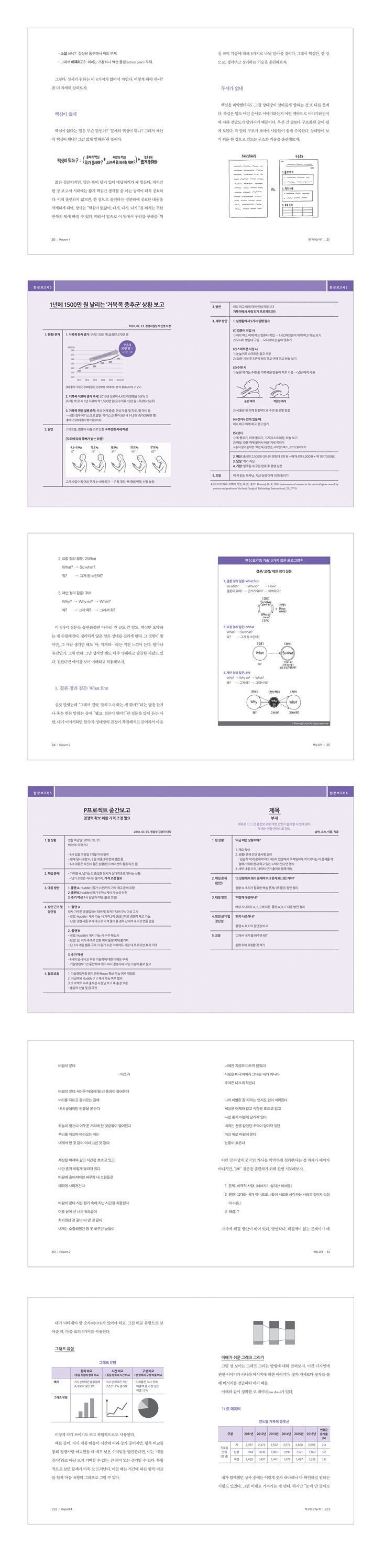
A single report can be 'criticized' more easily.
If you make a very long report by 'smashing' all the available data, you'll say, "Oh.
You might get lucky and get one like "Here's what you said" (if the other person reads it all, of course), but if you read one page, you can see everything at a glance, so it's easier to get scammed.
So why do they get criticized? If we look at the words that often come up when criticized, we can see why.
- There is no core: There is a lot of talk, but no core.
- Disorganized: dense text with no structure.
- Do you write novels?: Rich imagination, but lacking facts.
- So what?: The meaning is grand, but there is no action plan.
Yes, that's right.
I'm being criticized because I don't have these four things my boss wants.
--- 「Report 1.
From "Why is it 'critical'?"
People who have talked a lot and then heard the answer, “So, what are you trying to say?” or who have been talking for a while and often hear the question, “Okay, what’s your conclusion?” or who are having a hard time because the more I talk, the more the other person’s expression becomes complicated and hardened. This questioning method is definitely ‘What First.’
In short, it starts with the question, 'So what? What is the conclusion?'
And then ask, 'Why so? What is the basis?'
'So what? ↔ Why so?' is a famous McKinsey question method.
It's about repeatedly asking, "What? Why is that?" or "Why? So what?" to get to the point.
However, since the report ultimately requires action, it must be organized by adding 'So, what will we do (How)?'
--- 「Report 2.
From the "Key Summary"
The purpose of the report is to ‘inform’.
So what's the outcome of "reporting"? Since the purpose is "information," if they understand, there's an outcome. If they don't, there's no outcome.
If I spoke my mind, but the person in front of me didn't understand? I spoke well, but the other person was stupid and didn't understand, then it's a case of no result regardless of my intelligence.
So, in the end, it's more important to speak in a way that the other person can understand than to appear smart.
Of course, you should tell me ‘what you are curious about’, not ‘what I want to write’ or ‘what I know’.
So the structure of the report means that you (the boss, the reportee) write down what you are curious about in the order you want to know it.
It's so obvious.
--- 「Report 3.
From "Structure Summary"
Since a report is not a novel, it must be written based on objective expression.
If we look up the meaning of 'objective', it is as follows.
'Seeing or thinking about things from a third-party perspective, or something like that, outside of one's own relationship with oneself.' Since speaking only of one's own thoughts and feelings is primary, something from a third-party perspective, such as the following three, is necessary.
1.
Present specific data
Sales were very good → Sales increased by 30% compared to last year
A cold body is bad for your health → If your body temperature drops by 1 degree, your immunity drops by 30%.
2.
Presenting a comparison standard
This is a very high figure → This is a very high figure that ranks second when comparing 5 advanced countries.
This is a very good result → 23% higher than the same period last year.
3.
Presentation of judgment criteria
Received a positive response → 72% of 100 people expressed satisfaction with the survey results, saying they were 'very positive'.
In my opinion, it is like this → According to this authority/According to the book/According to the doctor, it is like this
This works → It has been proven effective in cases A, B, and C.
Because both the reporter writing the dozens of pages of report and the reportee reading it are too tired.
The reporter is angry, saying, “When will I ever read all this?” and the reporter is angry, saying, “When will I ever write all this?”
So both sides gathered their hearts and shouted.
“Let’s write it together!”
“Okay!” I said and sat down at my desk, but I was at a loss as to ‘how’ and ‘what should I write first.’
So, I wrote this book to share methods such as how to identify the key points that should go into a 'one-page report', how to organize the structure, and how to write sentences.
--- From the "Prologue"
A single report can be 'criticized' more easily.
If you make a very long report by 'smashing' all the available data, you'll say, "Oh.
You might get lucky and get one like "Here's what you said" (if the other person reads it all, of course), but if you read one page, you can see everything at a glance, so it's easier to get scammed.
So why do they get criticized? If we look at the words that often come up when criticized, we can see why.
- There is no core: There is a lot of talk, but no core.
- Disorganized: dense text with no structure.
- Do you write novels?: Rich imagination, but lacking facts.
- So what?: The meaning is grand, but there is no action plan.
Yes, that's right.
I'm being criticized because I don't have these four things my boss wants.
--- 「Report 1.
From "Why is it 'critical'?"
People who have talked a lot and then heard the answer, “So, what are you trying to say?” or who have been talking for a while and often hear the question, “Okay, what’s your conclusion?” or who are having a hard time because the more I talk, the more the other person’s expression becomes complicated and hardened. This questioning method is definitely ‘What First.’
In short, it starts with the question, 'So what? What is the conclusion?'
And then ask, 'Why so? What is the basis?'
'So what? ↔ Why so?' is a famous McKinsey question method.
It's about repeatedly asking, "What? Why is that?" or "Why? So what?" to get to the point.
However, since the report ultimately requires action, it must be organized by adding 'So, what will we do (How)?'
--- 「Report 2.
From the "Key Summary"
The purpose of the report is to ‘inform’.
So what's the outcome of "reporting"? Since the purpose is "information," if they understand, there's an outcome. If they don't, there's no outcome.
If I spoke my mind, but the person in front of me didn't understand? I spoke well, but the other person was stupid and didn't understand, then it's a case of no result regardless of my intelligence.
So, in the end, it's more important to speak in a way that the other person can understand than to appear smart.
Of course, you should tell me ‘what you are curious about’, not ‘what I want to write’ or ‘what I know’.
So the structure of the report means that you (the boss, the reportee) write down what you are curious about in the order you want to know it.
It's so obvious.
--- 「Report 3.
From "Structure Summary"
Since a report is not a novel, it must be written based on objective expression.
If we look up the meaning of 'objective', it is as follows.
'Seeing or thinking about things from a third-party perspective, or something like that, outside of one's own relationship with oneself.' Since speaking only of one's own thoughts and feelings is primary, something from a third-party perspective, such as the following three, is necessary.
1.
Present specific data
Sales were very good → Sales increased by 30% compared to last year
A cold body is bad for your health → If your body temperature drops by 1 degree, your immunity drops by 30%.
2.
Presenting a comparison standard
This is a very high figure → This is a very high figure that ranks second when comparing 5 advanced countries.
This is a very good result → 23% higher than the same period last year.
3.
Presentation of judgment criteria
Received a positive response → 72% of 100 people expressed satisfaction with the survey results, saying they were 'very positive'.
In my opinion, it is like this → According to this authority/According to the book/According to the doctor, it is like this
This works → It has been proven effective in cases A, B, and C.
--- 「Report 4.
From “10 Report Sentence Tips”
From “10 Report Sentence Tips”
Publisher's Review
In the era of simplified reporting, one page is enough!
Every working person writes reports.
And I think everyone will agree.
How arduous is writing reports! The battle with them unfolds several times a day.
There was a time when I would diligently write dozens of pages at a time, as if I could just 'punch down' any content and it would seem like something.
However, these days, government ministries, corporations, and the financial sector are all trying to increase work efficiency by simplifying reporting.
Now, just writing a lot is a sin.
Long reports that are difficult to report and even more tiring for the person being reported on are the number one target for dismissal.
The era of the 'one-page report', or one-page report (OPR), has arrived.
However, everyone is talking about simplifying work and saying that reports should be written in 'one page', but I have no idea how to compress a report that is dozens of pages long into one page.
Author Park Shin-young wanted to be an oasis in the desert, a drop of rain in a drought, for many office workers who are experiencing these difficulties.
This book faithfully covers everything about writing a one-page report, including what a "one-page report" is, what content should be included in it, how to summarize the key points, how to structure it, and how to write sentences.
In particular, the author states that this book will be most helpful to the following three types of people:
1. For those who are starting a one-page report for the first time, 2.
3. A person who has not paid much attention to communication skills because he or she is busy studying his or her own specialty.
Decision maker or leader.
In other words, this book is for 'complete beginners' who have never written a single-page report, office workers who have no one around them to ask about writing a single-page report, people who are excellent at their jobs but have difficulty communicating and delivering, and many leaders who feel tired and disillusioned with inefficient report work.
In short, this book is a must-read for anyone involved in report writing.
Everything about one-page reports, from key summaries to sentence delivery!
First of all, this book emphasizes the importance of reporting.
'Reporting is the language of the company.'
What good is a good person if they can't properly communicate their work? No matter how smart they are, if they can't translate their thoughts into the company's language, it's obvious they won't receive a good evaluation at work.
Additionally, there are disruptions to the progress of the work itself.
Without effective communication skills, you cannot fully utilize your work capabilities.
In addition, reporting ability becomes the foundation for other tasks.
There is no area that does not require reporting, such as document writing, meetings, presentations, and work-related conversations.
In addition, we cannot ignore the damage caused by unreported information and the large losses to the company due to late reporting.
So, what's the most effective way to report on such an important matter? How do we distill complex thoughts and lengthy texts into a single report?
In this book, author Park Shin-young meticulously and specifically explains everything about one-page reports, focusing on the three skills necessary to write a one-page report.
This is the explanation of the core, structure, and sentences, which are the key points that can be clearly summarized, the method of clearly structuring complex thoughts, and the method of writing in short and clear sentences.
Above all, the author advises that when writing a report, one should always keep in mind the purpose of the report.
This way, you can clearly convey what you want to say without rambling on.
For this reason, I strongly recommend that you practice 'practicing one sentence conclusion'.
Detailed methods are provided in the book.
Additionally, the '3 Key Insights Question Method' is emphasized as a way to skillfully summarize key points.
These are the 'conclusion-summary question method', which starts with the conclusion and then talks about the situation (problem) and requests in order; the 'point-summary question method', which reports a complex situation first and then conveys the request; and the 'proposal-summary question method', which talks about the problem, cause, and suggestion in order.
When reporting to a boss who values conclusions or in a meeting where concentration declines over time, the concluding question method, which states the conclusion first, is useful.
The summarizing question method is suitable for reporting a situation, and the propositional question method is useful when you need to convince the other person of your proposal.
If you make these three types of questioning a habit, it will become easier to summarize only the main points, no matter how long the text or speech is.
To practice these three questioning methods, the author explores the strengths and usage of questioning methods through the lyrics of songs such as Yoon Jong-shin's "Like It," Kim Gun-mo's "Love is Leaving You," and Giant's "Take It Out and Eat It."
The author's eight methods for writing reports by type, each of which was personally written by assuming actual reporting situations, are also very useful.
Depending on the purpose of the report, it provides examples of as many as 26 types of "one-page reports," including review results reports, situation reports, business improvement reports, proposal reports, planning reports, business trip reports, meeting reports, and results reports, showing specifically how to structure the summarized key contents in the report.
In addition, this book also provides detailed instructions on how to write sentences for reports as a way to increase 'delivery efficiency.'
It is full of diverse content, especially in the area of sentences, such as how to create graphs for reports, the correct way to write numbers, whether to use spoken or written language depending on the situation, and even how to use abbreviations.
These 10 reporting sentence tips presented by the author are very useful examples for writing a 'one-page report' in real life.
"You only need to write one page!" I highly recommend this book to all the office workers who work late into the night without knowing it, and to anyone who's curious about everything about writing a "one-page report."
Every working person writes reports.
And I think everyone will agree.
How arduous is writing reports! The battle with them unfolds several times a day.
There was a time when I would diligently write dozens of pages at a time, as if I could just 'punch down' any content and it would seem like something.
However, these days, government ministries, corporations, and the financial sector are all trying to increase work efficiency by simplifying reporting.
Now, just writing a lot is a sin.
Long reports that are difficult to report and even more tiring for the person being reported on are the number one target for dismissal.
The era of the 'one-page report', or one-page report (OPR), has arrived.
However, everyone is talking about simplifying work and saying that reports should be written in 'one page', but I have no idea how to compress a report that is dozens of pages long into one page.
Author Park Shin-young wanted to be an oasis in the desert, a drop of rain in a drought, for many office workers who are experiencing these difficulties.
This book faithfully covers everything about writing a one-page report, including what a "one-page report" is, what content should be included in it, how to summarize the key points, how to structure it, and how to write sentences.
In particular, the author states that this book will be most helpful to the following three types of people:
1. For those who are starting a one-page report for the first time, 2.
3. A person who has not paid much attention to communication skills because he or she is busy studying his or her own specialty.
Decision maker or leader.
In other words, this book is for 'complete beginners' who have never written a single-page report, office workers who have no one around them to ask about writing a single-page report, people who are excellent at their jobs but have difficulty communicating and delivering, and many leaders who feel tired and disillusioned with inefficient report work.
In short, this book is a must-read for anyone involved in report writing.
Everything about one-page reports, from key summaries to sentence delivery!
First of all, this book emphasizes the importance of reporting.
'Reporting is the language of the company.'
What good is a good person if they can't properly communicate their work? No matter how smart they are, if they can't translate their thoughts into the company's language, it's obvious they won't receive a good evaluation at work.
Additionally, there are disruptions to the progress of the work itself.
Without effective communication skills, you cannot fully utilize your work capabilities.
In addition, reporting ability becomes the foundation for other tasks.
There is no area that does not require reporting, such as document writing, meetings, presentations, and work-related conversations.
In addition, we cannot ignore the damage caused by unreported information and the large losses to the company due to late reporting.
So, what's the most effective way to report on such an important matter? How do we distill complex thoughts and lengthy texts into a single report?
In this book, author Park Shin-young meticulously and specifically explains everything about one-page reports, focusing on the three skills necessary to write a one-page report.
This is the explanation of the core, structure, and sentences, which are the key points that can be clearly summarized, the method of clearly structuring complex thoughts, and the method of writing in short and clear sentences.
Above all, the author advises that when writing a report, one should always keep in mind the purpose of the report.
This way, you can clearly convey what you want to say without rambling on.
For this reason, I strongly recommend that you practice 'practicing one sentence conclusion'.
Detailed methods are provided in the book.
Additionally, the '3 Key Insights Question Method' is emphasized as a way to skillfully summarize key points.
These are the 'conclusion-summary question method', which starts with the conclusion and then talks about the situation (problem) and requests in order; the 'point-summary question method', which reports a complex situation first and then conveys the request; and the 'proposal-summary question method', which talks about the problem, cause, and suggestion in order.
When reporting to a boss who values conclusions or in a meeting where concentration declines over time, the concluding question method, which states the conclusion first, is useful.
The summarizing question method is suitable for reporting a situation, and the propositional question method is useful when you need to convince the other person of your proposal.
If you make these three types of questioning a habit, it will become easier to summarize only the main points, no matter how long the text or speech is.
To practice these three questioning methods, the author explores the strengths and usage of questioning methods through the lyrics of songs such as Yoon Jong-shin's "Like It," Kim Gun-mo's "Love is Leaving You," and Giant's "Take It Out and Eat It."
The author's eight methods for writing reports by type, each of which was personally written by assuming actual reporting situations, are also very useful.
Depending on the purpose of the report, it provides examples of as many as 26 types of "one-page reports," including review results reports, situation reports, business improvement reports, proposal reports, planning reports, business trip reports, meeting reports, and results reports, showing specifically how to structure the summarized key contents in the report.
In addition, this book also provides detailed instructions on how to write sentences for reports as a way to increase 'delivery efficiency.'
It is full of diverse content, especially in the area of sentences, such as how to create graphs for reports, the correct way to write numbers, whether to use spoken or written language depending on the situation, and even how to use abbreviations.
These 10 reporting sentence tips presented by the author are very useful examples for writing a 'one-page report' in real life.
"You only need to write one page!" I highly recommend this book to all the office workers who work late into the night without knowing it, and to anyone who's curious about everything about writing a "one-page report."
GOODS SPECIFICS
- Date of issue: July 2, 2018
- Page count, weight, size: 248 pages | 359g | 150*210*16mm
- ISBN13: 9788984077195
- ISBN10: 8984077194
You may also like
카테고리
korean


korean

![GQ KOREA Mark (Monthly): December [2025]](http://librairie.coreenne.fr/cdn/shop/files/8ef265dbbfbf186523ed75ba7319009d.jpg?v=1765340328&width=3840)


