

Deep work
 |
Description
Book Introduction
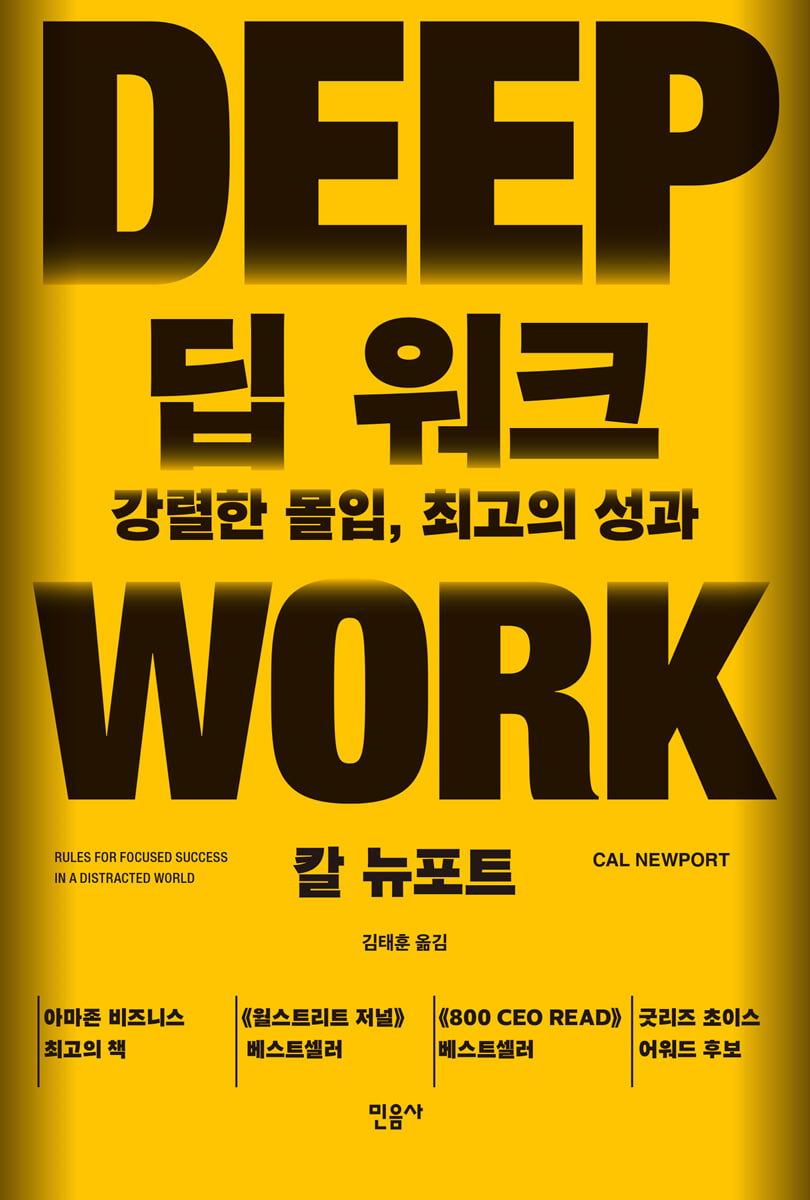
Best Books on Amazon Business
[Wall Street Journal] Bestseller
[800 CEO READ] Bestseller
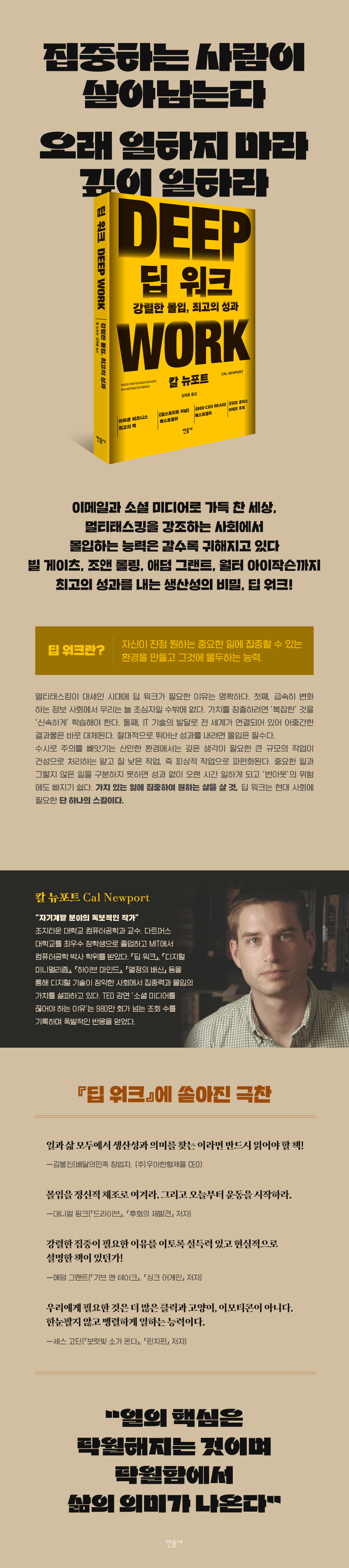
Highly recommended by business gurus like Adam Grant, Daniel Pink, and Seth Godin!
How to work properly without getting lost in a distracting world
Minumsa has published "Deep Work," a book that reveals the secrets of a smart "work" that achieves both productivity and meaning. This book explains how to immerse yourself in truly important work in a work environment where the constraints of time and space are disappearing due to advancements in IT.
Author Cal Newport is a promising computer scientist with a PhD in artificial intelligence from MIT and currently teaches at Georgetown University. He also runs the popular learning and career blog, Study Hack.
Having discussed in depth the impact of modern digital technologies on the workplace, he defines the ability to perform "deep work" as the single skill needed in today's society, which is overflowing with distractions.
Newport's article on learning quickly and achieving peak performance through intense focus has garnered hundreds of thousands of views, led to a book, and sparked a craze for deep work.
This book explains what deep work is and how it benefits us, drawing on neuroscience and psychological evidence. It also presents concrete steps for organizing work around deep work, citing examples of people who have achieved great things and achieved outstanding results, including Bill Gates, J.K. Rowling, Adam Grant, and Walter Isaacson.
In the increasingly competitive and constantly updated 21st-century world of cutting-edge technology, "Deep Work" is a must-read for anyone seeking success through focus.
[Wall Street Journal] Bestseller
[800 CEO READ] Bestseller
Highly recommended by business gurus like Adam Grant, Daniel Pink, and Seth Godin!
How to work properly without getting lost in a distracting world
Minumsa has published "Deep Work," a book that reveals the secrets of a smart "work" that achieves both productivity and meaning. This book explains how to immerse yourself in truly important work in a work environment where the constraints of time and space are disappearing due to advancements in IT.
Author Cal Newport is a promising computer scientist with a PhD in artificial intelligence from MIT and currently teaches at Georgetown University. He also runs the popular learning and career blog, Study Hack.
Having discussed in depth the impact of modern digital technologies on the workplace, he defines the ability to perform "deep work" as the single skill needed in today's society, which is overflowing with distractions.
Newport's article on learning quickly and achieving peak performance through intense focus has garnered hundreds of thousands of views, led to a book, and sparked a craze for deep work.
This book explains what deep work is and how it benefits us, drawing on neuroscience and psychological evidence. It also presents concrete steps for organizing work around deep work, citing examples of people who have achieved great things and achieved outstanding results, including Bill Gates, J.K. Rowling, Adam Grant, and Walter Isaacson.
In the increasingly competitive and constantly updated 21st-century world of cutting-edge technology, "Deep Work" is a must-read for anyone seeking success through focus.
- You can preview some of the book's contents.
Preview
index
Preface: The Secret to Outstanding Performance
Part 1: Why Deep Work?
1 How to Become an Irreplaceable Expert
3 Groups Surviving the Competition with Machines | How to Win in the New Economy | Quickly Learn Difficult Things | Achieve Outstanding Results | Who Succeeds Without Deep Work?
2 A world that disrupts immersion and concentration
Three Trends Stealing Modern Attention | Why It's Easy to Overlook the Power of Flow | How Distracted Companies Are Created | Busyness Isn't Synonymous with Productivity | The Cult of the Internet | The Competitive Edge of Deep Work
3 A focused life is the best life.
The brain is shaped by our attention - a neuroscientific perspective | The joy of immersion - a psychological perspective | Giving meaning to work and life - a philosophical perspective | A commitment to depth
Part 2: Four Rules for Executing Deep Work
1. Get Immersed - Strategies for Developing Deep Work Habits
Four ways to incorporate deep work into your daily life | Deep work rituals that maximize focus | An immersive environment that changes your mindset | Let's do deep work together | The 4DX methodology for deep work | When work is over, turn off your mind from work
2 Embrace Freedom - Training to Overcome Distraction
How to Use the Internet Wisely | The Power of Deadlines | Productive Meditation Exercises | Memorization Exercises to Boost Concentration
3. Quit Social Media - Digital Minimalism
Two Perspectives on Network Tools | Carefully Examine Their Impact on Your Goals | Experiments with Social Media Blocking | Don't Use the Internet for Fun
4. Block Out Superficial Work - How to Make Time for Deep Work
Plan your day down to the minute | Understand the depth of your tasks | Reduce the proportion of superficial work | Finish your work by 5:30 | Become a person who is difficult to contact
Conclusion
main
Part 1: Why Deep Work?
1 How to Become an Irreplaceable Expert
3 Groups Surviving the Competition with Machines | How to Win in the New Economy | Quickly Learn Difficult Things | Achieve Outstanding Results | Who Succeeds Without Deep Work?
2 A world that disrupts immersion and concentration
Three Trends Stealing Modern Attention | Why It's Easy to Overlook the Power of Flow | How Distracted Companies Are Created | Busyness Isn't Synonymous with Productivity | The Cult of the Internet | The Competitive Edge of Deep Work
3 A focused life is the best life.
The brain is shaped by our attention - a neuroscientific perspective | The joy of immersion - a psychological perspective | Giving meaning to work and life - a philosophical perspective | A commitment to depth
Part 2: Four Rules for Executing Deep Work
1. Get Immersed - Strategies for Developing Deep Work Habits
Four ways to incorporate deep work into your daily life | Deep work rituals that maximize focus | An immersive environment that changes your mindset | Let's do deep work together | The 4DX methodology for deep work | When work is over, turn off your mind from work
2 Embrace Freedom - Training to Overcome Distraction
How to Use the Internet Wisely | The Power of Deadlines | Productive Meditation Exercises | Memorization Exercises to Boost Concentration
3. Quit Social Media - Digital Minimalism
Two Perspectives on Network Tools | Carefully Examine Their Impact on Your Goals | Experiments with Social Media Blocking | Don't Use the Internet for Fun
4. Block Out Superficial Work - How to Make Time for Deep Work
Plan your day down to the minute | Understand the depth of your tasks | Reduce the proportion of superficial work | Finish your work by 5:30 | Become a person who is difficult to contact
Conclusion
main
Detailed image
Into the book
The ability to focus on work is becoming increasingly rare.
At the same time, its value in our economy is increasing.
As a result, the few who develop this ability and make it a core part of their lives will prosper greatly.
---From the "Preface"
One reason the always-on culture makes life easier is that it creates an environment where it's acceptable to spend your days in your inbox, feeling the satisfaction of productivity from quickly responding to the growing volume of emails.
Moving email to the back of your workday requires a careful approach to figuring out what tasks need to be done and for how long.
Planning like this is difficult.
---From "Part 1, Chapter 2, 'A World That Interferes with Immersion and Concentration'"
Our brain forms our worldview based on what we pay attention to.
So if you focus on the fact that you have cancer, your life becomes dark and miserable, but if you focus on the martini you're having in the evening, your life becomes more enjoyable.
Even if the given conditions are the same in both situations.
---From "Part 1, Chapter 3, 'A Focused Life is the Best Life'"
What makes work meaningful is not the results, but the skill and appreciation inherent in the craftsman's spirit.
In other words, the wheel may not be noble, but the work of making the wheel may be noble.
The same goes for knowledge work.
It doesn't have to be a rare occurrence.
Instead, a rare approach to work is needed.
---From "Part 1, Chapter 3, 'A Focused Life is the Best Life'"
Using the Internet itself does not reduce concentration.
The challenge is to switch from low-stimulus/high-value activities to high-stimulus/low-value activities when they become even slightly boring or mentally taxing.
During this process, the brain becomes unable to tolerate a state without stimulation.
Such frequent switching weakens the mental muscles that organize the many resources demanding attention.
Separating your internet usage time can help reduce the amount of time you succumb to distractions.
Accordingly, the mental muscles that govern attention are strengthened.
---From "Part 2, Chapter 2, 'Embrace Free Time'"
Within the social conventions of social media services, attention is drawn in the form of 'likes' and comments.
The implicit agreement behind this behavior is that in return for attention, attention is given generously in return.
For example, if you like my status update, I will like you back.
This agreement gives everyone the illusion of having important content without much effort.
---From "Part 2, Chapter 3, 'Quit Social Media'"
Without structure, it's easy to lose track of time on superficial activities like email, social media, and web surfing.
Such superficial activities may be satisfying in the moment, but they do not lead to creativity.
On the other hand, having a system allows you to regularly spend time wrestling with new ideas that foster innovation, immersing yourself in challenging tasks, or holding brainstorming sessions.
At the same time, its value in our economy is increasing.
As a result, the few who develop this ability and make it a core part of their lives will prosper greatly.
---From the "Preface"
One reason the always-on culture makes life easier is that it creates an environment where it's acceptable to spend your days in your inbox, feeling the satisfaction of productivity from quickly responding to the growing volume of emails.
Moving email to the back of your workday requires a careful approach to figuring out what tasks need to be done and for how long.
Planning like this is difficult.
---From "Part 1, Chapter 2, 'A World That Interferes with Immersion and Concentration'"
Our brain forms our worldview based on what we pay attention to.
So if you focus on the fact that you have cancer, your life becomes dark and miserable, but if you focus on the martini you're having in the evening, your life becomes more enjoyable.
Even if the given conditions are the same in both situations.
---From "Part 1, Chapter 3, 'A Focused Life is the Best Life'"
What makes work meaningful is not the results, but the skill and appreciation inherent in the craftsman's spirit.
In other words, the wheel may not be noble, but the work of making the wheel may be noble.
The same goes for knowledge work.
It doesn't have to be a rare occurrence.
Instead, a rare approach to work is needed.
---From "Part 1, Chapter 3, 'A Focused Life is the Best Life'"
Using the Internet itself does not reduce concentration.
The challenge is to switch from low-stimulus/high-value activities to high-stimulus/low-value activities when they become even slightly boring or mentally taxing.
During this process, the brain becomes unable to tolerate a state without stimulation.
Such frequent switching weakens the mental muscles that organize the many resources demanding attention.
Separating your internet usage time can help reduce the amount of time you succumb to distractions.
Accordingly, the mental muscles that govern attention are strengthened.
---From "Part 2, Chapter 2, 'Embrace Free Time'"
Within the social conventions of social media services, attention is drawn in the form of 'likes' and comments.
The implicit agreement behind this behavior is that in return for attention, attention is given generously in return.
For example, if you like my status update, I will like you back.
This agreement gives everyone the illusion of having important content without much effort.
---From "Part 2, Chapter 3, 'Quit Social Media'"
Without structure, it's easy to lose track of time on superficial activities like email, social media, and web surfing.
Such superficial activities may be satisfying in the moment, but they do not lead to creativity.
On the other hand, having a system allows you to regularly spend time wrestling with new ideas that foster innovation, immersing yourself in challenging tasks, or holding brainstorming sessions.
---From "Chapter 4, Part 2: Block Superficial Work"
Publisher's Review
The era in which robots replace human labor
Deep work: The key to becoming a winner under the new rules!
Bill Gates has a "think week" twice a year where he completely cuts off contact with the outside world and designs the future.
J.K. Rowling rented a hotel suite in central Edinburgh to write the final book in the Harry Potter series.
Carl Jung built a villa in a small lakeside village and wrote the papers that laid the foundations of analytical psychology in a room he had access to alone.
Adam Grant of Wharton School, famous for his books "Originals" and "Give and Take," crams his lectures into one semester, and even during his research semesters, he alternates between periods when he opens his lab and periods when he concentrates on research without any visitors.
What they all have in common is an environment where they can focus without interruption, an environment where they can do deep work.
When you can focus and work for long periods of time, you get great results.
Otherwise, in an environment where distractions constantly ensue, large-scale work requiring deep thought becomes fragmented into shallow, low-quality tasks that are handled perfunctoryly.
Deep work is the ability to create an environment where you can focus on important tasks that you truly want to do and immerse yourself in them.
In the age of automation and artificial intelligence, the need for deep work is clear.
First, in a rapidly changing information society, we cannot help but always be beginners.
To accomplish anything worthwhile, you have to learn 'complex' things 'quickly'.
Second, the digital network revolution has connected the entire world, so mediocre results are immediately replaced.
Immersion is essential for achieving absolute excellence.
However, in a society where we are flooded with information, equipped with various digital devices, and constantly required to be online, the ability to focus on work is becoming increasingly rare.
At the same time, the ability to perform deep work is becoming increasingly valuable.
Break away from simple, mechanical tasks
Deep work strategies for accomplishing complex and creative work
Deep work isn't just about planning and doing things.
Just as athletes take care of their bodies in addition to training, deep work requires constant mental training.
The key here is not simply to strengthen your will, but to develop and practice an environment and habits that allow you to remain fully focused.
Part 2 of this book presents detailed strategies for organizing work around deep work under four major principles: "Get lost," "Embrace boredom," "Disconnect from social media," and "Block out clutter."
Some of them are introduced below:
· Create a deep work start ritual
It signals to yourself that you want to engage in deep work.
For example, you can engage in deep work by simply closing the office door and clearing your desk.
Alternatively, you can start your day with a good cup of coffee, prepare some energizing foods, or clear your head with some light exercise like a walk.
· Divide your time
Clearly divide your time so that some of it is dedicated to deep work and the rest is dedicated to other things.
You could dedicate four days a week, including the weekend, to deep work, set aside a certain amount of time each day, or even dedicate a year or season like a sabbatical.
People generally respect your right to discontinue contact if you set a clear timeframe, make it clear, and make it easily retrievable after that timeframe.
· Perform a blocking ritual
After work, I don't think about work at all until the next morning.
To do this, I have a blocking ritual where I check the day's tasks and make plans for the next day before finishing my work.
After that, completely block out any work-related thoughts.
After I unwind, I relax by chatting with a friend, listening to music while preparing dinner, playing with my kids, or going for a run.
· Embrace freedom
Just as athletes must take care of their bodies outside of training hours, if you can't tolerate even a little free time during your free time, you won't be able to reach the deepest levels of focus when doing deep work.
For example, if you look at your smartphone every time you feel bored, like while standing in line for five minutes or waiting for a friend at a restaurant, your brain will be in what Clifford Nass calls a "mentally broken state."
To succeed at deep work, you need to reset your brain to overcome distracting stimuli.
· Quit social media
Social media is incredibly addictive because it delivers personalized information at unpredictable intervals.
So, it can be a huge hindrance to setting a routine and focusing.
The fear of missing out on so much that happens on social media—events, conversations, shared cultural experiences—is similar to the fear of having a mountain of stuff piled up in your closet that you might one day need.
Additionally, readers will find specific, practical advice on how to schedule deep work, deal with the onslaught of emails, and harness the power of deadlines.
Despite his demanding workload of lectures, research, and writing, Newport manages to finish work by 5:30 PM and maintains a life with evenings and weekends.
This is thanks to thoroughly analyzing and eliminating factors that interfere with concentration and securing time for deep work.
If you're a reader who finds yourself losing time to email, social media, and infotainment content, and relying heavily on your computer for research and organizing, yet always finds yourself with a tight schedule and a barrage of miscellaneous tasks, leaving the important work behind, then listen to the advice in this book, "Deep Work."
You will find the ultimate guide to a deeper and more fulfilling life.
Deep work: The key to becoming a winner under the new rules!
Bill Gates has a "think week" twice a year where he completely cuts off contact with the outside world and designs the future.
J.K. Rowling rented a hotel suite in central Edinburgh to write the final book in the Harry Potter series.
Carl Jung built a villa in a small lakeside village and wrote the papers that laid the foundations of analytical psychology in a room he had access to alone.
Adam Grant of Wharton School, famous for his books "Originals" and "Give and Take," crams his lectures into one semester, and even during his research semesters, he alternates between periods when he opens his lab and periods when he concentrates on research without any visitors.
What they all have in common is an environment where they can focus without interruption, an environment where they can do deep work.
When you can focus and work for long periods of time, you get great results.
Otherwise, in an environment where distractions constantly ensue, large-scale work requiring deep thought becomes fragmented into shallow, low-quality tasks that are handled perfunctoryly.
Deep work is the ability to create an environment where you can focus on important tasks that you truly want to do and immerse yourself in them.
In the age of automation and artificial intelligence, the need for deep work is clear.
First, in a rapidly changing information society, we cannot help but always be beginners.
To accomplish anything worthwhile, you have to learn 'complex' things 'quickly'.
Second, the digital network revolution has connected the entire world, so mediocre results are immediately replaced.
Immersion is essential for achieving absolute excellence.
However, in a society where we are flooded with information, equipped with various digital devices, and constantly required to be online, the ability to focus on work is becoming increasingly rare.
At the same time, the ability to perform deep work is becoming increasingly valuable.
Break away from simple, mechanical tasks
Deep work strategies for accomplishing complex and creative work
Deep work isn't just about planning and doing things.
Just as athletes take care of their bodies in addition to training, deep work requires constant mental training.
The key here is not simply to strengthen your will, but to develop and practice an environment and habits that allow you to remain fully focused.
Part 2 of this book presents detailed strategies for organizing work around deep work under four major principles: "Get lost," "Embrace boredom," "Disconnect from social media," and "Block out clutter."
Some of them are introduced below:
· Create a deep work start ritual
It signals to yourself that you want to engage in deep work.
For example, you can engage in deep work by simply closing the office door and clearing your desk.
Alternatively, you can start your day with a good cup of coffee, prepare some energizing foods, or clear your head with some light exercise like a walk.
· Divide your time
Clearly divide your time so that some of it is dedicated to deep work and the rest is dedicated to other things.
You could dedicate four days a week, including the weekend, to deep work, set aside a certain amount of time each day, or even dedicate a year or season like a sabbatical.
People generally respect your right to discontinue contact if you set a clear timeframe, make it clear, and make it easily retrievable after that timeframe.
· Perform a blocking ritual
After work, I don't think about work at all until the next morning.
To do this, I have a blocking ritual where I check the day's tasks and make plans for the next day before finishing my work.
After that, completely block out any work-related thoughts.
After I unwind, I relax by chatting with a friend, listening to music while preparing dinner, playing with my kids, or going for a run.
· Embrace freedom
Just as athletes must take care of their bodies outside of training hours, if you can't tolerate even a little free time during your free time, you won't be able to reach the deepest levels of focus when doing deep work.
For example, if you look at your smartphone every time you feel bored, like while standing in line for five minutes or waiting for a friend at a restaurant, your brain will be in what Clifford Nass calls a "mentally broken state."
To succeed at deep work, you need to reset your brain to overcome distracting stimuli.
· Quit social media
Social media is incredibly addictive because it delivers personalized information at unpredictable intervals.
So, it can be a huge hindrance to setting a routine and focusing.
The fear of missing out on so much that happens on social media—events, conversations, shared cultural experiences—is similar to the fear of having a mountain of stuff piled up in your closet that you might one day need.
Additionally, readers will find specific, practical advice on how to schedule deep work, deal with the onslaught of emails, and harness the power of deadlines.
Despite his demanding workload of lectures, research, and writing, Newport manages to finish work by 5:30 PM and maintains a life with evenings and weekends.
This is thanks to thoroughly analyzing and eliminating factors that interfere with concentration and securing time for deep work.
If you're a reader who finds yourself losing time to email, social media, and infotainment content, and relying heavily on your computer for research and organizing, yet always finds yourself with a tight schedule and a barrage of miscellaneous tasks, leaving the important work behind, then listen to the advice in this book, "Deep Work."
You will find the ultimate guide to a deeper and more fulfilling life.
GOODS SPECIFICS
- Date of issue: April 1, 2017
- Page count, weight, size: 268 pages | 467g | 145*215*16mm
- ISBN13: 9788937434082
- ISBN10: 8937434083
You may also like
카테고리
korean


korean

![GQ KOREA Mark (Monthly): December [2025]](http://librairie.coreenne.fr/cdn/shop/files/8ef265dbbfbf186523ed75ba7319009d.jpg?v=1765340328&width=3840)


