

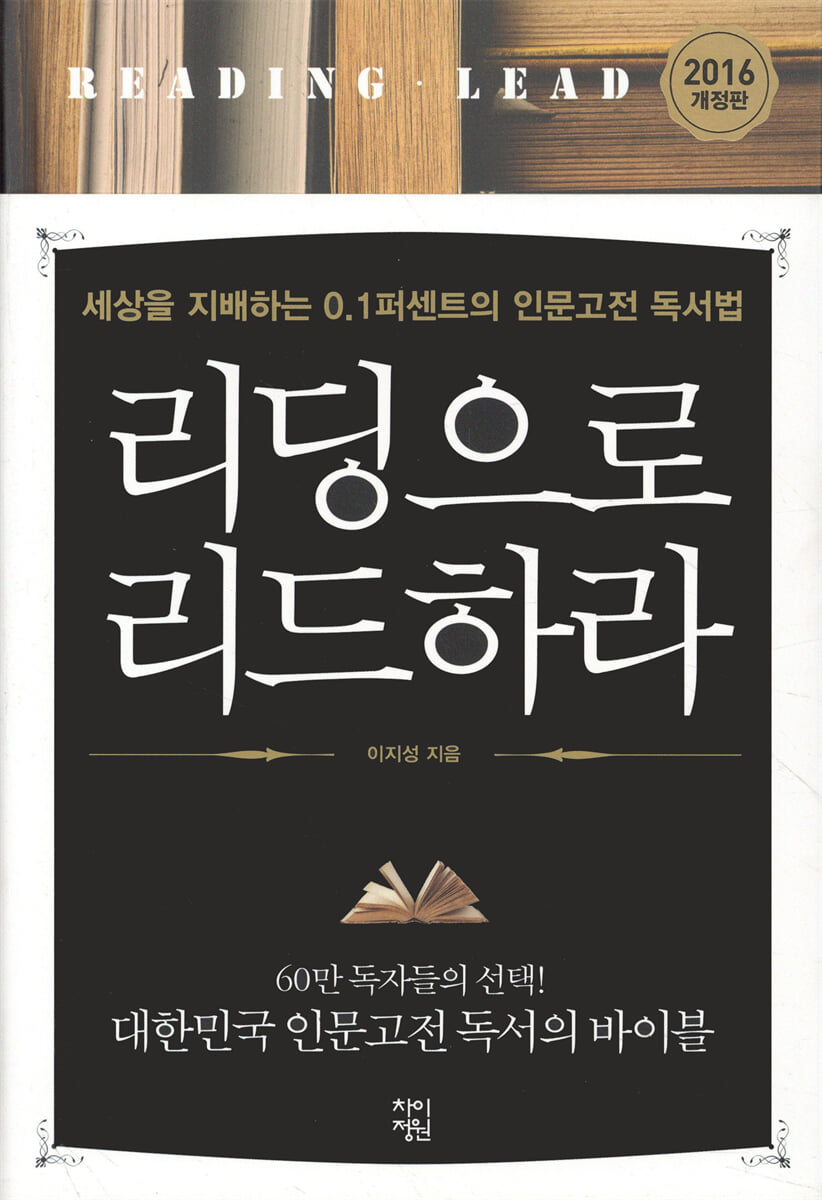
Lead by leading
 |
Description
Book Introduction
This is a revised edition of “Lead by Reading,” which has been chosen by 600,000 readers since its publication in 2010.
This book was not only beloved by readers, but was also considered a must-read for leaders in various fields, including politics, society, education, and religion, as well as corporate CEOs, and was praised by the media as "the book that brought about a humanities craze in Korea."
Furthermore, it provided an opportunity to create a 'Reading 100 Classics in Humanities' curriculum at universities, and sparked a craze for reading classics in humanities among parents and teachers.
He also popularized reading clubs for humanities classics across the country.
The book consists of six chapters in total. Chapter 1 is about the power of reading humanities classics that can change the fate of not only individuals, but also families and nations. Chapter 2 is about the method of reading humanities classics to cultivate leaders. Chapter 3 is about how to become a winner in the capitalist system by reading humanities classics. Chapter 4 is about life management methods learned from literary, philosophical, and historical classics. Chapter 5 is the author's guide to reading humanities classics for beginners. Chapter 6 contains the reading methods of humanities classics by famous people who rewrote human history.
The appendix at the end of the book includes a guide to reading classic humanities books for parents and children, a step-by-step recommended book guide, a step-by-step recommended book guide for adults, and a list of representative readers of classic humanities books.
This revised edition includes an honest interview with the author at the end to help readers and bibliophiles, from elementary school students to adults, who wish to take on the challenge of systematically reading the humanities classics.
This book was not only beloved by readers, but was also considered a must-read for leaders in various fields, including politics, society, education, and religion, as well as corporate CEOs, and was praised by the media as "the book that brought about a humanities craze in Korea."
Furthermore, it provided an opportunity to create a 'Reading 100 Classics in Humanities' curriculum at universities, and sparked a craze for reading classics in humanities among parents and teachers.
He also popularized reading clubs for humanities classics across the country.
The book consists of six chapters in total. Chapter 1 is about the power of reading humanities classics that can change the fate of not only individuals, but also families and nations. Chapter 2 is about the method of reading humanities classics to cultivate leaders. Chapter 3 is about how to become a winner in the capitalist system by reading humanities classics. Chapter 4 is about life management methods learned from literary, philosophical, and historical classics. Chapter 5 is the author's guide to reading humanities classics for beginners. Chapter 6 contains the reading methods of humanities classics by famous people who rewrote human history.
The appendix at the end of the book includes a guide to reading classic humanities books for parents and children, a step-by-step recommended book guide, a step-by-step recommended book guide for adults, and a list of representative readers of classic humanities books.
This revised edition includes an honest interview with the author at the end to help readers and bibliophiles, from elementary school students to adults, who wish to take on the challenge of systematically reading the humanities classics.
- You can preview some of the book's contents.
Preview
index
As we go in, what happened to them?
Chapter 1: The Power of Reading Classics
Leading to change the lives of nations, families, and individuals
- Things forbidden to citizens of the Republic of Korea in the 21st century
-Superpowers have a special secret.
Japan's reading project to strengthen national power
-130 legal professionals vs.
96 ex-convicts
Chapter 2: Leadership Training, Follower Training
The power to create wisdom beyond knowledge
-Karl Witte's "different education" that even Harvard professors were enthusiastic about
-Why did Jang Han-na choose Harvard's Department of Philosophy?
-The story of how the University of Chicago, a third-rate school, became a Nobel Prize kingdom.
The "Question Mark" Revolution Caused by Reading Philosophy Classics
-Don't read humanities classics for essay writing.
"Happy" Genius: The Answer Lies in Reading the Humanities Classics
Chapter 3: Compete and Win by Reading
How to Win in a Capitalist System
How did George Soros take over Wall Street?
-The first philosopher was the best investor.
Capitalism was created in the humanities tradition.
-The world's wealthy read the classics.
Chapter 4: Life Management: Win with the Humanities Classics
Life management lessons from literature, philosophy, and history
-What do Lee Byung-chul and Chung Ju-young have in common?
-Those who know the humanities manage the world.
The Socratic Method That Fascinated the World's Greatest Business Leaders
-Why they reread The Art of War
-16 Paths to the Analects
-What book are you reading now?
Chapter 5: A Beginner's Guide to the World of Humanities Classics
-Whenever you feel frustrated, meditate on the purpose of reading.
- I have to fight with myself to meet you and protect us.
-100% Empathy: How to Read Humanities Classics
-Immerse yourself in reading even in the worst of circumstances.
-Things you misunderstand about the humanities classics
Chapter 6: The Reading Methods of the Humanities Classics of the 0.1 Percent Geniuses Who Rule the World
-Reading·Lead 1 Love with all your heart
-Reading·Read 2 Charge forward with the momentum to break through the bookshelf.
-Reading/Leading 3 Be acutely aware of your own limitations.
-Reading·Reading 4 Read and read until the book is worn out.
-Reading/Reading 5 Write it like a love letter.
-Reading·Reading 6 Think until you understand
-Leading/Leading 7 Gain 'Enlightenment' and Change
- A "Self-Cautionary Text" for anyone beginning to read the humanities classics.
I look forward to the revival of the tradition of reading humanities classics.
Acknowledgements
Publishing a revised edition
Appendix 1
A Guide to Reading Classics for Parents and Children
Reference Books for Humanities Classics Reading Education | Lee Ji-seong's Recommended Books for Humanities Classics Reading Education by Stage
Appendix 2
A Guide to Reading Classics for Adults
Humanities Classics Reading Reference Books | Lee Ji-seong's Recommended Reading Guide for Humanities Classics
Appendix 3 Representative Readers of Humanities Classics
Appendix 4
Self-Development Through the Humanities: Interview with Lee Ji-seong Part 1
The Beginning of the Humanities: Treating Yourself as a Human Being: Interview with Lee Ji-seong Part 2
Chapter 1: The Power of Reading Classics
Leading to change the lives of nations, families, and individuals
- Things forbidden to citizens of the Republic of Korea in the 21st century
-Superpowers have a special secret.
Japan's reading project to strengthen national power
-130 legal professionals vs.
96 ex-convicts
Chapter 2: Leadership Training, Follower Training
The power to create wisdom beyond knowledge
-Karl Witte's "different education" that even Harvard professors were enthusiastic about
-Why did Jang Han-na choose Harvard's Department of Philosophy?
-The story of how the University of Chicago, a third-rate school, became a Nobel Prize kingdom.
The "Question Mark" Revolution Caused by Reading Philosophy Classics
-Don't read humanities classics for essay writing.
"Happy" Genius: The Answer Lies in Reading the Humanities Classics
Chapter 3: Compete and Win by Reading
How to Win in a Capitalist System
How did George Soros take over Wall Street?
-The first philosopher was the best investor.
Capitalism was created in the humanities tradition.
-The world's wealthy read the classics.
Chapter 4: Life Management: Win with the Humanities Classics
Life management lessons from literature, philosophy, and history
-What do Lee Byung-chul and Chung Ju-young have in common?
-Those who know the humanities manage the world.
The Socratic Method That Fascinated the World's Greatest Business Leaders
-Why they reread The Art of War
-16 Paths to the Analects
-What book are you reading now?
Chapter 5: A Beginner's Guide to the World of Humanities Classics
-Whenever you feel frustrated, meditate on the purpose of reading.
- I have to fight with myself to meet you and protect us.
-100% Empathy: How to Read Humanities Classics
-Immerse yourself in reading even in the worst of circumstances.
-Things you misunderstand about the humanities classics
Chapter 6: The Reading Methods of the Humanities Classics of the 0.1 Percent Geniuses Who Rule the World
-Reading·Lead 1 Love with all your heart
-Reading·Read 2 Charge forward with the momentum to break through the bookshelf.
-Reading/Leading 3 Be acutely aware of your own limitations.
-Reading·Reading 4 Read and read until the book is worn out.
-Reading/Reading 5 Write it like a love letter.
-Reading·Reading 6 Think until you understand
-Leading/Leading 7 Gain 'Enlightenment' and Change
- A "Self-Cautionary Text" for anyone beginning to read the humanities classics.
I look forward to the revival of the tradition of reading humanities classics.
Acknowledgements
Publishing a revised edition
Appendix 1
A Guide to Reading Classics for Parents and Children
Reference Books for Humanities Classics Reading Education | Lee Ji-seong's Recommended Books for Humanities Classics Reading Education by Stage
Appendix 2
A Guide to Reading Classics for Adults
Humanities Classics Reading Reference Books | Lee Ji-seong's Recommended Reading Guide for Humanities Classics
Appendix 3 Representative Readers of Humanities Classics
Appendix 4
Self-Development Through the Humanities: Interview with Lee Ji-seong Part 1
The Beginning of the Humanities: Treating Yourself as a Human Being: Interview with Lee Ji-seong Part 2
Into the book
(France) is a country where philosophy questions on university entrance exams become a national topic of conversation, and where ordinary citizens engage in philosophical discussions in cafes to kill time, at the level of university professors from the perspective of Korea or Japan.
France, which was the most powerful nation in modern times, remains a powerful nation today, and even looks down on the United States to the point of arrogance, could rightly be considered to have originated from its reading of the classics in the humanities, if we look at it only from an educational perspective.
--- p.44
Reading the humanities classics, without the desperate struggle to kill one's past self, is nothing more or less than the accumulation of knowledge.
I say this over and over again, but knowledge does not change people.
Fundamental changes in life occur when there is wisdom that penetrates the essence of things.
The 'change' I'm talking about through reading the humanities classics is precisely 'wisdom.'
--- p.77
The philosopher's way of thinking, paradoxically, shines even in the realm of money, a realm that philosophers seem to despise.
As all the rich people in the world unanimously say, money strangely piles up in places where the crowds don't go.
This means that only those who explore places where the crowds do not go can become rich.
So who would go where the crowds don't? Naturally, it's those who think differently.
So, only people with a philosopher's mindset can become rich.
--- p.135
How can I explain those moments when the black letters printed on white paper did not remain mere letters, but rather came to me as a 'conversation' that transcended time and space?
Those moments came mostly when I was writing, and I believe that they accumulated and created small changes in me.
--- p.209
Geniuses read the classics of the humanities, immersed themselves in endless contemplation, and in the midst of their contemplation, they attained enlightenment that struck their heads and hearts.
Geniuses recorded their realizations.
As if stringing together scattered, shining pearls with a single thread to create a beautiful necklace.
--- p.270
Read, transcribe, and reflect on the classics of humanities with unconditional love.
Then it will be visible.
Hidden behind the sentences, the sublime 'love' of geniuses towards humanity.
The moment you meet that love, your heart will feel a great thrill.
At the same time, a radiant light of enlightenment will burst from deep within your brain, transforming you completely.
So love.
Love deeply in your soul.
France, which was the most powerful nation in modern times, remains a powerful nation today, and even looks down on the United States to the point of arrogance, could rightly be considered to have originated from its reading of the classics in the humanities, if we look at it only from an educational perspective.
--- p.44
Reading the humanities classics, without the desperate struggle to kill one's past self, is nothing more or less than the accumulation of knowledge.
I say this over and over again, but knowledge does not change people.
Fundamental changes in life occur when there is wisdom that penetrates the essence of things.
The 'change' I'm talking about through reading the humanities classics is precisely 'wisdom.'
--- p.77
The philosopher's way of thinking, paradoxically, shines even in the realm of money, a realm that philosophers seem to despise.
As all the rich people in the world unanimously say, money strangely piles up in places where the crowds don't go.
This means that only those who explore places where the crowds do not go can become rich.
So who would go where the crowds don't? Naturally, it's those who think differently.
So, only people with a philosopher's mindset can become rich.
--- p.135
How can I explain those moments when the black letters printed on white paper did not remain mere letters, but rather came to me as a 'conversation' that transcended time and space?
Those moments came mostly when I was writing, and I believe that they accumulated and created small changes in me.
--- p.209
Geniuses read the classics of the humanities, immersed themselves in endless contemplation, and in the midst of their contemplation, they attained enlightenment that struck their heads and hearts.
Geniuses recorded their realizations.
As if stringing together scattered, shining pearls with a single thread to create a beautiful necklace.
--- p.270
Read, transcribe, and reflect on the classics of humanities with unconditional love.
Then it will be visible.
Hidden behind the sentences, the sublime 'love' of geniuses towards humanity.
The moment you meet that love, your heart will feel a great thrill.
At the same time, a radiant light of enlightenment will burst from deep within your brain, transforming you completely.
So love.
Love deeply in your soul.
--- p.289
Publisher's Review
The bible of reading humanities classics chosen by 600,000 readers!
"Lead by Leading" 2016 Revised Edition Published
This is a revised edition of “Lead by Reading,” which has been chosen by 600,000 readers since its publication in 2010.
This book was not only beloved by readers, but was also considered a must-read for leaders in various fields, including politics, society, education, and religion, as well as corporate CEOs, and was praised by the media as "the book that brought about a humanities craze in Korea."
Furthermore, it provided an opportunity to create a 'Reading 100 Classics in Humanities' curriculum at universities, and sparked a craze for reading classics in humanities among parents and teachers.
He also popularized reading clubs for humanities classics across the country.
Self-development through humanities.
Now, why read the humanities classics?
In his thoughts on the publication of the revised edition, author Lee Ji-seong said, “If there is no practice of enlightenment and love, reading the humanities classics is extremely futile,” and he expressed concern toward “the knowledge-oriented humanities craze that is essentially no different from the study of Neo-Confucianism in the Joseon Dynasty or today’s entrance exams, which centers on reading books and listening to lectures.”
“Humanities like this do not advance the world.
“On the contrary, it regresses.” What are the humanities that advance the world?
Let's think about King Sejong.
His method of reading the humanities classics can be summarized as a fierceness that transcends human limitations.
His reading method was to read 100 times and copy 100 times.
(…) Why did Sejong devote so much effort to reading? I'm convinced it was because he deeply loved his people.
Sejong gained this confidence from the following words he spoke to the scholars of Jiphyeonjeon, which could be called an institute for researching classical humanities.
“My only wish is for the people to be free from their grievances and injustices, for the worries and sighs in the farming villages to cease forever, and for the people to enjoy the joy of life through this.
I hope you understand my sincere heart.” _Page 237
In an interview with a media outlet (included in Appendix 4, “Self-Development through Humanities”), the author responds, “The basic spirit of humanities is to think about how we can help those in low positions and how we can make them happy,” and that this is “the flow of people who studied humanities throughout human history.”
In fact, since the success of “Lead by Leading,” he has focused on “practicing love,” which he stated as the theme of the book.
Through the fan cafe 'Pole Pole', volunteers were gathered to provide humanities education to children in low-income study rooms across the country, and together with the international relief organization 'Korea Food for the Hungry', the Dream Project was launched to build schools and hospitals in slum villages overseas.
Seongho Lee said this.
“Read as if you were reunited with your beloved mother after a long separation.
“Question and discuss as if you were asking for a cure for a sick child.” For Seongho, a book was not a book.
It was a loving family.
Page 241
Reading a book with the joy of meeting a beloved mother again after a long time, and asking questions and discussing them with the longing of someone seeking treatment for a sick child.
It's a sentence that I can't shake from my heart while reading the book.
With "Leading Through Reading," let's enter the world of humanities and humanities classics, which we need now.
Lead by reading.
From beginners to avid readers, from elementary school students to adults
Reading humanities classics that guide everyone's life
The book consists of six chapters in total.
Chapter 1 contains the power of reading classic humanities literature that can change the fate of not only individuals, but also families and nations; Chapter 2 contains a method of teaching reading classic humanities literature to cultivate leaders; Chapter 3 contains a method of becoming a winner in the capitalist system by reading classic humanities literature; Chapter 4 contains a method of life management learned from classics of literature, philosophy, and history; Chapter 5 contains the author's know-how on reading classic humanities literature for beginners; and Chapter 6 contains a method of reading classic humanities literature by famous people who rewrote human history.
The appendix at the end of the book includes a guide to reading classic humanities books for parents and children, a step-by-step recommended book guide, a step-by-step recommended book guide for adults, and a list of representative readers of classic humanities books.
This revised edition includes an honest interview with the author at the end to help readers, from beginners to avid readers and bibliophiles, from elementary school students to adults, who wish to take on the challenge of systematically reading the humanities classics.
Reading the humanities classics that will change the fate of your family and country
In Chapter 1, the author argues that the superpowers of history have a special secret.
For example, Sparta, which loved philosophy and implemented the best education in philosophy and debate, was known as a nation that pursued only a strong body because they imprinted the image of fighting on foreigners in order to hide the fact that their secret lay in 'wisdom'.
The author introduces the tradition of reading education in the humanities classics in Europe and the United States, and then mentions the Japanese reading education project that was led and implemented at a national level after World War II.
He emphasizes that our country's history of translating Western classics is far behind that of Japan, and says that if we want to receive a true apology from Japan, we must diligently read the classics and become a culturally advanced country.
Finally, by quoting the results of a survey by the New York City Board of Education comparing the five generations of the Jonathan Edwards family, who received education in reading the classics from an early age and served as university presidents, with the five generations of the Schultz family, who had similar economic power at the same time, he arrives at the conclusion that reading the classics changes not only an individual's life but also the fate of a family and a nation.
If you feel like something is wrong with the world, I recommend opening a classic humanities book when you have time to feel discouraged or lament.
I recommend feeding your brain plenty of ginseng, the wisdom of over a thousand years.
Then, one day, you yourself will surely become revolutionary, and a tradition of reading the classics will be established in your family.
And the talents produced from your family will do great things that will change the history of our country, the world, and humanity.
Page 57
Reading the humanities classics to cultivate leaders
How did Carl Witte raise his son, who was mentally retarded, into a genius? Why did classical musician Chang Hanna choose Harvard's philosophy department? How did the University of Chicago, known as a third-rate school, become a Nobel Prize-winning powerhouse? Chapter 2 introduces reading the humanities classics, not simply for the accumulation of knowledge, but to cultivate life-changing wisdom.
The author introduces not only the cases of several celebrities, but also his own valuable experiences as a current elementary school teacher.
This is the 'question mark revolution' that occurred among children who read the classics of philosophy.
In this chapter, the author reminds us of the harmful effects of parental coercive reading education, which creates unfortunate geniuses, saying, “Don’t read humanities classics for the sake of writing essays.”
Only humanities classics reading education implemented in a free and enjoyable atmosphere can create 'happy' geniuses.
Don't focus on university admission as the purpose of reading the humanities classics.
That's something you would only do at an essay academy.
I hope that the purpose of reading will be to reach the highest level that humans can achieve.
It is a realm that fundamentally changes a child's brain.
It is the realm of raising ordinary children into figures like Sejong, Yi Sun-sin, Jeong Yak-yong, Park Ji-won, Heo Jun, Kim Gu, Leonardo da Vinci, Churchill, Edison, and Einstein.
Page 92
Reading the humanities classics to become a winner in the capitalist system
How did George Soros take over Wall Street? Why don't poor people study the humanities? These are the key questions the author poses in Chapter 3.
As a boy who moved through the slums of London, working as a dishwasher, waiter, painter, farm laborer, factory park attendant, swimming pool attendant, and railway station porter, Soros lived a miserable life, being rejected, fired, and heartbroken wherever he went and by everyone he met.
He decided to become a winner in capitalism and entered the world of finance, but he also suffered a long period of defeat there.
From the time he became the emperor of the world's finance world in a matter of decades, there was one thing he never let go of: the classics of philosophy.
Whenever I had free time, I read philosophy books, received private tutoring from philosophy graduate students on weekends and holidays, and occasionally wrote philosophy papers.
The author addresses readers who might be offended by the sudden mention of money in a book about the humanities, quoting Earl Shorris, who created a classic humanities reading program for the economically disadvantaged, in his book, Hope for the Humanities.
“You have been deceived all along.
The rich study the humanities.
“The humanities are essential studies for living well in the world, for thinking clearly, and for learning how to respond thoughtfully rather than reacting automatically when some ‘powerless force’ from outside influences you.”
Life management methods learned from humanities classics
What do Lee Byung-chul and Chung Ju-yung, Alexander the Great and King Sejong the Great have in common? They all read the classics.
Chapter 4 introduces life management methods learned from classics of philosophy, literature, and history.
From Steve Jobs, who was a fan of Socrates to the point of saying, “If I could have lunch with Socrates, I would trade all the technology our company has for him,” to Alan Wurtzel, Charles Handy, Peter Drucker, William Durant, Jack Welch, and Lee Kun-hee, people who applied the Socratic questioning method to management and became world-class managers are introduced.
Also, after World War II, the American military and Japanese executives accepted Sun Tzu's "The Art of War," and the examples of Chinese managers, as well as Lee Byung-chul, who read the "Analects" and used it as a management guideline.
It mentions the stories of Korean business leaders such as Chung Ju-yung, Lee Kun-hee, Chung Joon-yang, the chairman of POSCO, and Koo Hak-seo, the former chairman of Shinsegae, and recommends 16 paths to the Analects.
At the end of this chapter, the author emphasizes that the less wealthy, less capable, and less backgrounded a person is, the more intensely he or she should read the classics of the humanities.
Because those who know the humanities manage the world.
What book are you reading now?
I want to ask those who always say, "This is a dirty world where only the rich are treated well."
I would like to ask those who say, 'There is no hope in our country where the rich are getting richer and the poor are getting poorer.'
I would like to ask a question to those who make difficult claims such as that our country's capitalism must change while neglecting self-cultivation.
I dare to ask with a trembling voice.
“What book are you reading now?” _Page 185
‣ Lee Ji-seong shares his tips for reading humanities classics
- Stay away from commentaries
I recommend reading the commentary after you have properly developed the ability to read humanities classics.
The ability to read humanities classics develops naturally through intense reading of humanities classics in their raw form.
- Establish your own system
If you start reading with a system in place from the beginning, the fun of reading diminishes.
Picking up a random book and reading it, and then suddenly realizing that you have to read it, can be a huge motivator.
- Write it down
How can I explain those moments when the black letters printed on white paper did not remain as simple letters but turned into a 'conversation' and came to me?
Those moments came mostly when I was desperate.
I believe that those moments accumulated and created small changes in me.
-Just do it
Buy a classic humanities book and read it from cover to cover, whether it be a meal or a meal.
And then copy it from beginning to end.
If you read three to five books like this, you will develop a kind of 'feel' for it.
- Always carry a humanities classic with you.
I hope you too always carry a humanities classic in your bag.
If you do this, you will find yourself picking up a classic humanities book in an unexpected place without even realizing it, and you will suddenly develop incredible concentration.
- Explain to someone else what you read.
Even if there is just one person who nods and looks at you with warm eyes as you talk about something difficult, your reading of humanities classics will be enriched.
"Lead by Leading" 2016 Revised Edition Published
This is a revised edition of “Lead by Reading,” which has been chosen by 600,000 readers since its publication in 2010.
This book was not only beloved by readers, but was also considered a must-read for leaders in various fields, including politics, society, education, and religion, as well as corporate CEOs, and was praised by the media as "the book that brought about a humanities craze in Korea."
Furthermore, it provided an opportunity to create a 'Reading 100 Classics in Humanities' curriculum at universities, and sparked a craze for reading classics in humanities among parents and teachers.
He also popularized reading clubs for humanities classics across the country.
Self-development through humanities.
Now, why read the humanities classics?
In his thoughts on the publication of the revised edition, author Lee Ji-seong said, “If there is no practice of enlightenment and love, reading the humanities classics is extremely futile,” and he expressed concern toward “the knowledge-oriented humanities craze that is essentially no different from the study of Neo-Confucianism in the Joseon Dynasty or today’s entrance exams, which centers on reading books and listening to lectures.”
“Humanities like this do not advance the world.
“On the contrary, it regresses.” What are the humanities that advance the world?
Let's think about King Sejong.
His method of reading the humanities classics can be summarized as a fierceness that transcends human limitations.
His reading method was to read 100 times and copy 100 times.
(…) Why did Sejong devote so much effort to reading? I'm convinced it was because he deeply loved his people.
Sejong gained this confidence from the following words he spoke to the scholars of Jiphyeonjeon, which could be called an institute for researching classical humanities.
“My only wish is for the people to be free from their grievances and injustices, for the worries and sighs in the farming villages to cease forever, and for the people to enjoy the joy of life through this.
I hope you understand my sincere heart.” _Page 237
In an interview with a media outlet (included in Appendix 4, “Self-Development through Humanities”), the author responds, “The basic spirit of humanities is to think about how we can help those in low positions and how we can make them happy,” and that this is “the flow of people who studied humanities throughout human history.”
In fact, since the success of “Lead by Leading,” he has focused on “practicing love,” which he stated as the theme of the book.
Through the fan cafe 'Pole Pole', volunteers were gathered to provide humanities education to children in low-income study rooms across the country, and together with the international relief organization 'Korea Food for the Hungry', the Dream Project was launched to build schools and hospitals in slum villages overseas.
Seongho Lee said this.
“Read as if you were reunited with your beloved mother after a long separation.
“Question and discuss as if you were asking for a cure for a sick child.” For Seongho, a book was not a book.
It was a loving family.
Page 241
Reading a book with the joy of meeting a beloved mother again after a long time, and asking questions and discussing them with the longing of someone seeking treatment for a sick child.
It's a sentence that I can't shake from my heart while reading the book.
With "Leading Through Reading," let's enter the world of humanities and humanities classics, which we need now.
Lead by reading.
From beginners to avid readers, from elementary school students to adults
Reading humanities classics that guide everyone's life
The book consists of six chapters in total.
Chapter 1 contains the power of reading classic humanities literature that can change the fate of not only individuals, but also families and nations; Chapter 2 contains a method of teaching reading classic humanities literature to cultivate leaders; Chapter 3 contains a method of becoming a winner in the capitalist system by reading classic humanities literature; Chapter 4 contains a method of life management learned from classics of literature, philosophy, and history; Chapter 5 contains the author's know-how on reading classic humanities literature for beginners; and Chapter 6 contains a method of reading classic humanities literature by famous people who rewrote human history.
The appendix at the end of the book includes a guide to reading classic humanities books for parents and children, a step-by-step recommended book guide, a step-by-step recommended book guide for adults, and a list of representative readers of classic humanities books.
This revised edition includes an honest interview with the author at the end to help readers, from beginners to avid readers and bibliophiles, from elementary school students to adults, who wish to take on the challenge of systematically reading the humanities classics.
Reading the humanities classics that will change the fate of your family and country
In Chapter 1, the author argues that the superpowers of history have a special secret.
For example, Sparta, which loved philosophy and implemented the best education in philosophy and debate, was known as a nation that pursued only a strong body because they imprinted the image of fighting on foreigners in order to hide the fact that their secret lay in 'wisdom'.
The author introduces the tradition of reading education in the humanities classics in Europe and the United States, and then mentions the Japanese reading education project that was led and implemented at a national level after World War II.
He emphasizes that our country's history of translating Western classics is far behind that of Japan, and says that if we want to receive a true apology from Japan, we must diligently read the classics and become a culturally advanced country.
Finally, by quoting the results of a survey by the New York City Board of Education comparing the five generations of the Jonathan Edwards family, who received education in reading the classics from an early age and served as university presidents, with the five generations of the Schultz family, who had similar economic power at the same time, he arrives at the conclusion that reading the classics changes not only an individual's life but also the fate of a family and a nation.
If you feel like something is wrong with the world, I recommend opening a classic humanities book when you have time to feel discouraged or lament.
I recommend feeding your brain plenty of ginseng, the wisdom of over a thousand years.
Then, one day, you yourself will surely become revolutionary, and a tradition of reading the classics will be established in your family.
And the talents produced from your family will do great things that will change the history of our country, the world, and humanity.
Page 57
Reading the humanities classics to cultivate leaders
How did Carl Witte raise his son, who was mentally retarded, into a genius? Why did classical musician Chang Hanna choose Harvard's philosophy department? How did the University of Chicago, known as a third-rate school, become a Nobel Prize-winning powerhouse? Chapter 2 introduces reading the humanities classics, not simply for the accumulation of knowledge, but to cultivate life-changing wisdom.
The author introduces not only the cases of several celebrities, but also his own valuable experiences as a current elementary school teacher.
This is the 'question mark revolution' that occurred among children who read the classics of philosophy.
In this chapter, the author reminds us of the harmful effects of parental coercive reading education, which creates unfortunate geniuses, saying, “Don’t read humanities classics for the sake of writing essays.”
Only humanities classics reading education implemented in a free and enjoyable atmosphere can create 'happy' geniuses.
Don't focus on university admission as the purpose of reading the humanities classics.
That's something you would only do at an essay academy.
I hope that the purpose of reading will be to reach the highest level that humans can achieve.
It is a realm that fundamentally changes a child's brain.
It is the realm of raising ordinary children into figures like Sejong, Yi Sun-sin, Jeong Yak-yong, Park Ji-won, Heo Jun, Kim Gu, Leonardo da Vinci, Churchill, Edison, and Einstein.
Page 92
Reading the humanities classics to become a winner in the capitalist system
How did George Soros take over Wall Street? Why don't poor people study the humanities? These are the key questions the author poses in Chapter 3.
As a boy who moved through the slums of London, working as a dishwasher, waiter, painter, farm laborer, factory park attendant, swimming pool attendant, and railway station porter, Soros lived a miserable life, being rejected, fired, and heartbroken wherever he went and by everyone he met.
He decided to become a winner in capitalism and entered the world of finance, but he also suffered a long period of defeat there.
From the time he became the emperor of the world's finance world in a matter of decades, there was one thing he never let go of: the classics of philosophy.
Whenever I had free time, I read philosophy books, received private tutoring from philosophy graduate students on weekends and holidays, and occasionally wrote philosophy papers.
The author addresses readers who might be offended by the sudden mention of money in a book about the humanities, quoting Earl Shorris, who created a classic humanities reading program for the economically disadvantaged, in his book, Hope for the Humanities.
“You have been deceived all along.
The rich study the humanities.
“The humanities are essential studies for living well in the world, for thinking clearly, and for learning how to respond thoughtfully rather than reacting automatically when some ‘powerless force’ from outside influences you.”
Life management methods learned from humanities classics
What do Lee Byung-chul and Chung Ju-yung, Alexander the Great and King Sejong the Great have in common? They all read the classics.
Chapter 4 introduces life management methods learned from classics of philosophy, literature, and history.
From Steve Jobs, who was a fan of Socrates to the point of saying, “If I could have lunch with Socrates, I would trade all the technology our company has for him,” to Alan Wurtzel, Charles Handy, Peter Drucker, William Durant, Jack Welch, and Lee Kun-hee, people who applied the Socratic questioning method to management and became world-class managers are introduced.
Also, after World War II, the American military and Japanese executives accepted Sun Tzu's "The Art of War," and the examples of Chinese managers, as well as Lee Byung-chul, who read the "Analects" and used it as a management guideline.
It mentions the stories of Korean business leaders such as Chung Ju-yung, Lee Kun-hee, Chung Joon-yang, the chairman of POSCO, and Koo Hak-seo, the former chairman of Shinsegae, and recommends 16 paths to the Analects.
At the end of this chapter, the author emphasizes that the less wealthy, less capable, and less backgrounded a person is, the more intensely he or she should read the classics of the humanities.
Because those who know the humanities manage the world.
What book are you reading now?
I want to ask those who always say, "This is a dirty world where only the rich are treated well."
I would like to ask those who say, 'There is no hope in our country where the rich are getting richer and the poor are getting poorer.'
I would like to ask a question to those who make difficult claims such as that our country's capitalism must change while neglecting self-cultivation.
I dare to ask with a trembling voice.
“What book are you reading now?” _Page 185
‣ Lee Ji-seong shares his tips for reading humanities classics
- Stay away from commentaries
I recommend reading the commentary after you have properly developed the ability to read humanities classics.
The ability to read humanities classics develops naturally through intense reading of humanities classics in their raw form.
- Establish your own system
If you start reading with a system in place from the beginning, the fun of reading diminishes.
Picking up a random book and reading it, and then suddenly realizing that you have to read it, can be a huge motivator.
- Write it down
How can I explain those moments when the black letters printed on white paper did not remain as simple letters but turned into a 'conversation' and came to me?
Those moments came mostly when I was desperate.
I believe that those moments accumulated and created small changes in me.
-Just do it
Buy a classic humanities book and read it from cover to cover, whether it be a meal or a meal.
And then copy it from beginning to end.
If you read three to five books like this, you will develop a kind of 'feel' for it.
- Always carry a humanities classic with you.
I hope you too always carry a humanities classic in your bag.
If you do this, you will find yourself picking up a classic humanities book in an unexpected place without even realizing it, and you will suddenly develop incredible concentration.
- Explain to someone else what you read.
Even if there is just one person who nods and looks at you with warm eyes as you talk about something difficult, your reading of humanities classics will be enriched.
GOODS SPECIFICS
- Date of issue: April 5, 2016
- Format: Hardcover book binding method guide
- Page count, weight, size: 432 pages | 840g | 152*223*30mm
- ISBN13: 9791185035444
- ISBN10: 1185035443
You may also like
카테고리
korean


korean

![GQ KOREA Mark (Monthly): December [2025]](http://librairie.coreenne.fr/cdn/shop/files/8ef265dbbfbf186523ed75ba7319009d.jpg?v=1765340328&width=3840)


