

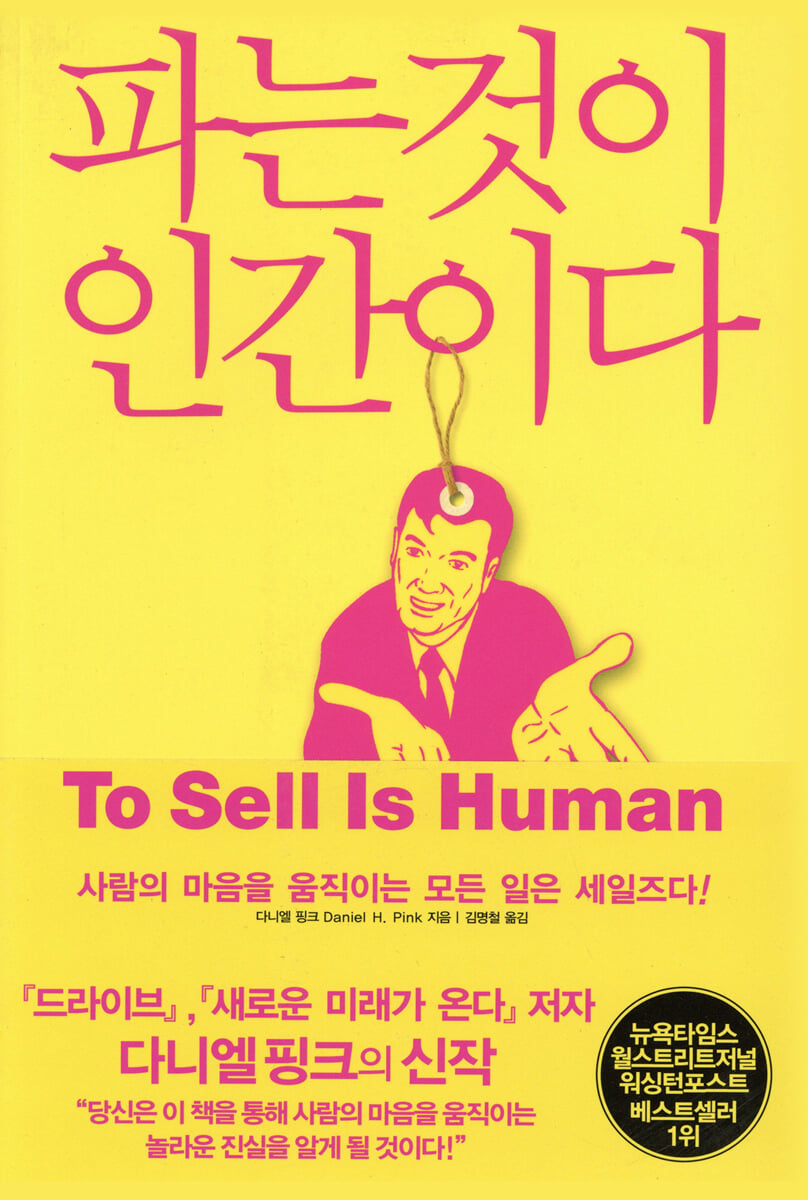
Selling is human
 |
Description
Book Introduction
Anything that moves someone's heart is a sale.
A new way of survival suggested by world-renowned futurist Daniel Pink.
Most of us are doing sales without even realizing it.
When people hear the word sales, they often associate it with negative words like “pushy,” “insincere and overly friendly,” and “false.”
But I am doing that kind of sales without even knowing it.
For example, asking a child to do their homework or giving a passionate presentation to get your idea accepted are all sales activities.
You have used your resources, talents, and ideas to persuade others, convince them of your reasons, and influence their decisions to take what you propose.
How is this different from selling cars or selling personal accident insurance?
Daniel Pink, the author of a fascinating analysis of how we will work and live in the future, emphasizes, based on statistical data from various countries, that the traditional concept of sales is still valid.
A survey asking, “What do you do at work?” revealed that non-salespeople across a range of occupations spend about 40% of their time on selling activities, and that most of them believe that these activities—persuading, convincing, and influencing others—are important to their professional success.
The sales methods of the past can no longer exert a strong influence.
In other words, sales is no longer something that can be achieved by relying on persistent and persistent attitudes or flowery speeches, but rather something that can only be successful when armed with knowledge and honesty.
The era of buyer risk and information asymmetry, where sellers monopolized information and consumers had no choice but to rely on the limited information provided by sellers, is long gone.
In today's digital world, we must recognize the need for new values and methods suited to the information-symmetric era, where consumers and sellers possess the same information.
Daniel Pink defines the essential qualities as the ABCs of:
He says that in order to move the hearts of others, you need to have Attunement, which elicits empathy from others, Buoyancy, which is the resilience to not give in even in a sea of rejection, and Clarity, which is the clarity through problem identification.
A new way of survival suggested by world-renowned futurist Daniel Pink.
Most of us are doing sales without even realizing it.
When people hear the word sales, they often associate it with negative words like “pushy,” “insincere and overly friendly,” and “false.”
But I am doing that kind of sales without even knowing it.
For example, asking a child to do their homework or giving a passionate presentation to get your idea accepted are all sales activities.
You have used your resources, talents, and ideas to persuade others, convince them of your reasons, and influence their decisions to take what you propose.
How is this different from selling cars or selling personal accident insurance?
Daniel Pink, the author of a fascinating analysis of how we will work and live in the future, emphasizes, based on statistical data from various countries, that the traditional concept of sales is still valid.
A survey asking, “What do you do at work?” revealed that non-salespeople across a range of occupations spend about 40% of their time on selling activities, and that most of them believe that these activities—persuading, convincing, and influencing others—are important to their professional success.
The sales methods of the past can no longer exert a strong influence.
In other words, sales is no longer something that can be achieved by relying on persistent and persistent attitudes or flowery speeches, but rather something that can only be successful when armed with knowledge and honesty.
The era of buyer risk and information asymmetry, where sellers monopolized information and consumers had no choice but to rely on the limited information provided by sellers, is long gone.
In today's digital world, we must recognize the need for new values and methods suited to the information-symmetric era, where consumers and sellers possess the same information.
Daniel Pink defines the essential qualities as the ABCs of:
He says that in order to move the hearts of others, you need to have Attunement, which elicits empathy from others, Buoyancy, which is the resilience to not give in even in a sea of rejection, and Clarity, which is the clarity through problem identification.
- You can preview some of the book's contents.
Preview
index
prolog
Part 1: Everyone's Selling Something - The Resurrection of the Salesman
Chapter 1: People Who Move Others
The Golden Age of the Fullerbrush Man│The Resurgence of Salesmen and Saleswomen│
The rise of new forms of sales and non-sales sales
Chapter 2: The Golden Age of Sales is Coming
Entrepreneurship: An Era Where Anyone Can Become an Entrepreneur│Flexibility, the Ability to Expand Your Business│
Growth in education and healthcare, where non-sales sales are key
Chapter 3: The Changes Made by a World of Information Symmetry
Lemons and Bad Products│Cliche Sales Techniques│Old-Fashioned Business vs.
New Business│
A new rule called seller risk
Part 2: 3 Conditions for Moving Others' Hearts - Pay Attention to the New ABCs
Chapter 4: Attunement: How to Coordinate with Others
Power, Empathy, and the Chameleon│Are Extroverts Better at Sales?│Sample Case
Chapter 5: Resilience: Navigating the "Sea of Rejection"
Elements needed in advance_Self-talk starting with a question │Elements needed in the process_Appropriate positivity ratio │
Elements Needed After Death_Positive Explanation Method│Sample Case
Chapter 6 Clarity: Finding the Right Problem to Solve
From Problem Solver to Problem Finder│What to Compare to│
Telling Others Where to Go│Sample Case
Part 3: How to Captivate Your Opponents - 3 Essentials for Sales and Non-Sales Sales
Chapter 7 Pitch: The ability to convey the point persuasively
Lessons from Hollywood: What's the Purpose of Pitch?
Elevator Pitches and 6 Effective Pitches│Sample Cases
Chapter 8 Improvisation: Instantaneous Judgment and Coping Skills
Coping with Dynamic and Complex Environments│Sample Cases
Chapter 9: Contribution: The Power to Help
Making it Human│Giving it a Sense of Purpose│Sample Case
Part 1: Everyone's Selling Something - The Resurrection of the Salesman
Chapter 1: People Who Move Others
The Golden Age of the Fullerbrush Man│The Resurgence of Salesmen and Saleswomen│
The rise of new forms of sales and non-sales sales
Chapter 2: The Golden Age of Sales is Coming
Entrepreneurship: An Era Where Anyone Can Become an Entrepreneur│Flexibility, the Ability to Expand Your Business│
Growth in education and healthcare, where non-sales sales are key
Chapter 3: The Changes Made by a World of Information Symmetry
Lemons and Bad Products│Cliche Sales Techniques│Old-Fashioned Business vs.
New Business│
A new rule called seller risk
Part 2: 3 Conditions for Moving Others' Hearts - Pay Attention to the New ABCs
Chapter 4: Attunement: How to Coordinate with Others
Power, Empathy, and the Chameleon│Are Extroverts Better at Sales?│Sample Case
Chapter 5: Resilience: Navigating the "Sea of Rejection"
Elements needed in advance_Self-talk starting with a question │Elements needed in the process_Appropriate positivity ratio │
Elements Needed After Death_Positive Explanation Method│Sample Case
Chapter 6 Clarity: Finding the Right Problem to Solve
From Problem Solver to Problem Finder│What to Compare to│
Telling Others Where to Go│Sample Case
Part 3: How to Captivate Your Opponents - 3 Essentials for Sales and Non-Sales Sales
Chapter 7 Pitch: The ability to convey the point persuasively
Lessons from Hollywood: What's the Purpose of Pitch?
Elevator Pitches and 6 Effective Pitches│Sample Cases
Chapter 8 Improvisation: Instantaneous Judgment and Coping Skills
Coping with Dynamic and Complex Environments│Sample Cases
Chapter 9: Contribution: The Power to Help
Making it Human│Giving it a Sense of Purpose│Sample Case
Into the book
But equally important is seeing the act of selling from a different perspective, and I hope you will too.
As I wrote this book, I also came to realize that selling is much more urgent and important than I had previously understood, and that its appearance is much more beautiful than we realize.
The ability to move others to exchange what they have for what we have is crucial to our survival and well-being.
Such activities have helped humans evolve, improve their standard of living, and elevate their everyday lives.
The ability to sell is not an unnatural activity that adapts to the ruthless world of commerce.
Sales is a part of who we are as humans.
As you turn each page of this book, you will gradually come to understand that sales is essentially about humanity itself.
---pp.
12~13
U.S. Bureau of Labor Statistics
A closer look at the thick, semiannual report of Occupational Employment Statistics published by the Bureau of Labor Statistics reveals some surprising and very important data hidden within.
The fact is that one in nine American workers works in sales.
Over 15 million people make a living every day persuading and convincing others to buy something.
Examples include real estate agents, corporate sales representatives, and securities dealers.
They sell planes to airlines, trains to governments, and cars to drivers at their 10,000-odd dealerships across the country.
---pp.
30~31
Contrary to what many people expected, the Internet has had little impact on sales.
From 2000 to today, despite the dramatic rise of broadband, smartphones, and e-commerce, which has significantly reduced the need for salespeople to broker and sell, the share of the U.S. workforce engaged in sales has remained virtually unchanged at about one in nine.
---p.
33
Our new data reveals an even more surprising fact: the same is true for eight of those nine.
Because they too spend time moving other people and make a living from that activity.
Whether it's traditional sales or a shift toward non-sales, we're all selling something these days.
Although we may not fully realize it, we are each doing exactly what Norman Hall has been doing for nearly half a century, and what Fuller salesmen were doing half a century ago.
The salesman is not dead.
The salesman is alive.
That's because we are salesmen.
---pp.
42~43
The world of flat organizations and turbulent business environments (this is the world we live in) punishes fixed skills and rewards flexible skills.
Today, individuals performing routine tasks must transcend functional boundaries.
Designers must analyze, and analysts must design.
Marketers have to produce, and production managers have to market.
Additionally, as next-generation technologies emerge and current business models collapse, existing technologies will need to be expanded in new directions.
---p.
58
The negative impression we have of sales is largely due not to the inherent nature of selling, but to the chronic information asymmetry associated with it.
But everything changed as information asymmetry decreased and a new balance emerged between buyers and sellers.
---pp.
87~88
When social scientists looked into whether there was a relationship between extroversion and sales success, they found that the relationship was minimal at best.
Managers often give extroverted employees higher ratings, but researchers have found no statistically significant relationship between extroversion and sales performance, and extroversion was not associated with sales volume.
---p.
119
This fascinating perspective on the root of the problem has significant implications for the new world of sales.
These days, sales and non-sales sales depend more on creative and experiential problem-solving skills like artists rather than on problem-solving skills based on structured, rule-based calculations like engineers.
This is because of the fundamental environmental changes explained in Chapter 3.
Until recently, buyers faced numerous obstacles before they could resolve their issues.
So the buyer relied on the seller because they had information he didn't have.
But today, the shift from information asymmetry to information symmetry has not only created a seller-risk principle, but also changed what buyers can do for themselves and what sellers must do accordingly (to avoid becoming useless).
---p.
178
Even this book could be summarized in a Pixar pitch as follows:
In the old days, only some people did sales.
Every day they sold things, we bought them, and everyone was happy.
One day everything changed.
Everyone started selling, and sales changed from a buyer-at-risk principle to a seller-at-risk principle.
So we had to learn new ABC principles: alignment, resilience, and clarity.
So we need new skills: pitch, improvisation, and contribution.
Finally, we realized that sales isn't about bleakly conforming to a harsh market culture.
Sales is a part of who we are, so the more human we are, the better we can do it.
As I wrote this book, I also came to realize that selling is much more urgent and important than I had previously understood, and that its appearance is much more beautiful than we realize.
The ability to move others to exchange what they have for what we have is crucial to our survival and well-being.
Such activities have helped humans evolve, improve their standard of living, and elevate their everyday lives.
The ability to sell is not an unnatural activity that adapts to the ruthless world of commerce.
Sales is a part of who we are as humans.
As you turn each page of this book, you will gradually come to understand that sales is essentially about humanity itself.
---pp.
12~13
U.S. Bureau of Labor Statistics
A closer look at the thick, semiannual report of Occupational Employment Statistics published by the Bureau of Labor Statistics reveals some surprising and very important data hidden within.
The fact is that one in nine American workers works in sales.
Over 15 million people make a living every day persuading and convincing others to buy something.
Examples include real estate agents, corporate sales representatives, and securities dealers.
They sell planes to airlines, trains to governments, and cars to drivers at their 10,000-odd dealerships across the country.
---pp.
30~31
Contrary to what many people expected, the Internet has had little impact on sales.
From 2000 to today, despite the dramatic rise of broadband, smartphones, and e-commerce, which has significantly reduced the need for salespeople to broker and sell, the share of the U.S. workforce engaged in sales has remained virtually unchanged at about one in nine.
---p.
33
Our new data reveals an even more surprising fact: the same is true for eight of those nine.
Because they too spend time moving other people and make a living from that activity.
Whether it's traditional sales or a shift toward non-sales, we're all selling something these days.
Although we may not fully realize it, we are each doing exactly what Norman Hall has been doing for nearly half a century, and what Fuller salesmen were doing half a century ago.
The salesman is not dead.
The salesman is alive.
That's because we are salesmen.
---pp.
42~43
The world of flat organizations and turbulent business environments (this is the world we live in) punishes fixed skills and rewards flexible skills.
Today, individuals performing routine tasks must transcend functional boundaries.
Designers must analyze, and analysts must design.
Marketers have to produce, and production managers have to market.
Additionally, as next-generation technologies emerge and current business models collapse, existing technologies will need to be expanded in new directions.
---p.
58
The negative impression we have of sales is largely due not to the inherent nature of selling, but to the chronic information asymmetry associated with it.
But everything changed as information asymmetry decreased and a new balance emerged between buyers and sellers.
---pp.
87~88
When social scientists looked into whether there was a relationship between extroversion and sales success, they found that the relationship was minimal at best.
Managers often give extroverted employees higher ratings, but researchers have found no statistically significant relationship between extroversion and sales performance, and extroversion was not associated with sales volume.
---p.
119
This fascinating perspective on the root of the problem has significant implications for the new world of sales.
These days, sales and non-sales sales depend more on creative and experiential problem-solving skills like artists rather than on problem-solving skills based on structured, rule-based calculations like engineers.
This is because of the fundamental environmental changes explained in Chapter 3.
Until recently, buyers faced numerous obstacles before they could resolve their issues.
So the buyer relied on the seller because they had information he didn't have.
But today, the shift from information asymmetry to information symmetry has not only created a seller-risk principle, but also changed what buyers can do for themselves and what sellers must do accordingly (to avoid becoming useless).
---p.
178
Even this book could be summarized in a Pixar pitch as follows:
In the old days, only some people did sales.
Every day they sold things, we bought them, and everyone was happy.
One day everything changed.
Everyone started selling, and sales changed from a buyer-at-risk principle to a seller-at-risk principle.
So we had to learn new ABC principles: alignment, resilience, and clarity.
So we need new skills: pitch, improvisation, and contribution.
Finally, we realized that sales isn't about bleakly conforming to a harsh market culture.
Sales is a part of who we are, so the more human we are, the better we can do it.
---pp.
231~232
231~232
Publisher's Review
#1 bestseller in the New York Times, Wall Street Journal, and Washington Post
A new book by Daniel Pink, author of Drive and The New Future
Everyone is selling something, whether you realize it or not!
It is true that ‘sales’ is a bit of an uncomfortable word for us.
Although it may vary from person to person, the word sales often conjures up negative connotations such as “pushy,” “overly friendly without sincerity,” and “false.”
But what if you were doing that kind of sales? Most people would just wave their hands and say, "No, I don't do sales."
But most of us are in sales.
First, let's take a look at our daily routine.
You probably asked your child to finish their homework before leaving for work in the morning, you passionately presented your idea at the morning meeting to get it accepted, and you met with investors to convince them of the amazing results your project would bring, hoping to achieve what you wanted.
How about this? You've used your resources, talents, and ideas to persuade others to take what you propose, to convince them of your reasons, and to influence their decisions.
How is this different from selling cars or selling personal accident insurance?
Daniel H. Pink, one of the "50 World's Greatest Management Thinkers" selected by the Harvard Business Review
Pink asserts that all of these activities in our work and daily lives are sales activities in the broad sense, that we spend a lot of our time on them, and that, above all, these sales activities in the broad sense will become an important value that determines our survival and personal happiness.
The new book, "To Sell IS Human," diagnoses the advent of an era where everyone is selling, and is filled with sharp insights and suggestions on what qualities are required of us in this new world and how we can navigate this era.
The golden age of sales is upon us! How will we lead this new era?
In this book, Daniel Pink uses statistical data from various countries to prove that traditional sales concepts, which are often thought to have been replaced by digital technologies like online shopping malls and smartphones, are still valid.
For example, according to data from the U.S. Department of Labor, one in nine American workers is employed in sales, representing 15 million people.
But what's more important is what happened to the other eight of these nine people.
The author points out that sales, in a broad sense, is surprisingly widespread in our work.
He conducted a survey with Qualtrics, a research and analysis firm, of over 9,000 working adults asking, “What do you do at work?” The results revealed that non-salespeople across various occupations spend about 40% of their time on sales activities, and most of them believe that these activities—persuading, convincing, and influencing others—are important factors in their professional success.
Meanwhile, this type of activity, that is, sales that are not accompanied by activities that lead others to make purchases, is called 'non-selling sales', and the reason for the rapid increase in the non-selling sales population is attributed to environmental changes.
The first is the rise of small businesses, which means digital technologies have created an environment where anyone can become an entrepreneur.
Entrepreneurship ultimately leads to discussions about how to better market your idea or unique product.
The second is that organizations have become more horizontal and decentralized in a rapidly changing business environment.
In other words, in an environment where we have to do more with fewer people, we are faced with the challenge of proposing our business to potential customers and effectively communicating what services we can provide.
He explains this as an expansion of the scope of work, or flexibility.
The third was growth in the education and healthcare sectors.
These two areas are where Daniel Pink emphasizes non-sales sales as a key area. In the medical field, while doctors used their expertise and authority to get patients to follow their prescriptions, now effective treatment is only possible when patients hand over their own resources (their time, attention, and effort).
This is an era in which teachers are also required to have the ability to motivate students to take action on their own.
Daniel Pink examines these changing times and vividly portrays the actual phenomenon through research and interviews with people working in actual business settings.
Let go of the old ways! These are the qualities and business methods needed for a new future!
The author of this book, Daniel Pink, has been predicting social change and clearly suggesting a new future based on research results and real-life cases from various fields such as psychology, science, and economics.
In particular, it went beyond simply noticing changes in social structure, but also delved into the changes in the people who will live in the future, presenting an interesting analysis of how we will work and live, which resonated widely.
The era of free agents, which he presented in his 2001 book 『Free Agent Nation』 (translated as 『The Age of Free Agents』), is no longer a future but a present tense, and the high concept and high touch presented in 『A Whole New Mind』 (translated as 『A New Future is Coming』) have become important topics for those living in the digital age.
His insight is fully alive in 『To Sell is Human』.
He diagnoses the advent of the golden age of sales and defines the act of selling itself as follows:
“Selling well means persuading someone else to give you resources.
“It’s not about taking something away from someone, but rather ending things on good terms with them in the end.”
That's why I say that the sales methods of the past era were not influential.
In other words, sales is no longer something that can be achieved by relying on persistent and persistent attitudes or flowery speeches, but rather something that can only be successful when armed with knowledge and honesty.
He emphasizes that the era of buyer risk and information asymmetry, where only sellers had a monopoly on information and consumers had no choice but to rely on the limited information provided by sellers, has ended, and that in today's digital world, an era of information symmetry has begun, where consumers and sellers possess the same information.
That is why new values and methods are needed.
The first thing he presents is quality, that is, attitude.
He defines it as the new ABC.
The ABC of traditional sales was Always Be Closing.
But today, to move the hearts of others, you need Attunement, which elicits empathy from others, Buoyancy, which allows you to remain unwavering in a sea of rejection, and Clarity, which allows you to identify problems.
One thing that stands out in this section, which highlights the integration of psychology and economics, is that contrary to the common belief that 'extroverts' are good at sales, it is surprisingly revealed that extroverts are more likely to fail.
Daniel Pink says that people who are both extroverted and introverted are more effective in sales because they are able to accept and attune to others' perspectives.
He also explains specifically what to do and how to do it, and three ways to move the hearts of others: short and concise sentences (pitch: an activity of asserting or promoting one's own ideas to persuade others), improvisation to actively deal with a dynamic environment, and ultimately, contribution that helps others.
In particular, Pitch emphasizes that presenting compelling ideas can be one of the most essential survival skills we need today: to start conversations, engage others, and serve as a starting point toward a mutually satisfying outcome.
Daniel Pink suggests several types of pitches we can utilize, including the Pixar Pitch, which is inspired by Pixar's animation story structure and is a way to present your ideas and intentions efficiently and clearly, while also being useful for getting to the core of your message.
Meanwhile, what is noteworthy about this book is the sample cases drawn from the latest research results and best practices.
This book provides tools that specifically suggest survival strategies suited to the new era, a checklist for diagnosis, and recommended reading, allowing anyone to actively utilize it.
The Essence of Selling Revealed Through Daniel Pink's Insights
This book, "Selling is Human," starts from the premise that the act of selling is inherently connected to human nature.
Through multifaceted meta-research, reporting, interviews, and case studies, Daniel Pink demonstrates the reality of "selling" in our daily lives. He objectively demonstrates how closely it is connected to our lives and the extent of its impact. He also discusses the necessary qualities to suggest changes in our emotions, or attitudes, and guides us toward concrete behavioral changes.
In other words, it has a logical structure of change in perception → change in attitude → change in behavior.
In this way, 『To Sell is Human』, by not focusing on the grand narrative in which the individual has disappeared, allows us to accept a new future more directly and realistically.
All of this is the amazing power of the author, Daniel Pink.
The book's sharp, yet playful nature and insightful approach to reading humanity from all the data add even more power to the book.
Furthermore, by following his logical flow, we will be able to confirm that the act of 'selling' has amazingly transformed our work and daily lives and advanced us to a greater extent. We will also recognize how urgent and important this act is to us and learn how to sell better.
A new book by Daniel Pink, author of Drive and The New Future
Everyone is selling something, whether you realize it or not!
It is true that ‘sales’ is a bit of an uncomfortable word for us.
Although it may vary from person to person, the word sales often conjures up negative connotations such as “pushy,” “overly friendly without sincerity,” and “false.”
But what if you were doing that kind of sales? Most people would just wave their hands and say, "No, I don't do sales."
But most of us are in sales.
First, let's take a look at our daily routine.
You probably asked your child to finish their homework before leaving for work in the morning, you passionately presented your idea at the morning meeting to get it accepted, and you met with investors to convince them of the amazing results your project would bring, hoping to achieve what you wanted.
How about this? You've used your resources, talents, and ideas to persuade others to take what you propose, to convince them of your reasons, and to influence their decisions.
How is this different from selling cars or selling personal accident insurance?
Daniel H. Pink, one of the "50 World's Greatest Management Thinkers" selected by the Harvard Business Review
Pink asserts that all of these activities in our work and daily lives are sales activities in the broad sense, that we spend a lot of our time on them, and that, above all, these sales activities in the broad sense will become an important value that determines our survival and personal happiness.
The new book, "To Sell IS Human," diagnoses the advent of an era where everyone is selling, and is filled with sharp insights and suggestions on what qualities are required of us in this new world and how we can navigate this era.
The golden age of sales is upon us! How will we lead this new era?
In this book, Daniel Pink uses statistical data from various countries to prove that traditional sales concepts, which are often thought to have been replaced by digital technologies like online shopping malls and smartphones, are still valid.
For example, according to data from the U.S. Department of Labor, one in nine American workers is employed in sales, representing 15 million people.
But what's more important is what happened to the other eight of these nine people.
The author points out that sales, in a broad sense, is surprisingly widespread in our work.
He conducted a survey with Qualtrics, a research and analysis firm, of over 9,000 working adults asking, “What do you do at work?” The results revealed that non-salespeople across various occupations spend about 40% of their time on sales activities, and most of them believe that these activities—persuading, convincing, and influencing others—are important factors in their professional success.
Meanwhile, this type of activity, that is, sales that are not accompanied by activities that lead others to make purchases, is called 'non-selling sales', and the reason for the rapid increase in the non-selling sales population is attributed to environmental changes.
The first is the rise of small businesses, which means digital technologies have created an environment where anyone can become an entrepreneur.
Entrepreneurship ultimately leads to discussions about how to better market your idea or unique product.
The second is that organizations have become more horizontal and decentralized in a rapidly changing business environment.
In other words, in an environment where we have to do more with fewer people, we are faced with the challenge of proposing our business to potential customers and effectively communicating what services we can provide.
He explains this as an expansion of the scope of work, or flexibility.
The third was growth in the education and healthcare sectors.
These two areas are where Daniel Pink emphasizes non-sales sales as a key area. In the medical field, while doctors used their expertise and authority to get patients to follow their prescriptions, now effective treatment is only possible when patients hand over their own resources (their time, attention, and effort).
This is an era in which teachers are also required to have the ability to motivate students to take action on their own.
Daniel Pink examines these changing times and vividly portrays the actual phenomenon through research and interviews with people working in actual business settings.
Let go of the old ways! These are the qualities and business methods needed for a new future!
The author of this book, Daniel Pink, has been predicting social change and clearly suggesting a new future based on research results and real-life cases from various fields such as psychology, science, and economics.
In particular, it went beyond simply noticing changes in social structure, but also delved into the changes in the people who will live in the future, presenting an interesting analysis of how we will work and live, which resonated widely.
The era of free agents, which he presented in his 2001 book 『Free Agent Nation』 (translated as 『The Age of Free Agents』), is no longer a future but a present tense, and the high concept and high touch presented in 『A Whole New Mind』 (translated as 『A New Future is Coming』) have become important topics for those living in the digital age.
His insight is fully alive in 『To Sell is Human』.
He diagnoses the advent of the golden age of sales and defines the act of selling itself as follows:
“Selling well means persuading someone else to give you resources.
“It’s not about taking something away from someone, but rather ending things on good terms with them in the end.”
That's why I say that the sales methods of the past era were not influential.
In other words, sales is no longer something that can be achieved by relying on persistent and persistent attitudes or flowery speeches, but rather something that can only be successful when armed with knowledge and honesty.
He emphasizes that the era of buyer risk and information asymmetry, where only sellers had a monopoly on information and consumers had no choice but to rely on the limited information provided by sellers, has ended, and that in today's digital world, an era of information symmetry has begun, where consumers and sellers possess the same information.
That is why new values and methods are needed.
The first thing he presents is quality, that is, attitude.
He defines it as the new ABC.
The ABC of traditional sales was Always Be Closing.
But today, to move the hearts of others, you need Attunement, which elicits empathy from others, Buoyancy, which allows you to remain unwavering in a sea of rejection, and Clarity, which allows you to identify problems.
One thing that stands out in this section, which highlights the integration of psychology and economics, is that contrary to the common belief that 'extroverts' are good at sales, it is surprisingly revealed that extroverts are more likely to fail.
Daniel Pink says that people who are both extroverted and introverted are more effective in sales because they are able to accept and attune to others' perspectives.
He also explains specifically what to do and how to do it, and three ways to move the hearts of others: short and concise sentences (pitch: an activity of asserting or promoting one's own ideas to persuade others), improvisation to actively deal with a dynamic environment, and ultimately, contribution that helps others.
In particular, Pitch emphasizes that presenting compelling ideas can be one of the most essential survival skills we need today: to start conversations, engage others, and serve as a starting point toward a mutually satisfying outcome.
Daniel Pink suggests several types of pitches we can utilize, including the Pixar Pitch, which is inspired by Pixar's animation story structure and is a way to present your ideas and intentions efficiently and clearly, while also being useful for getting to the core of your message.
Meanwhile, what is noteworthy about this book is the sample cases drawn from the latest research results and best practices.
This book provides tools that specifically suggest survival strategies suited to the new era, a checklist for diagnosis, and recommended reading, allowing anyone to actively utilize it.
The Essence of Selling Revealed Through Daniel Pink's Insights
This book, "Selling is Human," starts from the premise that the act of selling is inherently connected to human nature.
Through multifaceted meta-research, reporting, interviews, and case studies, Daniel Pink demonstrates the reality of "selling" in our daily lives. He objectively demonstrates how closely it is connected to our lives and the extent of its impact. He also discusses the necessary qualities to suggest changes in our emotions, or attitudes, and guides us toward concrete behavioral changes.
In other words, it has a logical structure of change in perception → change in attitude → change in behavior.
In this way, 『To Sell is Human』, by not focusing on the grand narrative in which the individual has disappeared, allows us to accept a new future more directly and realistically.
All of this is the amazing power of the author, Daniel Pink.
The book's sharp, yet playful nature and insightful approach to reading humanity from all the data add even more power to the book.
Furthermore, by following his logical flow, we will be able to confirm that the act of 'selling' has amazingly transformed our work and daily lives and advanced us to a greater extent. We will also recognize how urgent and important this act is to us and learn how to sell better.
GOODS SPECIFICS
- Date of publication: August 12, 2013
- Page count, weight, size: 312 pages | 600g | 153*224*30mm
- ISBN13: 9788935209743
- ISBN10: 8935209740
You may also like
카테고리
korean


korean

![GQ KOREA Mark (Monthly): December [2025]](http://librairie.coreenne.fr/cdn/shop/files/8ef265dbbfbf186523ed75ba7319009d.jpg?v=1765340328&width=3840)


