

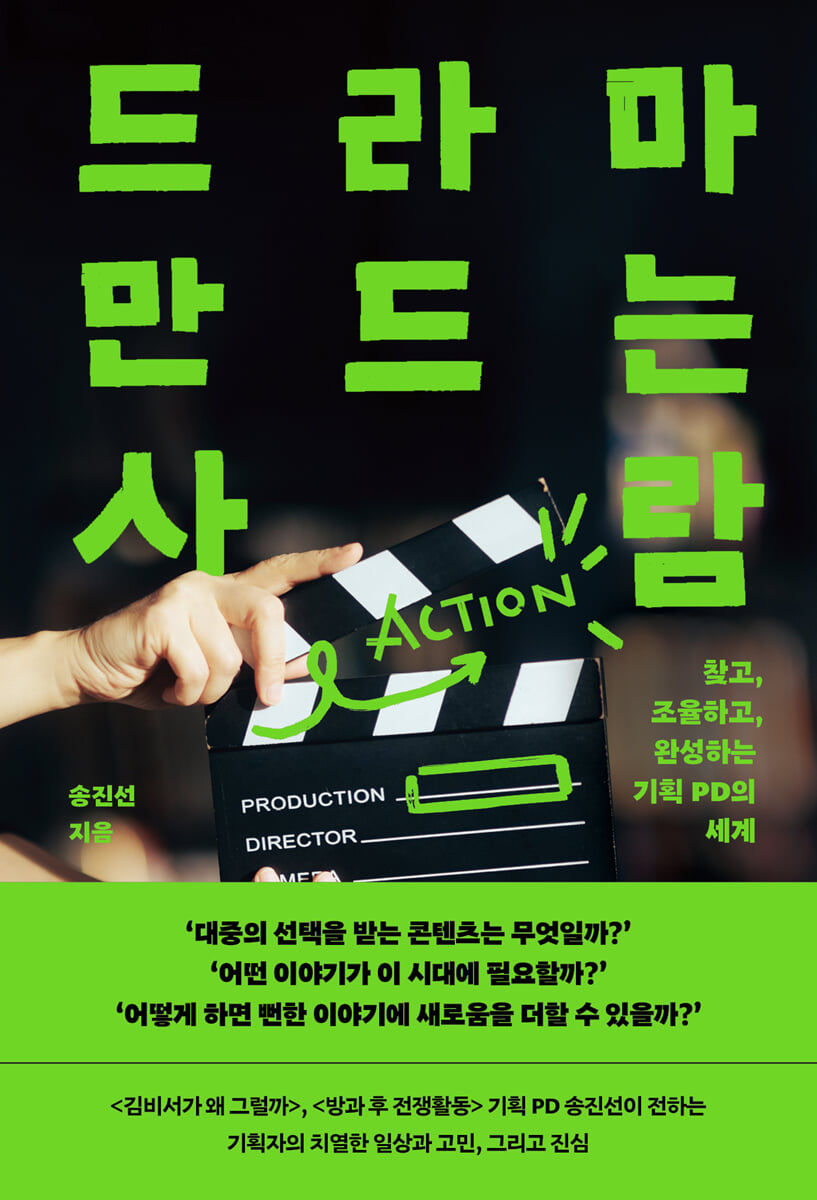
drama maker
 |
Description
Book Introduction
“Behind the life drama that makes us laugh and cry,
“There are people who strive for perfection.”
A person who thinks about what good content is and comes up with an answer.
A person who never forgets to keep a notebook of wrong answers, even if he fails.
The world of planning PDs
The world is crazy about K-content, and writers, directors, and actors are in the spotlight.
But behind every hit there is a real star who still remains unknown.
This is the planning producer (PD) who plans the content.
Those who determine the life or death of a drama are the ones who draw the grand blueprint while not missing a single detail. They are the problem solvers who discover the story, give reality to the writer's imagination, concretize the director's vision, and unite the entire creative team.
Behind the scenes, planning producers who connect platforms, creators, and viewers wrestle with these questions every day.
"What kind of story do the public want now?" "How can we overturn the obvious story?" "How can we expand the worldview?" It's the fate of a planning producer to cling to these unanswerable questions and hang on.
Song Jin-seon, a drama executive producer who established his own production company after working at SBS and Studio Dragon, is a survivor who has personally experienced the upheaval of the industry.
From the days when the job of a planning PD was treated as a shadow until now, he has experienced the joys, sorrows, and bitterness of the job, and through 'The Person Who Makes Dramas', he tells us about the 'job of a planning PD'.
As you can see from the list of his works, which freely cross genre boundaries and expand into the global stage, from romance to sci-fi thriller, such as “What’s Wrong with Secretary Kim,” “True Beauty,” “The Avengers,” “Connect,” “After School War Activities,” and “Whirlwind,” the list contains stories that only a creator who has created content that communicates with the world beyond Korea can tell.
He also gives honest and passionate answers about the capabilities and attitudes that this era demands of planners, and the mindset to rise above failure.
For those who dream of becoming a drama planning PD, it will provide a vivid roadmap, for planners in all fields, it will provide empathy and comfort, and for those who have been curious about this mysterious profession, it will provide a vivid and entertaining look inside.
“There are people who strive for perfection.”
A person who thinks about what good content is and comes up with an answer.
A person who never forgets to keep a notebook of wrong answers, even if he fails.
The world of planning PDs
The world is crazy about K-content, and writers, directors, and actors are in the spotlight.
But behind every hit there is a real star who still remains unknown.
This is the planning producer (PD) who plans the content.
Those who determine the life or death of a drama are the ones who draw the grand blueprint while not missing a single detail. They are the problem solvers who discover the story, give reality to the writer's imagination, concretize the director's vision, and unite the entire creative team.
Behind the scenes, planning producers who connect platforms, creators, and viewers wrestle with these questions every day.
"What kind of story do the public want now?" "How can we overturn the obvious story?" "How can we expand the worldview?" It's the fate of a planning producer to cling to these unanswerable questions and hang on.
Song Jin-seon, a drama executive producer who established his own production company after working at SBS and Studio Dragon, is a survivor who has personally experienced the upheaval of the industry.
From the days when the job of a planning PD was treated as a shadow until now, he has experienced the joys, sorrows, and bitterness of the job, and through 'The Person Who Makes Dramas', he tells us about the 'job of a planning PD'.
As you can see from the list of his works, which freely cross genre boundaries and expand into the global stage, from romance to sci-fi thriller, such as “What’s Wrong with Secretary Kim,” “True Beauty,” “The Avengers,” “Connect,” “After School War Activities,” and “Whirlwind,” the list contains stories that only a creator who has created content that communicates with the world beyond Korea can tell.
He also gives honest and passionate answers about the capabilities and attitudes that this era demands of planners, and the mindset to rise above failure.
For those who dream of becoming a drama planning PD, it will provide a vivid roadmap, for planners in all fields, it will provide empathy and comfort, and for those who have been curious about this mysterious profession, it will provide a vivid and entertaining look inside.
- You can preview some of the book's contents.
Preview
index
prolog
Chapter 1.
storyteller
· What makes good content?
· Under the name of 'planning producer'
· Until it becomes a drama
Chapter 2.
The routine where planning begins
· A person who reads anything
· Seeing as unfamiliar
· When planning starts from one sentence
· Talking with notes
Planning starts with a question
· 'How' to read the layers of people and stories
· Moments when isolation is necessary
Chapter 3.
Things that complete a piece
· What you see and read becomes a reference
· Eyes for reading the script
· Perspectives on selecting original works
· Teamwork through collaboration
· In search of an unfamiliar yet intense sensation
· Between the writer and the director, what should I keep in mind?
· Rational evaluator, sensitive emotional empathizer
Chapter 4.
Attitude towards failure
· The moment when you have a feeling that you're screwed
· When something you've been preparing for a long time doesn't go well
A straightforward producer who can't push things
· A job that requires enduring all kinds of evaluations
Moments of identity confusion
· Between what I and the public want
Chapter 5.
When the planner's world expands
· Opportunity to freely discuss your work
· In front of the world's bookshelves
· Failures and Challenges: Pitching Original Projects
A world of works that transcend language
From developer to IP creation
Chapter 6.
Back to the story
?Creative addiction
A planner's perspective that illuminates blind spots
A colleague who gives you a comfortable space
?The deficiency of this era
Colorful jumper
Epilogue_ A message to my junior producer
Chapter 1.
storyteller
· What makes good content?
· Under the name of 'planning producer'
· Until it becomes a drama
Chapter 2.
The routine where planning begins
· A person who reads anything
· Seeing as unfamiliar
· When planning starts from one sentence
· Talking with notes
Planning starts with a question
· 'How' to read the layers of people and stories
· Moments when isolation is necessary
Chapter 3.
Things that complete a piece
· What you see and read becomes a reference
· Eyes for reading the script
· Perspectives on selecting original works
· Teamwork through collaboration
· In search of an unfamiliar yet intense sensation
· Between the writer and the director, what should I keep in mind?
· Rational evaluator, sensitive emotional empathizer
Chapter 4.
Attitude towards failure
· The moment when you have a feeling that you're screwed
· When something you've been preparing for a long time doesn't go well
A straightforward producer who can't push things
· A job that requires enduring all kinds of evaluations
Moments of identity confusion
· Between what I and the public want
Chapter 5.
When the planner's world expands
· Opportunity to freely discuss your work
· In front of the world's bookshelves
· Failures and Challenges: Pitching Original Projects
A world of works that transcend language
From developer to IP creation
Chapter 6.
Back to the story
?Creative addiction
A planner's perspective that illuminates blind spots
A colleague who gives you a comfortable space
?The deficiency of this era
Colorful jumper
Epilogue_ A message to my junior producer
Detailed image

Into the book
The producer is the one who sees through the essence of the work, designs a balance between marketability and artistry, and takes full responsibility for the outcome of each choice.
--- p.41
I try to find my own answers to the questions, 'Why do I find something interesting when I read or watch it?' and 'Why do others choose this and find it interesting?'
It might seem easy to answer honestly, but it's not.
Sometimes, amidst the majority of opinions and criticism, I can't be honest about what I find interesting.
So, in order to get rid of the hardened gaze caused by prejudice, I need to be honest about my tastes and constantly create food for thought about tastes that are different from mine.
--- p.57
Every act of watching movies and dramas and reading books is actually an act of reading the world.
And the appreciation deepens with the questions that remain at the end of the reading.
--- p.67
Perhaps creation is not about moving toward the right answer, but about enduring questions.
Sometimes I find answers, and sometimes I end up with only questions, but I keep thinking and creating stories until the very end.
Ultimately, isn't a planner someone who can stay longer on questions than on answers?
--- p.74
Planning is always the result of choice.
Who to talk to and what to talk about, what emotions to react to, and what direction to change in ultimately come from the planner's unique perspective.
--- p.102
The important thing is not to create something out of nothing.
Recognizing the 'archetypes' of emotions and stories already embedded in countless contents and adding your own interpretations and questions to them.
The planner chooses to challenge the audience's expectations by giving a familiar plot a new twist or by adding an unexpected twist to a universal emotion.
--- p.104
A writer going through this process needs an assistant called a producer.
A being who looks at you with the same eyes and asks questions when you lose your way.
Just as you can't build a house without a blueprint, you need an objective perspective when writing a story.
Someone who helps balance the flow of emotions when they are not smooth and checks to make sure the story is not lost.
He is like a 'site supervisor' at a construction site.
--- p.111
When you watch a drama, you get emotional, but when you create it, you have to be cool-headed.
The audience sheds tears and gets absorbed, but the producer has to calculate where those tears come from.
A well-written script is not simply "moving words," but a blueprint for the gradual accumulation of emotions over a dense structure.
--- p.145
A creative producer willingly intervenes in someone else's creation without leaving his or her own mark.
This is a person who understands what the creator wants to express, understands the parts he or she was unable to express, and works with the creator to complete the work.
So it's important for producers to know exactly where the roots of their creation lie.
I am the one who prepares the soil and waters the seeds of the story that the creator has put out so that they can grow well.
I know for sure that the beginning is not mine.
--- p.167
I still stand closer to the back of the stage than to the lights.
But I want to be the essential stepping stone for someone's story to begin.
The regret of not receiving attention will eventually disappear only when I stand in a position where I can put my name on the line and compete directly.
This persistent sense of responsibility to create a good story is what keeps me moving forward.
--- p.169
If there's one thing that never wavers in the midst of all that changes, it's the essence of emotion.
Things like the desire to understand someone, longing and loneliness, the inevitably hating someone but wanting to embrace them again.
That's not a trend, that's just how humans are.
Maybe that's why.
Even if it's a story that someone has already told a thousand times, if it's true, it will resonate again.
Even clichés can touch someone's heart again if they contain sincerity.
People believe the story again and again.
--- p.171
Everything we see, hear, and read in the world becomes food for thought.
So even when there is no speech, my head is always noisy.
Once you start reading the work, you will find yourself following the speech, actions, and even the reasons behind the silence of each character.
Because you have to understand not only the emotions that are expressed outwardly, but also where those emotions come from and why you can only express them that way.
If you want to convey it properly through a single line of text or a single line of dialogue, you can't stop thinking about it.
--- p.41
I try to find my own answers to the questions, 'Why do I find something interesting when I read or watch it?' and 'Why do others choose this and find it interesting?'
It might seem easy to answer honestly, but it's not.
Sometimes, amidst the majority of opinions and criticism, I can't be honest about what I find interesting.
So, in order to get rid of the hardened gaze caused by prejudice, I need to be honest about my tastes and constantly create food for thought about tastes that are different from mine.
--- p.57
Every act of watching movies and dramas and reading books is actually an act of reading the world.
And the appreciation deepens with the questions that remain at the end of the reading.
--- p.67
Perhaps creation is not about moving toward the right answer, but about enduring questions.
Sometimes I find answers, and sometimes I end up with only questions, but I keep thinking and creating stories until the very end.
Ultimately, isn't a planner someone who can stay longer on questions than on answers?
--- p.74
Planning is always the result of choice.
Who to talk to and what to talk about, what emotions to react to, and what direction to change in ultimately come from the planner's unique perspective.
--- p.102
The important thing is not to create something out of nothing.
Recognizing the 'archetypes' of emotions and stories already embedded in countless contents and adding your own interpretations and questions to them.
The planner chooses to challenge the audience's expectations by giving a familiar plot a new twist or by adding an unexpected twist to a universal emotion.
--- p.104
A writer going through this process needs an assistant called a producer.
A being who looks at you with the same eyes and asks questions when you lose your way.
Just as you can't build a house without a blueprint, you need an objective perspective when writing a story.
Someone who helps balance the flow of emotions when they are not smooth and checks to make sure the story is not lost.
He is like a 'site supervisor' at a construction site.
--- p.111
When you watch a drama, you get emotional, but when you create it, you have to be cool-headed.
The audience sheds tears and gets absorbed, but the producer has to calculate where those tears come from.
A well-written script is not simply "moving words," but a blueprint for the gradual accumulation of emotions over a dense structure.
--- p.145
A creative producer willingly intervenes in someone else's creation without leaving his or her own mark.
This is a person who understands what the creator wants to express, understands the parts he or she was unable to express, and works with the creator to complete the work.
So it's important for producers to know exactly where the roots of their creation lie.
I am the one who prepares the soil and waters the seeds of the story that the creator has put out so that they can grow well.
I know for sure that the beginning is not mine.
--- p.167
I still stand closer to the back of the stage than to the lights.
But I want to be the essential stepping stone for someone's story to begin.
The regret of not receiving attention will eventually disappear only when I stand in a position where I can put my name on the line and compete directly.
This persistent sense of responsibility to create a good story is what keeps me moving forward.
--- p.169
If there's one thing that never wavers in the midst of all that changes, it's the essence of emotion.
Things like the desire to understand someone, longing and loneliness, the inevitably hating someone but wanting to embrace them again.
That's not a trend, that's just how humans are.
Maybe that's why.
Even if it's a story that someone has already told a thousand times, if it's true, it will resonate again.
Even clichés can touch someone's heart again if they contain sincerity.
People believe the story again and again.
--- p.171
Everything we see, hear, and read in the world becomes food for thought.
So even when there is no speech, my head is always noisy.
Once you start reading the work, you will find yourself following the speech, actions, and even the reasons behind the silence of each character.
Because you have to understand not only the emotions that are expressed outwardly, but also where those emotions come from and why you can only express them that way.
If you want to convey it properly through a single line of text or a single line of dialogue, you can't stop thinking about it.
--- p.200
Publisher's Review
A person who lives as a 'drama planner'
A very personal, yet universal story of karma
“Do you like dramas?” It’s not easy to answer this question with a definitive “no.”
Although tastes in genres may differ, everyone is drawn to 'stories', and dramas, the core of K-content, have been a fixture in our living rooms for a long time.
So, what process goes into creating the dramas that entertain us? Behind the screens we watch are people who love dramas more than anyone else.
"The Drama Maker" is the story of a planning producer whose head is full of dramas.
It wasn't long ago that the title 'planning producer' was recognized as an independent role.
But the person who maintains balance in the midst of numerous staff members, actors, and complex relationships of interest is the planning producer.
When planning, he displays his creative side, acts as an assistant to the writer, acts as a coordinator among various staff members, and works tirelessly behind the scenes as a person in charge who cannot let his guard down until the work is released.
This book contains the intense and realistic 'planning scene'.
It honestly explains how drama planning begins, how the eye for reading and interpreting content is developed, and what skills are needed to lead the entire process.
Song Jin-seon, the author of this book and a 'creative producer' who worked at SBS and Studio Dragon before starting his own production company, is seen by others as an 'unique' person.
When people talk about 'work-life balance,' he still thinks about the next scene in his work.
He has built his career by not being afraid to collaborate with foreign directors and staff, and by willingly challenging himself in ways no one has tried before.
But as I follow his struggles and worries, it never sounds like the story of someone unrelated to me.
It will be read as a story of all of us who live while simultaneously taking on multiple roles, struggling and striving to do our best in our respective positions.
The work of a planner who builds a bigger world from the fallen place
For someone who creates a drama, the moment of revealing their work is always scary.
The moment the result of a long period of dedication is revealed to the world, anticipation and anxiety come at the same time.
It would be nice if things were always well-received, but that's not always the case in business.
Especially in jobs that are evaluated by the public, ‘failure’ is more painful.
When a work you pushed forward with ambition fails to do well at the box office, it seems like it's due to a lack of discernment. When something you wanted to hide is eventually exposed to others, and when a hurtful comment lingers in your mind... you feel like it's all your fault.
Moreover, making a drama is a risky business, so there are many moments that cannot be laughed off.
The author's filmography includes works that ended with great fanfare amidst public interest, but others that disappeared without even receiving attention.
But he doesn't turn away from failure.
Acknowledge your shortcomings, reflect on what caused them, and consider whether there was anything you could have done to address them in advance.
Even in things that others would dismiss as failures, you must always find meaning and make that experience valuable.
The author diligently kept a notebook of error answers and gradually expanded his scope in the process.
From a humble planning producer to a challenging producer who leads global collaborations, and now a producer who mentors around the world, he's reaching places others haven't.
It's not just about making dramas.
Everyone who plans something and puts it out into the world lives with similar fears.
When faced with an unwanted outcome, your attitude toward that moment makes all the difference.
Through his own anecdotes, the author personally demonstrates that failure is not the 'end' but 'the entrance to a broader world.'
His attitude of moving beyond failure and into a bigger world offers strong encouragement to many who endure today.
A very personal, yet universal story of karma
“Do you like dramas?” It’s not easy to answer this question with a definitive “no.”
Although tastes in genres may differ, everyone is drawn to 'stories', and dramas, the core of K-content, have been a fixture in our living rooms for a long time.
So, what process goes into creating the dramas that entertain us? Behind the screens we watch are people who love dramas more than anyone else.
"The Drama Maker" is the story of a planning producer whose head is full of dramas.
It wasn't long ago that the title 'planning producer' was recognized as an independent role.
But the person who maintains balance in the midst of numerous staff members, actors, and complex relationships of interest is the planning producer.
When planning, he displays his creative side, acts as an assistant to the writer, acts as a coordinator among various staff members, and works tirelessly behind the scenes as a person in charge who cannot let his guard down until the work is released.
This book contains the intense and realistic 'planning scene'.
It honestly explains how drama planning begins, how the eye for reading and interpreting content is developed, and what skills are needed to lead the entire process.
Song Jin-seon, the author of this book and a 'creative producer' who worked at SBS and Studio Dragon before starting his own production company, is seen by others as an 'unique' person.
When people talk about 'work-life balance,' he still thinks about the next scene in his work.
He has built his career by not being afraid to collaborate with foreign directors and staff, and by willingly challenging himself in ways no one has tried before.
But as I follow his struggles and worries, it never sounds like the story of someone unrelated to me.
It will be read as a story of all of us who live while simultaneously taking on multiple roles, struggling and striving to do our best in our respective positions.
The work of a planner who builds a bigger world from the fallen place
For someone who creates a drama, the moment of revealing their work is always scary.
The moment the result of a long period of dedication is revealed to the world, anticipation and anxiety come at the same time.
It would be nice if things were always well-received, but that's not always the case in business.
Especially in jobs that are evaluated by the public, ‘failure’ is more painful.
When a work you pushed forward with ambition fails to do well at the box office, it seems like it's due to a lack of discernment. When something you wanted to hide is eventually exposed to others, and when a hurtful comment lingers in your mind... you feel like it's all your fault.
Moreover, making a drama is a risky business, so there are many moments that cannot be laughed off.
The author's filmography includes works that ended with great fanfare amidst public interest, but others that disappeared without even receiving attention.
But he doesn't turn away from failure.
Acknowledge your shortcomings, reflect on what caused them, and consider whether there was anything you could have done to address them in advance.
Even in things that others would dismiss as failures, you must always find meaning and make that experience valuable.
The author diligently kept a notebook of error answers and gradually expanded his scope in the process.
From a humble planning producer to a challenging producer who leads global collaborations, and now a producer who mentors around the world, he's reaching places others haven't.
It's not just about making dramas.
Everyone who plans something and puts it out into the world lives with similar fears.
When faced with an unwanted outcome, your attitude toward that moment makes all the difference.
Through his own anecdotes, the author personally demonstrates that failure is not the 'end' but 'the entrance to a broader world.'
His attitude of moving beyond failure and into a bigger world offers strong encouragement to many who endure today.
GOODS SPECIFICS
- Date of issue: October 30, 2025
- Page count, weight, size: 224 pages | 288g | 128*188*15mm
- ISBN13: 9788925572970
- ISBN10: 8925572974
You may also like
카테고리
korean


korean

![GQ KOREA Mark (Monthly): December [2025]](http://librairie.coreenne.fr/cdn/shop/files/8ef265dbbfbf186523ed75ba7319009d.jpg?v=1765340328&width=3840)


