

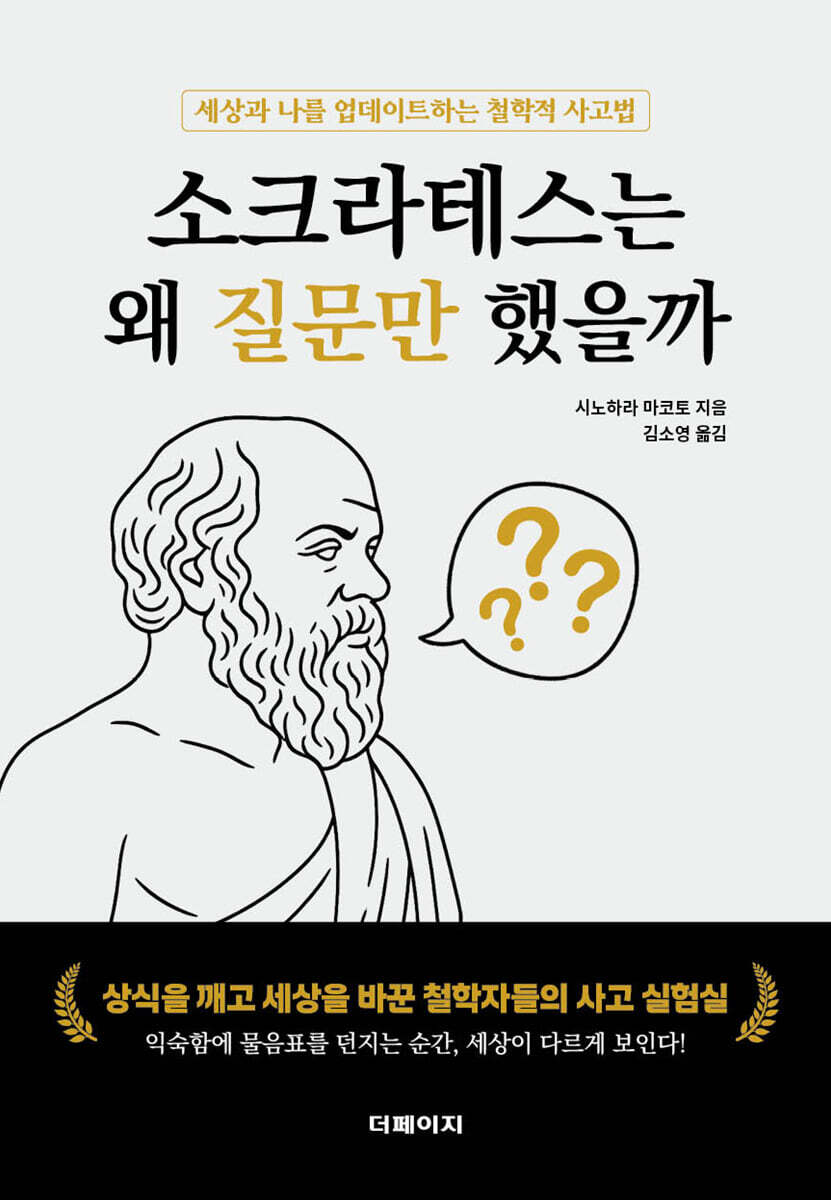
Why did Socrates only ask questions?
 |
Description
Book Introduction
An introductory book to philosophy that provides a glimpse into the history of thought.
Philosophy is always,
It was a matter of rewriting the world.
We are currently living in the most rapidly changing era in human history.
Technology evolves every day, yesterday's common sense becomes today's stereotypes, and yesterday's right answer often becomes today's wrong answer.
What do we truly need in these times? Perhaps it's learning how the great thinkers of the past shattered the conventions of their time and created a new order.
To understand the present and prepare for the future, we must listen to the questions we asked in the past: "Why?"
"Why did Socrates only ask questions?" also starts with a question.
Rather than simply listing the history of philosophy chronologically, it follows the questions, “How did philosophers pierce through stereotypes and present new ideas?” and “How did thinkers deconstruct and reconstruct the existing world?”
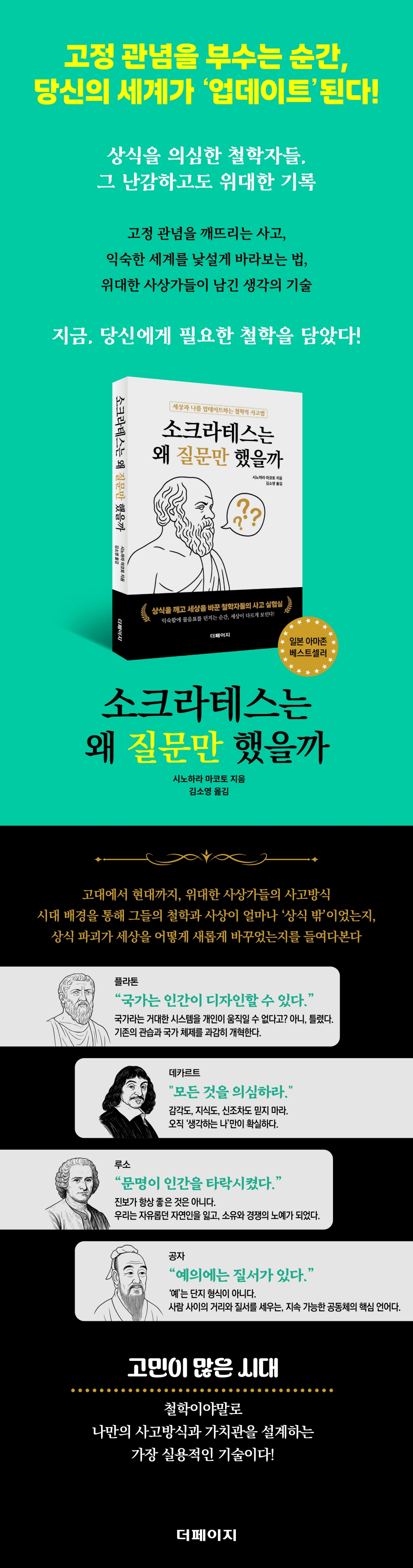
Socrates overturned the concept of knowledge of his time with his paradoxical declaration that he was "the only one who recognized his own ignorance," and Plato made us imagine a utopia with the idea that individuals could design the "state," a system that was then thought to be simply given as fate.
Descartes started modern philosophy by doubting everything, and Rousseau argued that humans had not progressed through civilization, but rather had degenerated.
And Marx changed the course of modern history with his revolutionary idea that workers could rule the country.
This book can be read without difficulty even by people who have never encountered philosophy before.
It explains the background of the common sense that people were bound to at the time through the times, and tells how the philosophers' ideas that broke common sense updated the world.
Thanks to this, it reads like a travelogue rather than a boring or difficult history of philosophy.
Readers unknowingly encounter Socrates in ancient Athens, see the world through the eyes of Marx in the midst of the European revolution, and then travel to Zhuangzi in China's Spring and Autumn Period and Warring States Period to embark on a journey that questions the boundaries of existence.
The world is always changing.
However, the people who led that change were those who broke the common sense of the time and thought differently.
And the power to change the way we think comes from philosophy.
If you want to change the world, first of all, question and doubt your common sense.
And think again.
That's the philosophy we need now.
Philosophy is always,
It was a matter of rewriting the world.
We are currently living in the most rapidly changing era in human history.
Technology evolves every day, yesterday's common sense becomes today's stereotypes, and yesterday's right answer often becomes today's wrong answer.
What do we truly need in these times? Perhaps it's learning how the great thinkers of the past shattered the conventions of their time and created a new order.
To understand the present and prepare for the future, we must listen to the questions we asked in the past: "Why?"
"Why did Socrates only ask questions?" also starts with a question.
Rather than simply listing the history of philosophy chronologically, it follows the questions, “How did philosophers pierce through stereotypes and present new ideas?” and “How did thinkers deconstruct and reconstruct the existing world?”
Socrates overturned the concept of knowledge of his time with his paradoxical declaration that he was "the only one who recognized his own ignorance," and Plato made us imagine a utopia with the idea that individuals could design the "state," a system that was then thought to be simply given as fate.
Descartes started modern philosophy by doubting everything, and Rousseau argued that humans had not progressed through civilization, but rather had degenerated.
And Marx changed the course of modern history with his revolutionary idea that workers could rule the country.
This book can be read without difficulty even by people who have never encountered philosophy before.
It explains the background of the common sense that people were bound to at the time through the times, and tells how the philosophers' ideas that broke common sense updated the world.
Thanks to this, it reads like a travelogue rather than a boring or difficult history of philosophy.
Readers unknowingly encounter Socrates in ancient Athens, see the world through the eyes of Marx in the midst of the European revolution, and then travel to Zhuangzi in China's Spring and Autumn Period and Warring States Period to embark on a journey that questions the boundaries of existence.
The world is always changing.
However, the people who led that change were those who broke the common sense of the time and thought differently.
And the power to change the way we think comes from philosophy.
If you want to change the world, first of all, question and doubt your common sense.
And think again.
That's the philosophy we need now.
- You can preview some of the book's contents.
Preview
index
prolog
PART 1.
Western Philosophy and Thought - People Who Break with Past Common Sense and Create New Common Sense
Chap 1.
Ancient philosophy and thought
Making knowledge accessible to the common people · Socrates
Designing a State by Human Hands · Plato
Aristotle popularized the observational approach.
Chap 2.
Medieval philosophy and thought
Big Bang Cosmology: Where Did It Begin? · St. Augustine
The Christian era · Middle Ages
Black Ships and Crusaders who went on an external attack
Attempting to Save Christianity · Thomas Aquinas
Chap 3.
Philosophy and Thought of the Renaissance
Two revolutions brought about by the Crusades: the Renaissance and the Reformation
Boccaccio: The Obscene Book That Changed World History
Turning Humanity into a Supporting Role · Copernicus, Galileo, and Kepler
Montaigne, a model of common sense destruction
The more you doubt, the more you fall into faith · Descartes
Chap 4.
Modern philosophy and thought
The universe is governed by law · Newton
Rousseau, the genius who gave birth to democracy
People who established a rational-centered philosophical worldview: Kant and Hegel
Emphasize observation, experimentation, and experience · British philosophy and thought
The Birth of Economics · Adam Smith
Chap 5.
Philosophy and Thought after the Industrial Revolution
The prevalence of the law of the jungle · Darwin
For Workers to Live Happily · Robert Owen
A worldview where the people become king · Marx
A Proposal for a Superman to Replace God · Nietzsche
The small boat of reason, the unconscious that exists beneath it, Freud, Jung
Chap 6.
Modern philosophy and thought
Doubts about rationalism and the rise of Nazism
Neither communism nor liberalism, but modified capitalism · Keynes
Questioning the Goodness of Science and the Sense of Wonder by Rachel Carson
Science must reveal its own weaknesses · Karl Popper
Think of relationships before you see existence · Kenneth Gergen
PART 2.
Eastern Philosophy and Thought - Thoughts that Repeat Reinterpret
Chap 7.
Chinese philosophy and thought
How Much Wisdom Can Be Measured? - Chinese Classics
Confucius, the man who made me realize the power of courtesy
The Strength of Paradoxical Thinking · Lao-tzu and Zhuang-tzu
A man who showed off the power of the law · Han Feizi
Drawing Humanity Through History · Sima Qian
Practice over theory · Yangmingism
Finally - to revolutionize modern common sense
The world that philosophers destroyed, and we will redesign it.
To you who will create new common sense
Epilogue
PART 1.
Western Philosophy and Thought - People Who Break with Past Common Sense and Create New Common Sense
Chap 1.
Ancient philosophy and thought
Making knowledge accessible to the common people · Socrates
Designing a State by Human Hands · Plato
Aristotle popularized the observational approach.
Chap 2.
Medieval philosophy and thought
Big Bang Cosmology: Where Did It Begin? · St. Augustine
The Christian era · Middle Ages
Black Ships and Crusaders who went on an external attack
Attempting to Save Christianity · Thomas Aquinas
Chap 3.
Philosophy and Thought of the Renaissance
Two revolutions brought about by the Crusades: the Renaissance and the Reformation
Boccaccio: The Obscene Book That Changed World History
Turning Humanity into a Supporting Role · Copernicus, Galileo, and Kepler
Montaigne, a model of common sense destruction
The more you doubt, the more you fall into faith · Descartes
Chap 4.
Modern philosophy and thought
The universe is governed by law · Newton
Rousseau, the genius who gave birth to democracy
People who established a rational-centered philosophical worldview: Kant and Hegel
Emphasize observation, experimentation, and experience · British philosophy and thought
The Birth of Economics · Adam Smith
Chap 5.
Philosophy and Thought after the Industrial Revolution
The prevalence of the law of the jungle · Darwin
For Workers to Live Happily · Robert Owen
A worldview where the people become king · Marx
A Proposal for a Superman to Replace God · Nietzsche
The small boat of reason, the unconscious that exists beneath it, Freud, Jung
Chap 6.
Modern philosophy and thought
Doubts about rationalism and the rise of Nazism
Neither communism nor liberalism, but modified capitalism · Keynes
Questioning the Goodness of Science and the Sense of Wonder by Rachel Carson
Science must reveal its own weaknesses · Karl Popper
Think of relationships before you see existence · Kenneth Gergen
PART 2.
Eastern Philosophy and Thought - Thoughts that Repeat Reinterpret
Chap 7.
Chinese philosophy and thought
How Much Wisdom Can Be Measured? - Chinese Classics
Confucius, the man who made me realize the power of courtesy
The Strength of Paradoxical Thinking · Lao-tzu and Zhuang-tzu
A man who showed off the power of the law · Han Feizi
Drawing Humanity Through History · Sima Qian
Practice over theory · Yangmingism
Finally - to revolutionize modern common sense
The world that philosophers destroyed, and we will redesign it.
To you who will create new common sense
Epilogue
Detailed image
Into the book
** When Socrates asks, “What does that mean?” the young people think for a while and then give an answer.
Then the question follows: “What happens if we connect that with this?”
Through this process of repeated questions and answers, young people begin to express thoughts they were not aware of.
Then I think, 'Did I even know how to think like this?'
** The Crusades were the Black Ships of Western Europe, and the Renaissance was the Meiji Restoration that followed.
Those who went on the Crusades were excited about the image of Christianity they had dreamed of.
While shouting, 'We will reclaim Jerusalem, the Holy Land, from the pagans.'
But for the locals, it was an unbearable nightmare.
It is said that the palace in Jerusalem was soaked in blood up to its ankles due to the massacre of local people by the Crusaders.
They did not consider pagans as human beings.
** Thomas Aquinas attempted to resolve the contradiction between Aristotle and Christianity and save Christianity by reinterpreting Christianity through Aristotle's philosophy.
Thomas Aquinas's Summa Theologica achieved some success, and Aristotle's philosophy came to be seen as complementing rather than opposing Christianity.
** Montaigne's Essays are full of stories that defy common sense.
A Western European had an audience with a king from another country, and when the king blew his nose with his hand, the Western European grimaced as if it were dirty.
When the king asked, “How do you blow your nose?” the Western European replied, “We blow our noses with a silk handkerchief, which is elegant.”
The king is said to have replied, “You are strangers, using a luxurious silk handkerchief for something like a runny nose.”
** However, if we only ask about the premise, there is no need to doubt everything.
If we leave the existing premise as is, we are led to believe that the same results as in the textbook will inevitably come out.
But if you change the premise, the result may also change.
If you want to create new knowledge, it's enough to replace everything with a premise that has never been tested before, rather than denying everything.
** Smith's suggestion at the time that 'the government should refrain from unnecessary interference' was certainly novel.
But unfortunately, that phrase, which appears only once in his book, gave birth to liberalism and neoliberalism, leading to a way of thinking that justifies or ignores the gap between rich and poor.
And later Marxism emerged as a form of criticism of it.
Smith's economics became the 'mother' of all economics.
** There is another important concept in Nietzsche's thought.
It is ‘eternal return.’
He saw the world as repeating itself endlessly.
The reality of endless repetition of boring and dull tasks was expressed with the phrase 'eternal return'.
This idea seems to have originated from Newton's mechanical worldview.
Since Newton discovered the law of universal gravitation, people have believed that all objects in the universe move according to certain laws, and that those laws will still be valid a hundred or ten thousand years from now.
** Carson's suggestion that teaching isn't important came as quite a shock to many parents and educators.
This is because education has long focused only on ‘teaching.’
This proposal also has some similarities with Jean-Jacques Rousseau's Emile.
But Carson's approach is even more refreshing because he puts it clearly: "Teaching is not important."
** It was very interesting that the 『Laozi』 made a very unique suggestion called the ‘design of emptiness.’
For example, if you give commands to water like "roll over" or "move around," it won't listen, and if you hit or kick it, it will just scatter.
However, if we prepare a 'void' such as a round or square bowl, the water will spontaneously become round or angular to fill the void.
** Han Fei was a person who thoroughly analyzed people and precisely demonstrated the power of law.
But if we make it too detailed, people will end up suffocating within the law.
The Qin Dynasty perished because its laws were too strict, while the Han Dynasty prospered because its laws were lenient.
In that sense, although 『Han Feizi』 emphasized the power of law, it could be said that its perspective on ‘how to secure freedom within the law’ was somewhat lacking.
Then the question follows: “What happens if we connect that with this?”
Through this process of repeated questions and answers, young people begin to express thoughts they were not aware of.
Then I think, 'Did I even know how to think like this?'
** The Crusades were the Black Ships of Western Europe, and the Renaissance was the Meiji Restoration that followed.
Those who went on the Crusades were excited about the image of Christianity they had dreamed of.
While shouting, 'We will reclaim Jerusalem, the Holy Land, from the pagans.'
But for the locals, it was an unbearable nightmare.
It is said that the palace in Jerusalem was soaked in blood up to its ankles due to the massacre of local people by the Crusaders.
They did not consider pagans as human beings.
** Thomas Aquinas attempted to resolve the contradiction between Aristotle and Christianity and save Christianity by reinterpreting Christianity through Aristotle's philosophy.
Thomas Aquinas's Summa Theologica achieved some success, and Aristotle's philosophy came to be seen as complementing rather than opposing Christianity.
** Montaigne's Essays are full of stories that defy common sense.
A Western European had an audience with a king from another country, and when the king blew his nose with his hand, the Western European grimaced as if it were dirty.
When the king asked, “How do you blow your nose?” the Western European replied, “We blow our noses with a silk handkerchief, which is elegant.”
The king is said to have replied, “You are strangers, using a luxurious silk handkerchief for something like a runny nose.”
** However, if we only ask about the premise, there is no need to doubt everything.
If we leave the existing premise as is, we are led to believe that the same results as in the textbook will inevitably come out.
But if you change the premise, the result may also change.
If you want to create new knowledge, it's enough to replace everything with a premise that has never been tested before, rather than denying everything.
** Smith's suggestion at the time that 'the government should refrain from unnecessary interference' was certainly novel.
But unfortunately, that phrase, which appears only once in his book, gave birth to liberalism and neoliberalism, leading to a way of thinking that justifies or ignores the gap between rich and poor.
And later Marxism emerged as a form of criticism of it.
Smith's economics became the 'mother' of all economics.
** There is another important concept in Nietzsche's thought.
It is ‘eternal return.’
He saw the world as repeating itself endlessly.
The reality of endless repetition of boring and dull tasks was expressed with the phrase 'eternal return'.
This idea seems to have originated from Newton's mechanical worldview.
Since Newton discovered the law of universal gravitation, people have believed that all objects in the universe move according to certain laws, and that those laws will still be valid a hundred or ten thousand years from now.
** Carson's suggestion that teaching isn't important came as quite a shock to many parents and educators.
This is because education has long focused only on ‘teaching.’
This proposal also has some similarities with Jean-Jacques Rousseau's Emile.
But Carson's approach is even more refreshing because he puts it clearly: "Teaching is not important."
** It was very interesting that the 『Laozi』 made a very unique suggestion called the ‘design of emptiness.’
For example, if you give commands to water like "roll over" or "move around," it won't listen, and if you hit or kick it, it will just scatter.
However, if we prepare a 'void' such as a round or square bowl, the water will spontaneously become round or angular to fill the void.
** Han Fei was a person who thoroughly analyzed people and precisely demonstrated the power of law.
But if we make it too detailed, people will end up suffocating within the law.
The Qin Dynasty perished because its laws were too strict, while the Han Dynasty prospered because its laws were lenient.
In that sense, although 『Han Feizi』 emphasized the power of law, it could be said that its perspective on ‘how to secure freedom within the law’ was somewhat lacking.
--- From the text
Publisher's Review
“The moment you start questioning the obvious, philosophy begins.
And the world changed.”
The moment you break stereotypes,
Your world is 'updated'
We live in an era where everyone uses artificial intelligence.
Machines already analyze data faster than people, make more accurate diagnoses, and even write more fluently.
What matters now is not what you 'know', but what you 'ask'.
The ability to be skeptical of the information given and to look at what has been considered correct in a new light has become important.
This is why the statement that philosophy is necessary in an age like today does not sound empty.
We must relearn the art of thinking, that is, the power of questioning and questioning common sense.
Learning philosophy or ideology is ultimately about learning how to break stereotypes.
There are countless stereotypes around us, but it's often difficult to even recognize that they are stereotypes.
Because stereotypes are usually what most people of that era believe is 'normal'.
This book, "Why Did Socrates Just Ask Questions?", introduces philosophers and thinkers from ancient times to the present, from both the West and the East, who changed the world by breaking common sense, presenting new standards of thinking.
People who changed the world were the first to question the obvious.
You will learn the skills of thinking beyond stereotypes from the way philosophers and thinkers think.
The power of philosophy to change the way we think
The "Common Sense-Breaking" Stories of Philosophers
In an era when church power was absolute, Boccaccio published a book about the debauched lives of corrupt monks, giving the intellectuals of the time the courage to criticize monks. This gradually spread, becoming the fuse for the Renaissance movement and liberating people from religious oppression.
Before Socrates, it was believed that only those born with genius could possess knowledge, and that whether or not one would become an intellectual was determined by fate.
Socrates, who rebelled against this common sense, established a method for anyone to think deeply, even if they were not a genius, through the question-and-answer method called 'midwifery'.
It's like changing history.
This radical imagination takes another leap forward in modern times with Descartes.
Descartes started from a place of thorough doubt.
In his search for the 'one indubitable truth', he even doubted his own senses and the existence of God.
So the first sentence he arrived at was “I think, therefore I am.”
Descartes' philosophy placed human beings as thinking subjects at the center of philosophy, and later became the foundation of Western modern rationalism.
What he dismantled was not just the theological worldview, but everything humans 'believed'.
In a completely opposite way, but equally shockingly, Rousseau shook the world.
He criticized the very civilization we believed to be progressive.
Rousseau believed that as civilization developed, humans became more unhappy and corrupt.
He believes that humans in the natural state of being free and equal have become oppressed through the systems of society, property, and education.
This was not a simple romantic return, but a fundamental rethinking of human nature and social structure.
The question, 'Are we better off because of civilization?' remains an ongoing one.
Marx goes one step further.
He questioned the very structure of modern capitalism and argued that the working class should become the masters of the world.
Labor was traditionally thought to ennoble humans, but Marx saw it as a sacrifice for capital and the source of human alienation.
Labor does not liberate man, but rather oppresses him by the products and systems he has created.
Ultimately, he argued that workers must wake up and become the main players in society.
It was not simply an economic theory, but a colossal refutation of the condition of human existence.
Meanwhile, in the East, Confucius shakes up stereotypes from a completely different direction.
Confucius believed that humans live in communities and build relationships through courtesy.
For him, 'yes' was not just a formality.
It was a way of distance, order, respect and harmony between people.
The more chaotic and uncertain the times, the more he emphasized the value of 'yes'.
Confucius believed that human morality and social stability were possible through cultural sensitivity called 'rites' rather than through coercion or law.
In today's era of weakening norms, Confucius's example comes not as a formal constraint, but as another force that sustains the community.
The subversive thinking of philosophers who changed human history
How did they come up with such out-of-the-box ideas?
Philosophers have always started their thinking by breaking the common sense of their time.
First and foremost, they questioned the 'obvious'.
And I tried to think for myself.
This book poses the same question to its readers.
“Is what I now take for granted truly true?”, “Can I look at the world again through my own standards?” Philosophy begins with those very questions.
And we can naturally learn how to ask that question by following in the footsteps of thinkers from ancient times to the present.
Rather than interpreting ideas academically, I hope that we will treat them as tools for life, and that we will view philosophy not as something unfamiliar and boring, but as a guide that allows us to re-examine reality.
What do you take for granted right now? I encourage you to question that "obviousness" and create a "new common sense."
And the world changed.”
The moment you break stereotypes,
Your world is 'updated'
We live in an era where everyone uses artificial intelligence.
Machines already analyze data faster than people, make more accurate diagnoses, and even write more fluently.
What matters now is not what you 'know', but what you 'ask'.
The ability to be skeptical of the information given and to look at what has been considered correct in a new light has become important.
This is why the statement that philosophy is necessary in an age like today does not sound empty.
We must relearn the art of thinking, that is, the power of questioning and questioning common sense.
Learning philosophy or ideology is ultimately about learning how to break stereotypes.
There are countless stereotypes around us, but it's often difficult to even recognize that they are stereotypes.
Because stereotypes are usually what most people of that era believe is 'normal'.
This book, "Why Did Socrates Just Ask Questions?", introduces philosophers and thinkers from ancient times to the present, from both the West and the East, who changed the world by breaking common sense, presenting new standards of thinking.
People who changed the world were the first to question the obvious.
You will learn the skills of thinking beyond stereotypes from the way philosophers and thinkers think.
The power of philosophy to change the way we think
The "Common Sense-Breaking" Stories of Philosophers
In an era when church power was absolute, Boccaccio published a book about the debauched lives of corrupt monks, giving the intellectuals of the time the courage to criticize monks. This gradually spread, becoming the fuse for the Renaissance movement and liberating people from religious oppression.
Before Socrates, it was believed that only those born with genius could possess knowledge, and that whether or not one would become an intellectual was determined by fate.
Socrates, who rebelled against this common sense, established a method for anyone to think deeply, even if they were not a genius, through the question-and-answer method called 'midwifery'.
It's like changing history.
This radical imagination takes another leap forward in modern times with Descartes.
Descartes started from a place of thorough doubt.
In his search for the 'one indubitable truth', he even doubted his own senses and the existence of God.
So the first sentence he arrived at was “I think, therefore I am.”
Descartes' philosophy placed human beings as thinking subjects at the center of philosophy, and later became the foundation of Western modern rationalism.
What he dismantled was not just the theological worldview, but everything humans 'believed'.
In a completely opposite way, but equally shockingly, Rousseau shook the world.
He criticized the very civilization we believed to be progressive.
Rousseau believed that as civilization developed, humans became more unhappy and corrupt.
He believes that humans in the natural state of being free and equal have become oppressed through the systems of society, property, and education.
This was not a simple romantic return, but a fundamental rethinking of human nature and social structure.
The question, 'Are we better off because of civilization?' remains an ongoing one.
Marx goes one step further.
He questioned the very structure of modern capitalism and argued that the working class should become the masters of the world.
Labor was traditionally thought to ennoble humans, but Marx saw it as a sacrifice for capital and the source of human alienation.
Labor does not liberate man, but rather oppresses him by the products and systems he has created.
Ultimately, he argued that workers must wake up and become the main players in society.
It was not simply an economic theory, but a colossal refutation of the condition of human existence.
Meanwhile, in the East, Confucius shakes up stereotypes from a completely different direction.
Confucius believed that humans live in communities and build relationships through courtesy.
For him, 'yes' was not just a formality.
It was a way of distance, order, respect and harmony between people.
The more chaotic and uncertain the times, the more he emphasized the value of 'yes'.
Confucius believed that human morality and social stability were possible through cultural sensitivity called 'rites' rather than through coercion or law.
In today's era of weakening norms, Confucius's example comes not as a formal constraint, but as another force that sustains the community.
The subversive thinking of philosophers who changed human history
How did they come up with such out-of-the-box ideas?
Philosophers have always started their thinking by breaking the common sense of their time.
First and foremost, they questioned the 'obvious'.
And I tried to think for myself.
This book poses the same question to its readers.
“Is what I now take for granted truly true?”, “Can I look at the world again through my own standards?” Philosophy begins with those very questions.
And we can naturally learn how to ask that question by following in the footsteps of thinkers from ancient times to the present.
Rather than interpreting ideas academically, I hope that we will treat them as tools for life, and that we will view philosophy not as something unfamiliar and boring, but as a guide that allows us to re-examine reality.
What do you take for granted right now? I encourage you to question that "obviousness" and create a "new common sense."
GOODS SPECIFICS
- Date of issue: August 10, 2025
- Page count, weight, size: 208 pages | 147*212*20mm
- ISBN13: 9791194156246
- ISBN10: 119415624X
You may also like
카테고리
korean


korean

![GQ KOREA Mark (Monthly): December [2025]](http://librairie.coreenne.fr/cdn/shop/files/8ef265dbbfbf186523ed75ba7319009d.jpg?v=1765340328&width=3840)


