

Report writing and reporting skills
 |
Description
Book Introduction
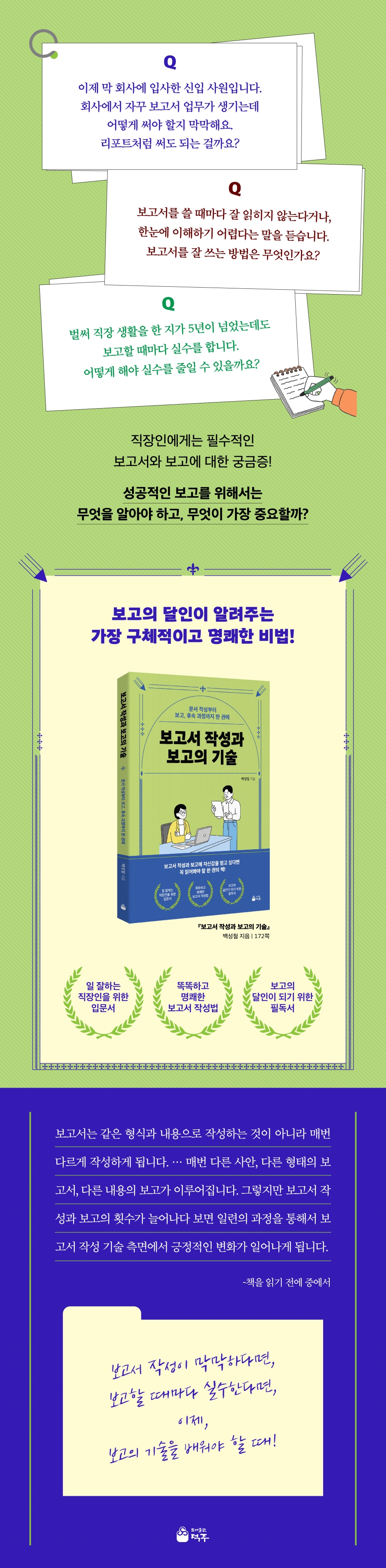
As told by the master of reporting,
The secret to successful report writing and the art of reporting!
So, what should a report focus on? Is it enough to be long and verbose, with lots of content? Is it enough to be visually appealing and show off a design sense? Is it enough to add statistics and graphs to make it look fancy? As anyone who's ever written a report knows, the process isn't that simple.
By carefully understanding the direction and steps of the report, including the reason for writing the report, the recipient, what must be included in the report, and the desired results, you can create a report that is easy for anyone to understand and that they want to read.
Being good at reporting won't instantly transform your work life, but we know from experience that effective people make a difference in their reporting. Let's explore the process required to create a well-written report through the report writing and reporting techniques honed by the author, who has worked at KBS for many years, through countless reports.
The secret to successful report writing and the art of reporting!
So, what should a report focus on? Is it enough to be long and verbose, with lots of content? Is it enough to be visually appealing and show off a design sense? Is it enough to add statistics and graphs to make it look fancy? As anyone who's ever written a report knows, the process isn't that simple.
By carefully understanding the direction and steps of the report, including the reason for writing the report, the recipient, what must be included in the report, and the desired results, you can create a report that is easy for anyone to understand and that they want to read.
Being good at reporting won't instantly transform your work life, but we know from experience that effective people make a difference in their reporting. Let's explore the process required to create a well-written report through the report writing and reporting techniques honed by the author, who has worked at KBS for many years, through countless reports.
- You can preview some of the book's contents.
Preview
index
While publishing the book
Before reading the book
Chapter 1 Understanding the Report
Concept and Understanding of Reports
The ability to report well is a skill and an advantage.
Reporting is the process of confirming the reporter's judgment.
Prompt reporting before receiving instructions is meaningful and valuable.
Portrait of the wind, the results according to the report are the responsibility of the final reporter.
The need for trust built over time
Chapter 2: Preparing and Writing a Report
1.
Preparation of the report
Basics of Reporting, Professionalism
Avoiding reporting is a bigger problem
A clear understanding of why you are writing the report
Sincerity and a willingness to do one's best
2.
Data collection and verification
Check existing reports and reference cases
The need to hear opinions from stakeholders
Brainstorming before the report
3.
Support and utilization of report writing
Important parts are highlighted
Focus on the details of the report
Improving understanding and reliability using statistical data
Unity and consistency throughout the report
See exemplary reports
Using templates for efficient report writing
4.
Report writing
Put the conclusion in the title
Presenting decision-making proposals with confidence
Fully understand the written report
A report that can be understood without explanation
Flexibility without being obsessed with report formats
Formsengformsa, great report
A concise one-page report
Increase readability
The location of the conclusion takes into account the development of the content.
Differences between work reports and school reports
Customer-oriented reports, answers to boss's instructions
5.
Verification and confirmation of reports
Read several times before reporting
Criticize and oppose before reporting
Middle managers are bold in making changes
Chapter 3: The Essentials and Practice of Reporting
1.
Significance and evaluation of the report
Timing of reports you shouldn't miss
Consideration for reporting comfortably
Listen until the report is finished
Compliance with reporting chains and procedures
Maintaining confidential reports is practically impossible.
2.
Preparation of the report
The need for prior reporting
Writing a Scenario for Reporting
Practice as if it were real
The report is prepared in two parts.
Prepare manuscripts and notes for the reporter separately
Keep PC files separate from the report
On the day of reporting, I was a morning person.
3.
Prepare for unexpected variables
Check your boss's condition
Concerns about shortened reporting time
Check your boss's memory
Conflict of opinions during reporting
4.
Reporting and receiving reports
Reporting using the settlement board
Make sure your boss doesn't miss the report
The Effects of Confident Reporting
The Boundaries of Confirmation Bias
A report that leaves a lasting impression like a moving speech
Praise and encouragement for the prepared report
Refrain from reprimanding as much as possible
Decision making is quick
Follow-up to the Chapter 4 Report
Amendment Reports That Shouldn't Be Postponed
Storage of completed reports
The completion of the report is until the progress report.
Before reading the book
Chapter 1 Understanding the Report
Concept and Understanding of Reports
The ability to report well is a skill and an advantage.
Reporting is the process of confirming the reporter's judgment.
Prompt reporting before receiving instructions is meaningful and valuable.
Portrait of the wind, the results according to the report are the responsibility of the final reporter.
The need for trust built over time
Chapter 2: Preparing and Writing a Report
1.
Preparation of the report
Basics of Reporting, Professionalism
Avoiding reporting is a bigger problem
A clear understanding of why you are writing the report
Sincerity and a willingness to do one's best
2.
Data collection and verification
Check existing reports and reference cases
The need to hear opinions from stakeholders
Brainstorming before the report
3.
Support and utilization of report writing
Important parts are highlighted
Focus on the details of the report
Improving understanding and reliability using statistical data
Unity and consistency throughout the report
See exemplary reports
Using templates for efficient report writing
4.
Report writing
Put the conclusion in the title
Presenting decision-making proposals with confidence
Fully understand the written report
A report that can be understood without explanation
Flexibility without being obsessed with report formats
Formsengformsa, great report
A concise one-page report
Increase readability
The location of the conclusion takes into account the development of the content.
Differences between work reports and school reports
Customer-oriented reports, answers to boss's instructions
5.
Verification and confirmation of reports
Read several times before reporting
Criticize and oppose before reporting
Middle managers are bold in making changes
Chapter 3: The Essentials and Practice of Reporting
1.
Significance and evaluation of the report
Timing of reports you shouldn't miss
Consideration for reporting comfortably
Listen until the report is finished
Compliance with reporting chains and procedures
Maintaining confidential reports is practically impossible.
2.
Preparation of the report
The need for prior reporting
Writing a Scenario for Reporting
Practice as if it were real
The report is prepared in two parts.
Prepare manuscripts and notes for the reporter separately
Keep PC files separate from the report
On the day of reporting, I was a morning person.
3.
Prepare for unexpected variables
Check your boss's condition
Concerns about shortened reporting time
Check your boss's memory
Conflict of opinions during reporting
4.
Reporting and receiving reports
Reporting using the settlement board
Make sure your boss doesn't miss the report
The Effects of Confident Reporting
The Boundaries of Confirmation Bias
A report that leaves a lasting impression like a moving speech
Praise and encouragement for the prepared report
Refrain from reprimanding as much as possible
Decision making is quick
Follow-up to the Chapter 4 Report
Amendment Reports That Shouldn't Be Postponed
Storage of completed reports
The completion of the report is until the progress report.
Detailed image
Into the book
A great report or report can be likened to preparing a delicious meal and serving it to someone you love.
(Omitted) Food ingredients are the content, the chef is the top expert in the field who is full of passion and expertise for his or her work, and the pretty dishes are the template for the format of the report.
The procedure by which food is served in order can be called the order and scenario of reporting.
--- p.8
It is good for the report to be unified at a glance.
Let's say you have a document that feels like it was copied and pasted from various documents here and there.
When you look at such documents, they are so distracting that they are not even eye-catching, they are not visually effective, and the moment you look at the report, it becomes annoying.
--- p.56
Some middle managers may forget the experiences they had as subordinates, writing and reporting reports, and treat their employees accordingly. However, they need to think back to the difficult times they faced as subordinates.
Even if you receive a report that you are not entirely happy with, you should remain calm and patient, and create a comfortable atmosphere for your subordinates to report.
We should not be stingy with praise, and if a practitioner has tried something new and has a new perspective, we should not spare encouragement and support for it.
--- p.118
The goal is to allow the reporter to relax and report at ease, and for the superior receiving the report to also receive the report in a comfortable atmosphere.
A story that is unrelated or distant from the report can become the lubricant that helps the report to continue successfully.
(Omitted) Food ingredients are the content, the chef is the top expert in the field who is full of passion and expertise for his or her work, and the pretty dishes are the template for the format of the report.
The procedure by which food is served in order can be called the order and scenario of reporting.
--- p.8
It is good for the report to be unified at a glance.
Let's say you have a document that feels like it was copied and pasted from various documents here and there.
When you look at such documents, they are so distracting that they are not even eye-catching, they are not visually effective, and the moment you look at the report, it becomes annoying.
--- p.56
Some middle managers may forget the experiences they had as subordinates, writing and reporting reports, and treat their employees accordingly. However, they need to think back to the difficult times they faced as subordinates.
Even if you receive a report that you are not entirely happy with, you should remain calm and patient, and create a comfortable atmosphere for your subordinates to report.
We should not be stingy with praise, and if a practitioner has tried something new and has a new perspective, we should not spare encouragement and support for it.
--- p.118
The goal is to allow the reporter to relax and report at ease, and for the superior receiving the report to also receive the report in a comfortable atmosphere.
A story that is unrelated or distant from the report can become the lubricant that helps the report to continue successfully.
--- p.152
Publisher's Review
Let's understand the stages of reporting, from report preparation to follow-up reporting.
After graduating from school and joining a company, it is difficult for anyone to adapt easily.
Not only is it a change in daily routine of commuting to and from work, but the company doesn't teach you each and every task, and it's not easy to find books to learn how to do the job.
It's difficult enough to just focus on my work, but sometimes I have to write reports to organize or push forward with my work.
How exactly should a report be written? People say that simply writing like a school report is too long, and organizing it in a format found online is too messy. Therefore, the author guides you step-by-step through the entire process, from preparing and writing the report, to reviewing and submitting it, and even explains the follow-up measures that constitute the final step of the report.
Now, let's start writing smart reports with our step-by-step report writing guide.
Let's understand that reporting is both a practice and a process.
Some people think that reporting work is unnecessary in the age of AI.
Why bother writing and presenting reports? Reporting at work is a practical exercise that demonstrates your understanding of your job and is a step-by-step process for carrying out your work.
A report full of typos, a report that is incomprehensible no matter how many times you read it, a report that doesn't even cover the basics of document writing reveals just how poorly you understand your work.
The process of organizing a report is a process of carrying out work, and the process of presenting a report is a process of demonstrating communication skills.
Let's develop practical skills and communication skills by presenting a report that clearly shows your work and is easy for anyone to understand.
Let's find out why report writing and reporting require skills.
The author has held various positions and has written and presented reports in various fields.
Sometimes I wrote and reported reports myself, and sometimes I revised reports written by staff or made decisions.
This book is comprised of four chapters, each containing the author's practical experience, and introduces report writing and reporting techniques.
Chapter 1 explains what a report is and helps you understand the basics of a report.
Chapter 2 provides a step-by-step guide to preparing and writing a practical report.
Chapter 3 discusses the essential tips and preparations to remember when reporting, as well as the attitude of the superior receiving the report.
Chapter 4 explains how to conclude a report by following up on the report.
Let's follow the author's writing and overcome the fear of reporting, and proceed with reporting that feels rewarding and satisfying.
After graduating from school and joining a company, it is difficult for anyone to adapt easily.
Not only is it a change in daily routine of commuting to and from work, but the company doesn't teach you each and every task, and it's not easy to find books to learn how to do the job.
It's difficult enough to just focus on my work, but sometimes I have to write reports to organize or push forward with my work.
How exactly should a report be written? People say that simply writing like a school report is too long, and organizing it in a format found online is too messy. Therefore, the author guides you step-by-step through the entire process, from preparing and writing the report, to reviewing and submitting it, and even explains the follow-up measures that constitute the final step of the report.
Now, let's start writing smart reports with our step-by-step report writing guide.
Let's understand that reporting is both a practice and a process.
Some people think that reporting work is unnecessary in the age of AI.
Why bother writing and presenting reports? Reporting at work is a practical exercise that demonstrates your understanding of your job and is a step-by-step process for carrying out your work.
A report full of typos, a report that is incomprehensible no matter how many times you read it, a report that doesn't even cover the basics of document writing reveals just how poorly you understand your work.
The process of organizing a report is a process of carrying out work, and the process of presenting a report is a process of demonstrating communication skills.
Let's develop practical skills and communication skills by presenting a report that clearly shows your work and is easy for anyone to understand.
Let's find out why report writing and reporting require skills.
The author has held various positions and has written and presented reports in various fields.
Sometimes I wrote and reported reports myself, and sometimes I revised reports written by staff or made decisions.
This book is comprised of four chapters, each containing the author's practical experience, and introduces report writing and reporting techniques.
Chapter 1 explains what a report is and helps you understand the basics of a report.
Chapter 2 provides a step-by-step guide to preparing and writing a practical report.
Chapter 3 discusses the essential tips and preparations to remember when reporting, as well as the attitude of the superior receiving the report.
Chapter 4 explains how to conclude a report by following up on the report.
Let's follow the author's writing and overcome the fear of reporting, and proceed with reporting that feels rewarding and satisfying.
GOODS SPECIFICS
- Date of issue: July 10, 2025
- Page count, weight, size: 172 pages | 150*220*20mm
- ISBN13: 9791198814692
- ISBN10: 1198814691
You may also like
카테고리
korean


korean

![GQ KOREA Mark (Monthly): December [2025]](http://librairie.coreenne.fr/cdn/shop/files/8ef265dbbfbf186523ed75ba7319009d.jpg?v=1765340328&width=3840)


