

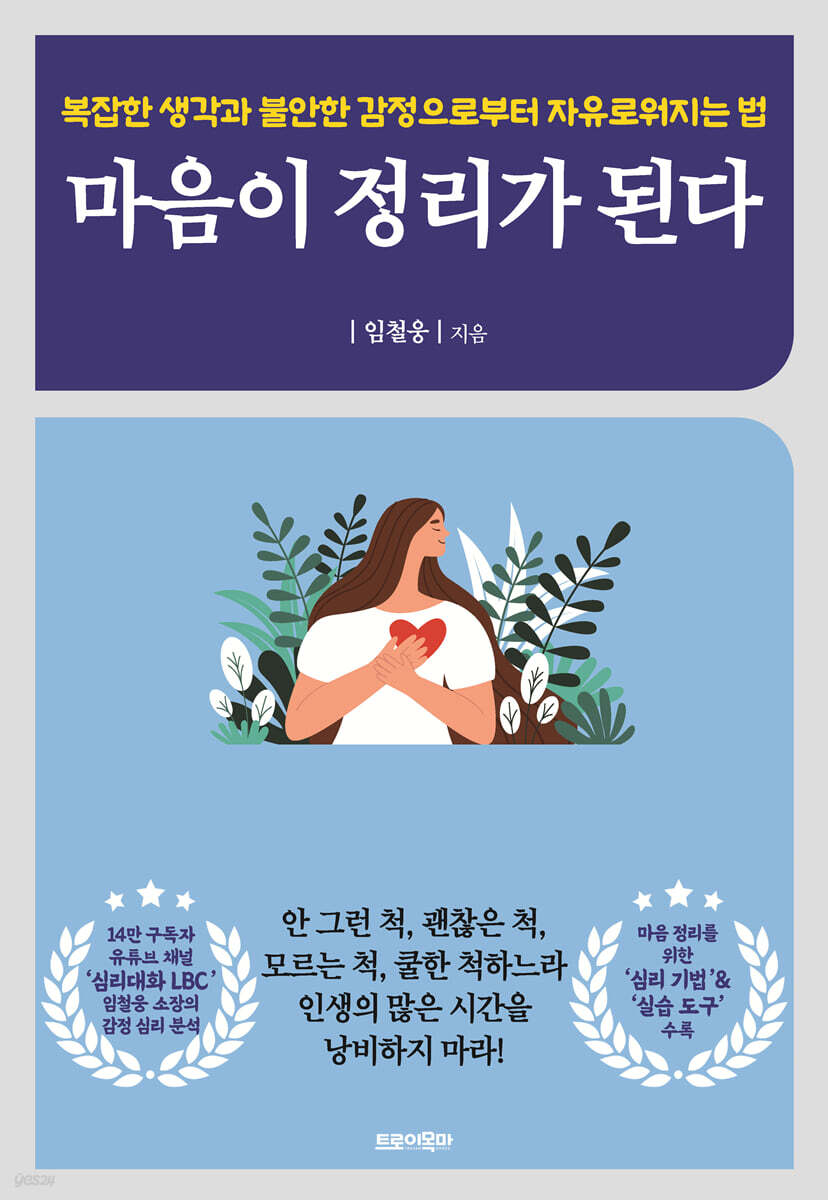
My mind is clear
 |
Description
Book Introduction
Only then can I feel at peace from the complex thoughts and countless emotions!
Lim Cheol-woong, a psychological conversation expert and author of “A Conversation Between a Psychologist and a Scammer,” which teaches us how to easily detect malicious deception and pressure from others through “the best psychological conversation technique that sees through the human psyche,” has published “The Mind is Organized.”
The author conducted research on humans at the HSD (Human Factors Engineering Laboratory) of Pohang University of Science and Technology, and with a Ph.D. in Industrial Engineering, gave lectures on management at Konkuk University and the IGM World Management Institute, a CEO training institute.
And since founding 'Psychological Dialogue LBC' in 2012, I have provided over 1,000 psychological counseling sessions. Based on my experience in teaching and consulting for universities, companies, and government agencies, I am working as a knowledge curator who formalizes knowledge, explains it in an easy-to-understand manner, and lectures and shares it.
Recently, he has been running the YouTube channel 'Psychological Dialogue LBC', and has been receiving explosive responses from 140,000 subscribers by providing content that sharply and accurately analyzes human psychology related to love and relationships, such as TV programs 'I'm Solo', 'Divorce Consideration Camp', and 'Transfer Love'.
The author wrote "The Mind is Organized" based on research on human relationships and psychology and extensive counseling experience.
Beyond the general understanding of the mind and psychology, it contains specific solutions on how to discover your own emotions, how to manage them, and how to change your life in a certain direction by doing so.
This book, a revised version of "The Power of Mind Design," published in 2021, covers 30 topics related to emotions, psychology, and life balance.
Depression, loneliness, anxiety and fear, love, jealousy and envy, pride, self-esteem, obsession, trauma, senses, sabotage, etc. - the various emotions and psychological factors that all humans have and that sometimes make life difficult are explained from a scientific perspective.
In addition, it presents specific practical tools utilizing 30 different psychological training techniques.
By utilizing various practical tools such as the Daily Quadrant to help you find balance in your daily life, the Basketball Court Thinking Method to reduce obsessions, the Mind Map to discover hidden enemies in your heart, Anchoring to bring about desired emotions, and the Life Graph to discover the value of life, it helps you find a way to reduce the time wasted in life by controlling your emotions and psychology and aiming for a growth-oriented self that utilizes both reason and logic.
Lim Cheol-woong, a psychological conversation expert and author of “A Conversation Between a Psychologist and a Scammer,” which teaches us how to easily detect malicious deception and pressure from others through “the best psychological conversation technique that sees through the human psyche,” has published “The Mind is Organized.”
The author conducted research on humans at the HSD (Human Factors Engineering Laboratory) of Pohang University of Science and Technology, and with a Ph.D. in Industrial Engineering, gave lectures on management at Konkuk University and the IGM World Management Institute, a CEO training institute.
And since founding 'Psychological Dialogue LBC' in 2012, I have provided over 1,000 psychological counseling sessions. Based on my experience in teaching and consulting for universities, companies, and government agencies, I am working as a knowledge curator who formalizes knowledge, explains it in an easy-to-understand manner, and lectures and shares it.
Recently, he has been running the YouTube channel 'Psychological Dialogue LBC', and has been receiving explosive responses from 140,000 subscribers by providing content that sharply and accurately analyzes human psychology related to love and relationships, such as TV programs 'I'm Solo', 'Divorce Consideration Camp', and 'Transfer Love'.
The author wrote "The Mind is Organized" based on research on human relationships and psychology and extensive counseling experience.
Beyond the general understanding of the mind and psychology, it contains specific solutions on how to discover your own emotions, how to manage them, and how to change your life in a certain direction by doing so.
This book, a revised version of "The Power of Mind Design," published in 2021, covers 30 topics related to emotions, psychology, and life balance.
Depression, loneliness, anxiety and fear, love, jealousy and envy, pride, self-esteem, obsession, trauma, senses, sabotage, etc. - the various emotions and psychological factors that all humans have and that sometimes make life difficult are explained from a scientific perspective.
In addition, it presents specific practical tools utilizing 30 different psychological training techniques.
By utilizing various practical tools such as the Daily Quadrant to help you find balance in your daily life, the Basketball Court Thinking Method to reduce obsessions, the Mind Map to discover hidden enemies in your heart, Anchoring to bring about desired emotions, and the Life Graph to discover the value of life, it helps you find a way to reduce the time wasted in life by controlling your emotions and psychology and aiming for a growth-oriented self that utilizes both reason and logic.
- You can preview some of the book's contents.
Preview
index
| Prologue | When your mind is in order, life moves.
PART 1 Discovery and Understanding of My Heart
1 Understanding Emotions: What They Are and How to Recognize Your Emotions
“But I have no idea what I’m feeling?”
2 Depression: A darkness that slowly settles and never fades away.
“Why am I always depressed?”
3 Anxiety and Fear: Two Storms That Shake the Heart
“Even when I’m still, I feel anxious all of a sudden.”
4 Loneliness: The Alarm Clock in Our Hearts
“I feel lonely whether I’m alone or with others.
“Is it like that for everyone else?”
5 Joy: The Fruit We Need to Harvest More of in Our Lives
“A life filled with joy? Is that even possible?”
6. Anger: A Useful Engine When You Know How to Handle It
“I’m having a hard time because of the anger.
“Why is the world so rude?”
7 Love: A Jewel That Changes Depending on Your Perspective
“Wouldn’t it be less difficult if you knew what love was?”
8 Jealousy: The Destructive Emotion That Love Creates
“I told you, that person doesn’t deserve that.
“Why do I have to be treated like this?”
Period 9: The contradictory feelings that arise when you want something
“That would suit me better, why would someone like that be given that opportunity?”
10 Emotional Intelligence: The Art of Reading Your Own Emotions
“What on earth is my heart yearning for?”
PART 2: Reclaiming My Heart
11 Balance in Life: Two Seesaws That Balance Our Lives
“I shouldn’t have lived like this.”
12 Self-Esteem: The Key to Changing Your Life
“I have lived without pride.
“Can I change it now?”
13 Shame: The Other Side of the Pride Coin
“I can’t stand the shame, can’t I just forget about it?”
14 The Good Child Complex and the Old Man: Those Who Have Lost Their Self-Esteem
“I’ve lived a good life, so why has my heart become like this?”
15 Everyday Remodeling: Techniques to Change Your Daily Life the Way You Want
“I wish someone would look at my daily life and make some changes.”
16 Habits of Not Getting Frustrated: Creating a Belief
“But I don’t think I can do it.
“Is there a way?”
17 Obsession: Wandering caused by not believing in oneself
“I’m going crazy if I don’t keep checking, what should I do?”
18 Handling Anxiety: Techniques for Overcoming Anxiety Instantly
“So what do you do when you suddenly feel anxious?”
19 To Love?: The Saboteurs Within Me That Block Love
“I want to love too, but what should I do?”
20 Emotional Recipes: Ingredients for Sustaining Emotions
“I hope you don’t get too emotional.”
PART 3: Organizing My Mind for My Life
21 Self-Esteem: The Two-Pillar Support of the Mind
“Self-esteem, self-esteem.
"Is the problem all about self-esteem? Am I the only one with low self-esteem?"
22 Logical Power: The Power to Become the Master of Your Mind
“I want to become a logical person. How can I do that?”
23 The Power of Reason: The Most Powerful Force in Controlling Emotions
"Think rationally? That's easy to say, but how do you actually do it?"
24 Sabotage: Discovering the Enemy of Your Mind
“I wish someone would look into my heart and find what’s wrong.”
25 Sabotage Exploration: The Art of Finding the Enemy Within
“Why has it been like this all along?”
26 Finding the Sabotage in My Heart: Exploring the Sabotage Within
“If I find the contradiction in my heart, can I change it?”
27 Senses: Clues that Change Experiences and Memories
“You can change your emotions with your senses?”
28 Anchoring: The Art of Evoking Desired Emotions
“What should I do when my heart races?”
29 Trauma: The Beast That Hides in Our Memories
“Do I still have trauma?”
30 Memories: A Book of Life That Is Always Redrawn
“How can I escape the memories I want to forget?”
EXERCISE: Practice for clearing your mind
1. Practice Understanding Emotions
2. Practice resisting depression
3 Practice Overcoming Anxiety and Fear
4. Overcoming Loneliness Practice
5 Understanding Joy and Purpose Practice
6. Practice Understanding and Managing Anger
7. Understanding Love Practice
8 Understanding Jealousy Exercises
9 Understanding Jealousy Practice
10 Practice Recognizing My Emotions
11. Practice Checking Life Balance
12 Pride Inspection Practice
13 Practice Using the Three Functions of Shame
14 Pride Praise Practice
15 Everyday Remodeling Practices
16 Practice not to get frustrated
17 Overcoming Obsessions Practice
18 Handling Anxiety Practice
19 Practice Expressing Love
20 Emotional Recipe Practice
21 Self-Esteem Boosting Exercises
22 Logical Thinking Practice
23 Practice using reason to counter depression
24 Example Mind Maps for Identifying Sabotage
25 Sabotage Exploration Practice
26. Practice Finding Sabotage in My Heart
27. Practice Evoking Emotions with Your Senses
28 Anchoring Practice
29 Overcoming Trauma Practice
30 Life Reflection Practice
| Epilogue | Now I can deal with the negativity within me.
PART 1 Discovery and Understanding of My Heart
1 Understanding Emotions: What They Are and How to Recognize Your Emotions
“But I have no idea what I’m feeling?”
2 Depression: A darkness that slowly settles and never fades away.
“Why am I always depressed?”
3 Anxiety and Fear: Two Storms That Shake the Heart
“Even when I’m still, I feel anxious all of a sudden.”
4 Loneliness: The Alarm Clock in Our Hearts
“I feel lonely whether I’m alone or with others.
“Is it like that for everyone else?”
5 Joy: The Fruit We Need to Harvest More of in Our Lives
“A life filled with joy? Is that even possible?”
6. Anger: A Useful Engine When You Know How to Handle It
“I’m having a hard time because of the anger.
“Why is the world so rude?”
7 Love: A Jewel That Changes Depending on Your Perspective
“Wouldn’t it be less difficult if you knew what love was?”
8 Jealousy: The Destructive Emotion That Love Creates
“I told you, that person doesn’t deserve that.
“Why do I have to be treated like this?”
Period 9: The contradictory feelings that arise when you want something
“That would suit me better, why would someone like that be given that opportunity?”
10 Emotional Intelligence: The Art of Reading Your Own Emotions
“What on earth is my heart yearning for?”
PART 2: Reclaiming My Heart
11 Balance in Life: Two Seesaws That Balance Our Lives
“I shouldn’t have lived like this.”
12 Self-Esteem: The Key to Changing Your Life
“I have lived without pride.
“Can I change it now?”
13 Shame: The Other Side of the Pride Coin
“I can’t stand the shame, can’t I just forget about it?”
14 The Good Child Complex and the Old Man: Those Who Have Lost Their Self-Esteem
“I’ve lived a good life, so why has my heart become like this?”
15 Everyday Remodeling: Techniques to Change Your Daily Life the Way You Want
“I wish someone would look at my daily life and make some changes.”
16 Habits of Not Getting Frustrated: Creating a Belief
“But I don’t think I can do it.
“Is there a way?”
17 Obsession: Wandering caused by not believing in oneself
“I’m going crazy if I don’t keep checking, what should I do?”
18 Handling Anxiety: Techniques for Overcoming Anxiety Instantly
“So what do you do when you suddenly feel anxious?”
19 To Love?: The Saboteurs Within Me That Block Love
“I want to love too, but what should I do?”
20 Emotional Recipes: Ingredients for Sustaining Emotions
“I hope you don’t get too emotional.”
PART 3: Organizing My Mind for My Life
21 Self-Esteem: The Two-Pillar Support of the Mind
“Self-esteem, self-esteem.
"Is the problem all about self-esteem? Am I the only one with low self-esteem?"
22 Logical Power: The Power to Become the Master of Your Mind
“I want to become a logical person. How can I do that?”
23 The Power of Reason: The Most Powerful Force in Controlling Emotions
"Think rationally? That's easy to say, but how do you actually do it?"
24 Sabotage: Discovering the Enemy of Your Mind
“I wish someone would look into my heart and find what’s wrong.”
25 Sabotage Exploration: The Art of Finding the Enemy Within
“Why has it been like this all along?”
26 Finding the Sabotage in My Heart: Exploring the Sabotage Within
“If I find the contradiction in my heart, can I change it?”
27 Senses: Clues that Change Experiences and Memories
“You can change your emotions with your senses?”
28 Anchoring: The Art of Evoking Desired Emotions
“What should I do when my heart races?”
29 Trauma: The Beast That Hides in Our Memories
“Do I still have trauma?”
30 Memories: A Book of Life That Is Always Redrawn
“How can I escape the memories I want to forget?”
EXERCISE: Practice for clearing your mind
1. Practice Understanding Emotions
2. Practice resisting depression
3 Practice Overcoming Anxiety and Fear
4. Overcoming Loneliness Practice
5 Understanding Joy and Purpose Practice
6. Practice Understanding and Managing Anger
7. Understanding Love Practice
8 Understanding Jealousy Exercises
9 Understanding Jealousy Practice
10 Practice Recognizing My Emotions
11. Practice Checking Life Balance
12 Pride Inspection Practice
13 Practice Using the Three Functions of Shame
14 Pride Praise Practice
15 Everyday Remodeling Practices
16 Practice not to get frustrated
17 Overcoming Obsessions Practice
18 Handling Anxiety Practice
19 Practice Expressing Love
20 Emotional Recipe Practice
21 Self-Esteem Boosting Exercises
22 Logical Thinking Practice
23 Practice using reason to counter depression
24 Example Mind Maps for Identifying Sabotage
25 Sabotage Exploration Practice
26. Practice Finding Sabotage in My Heart
27. Practice Evoking Emotions with Your Senses
28 Anchoring Practice
29 Overcoming Trauma Practice
30 Life Reflection Practice
| Epilogue | Now I can deal with the negativity within me.
Detailed image

Into the book
This is not a book you just read and leave.
A practice-oriented book to organize your inner self.
It is structured to help you untangle the knots of complex emotions one by one through short stories, questions, and practical exercises.
Through this process, you will become more aware of your emotions, reduce unnecessary thoughts, and gradually regain the power to 'regulate' and 'choose' your life.
You already know.
Rather than trying to force something to change, life begins to change little by little just by organizing your mind.
Now is the time to start making that change.
I hope this book will serve as a small guide to your journey, so that you can no longer be swayed by your mind and take charge of your own life.
--- pp.6~7, from 「Prologue _ When the mind is organized, life moves」
To rationally view and analyze anger and find a direction, you must first detach yourself from the hatred attached to it and look at it.
That is the first step in mastering anger.
Some people find it uncomfortable that babies get angry.
But that's because they can't tell the difference between anger and hatred.
Babies don't hate others when they're angry.
Once the goal is achieved, the anger usually subsides.
Of course, if you are always the one who provokes your anger, you may end up hating them.
However, if you get angry at someone because you hate them, the cause and effect are reversed.
You're just wasting unnecessary energy and putting yourself in a more negative direction.
Even if it's someone you hate, it's human nature to be willing to go along with them whenever they help you achieve your goals.
That's how humans have survived.
When hunting in groups and having a common goal, we have collaborated even with people we disliked.
It's something we need to survive.
So we think this direction is reasonable.
But when I see someone I actually hate, I get angry.
Why is that?
--- p.60, 「PART 1.
Discovery and Understanding of My Heart 6.
From "Rage: A Useful Engine When You Know How to Handle It"
To understand the balance of the mind, we need to talk about the two seesaws that exist in our mind.
On one seesaw rides stability and challenge.
On the other side of the seesaw, growth and contribution are riding.
Let's start with the first seesaw of stability and challenge.
Stability is the mind that pursues certainty.
They want to get into a company and stay at home with their parents.
Just think of today as being like yesterday, and tomorrow as being like today.
Change is stressful.
That's what I'm pursuing: no stress.
It is a stable and survival-guaranteed situation.
The challenge on the other side is the willingness to enjoy uncertainty.
I want to travel, start a business, or become a freelancer.
It's about experiencing new things and pursuing change.
I hope you experience surprise and excitement from the unexpected.
If either of these two is missing, the seesaw collapses.
So you end up pursuing something else.
But what happens when you suddenly seek a challenge after living a life filled with stability? You'll find yourself seeking stability again.
You will continue to live with one side of your heart broken.
So, if you want to pursue a challenge in a stable situation, you need to think of a way to take on the challenge without giving up stability.
--- pp.99~100, 「PART 2.
Reclaiming My Heart 11.
Balance of Life: Two Seesaws that Create Balance in Our Lives
Self-esteem is like a house with two pillars.
One pillar is the idea that you are a 'good person', and the other pillar is the idea that you are a 'right person'.
If these two pillars are not balanced, the house of self-esteem will collapse.
Just because one pillar is too high, you can't put a roof on top of it.
Likewise, the mind becomes sick.
What about brilliant con artists like Victor Lustig, who sold the Eiffel Tower twice, or Bong-i Kim Seon-dal, who sold water from the Taedong River? It's unlikely they'd have high self-esteem.
Because the pillar of righteousness was not established compared to the outstanding ability.
The opposite is also true.
If you are dedicated to working towards a higher ideal or teaching others what they need, you are completing a pillar of self-esteem.
But what if you don't have the skills you desire? Even if it's the right thing to do, the more you do it, the more miserable it becomes.
You may think you're a good person, but your self-esteem is low.
So you start to blame yourself and even blame the world.
I can't be happy.
The house of self-esteem collapses because the pillars of excellence cannot support it.
So there are two ways to boost your self-esteem.
One is to believe in yourself and not do anything wrong, and the other is to work hard at what you want to do and increase your ability.
--- p.174, 「PART 3.
From "Mind Organization for My Mind 21. Self-Esteem: The Two-Pillar Support of the Mind"
What if a saboteur has been lurking within you for a long time? It knows you better than anyone else and knows perfectly well how to obstruct and manipulate change without your knowledge.
So this sabotage class is a process that is more difficult for those who are more experienced or older.
As we saw in the previous example, sabotage gives the mind's owner a justification for taking actions that are contrary to his or her goals.
Let me rationalize it.
It would have protected your heart when you were frustrated or felt inadequate.
If we were forced to continue living a life that was off-track from our goals, sabotage would have long been entrenched as a psychological shield.
Sabotage is also armor because of its nature to protect the mind.
So, it is difficult to find the sabotage of these people, and it is even more difficult to admit it to oneself.
In fact, most people can easily spot other people's sabotage, but not their own.
So when I help people identify sabotage, I first create a map of their own inner self, and then I train them to identify sabotage in others.
Next, let's look at the mind map again and try to find self-sabotage.
--- pp.208~209, 「PART 3.
Mind Cleaning for My Mind 24.
From "Sabotage: Discovering the Enemy of Your Mind"
I will give you an assignment this time too.
This could be the first step towards boosting your self-esteem.
Write down some things that are good for you.
Good for me.
So think about what you need to continue doing.
Please write down at least 5.
................... ...
After you've written everything down, ask yourself:
“Are these really good for me?”
“Do I think it’s good just because other people say it’s good?”
Of course, other people's opinions and social standards may also be necessary.
Because we need to look at it objectively.
But there is no need to follow other people's thoughts.
Take a good look at what you've written and think about whether your past, present, and future self would consider it a good thing.
--- p.327, 「EXERCISE Practice 21 for Organizing the Mind.
From “Practice to Raise Self-Esteem”
Life is often likened to breaking out of an egg.
So, I think that once you break out of the egg, you will realize everything and become the master of your life.
But as I live and learn, I feel like our lives are actually coming out from the innermost part of the onion.
Every time a new world opens up, the shell continues to exist.
Continuously learning about aspects of yourself you didn't know about and adapting to a new world is the process of maturing.
If there is someone who walks that path and always makes his own choices, he can become the master of his own mind and the protagonist of his own life.
So it's important to know how much you can choose for yourself.
There are many things that we can choose, but we often mistakenly believe we cannot choose.
For example, health can sometimes seem like something we can't choose.
But we can choose to be healthier.
There are so many choices we can make to improve our health: keeping warm, getting regular sleep, exercising regularly, washing well, drinking plenty of water, creating a healthy environment, and eating well.
We always have more to choose from.
We always have the potential to be more and more valuable.
Potential comes from within.
And give voice to your emotions.
When you learn to understand and manage your emotions, you realize your potential.
A practice-oriented book to organize your inner self.
It is structured to help you untangle the knots of complex emotions one by one through short stories, questions, and practical exercises.
Through this process, you will become more aware of your emotions, reduce unnecessary thoughts, and gradually regain the power to 'regulate' and 'choose' your life.
You already know.
Rather than trying to force something to change, life begins to change little by little just by organizing your mind.
Now is the time to start making that change.
I hope this book will serve as a small guide to your journey, so that you can no longer be swayed by your mind and take charge of your own life.
--- pp.6~7, from 「Prologue _ When the mind is organized, life moves」
To rationally view and analyze anger and find a direction, you must first detach yourself from the hatred attached to it and look at it.
That is the first step in mastering anger.
Some people find it uncomfortable that babies get angry.
But that's because they can't tell the difference between anger and hatred.
Babies don't hate others when they're angry.
Once the goal is achieved, the anger usually subsides.
Of course, if you are always the one who provokes your anger, you may end up hating them.
However, if you get angry at someone because you hate them, the cause and effect are reversed.
You're just wasting unnecessary energy and putting yourself in a more negative direction.
Even if it's someone you hate, it's human nature to be willing to go along with them whenever they help you achieve your goals.
That's how humans have survived.
When hunting in groups and having a common goal, we have collaborated even with people we disliked.
It's something we need to survive.
So we think this direction is reasonable.
But when I see someone I actually hate, I get angry.
Why is that?
--- p.60, 「PART 1.
Discovery and Understanding of My Heart 6.
From "Rage: A Useful Engine When You Know How to Handle It"
To understand the balance of the mind, we need to talk about the two seesaws that exist in our mind.
On one seesaw rides stability and challenge.
On the other side of the seesaw, growth and contribution are riding.
Let's start with the first seesaw of stability and challenge.
Stability is the mind that pursues certainty.
They want to get into a company and stay at home with their parents.
Just think of today as being like yesterday, and tomorrow as being like today.
Change is stressful.
That's what I'm pursuing: no stress.
It is a stable and survival-guaranteed situation.
The challenge on the other side is the willingness to enjoy uncertainty.
I want to travel, start a business, or become a freelancer.
It's about experiencing new things and pursuing change.
I hope you experience surprise and excitement from the unexpected.
If either of these two is missing, the seesaw collapses.
So you end up pursuing something else.
But what happens when you suddenly seek a challenge after living a life filled with stability? You'll find yourself seeking stability again.
You will continue to live with one side of your heart broken.
So, if you want to pursue a challenge in a stable situation, you need to think of a way to take on the challenge without giving up stability.
--- pp.99~100, 「PART 2.
Reclaiming My Heart 11.
Balance of Life: Two Seesaws that Create Balance in Our Lives
Self-esteem is like a house with two pillars.
One pillar is the idea that you are a 'good person', and the other pillar is the idea that you are a 'right person'.
If these two pillars are not balanced, the house of self-esteem will collapse.
Just because one pillar is too high, you can't put a roof on top of it.
Likewise, the mind becomes sick.
What about brilliant con artists like Victor Lustig, who sold the Eiffel Tower twice, or Bong-i Kim Seon-dal, who sold water from the Taedong River? It's unlikely they'd have high self-esteem.
Because the pillar of righteousness was not established compared to the outstanding ability.
The opposite is also true.
If you are dedicated to working towards a higher ideal or teaching others what they need, you are completing a pillar of self-esteem.
But what if you don't have the skills you desire? Even if it's the right thing to do, the more you do it, the more miserable it becomes.
You may think you're a good person, but your self-esteem is low.
So you start to blame yourself and even blame the world.
I can't be happy.
The house of self-esteem collapses because the pillars of excellence cannot support it.
So there are two ways to boost your self-esteem.
One is to believe in yourself and not do anything wrong, and the other is to work hard at what you want to do and increase your ability.
--- p.174, 「PART 3.
From "Mind Organization for My Mind 21. Self-Esteem: The Two-Pillar Support of the Mind"
What if a saboteur has been lurking within you for a long time? It knows you better than anyone else and knows perfectly well how to obstruct and manipulate change without your knowledge.
So this sabotage class is a process that is more difficult for those who are more experienced or older.
As we saw in the previous example, sabotage gives the mind's owner a justification for taking actions that are contrary to his or her goals.
Let me rationalize it.
It would have protected your heart when you were frustrated or felt inadequate.
If we were forced to continue living a life that was off-track from our goals, sabotage would have long been entrenched as a psychological shield.
Sabotage is also armor because of its nature to protect the mind.
So, it is difficult to find the sabotage of these people, and it is even more difficult to admit it to oneself.
In fact, most people can easily spot other people's sabotage, but not their own.
So when I help people identify sabotage, I first create a map of their own inner self, and then I train them to identify sabotage in others.
Next, let's look at the mind map again and try to find self-sabotage.
--- pp.208~209, 「PART 3.
Mind Cleaning for My Mind 24.
From "Sabotage: Discovering the Enemy of Your Mind"
I will give you an assignment this time too.
This could be the first step towards boosting your self-esteem.
Write down some things that are good for you.
Good for me.
So think about what you need to continue doing.
Please write down at least 5.
................... ...
After you've written everything down, ask yourself:
“Are these really good for me?”
“Do I think it’s good just because other people say it’s good?”
Of course, other people's opinions and social standards may also be necessary.
Because we need to look at it objectively.
But there is no need to follow other people's thoughts.
Take a good look at what you've written and think about whether your past, present, and future self would consider it a good thing.
--- p.327, 「EXERCISE Practice 21 for Organizing the Mind.
From “Practice to Raise Self-Esteem”
Life is often likened to breaking out of an egg.
So, I think that once you break out of the egg, you will realize everything and become the master of your life.
But as I live and learn, I feel like our lives are actually coming out from the innermost part of the onion.
Every time a new world opens up, the shell continues to exist.
Continuously learning about aspects of yourself you didn't know about and adapting to a new world is the process of maturing.
If there is someone who walks that path and always makes his own choices, he can become the master of his own mind and the protagonist of his own life.
So it's important to know how much you can choose for yourself.
There are many things that we can choose, but we often mistakenly believe we cannot choose.
For example, health can sometimes seem like something we can't choose.
But we can choose to be healthier.
There are so many choices we can make to improve our health: keeping warm, getting regular sleep, exercising regularly, washing well, drinking plenty of water, creating a healthy environment, and eating well.
We always have more to choose from.
We always have the potential to be more and more valuable.
Potential comes from within.
And give voice to your emotions.
When you learn to understand and manage your emotions, you realize your potential.
--- pp.350~351, from 「Epilogue _ Now I can deal with the negative things inside me」
Publisher's Review
“Pretending not to know, pretending it’s okay, pretending not to know, pretending to be cool
“Don’t waste too much time in your life!”
■ Korea's only psychological dialogue expert's guide to solving emotional, psychological, and life problems
Lim Cheol-woong, author of "The Mind is Organized," is a psychological conversation expert who has been conducting psychological research and counseling for about 20 years to solve psychological and interpersonal relationship problems from an engineering and scientific perspective.
The author, who conducted research on humans at Pohang University of Science and Technology and lectured on management at universities and management education institutions with a doctorate in industrial engineering, analyzed statistical data obtained through offline practice and over 1,000 counseling cases to create his own small talk theory, psychological training techniques, and tools that can be applied to human relationships based on psychology.
Recently, he has been actively communicating with 140,000 subscribers through his YouTube channel 'Psychological Dialogue LBC', and is gaining popularity for his sharp and accurate analysis of the psychology of characters appearing on TV programs related to love and marriage such as 'I'm Solo', 'Divorce Consideration Camp', and 'Singles'.
In this book, the author unravels the mental problems and pain that everyone experiences from a different perspective than a psychologist, such as what self-esteem is, the difference between anxiety and fear, jealousy and envy, why the opposite of joy is anger and not sadness, and why firm resolutions fail due to enemies hidden deep within the mind.
Rather than being consumed by emotions and psychology, it presents specific tools and methods on how to overcome negative psychology and emotions and restore balance in life by actively utilizing the inherent power of reason.
Moreover, it helps us understand where and how various human emotions originate and continue to influence us, and what the true state of our hearts expressed through emotions means to us. Through this, it teaches us how to change and become more mature by understanding and managing our emotions and hearts.
■ Includes various mind-organizing practice tools
This book goes beyond simply exploring the psychology and emotions within humans, offering concrete methods for gradually overcoming negative emotions that can ruin our lives and leading a new life.
After covering 30 topics related to psychology, emotions, and life balance, readers are guided through 30 mind-clearing exercises to overcome and transform their current selves by facing their own problems.
Thought & Practice Tools for Organizing Your Mind
▶ Life balance chart that analyzes and resolves dissatisfaction with reality
▶ Anger analysis techniques that help you manage your anger
▶ Breathing technique to resolve anxious physical reactions
▶ Anchoring, a switch that brings out the desired emotion at any time
▶ 3 Ways to Unleash the Power of Reason
▶ Basketball Court Thinking: Reduce Obsessions and Find Things to Do
▶ A mind map to discover the hidden enemy in your heart
▶ The Quadrant of Daily Life that analyzes your daily life and transforms it into the life you want.
“Don’t waste too much time in your life!”
■ Korea's only psychological dialogue expert's guide to solving emotional, psychological, and life problems
Lim Cheol-woong, author of "The Mind is Organized," is a psychological conversation expert who has been conducting psychological research and counseling for about 20 years to solve psychological and interpersonal relationship problems from an engineering and scientific perspective.
The author, who conducted research on humans at Pohang University of Science and Technology and lectured on management at universities and management education institutions with a doctorate in industrial engineering, analyzed statistical data obtained through offline practice and over 1,000 counseling cases to create his own small talk theory, psychological training techniques, and tools that can be applied to human relationships based on psychology.
Recently, he has been actively communicating with 140,000 subscribers through his YouTube channel 'Psychological Dialogue LBC', and is gaining popularity for his sharp and accurate analysis of the psychology of characters appearing on TV programs related to love and marriage such as 'I'm Solo', 'Divorce Consideration Camp', and 'Singles'.
In this book, the author unravels the mental problems and pain that everyone experiences from a different perspective than a psychologist, such as what self-esteem is, the difference between anxiety and fear, jealousy and envy, why the opposite of joy is anger and not sadness, and why firm resolutions fail due to enemies hidden deep within the mind.
Rather than being consumed by emotions and psychology, it presents specific tools and methods on how to overcome negative psychology and emotions and restore balance in life by actively utilizing the inherent power of reason.
Moreover, it helps us understand where and how various human emotions originate and continue to influence us, and what the true state of our hearts expressed through emotions means to us. Through this, it teaches us how to change and become more mature by understanding and managing our emotions and hearts.
■ Includes various mind-organizing practice tools
This book goes beyond simply exploring the psychology and emotions within humans, offering concrete methods for gradually overcoming negative emotions that can ruin our lives and leading a new life.
After covering 30 topics related to psychology, emotions, and life balance, readers are guided through 30 mind-clearing exercises to overcome and transform their current selves by facing their own problems.
Thought & Practice Tools for Organizing Your Mind
▶ Life balance chart that analyzes and resolves dissatisfaction with reality
▶ Anger analysis techniques that help you manage your anger
▶ Breathing technique to resolve anxious physical reactions
▶ Anchoring, a switch that brings out the desired emotion at any time
▶ 3 Ways to Unleash the Power of Reason
▶ Basketball Court Thinking: Reduce Obsessions and Find Things to Do
▶ A mind map to discover the hidden enemy in your heart
▶ The Quadrant of Daily Life that analyzes your daily life and transforms it into the life you want.
GOODS SPECIFICS
- Date of issue: May 10, 2025
- Page count, weight, size: 352 pages | 470g | 145*210*22mm
- ISBN13: 9791192959504
- ISBN10: 1192959507
You may also like
카테고리
korean


korean

![GQ KOREA Mark (Monthly): December [2025]](http://librairie.coreenne.fr/cdn/shop/files/8ef265dbbfbf186523ed75ba7319009d.jpg?v=1765340328&width=3840)


