

Why do I have a hard time having warm conversations?
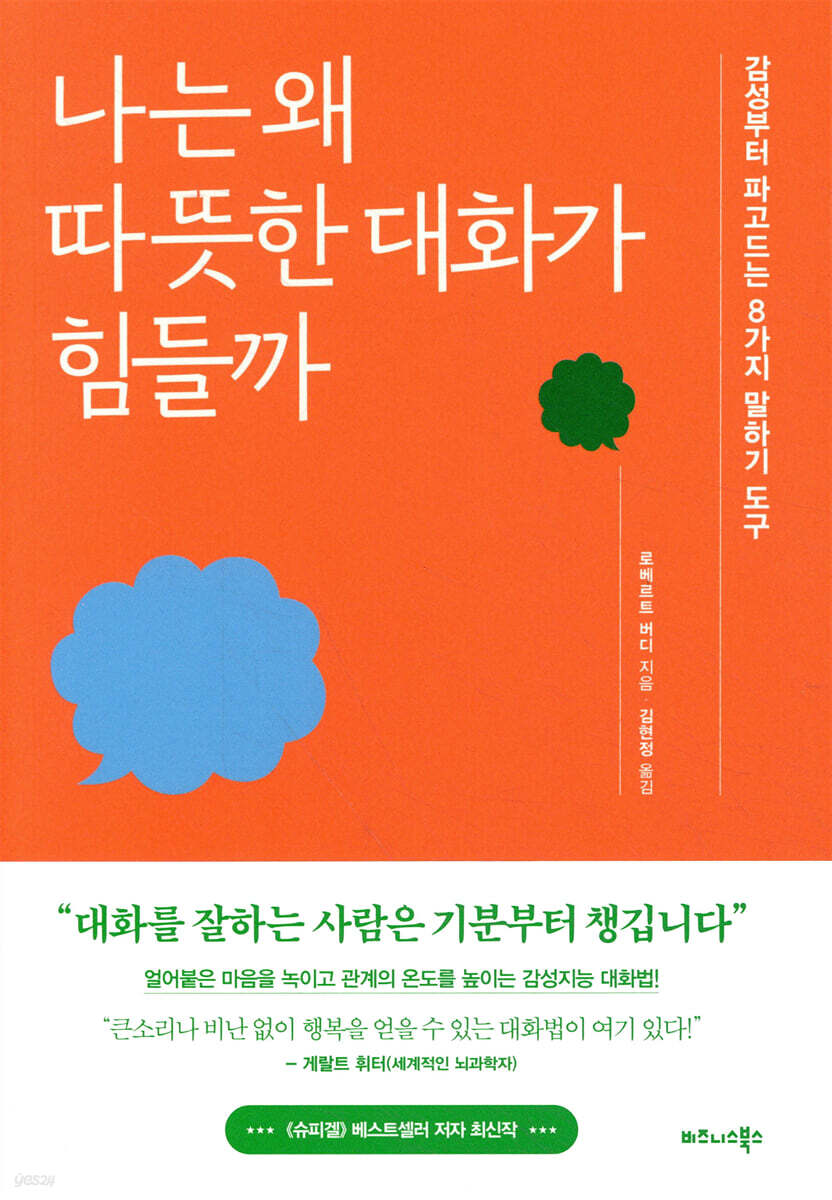 |
Description
Book Introduction
"Good conversationalists take care of your mood first."
For those of you who want to be good at 'conversation' rather than just talking!
Emotional intelligence conversation techniques from a communication expert with 40 years of experience!
'Why did I end up getting angry again when I started this conversation to clear up a misunderstanding?' 'Why couldn't I lead people even though I had the position and ability?' 'Why couldn't I persuade them even though I only spoke the right words?' It was because I believed that only by using reason in conversation could I effectively convey my meaning and achieve the desired results.
However, Robert Burdy, the author of this book, says that if you speak emotionally at the moment when you feel you should speak rationally, that is, if you have warm conversations rather than cold ones, your work and relationships will change dramatically.
"Why Do I Have Difficulty Having Warm Conversations?" is a book that contains emotional intelligence conversation techniques from a communications expert who has gained expertise through interviewing and reporting on thousands of people.
The author, who excels at using emotional intelligence to engage in genuine conversations with interviewees rather than superficial interviews, teaches you how to have "real conversations" that bring out your emotions so that you can be a person who governs without being pushy, a person who is friendly rather than someone who seems smart, and a person who listens better than someone who explains well.
To this end, the author cites various situations requiring conversation as examples and introduces eight key tools for conversation, such as 'eye level,' 'emotion,' 'relevance,' and 'kindness.'
The book's "How to Prioritize Emotions," "How to Make Eye Contact and Smile While Talking," "How to Make the Other Person Relevant to the Conversation," and "How to Infuse Respect into Your Conversation" will be the keys to taking your conversations beyond mere information transfer and into true communication.
If you have been struggling with work and relationships being tangled because of conversation, read this book.
And let's get our emotions out and start a warm conversation.
You will have better opportunities and be able to capture the hearts of more people.
For those of you who want to be good at 'conversation' rather than just talking!
Emotional intelligence conversation techniques from a communication expert with 40 years of experience!
'Why did I end up getting angry again when I started this conversation to clear up a misunderstanding?' 'Why couldn't I lead people even though I had the position and ability?' 'Why couldn't I persuade them even though I only spoke the right words?' It was because I believed that only by using reason in conversation could I effectively convey my meaning and achieve the desired results.
However, Robert Burdy, the author of this book, says that if you speak emotionally at the moment when you feel you should speak rationally, that is, if you have warm conversations rather than cold ones, your work and relationships will change dramatically.
"Why Do I Have Difficulty Having Warm Conversations?" is a book that contains emotional intelligence conversation techniques from a communications expert who has gained expertise through interviewing and reporting on thousands of people.
The author, who excels at using emotional intelligence to engage in genuine conversations with interviewees rather than superficial interviews, teaches you how to have "real conversations" that bring out your emotions so that you can be a person who governs without being pushy, a person who is friendly rather than someone who seems smart, and a person who listens better than someone who explains well.
To this end, the author cites various situations requiring conversation as examples and introduces eight key tools for conversation, such as 'eye level,' 'emotion,' 'relevance,' and 'kindness.'
The book's "How to Prioritize Emotions," "How to Make Eye Contact and Smile While Talking," "How to Make the Other Person Relevant to the Conversation," and "How to Infuse Respect into Your Conversation" will be the keys to taking your conversations beyond mere information transfer and into true communication.
If you have been struggling with work and relationships being tangled because of conversation, read this book.
And let's get our emotions out and start a warm conversation.
You will have better opportunities and be able to capture the hearts of more people.
- You can preview some of the book's contents.
Preview
index
Recommendation: We need to talk 'properly'
As you enter, if your words are to become 'communication' rather than just sounds,
Chapter 1: Let's Talk for a Minute
What happens in our brains when we have a conversation?
Your brain can't tell the difference between words and swords.
Stop and choose what conversation to have.
Chapter 2: Conversation is a matter of the heart, not the head.
First Speaking Tool - Emotions
Information reaches the brain through emotions.
Words that the other person likes are information.
Recognize the emotional impact of communication.
So emotional, so human!
Think about the 'feeling' that will remain at the end of the conversation
What can I say vs.
What am I trying to say?
To avoid becoming a 'mindless squirrel'
From quick and easy solutions to thoughtful communication
Chapter 3: The Gift of Kindness
Second Speaking Tool - Kindness
Only affectionate conversations survive.
How to make eye contact, smile, and talk
Why do you want to be a sheep in wolf's clothing?
The power of emotional intelligence to awaken inherent bonds
Chapter 4: From ‘A Story That Has Nothing to Do with Me’ to ‘My Story’
Third Speaking Tool - Relevance
Let's start by persuading the 'gatekeeper' in our brain.
Why can't we see it when it's right in front of us?
Let's ring the bell just for that person
A conversation that gives the gift of 'relevance'
Chapter 5: How to Reduce Misunderstandings and Conflicts in Conversation
The Fourth Speaking Tool - Desire
Recognize and meet the other person's needs
How to decipher the code called desire
The method of those who turn desire into need
Let's get rid of the habit of rationalizing for others.
Chapter 6: What a Plausible Story Doesn't Tell Us
Fifth Speaking Tool - Narrative
Can I repeat the touching lines from the movie?
Why do we get lost in fictional stories?
Things to think about before a relationship ends completely
Chapter 7: How to Incorporate Respect into Conversations
The Sixth Speaking Tool - Eye Level
There is no hierarchy for those who are good at motivating others.
Let's be willing to accept the other person's daily life.
For my motivation to be the same as the other person's motivation
Chapter 8: Silence as Language
The Seventh Speaking Tool - Silence
Silence speaks volumes
What Happens When You Choose Active Silence
Is this a monologue or a conversation?
How to 'listen' smartly
Even conversations sometimes require a break.
When you need to escape from the emotional trap
Practice not reacting to raging emotions
Nothing can change without action.
Let us have the courage to remain silent
Chapter 9: Let's Talk Together, Here and Now
Eighth Speaking Tool - Present
All communication is a conversation between two people.
From a 'me vs. many' conversation to a 'me vs. you' conversation
I can't change my opponent, but I can change my attitude.
How to Know if You're Not a Communication "Reverse Driver"
The me of today is different from the me of yesterday.
Why can't we have a conversation about 'here and now'?
Past experience is not yet wisdom.
The future is a time that exists only in my head.
How to focus on the present moment
Chapter 10: You Can Have Warm Conversations Too
Conversational Principles for Emotionally Intelligent Communication
Principle 1.
Conversation is our basic need.
Principle 2.
Every conversation carries responsibility.
Principle 3.
Conversation begins with eye contact.
Principle 4.
All conversations are ultimately one-on-one.
Principle 5.
Turn off your phone and make eye contact with the other person.
Principle 6.
Good conversations have moments of immersion.
Going beyond my story to our story
Sources and References
As you enter, if your words are to become 'communication' rather than just sounds,
Chapter 1: Let's Talk for a Minute
What happens in our brains when we have a conversation?
Your brain can't tell the difference between words and swords.
Stop and choose what conversation to have.
Chapter 2: Conversation is a matter of the heart, not the head.
First Speaking Tool - Emotions
Information reaches the brain through emotions.
Words that the other person likes are information.
Recognize the emotional impact of communication.
So emotional, so human!
Think about the 'feeling' that will remain at the end of the conversation
What can I say vs.
What am I trying to say?
To avoid becoming a 'mindless squirrel'
From quick and easy solutions to thoughtful communication
Chapter 3: The Gift of Kindness
Second Speaking Tool - Kindness
Only affectionate conversations survive.
How to make eye contact, smile, and talk
Why do you want to be a sheep in wolf's clothing?
The power of emotional intelligence to awaken inherent bonds
Chapter 4: From ‘A Story That Has Nothing to Do with Me’ to ‘My Story’
Third Speaking Tool - Relevance
Let's start by persuading the 'gatekeeper' in our brain.
Why can't we see it when it's right in front of us?
Let's ring the bell just for that person
A conversation that gives the gift of 'relevance'
Chapter 5: How to Reduce Misunderstandings and Conflicts in Conversation
The Fourth Speaking Tool - Desire
Recognize and meet the other person's needs
How to decipher the code called desire
The method of those who turn desire into need
Let's get rid of the habit of rationalizing for others.
Chapter 6: What a Plausible Story Doesn't Tell Us
Fifth Speaking Tool - Narrative
Can I repeat the touching lines from the movie?
Why do we get lost in fictional stories?
Things to think about before a relationship ends completely
Chapter 7: How to Incorporate Respect into Conversations
The Sixth Speaking Tool - Eye Level
There is no hierarchy for those who are good at motivating others.
Let's be willing to accept the other person's daily life.
For my motivation to be the same as the other person's motivation
Chapter 8: Silence as Language
The Seventh Speaking Tool - Silence
Silence speaks volumes
What Happens When You Choose Active Silence
Is this a monologue or a conversation?
How to 'listen' smartly
Even conversations sometimes require a break.
When you need to escape from the emotional trap
Practice not reacting to raging emotions
Nothing can change without action.
Let us have the courage to remain silent
Chapter 9: Let's Talk Together, Here and Now
Eighth Speaking Tool - Present
All communication is a conversation between two people.
From a 'me vs. many' conversation to a 'me vs. you' conversation
I can't change my opponent, but I can change my attitude.
How to Know if You're Not a Communication "Reverse Driver"
The me of today is different from the me of yesterday.
Why can't we have a conversation about 'here and now'?
Past experience is not yet wisdom.
The future is a time that exists only in my head.
How to focus on the present moment
Chapter 10: You Can Have Warm Conversations Too
Conversational Principles for Emotionally Intelligent Communication
Principle 1.
Conversation is our basic need.
Principle 2.
Every conversation carries responsibility.
Principle 3.
Conversation begins with eye contact.
Principle 4.
All conversations are ultimately one-on-one.
Principle 5.
Turn off your phone and make eye contact with the other person.
Principle 6.
Good conversations have moments of immersion.
Going beyond my story to our story
Sources and References
Detailed image

Into the book
“There is actually a very old reason why we are afraid to approach each other and talk.
This is because, as we grow into adults, we have no experience resolving conflicts in any way other than through confrontation or resistance, or, in a broader sense, fighting or war.
We have already experienced and witnessed how to effectively resolve conflicts in our homes with parents and siblings, in kindergartens, schools and workplaces, and, more than anywhere else, in political parties and associations where conflict is evident, as we strive to achieve leadership positions.
Rather than resolving the issue through dialogue, the easiest solution was to somehow act superior to others, ordering and directing them, trampling on others, ostracizing them, harassing them, and slandering them.
And this practice has continued for generations.
In this situation, how can we resolve conflicts without violence? How can we communicate warmly without pushing each other away? Now, we truly need to learn how to "converse properly."
“No more constantly contradicting each other or shouting loudly, saying everyone only wants to speak their own language.”
--- From the recommended article, “We must have a ‘proper’ conversation”
“For over 25 years, I have helped business leaders, as well as professionals in economics and politics, communicate their messages more effectively.
Their messages are sometimes directed at the public, and sometimes at employees.
Business leaders, in particular, are prone to the misconception that being rational means being reasonable, objective, and practical, as they often misinterpret the word "rational" to mean "unemotional."
Many of them completely eliminate the emotional dimension from their communication and focus solely on factual arguments.
But this escape into the realm of reason is the most irrational of all! It hinders communication, which is true interaction.
And it comes back with a big price.
For example, important political messages may not be conveyed properly, employees may feel alienated, or customers may criticize the company's information policies.”
--- From Chapter 2, “Conversation is a matter of the heart, not the head.”
“One client who came to me to prepare a presentation for a formal event was one of the most influential leaders in the industry.
She was a rare individual who graduated from a prestigious university, had an impeccable career, and possessed strong leadership qualities.
Thanks to this success, she was active in a position of high social influence.
But even though she seemed to have everything, the label of 'dislike' always followed her around.
Moreover, at the time, she was leading an organization with a poor reputation despite its remarkable achievements.
How can we help this incredibly intelligent and capable leader escape this perception trap? I gently reminded her that people like others not because they're smart or successful, but because they're kind.
Then she confidently answered:
“I’m kind!” Actually, I knew from our private meetings that she was a very nice and sometimes humorous person.
However, it was not well revealed because she was very reserved and objective in public.
So I advised this:
“That’s right! Show me you’re a kind person!”
--- From Chapter 3, “The Gift of Kindness”
“Take my umbrella.” This simple, everyday phrase and request operates in many relationships and contexts.
Are you saying this out of concern for the health of a loved one? Or are you telling someone you kicked out of your house after an argument to immediately take their belongings? Or are you saying this to a child who just received a long-awaited dinosaur-print umbrella for his birthday? The same sentence carries different nuances in each context.
The spoken words, the individual situations of the speaker and listener, and their relationships each have their own unique dynamics.
Every word we say interacts with everything we've said before, influencing what we say and how we say it next.
The speaker and the listener each come from somewhere and go somewhere.
They briefly meet under an umbrella and then go their separate ways.
The dynamics of the situation have occurred before and influence not only what is said in the future, but also the relationship between speaker and listener.
So, in emotionally intelligent communication, there is no distinction between the speaker and the listener.
This is because both parties to the conversation are protagonists of a continuous exchange, constantly changing their own situations and relationships with each other.
When we talk to each other, we are not simply sharing 'something'.
--- From Chapter 7, “How to Incorporate Respect into Conversations”
“There’s absolutely no need to worry about hesitating or appearing clueless if you don’t answer right away.
In a stressful situation like an interview, 3-4 seconds can feel like an eternity to us.
But for the conversation partner and the listener or viewer, it is a very short time.
Therefore, we must use that short time, which feels like an eternity, to say what we really want to say, not what comes out of an emotionally aroused state.
Former German Chancellor Helmut Schmidt used this strategy to perfection.
He first looked at the questioner as if he were looking at someone with some incompetence, then, in a suspicious situation, smoked half a cigarette and then began to speak very calmly.
No one said he seemed insecure about his attitude.
Quite the opposite!
This is the true meaning of 'karma'.
Every action and word we take today affects the life we will live tomorrow.
Therefore, if you don't know what to say, it's wiser to say nothing.
Otherwise, one day you might end up saying something like, “This is fucking karma!”
If you have to remember one sentence from this chapter, it's this one:
“If a word is not enough, you can add to it later, but if a word is too much, you can get in trouble later because of it.”
This is because, as we grow into adults, we have no experience resolving conflicts in any way other than through confrontation or resistance, or, in a broader sense, fighting or war.
We have already experienced and witnessed how to effectively resolve conflicts in our homes with parents and siblings, in kindergartens, schools and workplaces, and, more than anywhere else, in political parties and associations where conflict is evident, as we strive to achieve leadership positions.
Rather than resolving the issue through dialogue, the easiest solution was to somehow act superior to others, ordering and directing them, trampling on others, ostracizing them, harassing them, and slandering them.
And this practice has continued for generations.
In this situation, how can we resolve conflicts without violence? How can we communicate warmly without pushing each other away? Now, we truly need to learn how to "converse properly."
“No more constantly contradicting each other or shouting loudly, saying everyone only wants to speak their own language.”
--- From the recommended article, “We must have a ‘proper’ conversation”
“For over 25 years, I have helped business leaders, as well as professionals in economics and politics, communicate their messages more effectively.
Their messages are sometimes directed at the public, and sometimes at employees.
Business leaders, in particular, are prone to the misconception that being rational means being reasonable, objective, and practical, as they often misinterpret the word "rational" to mean "unemotional."
Many of them completely eliminate the emotional dimension from their communication and focus solely on factual arguments.
But this escape into the realm of reason is the most irrational of all! It hinders communication, which is true interaction.
And it comes back with a big price.
For example, important political messages may not be conveyed properly, employees may feel alienated, or customers may criticize the company's information policies.”
--- From Chapter 2, “Conversation is a matter of the heart, not the head.”
“One client who came to me to prepare a presentation for a formal event was one of the most influential leaders in the industry.
She was a rare individual who graduated from a prestigious university, had an impeccable career, and possessed strong leadership qualities.
Thanks to this success, she was active in a position of high social influence.
But even though she seemed to have everything, the label of 'dislike' always followed her around.
Moreover, at the time, she was leading an organization with a poor reputation despite its remarkable achievements.
How can we help this incredibly intelligent and capable leader escape this perception trap? I gently reminded her that people like others not because they're smart or successful, but because they're kind.
Then she confidently answered:
“I’m kind!” Actually, I knew from our private meetings that she was a very nice and sometimes humorous person.
However, it was not well revealed because she was very reserved and objective in public.
So I advised this:
“That’s right! Show me you’re a kind person!”
--- From Chapter 3, “The Gift of Kindness”
“Take my umbrella.” This simple, everyday phrase and request operates in many relationships and contexts.
Are you saying this out of concern for the health of a loved one? Or are you telling someone you kicked out of your house after an argument to immediately take their belongings? Or are you saying this to a child who just received a long-awaited dinosaur-print umbrella for his birthday? The same sentence carries different nuances in each context.
The spoken words, the individual situations of the speaker and listener, and their relationships each have their own unique dynamics.
Every word we say interacts with everything we've said before, influencing what we say and how we say it next.
The speaker and the listener each come from somewhere and go somewhere.
They briefly meet under an umbrella and then go their separate ways.
The dynamics of the situation have occurred before and influence not only what is said in the future, but also the relationship between speaker and listener.
So, in emotionally intelligent communication, there is no distinction between the speaker and the listener.
This is because both parties to the conversation are protagonists of a continuous exchange, constantly changing their own situations and relationships with each other.
When we talk to each other, we are not simply sharing 'something'.
--- From Chapter 7, “How to Incorporate Respect into Conversations”
“There’s absolutely no need to worry about hesitating or appearing clueless if you don’t answer right away.
In a stressful situation like an interview, 3-4 seconds can feel like an eternity to us.
But for the conversation partner and the listener or viewer, it is a very short time.
Therefore, we must use that short time, which feels like an eternity, to say what we really want to say, not what comes out of an emotionally aroused state.
Former German Chancellor Helmut Schmidt used this strategy to perfection.
He first looked at the questioner as if he were looking at someone with some incompetence, then, in a suspicious situation, smoked half a cigarette and then began to speak very calmly.
No one said he seemed insecure about his attitude.
Quite the opposite!
This is the true meaning of 'karma'.
Every action and word we take today affects the life we will live tomorrow.
Therefore, if you don't know what to say, it's wiser to say nothing.
Otherwise, one day you might end up saying something like, “This is fucking karma!”
If you have to remember one sentence from this chapter, it's this one:
“If a word is not enough, you can add to it later, but if a word is too much, you can get in trouble later because of it.”
--- From Chapter 8, “Silence as Language”
Publisher's Review
If you tried but couldn't get through,
If someone is hurt at the end of the conversation,
Don't speak with reason, speak with emotion!
How often have you had moments like this lately? "Let's talk." "We need to talk." Quite often, we fail to communicate.
We repeatedly hurt our family, lovers, and friends with cold words, contrary to our feelings, and regret it later.
On the other hand, you may also get hurt.
Around us, there are colleagues who apologize but say things that will put their own mind at ease instead of thinking of the other person, and there are leaders who guide with the attitude of, "I am capable enough, so all you have to do is follow along."
This is all a result of prioritizing reason over emotion.
Author Robert Budi, a communications expert with 40 years of experience, presents a variety of specific experiences and examples in his book, including trial and error from his broadcasting career, examples of conversations he learned from people he met through interviews and reporting, and examples of businesspeople who solved communication problems through his coaching.
And I repeatedly suggest that you use your emotional intelligence to have warm conversations.
Talking warmly doesn't mean you have to use nice words or pretty words.
Demonstrating emotional intelligence does not mean understanding and accepting all of the other person's emotions, but rather responding appropriately.
If none of the words you prepared were communicated, or if you felt uncomfortable after a conversation, or if you said something different than what you intended and someone ended up getting hurt, start reading this book.
You too can have a warm conversation.
What kind of conversation is a warm conversation that leaves people by my side?
No matter what situation you are in, from relationships to business to public speaking,
8 Speaking Tools to Melt a Frozen Heart and Warm Up Your Relationship!
Before starting a conversation, you should think about 'how' to say it rather than 'what' to say.
"How can I make sure my words are understood without misunderstanding?" "How can I become someone people want to talk to again?" The author helps readers use eight speaking tools that stimulate emotional intelligence to strengthen relationships with family and friends, collaborate successfully with colleagues, superiors, and business partners, and have warm and captivating conversations with the public.
8 Speaking Tools to Melt a Frozen Heart and Warm Up Your Relationship!
Tool ① Emotion: Conversation is an exercise in emotion, not reason.
Tool ② Kindness: People want to talk to kind people rather than smart people.
Tool ③ Relevance: Listeners only accept and understand words that are relevant to them.
Tool ④ Desire: You must distinguish between what the other person ‘wants’ (desires) and ‘needs’ (needs) and give them what they need.
Tool ⑤ Narrative: The dialogue of the main character in a movie cannot resolve real-life conflicts.
Tool ⑥ Eye level: There is no hierarchy in warm conversation.
There is only respect.
Tool ⑦ Silence: The listening posture is as important as the intention to convey.
Tool ⑧ Present: Past experiences ruin conversations, and fears about the future make people hesitate to talk.
The book is filled with examples of people who have effectively used speaking tools, from celebrities like former U.S. President Obama, former German Chancellor Helmut Schmidt, and Virgin Group CEO Richard Branson, to office workers, couples, and couples with children, so anyone can gain useful tips for successful conversations.
When Obama was the Democratic presidential candidate, he often felt a surge of excitement after finishing his speeches, knowing he had delivered the important message he had prepared.
But his enthusiasm wasn't matched by his approval ratings, and eventually his communications adviser tried to calm Obama's excitement by offering this advice:
“People are excited by feelings, not concepts.” Since then, Obama has strived to create a deep connection with each person, making them feel as if they are having a one-on-one conversation with him, and he remains an icon of communication today.
Author Robert Burdy also admits that he was once a person who had difficulty communicating properly.
The author, who hosted a documentary series during his time as a broadcaster, believed that the content he prepared would be of interest to everyone when preparing the program.
However, the author learned from the dismal viewer ratings that no matter how good the story is or how much quality information it contains, it is useless if it doesn't give viewers a sense of why they should watch it.
Ultimately, they inserted subtitles that gave viewers a sense of relevance before the program started, and it is said that this alone helped the program not end after just the first episode and secured fans for years to come.
Not everyone is good at having warm conversations from the beginning.
But everyone has emotional intelligence.
They just don't know how to communicate using emotional intelligence.
Gerald Hütter, a world-renowned German neuroscientist who recommended this book, said that everyone has the power of “plasticity” to change their attitude.
The author of this book also said that it will “inspire and encourage you to take a fresh perspective on conversation and try new solutions.”
So, whatever your situation, before you start a conversation, open this book.
You will learn how to truly understand and communicate with others' feelings.
If someone is hurt at the end of the conversation,
Don't speak with reason, speak with emotion!
How often have you had moments like this lately? "Let's talk." "We need to talk." Quite often, we fail to communicate.
We repeatedly hurt our family, lovers, and friends with cold words, contrary to our feelings, and regret it later.
On the other hand, you may also get hurt.
Around us, there are colleagues who apologize but say things that will put their own mind at ease instead of thinking of the other person, and there are leaders who guide with the attitude of, "I am capable enough, so all you have to do is follow along."
This is all a result of prioritizing reason over emotion.
Author Robert Budi, a communications expert with 40 years of experience, presents a variety of specific experiences and examples in his book, including trial and error from his broadcasting career, examples of conversations he learned from people he met through interviews and reporting, and examples of businesspeople who solved communication problems through his coaching.
And I repeatedly suggest that you use your emotional intelligence to have warm conversations.
Talking warmly doesn't mean you have to use nice words or pretty words.
Demonstrating emotional intelligence does not mean understanding and accepting all of the other person's emotions, but rather responding appropriately.
If none of the words you prepared were communicated, or if you felt uncomfortable after a conversation, or if you said something different than what you intended and someone ended up getting hurt, start reading this book.
You too can have a warm conversation.
What kind of conversation is a warm conversation that leaves people by my side?
No matter what situation you are in, from relationships to business to public speaking,
8 Speaking Tools to Melt a Frozen Heart and Warm Up Your Relationship!
Before starting a conversation, you should think about 'how' to say it rather than 'what' to say.
"How can I make sure my words are understood without misunderstanding?" "How can I become someone people want to talk to again?" The author helps readers use eight speaking tools that stimulate emotional intelligence to strengthen relationships with family and friends, collaborate successfully with colleagues, superiors, and business partners, and have warm and captivating conversations with the public.
8 Speaking Tools to Melt a Frozen Heart and Warm Up Your Relationship!
Tool ① Emotion: Conversation is an exercise in emotion, not reason.
Tool ② Kindness: People want to talk to kind people rather than smart people.
Tool ③ Relevance: Listeners only accept and understand words that are relevant to them.
Tool ④ Desire: You must distinguish between what the other person ‘wants’ (desires) and ‘needs’ (needs) and give them what they need.
Tool ⑤ Narrative: The dialogue of the main character in a movie cannot resolve real-life conflicts.
Tool ⑥ Eye level: There is no hierarchy in warm conversation.
There is only respect.
Tool ⑦ Silence: The listening posture is as important as the intention to convey.
Tool ⑧ Present: Past experiences ruin conversations, and fears about the future make people hesitate to talk.
The book is filled with examples of people who have effectively used speaking tools, from celebrities like former U.S. President Obama, former German Chancellor Helmut Schmidt, and Virgin Group CEO Richard Branson, to office workers, couples, and couples with children, so anyone can gain useful tips for successful conversations.
When Obama was the Democratic presidential candidate, he often felt a surge of excitement after finishing his speeches, knowing he had delivered the important message he had prepared.
But his enthusiasm wasn't matched by his approval ratings, and eventually his communications adviser tried to calm Obama's excitement by offering this advice:
“People are excited by feelings, not concepts.” Since then, Obama has strived to create a deep connection with each person, making them feel as if they are having a one-on-one conversation with him, and he remains an icon of communication today.
Author Robert Burdy also admits that he was once a person who had difficulty communicating properly.
The author, who hosted a documentary series during his time as a broadcaster, believed that the content he prepared would be of interest to everyone when preparing the program.
However, the author learned from the dismal viewer ratings that no matter how good the story is or how much quality information it contains, it is useless if it doesn't give viewers a sense of why they should watch it.
Ultimately, they inserted subtitles that gave viewers a sense of relevance before the program started, and it is said that this alone helped the program not end after just the first episode and secured fans for years to come.
Not everyone is good at having warm conversations from the beginning.
But everyone has emotional intelligence.
They just don't know how to communicate using emotional intelligence.
Gerald Hütter, a world-renowned German neuroscientist who recommended this book, said that everyone has the power of “plasticity” to change their attitude.
The author of this book also said that it will “inspire and encourage you to take a fresh perspective on conversation and try new solutions.”
So, whatever your situation, before you start a conversation, open this book.
You will learn how to truly understand and communicate with others' feelings.
GOODS SPECIFICS
- Date of issue: April 22, 2025
- Page count, weight, size: 308 pages | 486g | 145*210*20mm
- ISBN13: 9791162544198
- ISBN10: 1162544198
You may also like
카테고리
korean


korean

![GQ KOREA Mark (Monthly): December [2025]](http://librairie.coreenne.fr/cdn/shop/files/8ef265dbbfbf186523ed75ba7319009d.jpg?v=1765340328&width=3840)


