

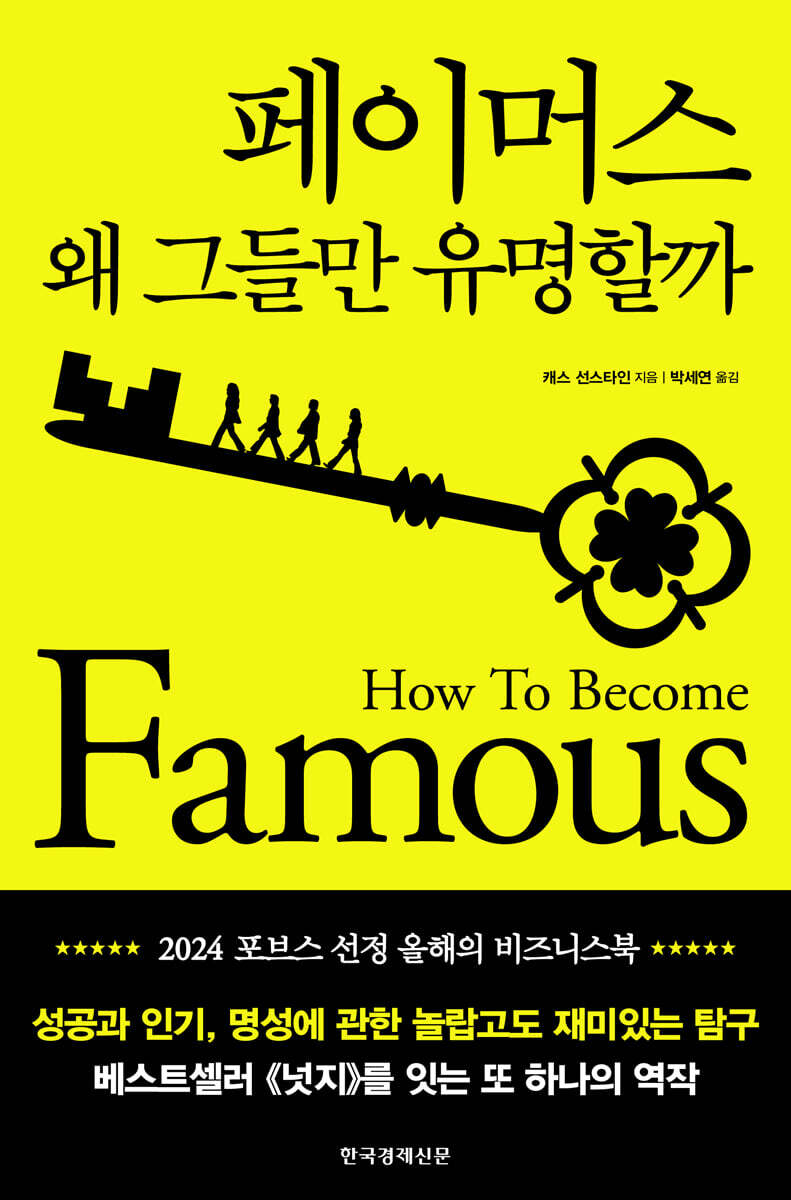
Famous: Why Are They the Only Ones Famous?
 |
Description
Book Introduction
Best Book of the Month, selected by B tv's Lee Dong-jin's Phaeacia
A hot topic from the author of the 2 million-copy bestseller "Nudge"
"How is fame born? Why do only certain people become famous?"
A surprising and entertaining exploration of success, popularity, and fame.
How did the success, popularity, and fame of countless celebrities come about? Was it simply a stroke of luck? Was the success of Einstein, Shakespeare, Leonardo da Vinci, Jane Austen, the Beatles, Bob Dylan, Stanley Lee, Oprah Winfrey, and many others truly inevitable or coincidental? It's difficult to imagine a world without popular stars, icons, and celebrities.
They may seem like they are a permanent part of our culture and history, but that is not the case.
Numerous and diverse factors, beyond individual ability, significantly influence success, failure, and reputation.
So, what is it about these people who, despite having similar talents and efforts, are particularly remembered?
This book explores the nature and mechanisms of fame, as well as the latest research, to explore why some people become famous and others remain, examining icons of their time in business, politics, music, literature, science, and the arts.
Based on this, I would like to reveal the surprising and powerful famous laws that show that actual success depends more on external circumstances, luck, coincidences, and the spirit of the times than on internal values such as talent or ability.
- You can preview some of the book's contents.
Preview
index
Prologue_Crossroads
Part 1 Iconic: How to Become an Icon
Chapter 1 Sliding Door
Chapter 2 Shock and Surprise
Chapter 3 Magic
Chapter 4: The Elephant in the Room
Part 2: Icons: How They Became Famous
Chapter 5: The Birth of a Famous Writer
Chapter 6: The Force Created by "Star Wars"
Chapter 7: The Irresistible Stan Lee
Chapter 8: Bob Dylan's Habitualization
Chapter 9: Houdini's Great Challenge
Chapter 10: Ayn Rand's Cult
Chapter 11 John, Paul, George, and Ringo
Epilogue_In favorable circumstances
Acknowledgements
main
Part 1 Iconic: How to Become an Icon
Chapter 1 Sliding Door
Chapter 2 Shock and Surprise
Chapter 3 Magic
Chapter 4: The Elephant in the Room
Part 2: Icons: How They Became Famous
Chapter 5: The Birth of a Famous Writer
Chapter 6: The Force Created by "Star Wars"
Chapter 7: The Irresistible Stan Lee
Chapter 8: Bob Dylan's Habitualization
Chapter 9: Houdini's Great Challenge
Chapter 10: Ayn Rand's Cult
Chapter 11 John, Paul, George, and Ringo
Epilogue_In favorable circumstances
Acknowledgements
main
Detailed image
Into the book
One goal of this book is to emphasize the importance of luck.
This is because we often make the mistake of trying to attribute tremendous success solely to an individual's internal qualities.
Of course, those who succeed are special.
The Beatles were special.
Taylor Swift was also special.
If they weren't special, they wouldn't have been so successful.
But how did they become special? How did they acquire these special talents? In no case did their success stem from their individual uniqueness alone.
And countless extraordinary people in business, politics, science, and the arts have failed to achieve great success.
Here I want to open the lid of the black box called luck and see what's inside.
We can create at least some luck.
--- pp.12-13
The Matthew Effect is a phenomenon discovered and studied by sociologist Robert Merton in 1968.
The reason Merton gave it that name was because of the Gospel of Matthew.
Among them, Matthew 25:29 in particular says this:
“For those who have, more will be given, and they will become richer, but those who do not have, what they have will be taken away, and they will become poorer.” In simple terms, this means that the rich will become richer, and the poor will become poorer.
This intuitive idea explains the concept of 'cumulative profit' well.
Cumulative gains mean that an initial advantage or existing advantageous position becomes more powerful over time.
In other words, the more famous you are, the easier it is to become famous.
--- pp.93-94
Many cultural products benefit from network effects.
People assume that they should know about certain cultural products.
If many people like Romantic poetry and the Beatles, we'll be interested in it for one reason above all else.
It's because I don't want to be left out.
We all want to be part of a group that is meaningful to us.
When a book or movie becomes incredibly popular, it's usually because of network effects.
Taylor Swift is a great singer.
I like it too.
But she also achieved tremendous success in part because she wanted to be part of a group that more and more people knew, liked, and loved her.
--- pp.107-108
When it comes to innovation in general, social scientists often speak, in a tone very similar to Jane Franklin's, of "the unnoticed Einsteins who, had they experienced innovation early in life, would have achieved remarkable things."
In particular, they note the importance of demographic factors such as race, gender, and socioeconomic status, as well as role models and network effects that contribute to success.
Many potential innovators in fields like science and business are born into families where they lack the right role models, are oppressed in many ways, or lack access to networking resources.
And in the end, innovation fails.
They don't win the lottery of life, let alone many other minor lotteries.
Would young Cassius Clay have become the world's most famous man if his bicycle hadn't been stolen? And aren't there athletes more skilled than Muhammad Ali who never stood before the public eye?
--- p.288
We want to give the many “Hunts and Saudis” another chance.
The main reason is that they failed due to accidental circumstances”.
We want to give many people another chance for the same reason.
(…) These thoughts also point to possibilities or inspiration.
There are countless Einsteins, Shakespeares, or Miltons who have not received much attention, and they could all be rediscovered.
In fact, they are being discovered every day.
The Mona Lisa and Jane Austen, William Blake, John Keats, Robert Johnson and Connie Converse are still being discovered, just as new discoveries are being made.
And if we continue to pay attention to the presence of those who may be among us right now, there will be fewer who disappear without receiving attention in the first place.
This is because we often make the mistake of trying to attribute tremendous success solely to an individual's internal qualities.
Of course, those who succeed are special.
The Beatles were special.
Taylor Swift was also special.
If they weren't special, they wouldn't have been so successful.
But how did they become special? How did they acquire these special talents? In no case did their success stem from their individual uniqueness alone.
And countless extraordinary people in business, politics, science, and the arts have failed to achieve great success.
Here I want to open the lid of the black box called luck and see what's inside.
We can create at least some luck.
--- pp.12-13
The Matthew Effect is a phenomenon discovered and studied by sociologist Robert Merton in 1968.
The reason Merton gave it that name was because of the Gospel of Matthew.
Among them, Matthew 25:29 in particular says this:
“For those who have, more will be given, and they will become richer, but those who do not have, what they have will be taken away, and they will become poorer.” In simple terms, this means that the rich will become richer, and the poor will become poorer.
This intuitive idea explains the concept of 'cumulative profit' well.
Cumulative gains mean that an initial advantage or existing advantageous position becomes more powerful over time.
In other words, the more famous you are, the easier it is to become famous.
--- pp.93-94
Many cultural products benefit from network effects.
People assume that they should know about certain cultural products.
If many people like Romantic poetry and the Beatles, we'll be interested in it for one reason above all else.
It's because I don't want to be left out.
We all want to be part of a group that is meaningful to us.
When a book or movie becomes incredibly popular, it's usually because of network effects.
Taylor Swift is a great singer.
I like it too.
But she also achieved tremendous success in part because she wanted to be part of a group that more and more people knew, liked, and loved her.
--- pp.107-108
When it comes to innovation in general, social scientists often speak, in a tone very similar to Jane Franklin's, of "the unnoticed Einsteins who, had they experienced innovation early in life, would have achieved remarkable things."
In particular, they note the importance of demographic factors such as race, gender, and socioeconomic status, as well as role models and network effects that contribute to success.
Many potential innovators in fields like science and business are born into families where they lack the right role models, are oppressed in many ways, or lack access to networking resources.
And in the end, innovation fails.
They don't win the lottery of life, let alone many other minor lotteries.
Would young Cassius Clay have become the world's most famous man if his bicycle hadn't been stolen? And aren't there athletes more skilled than Muhammad Ali who never stood before the public eye?
--- p.288
We want to give the many “Hunts and Saudis” another chance.
The main reason is that they failed due to accidental circumstances”.
We want to give many people another chance for the same reason.
(…) These thoughts also point to possibilities or inspiration.
There are countless Einsteins, Shakespeares, or Miltons who have not received much attention, and they could all be rediscovered.
In fact, they are being discovered every day.
The Mona Lisa and Jane Austen, William Blake, John Keats, Robert Johnson and Connie Converse are still being discovered, just as new discoveries are being made.
And if we continue to pay attention to the presence of those who may be among us right now, there will be fewer who disappear without receiving attention in the first place.
--- pp.290-291
Publisher's Review
A masterpiece following the international bestseller and steady seller, Nudge.
★ 2024 Forbes Business Book of the Year ★
★ Recommended by Financial Times, Forbes, and Kirkus Reviews ★
“Why do some people get remembered while others disappear despite similar talent and effort?”
An exciting journey about the opportunity and possibility that anyone can become famous.
Let's think about some of the most famous music groups in history.
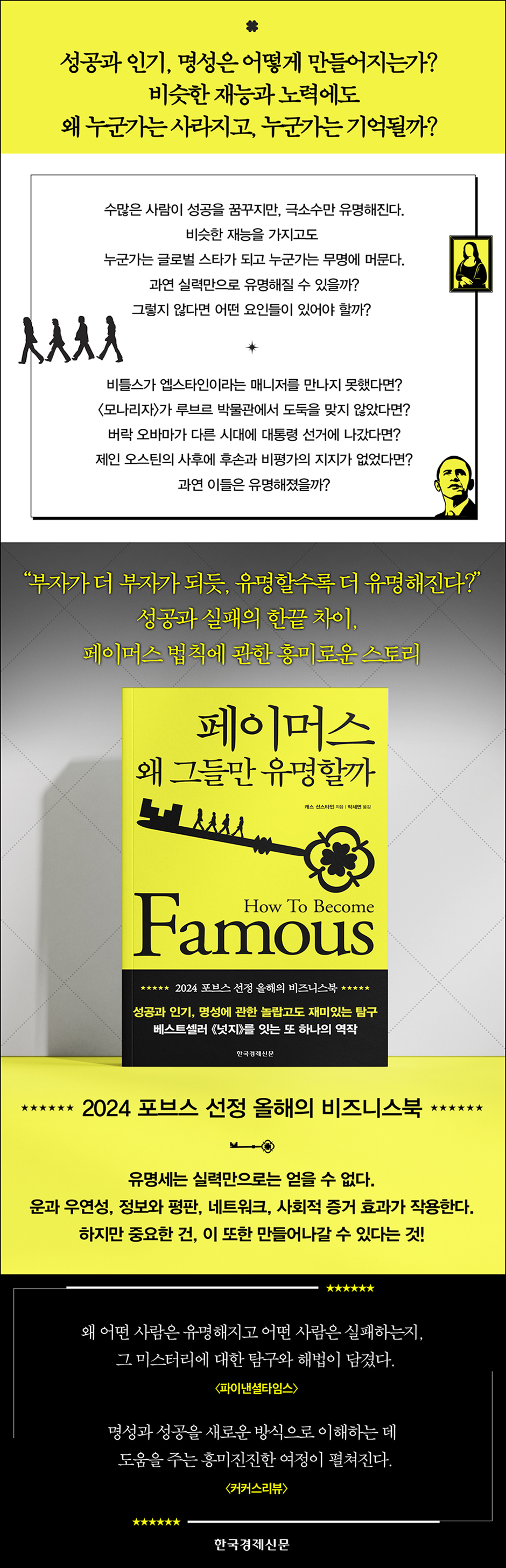
What would the world be like if the Beatles never existed? This is the question posed by the thought-provoking film "Yesterday" (2019), which begins with a young, unknown singer introducing the Beatles' songs to a world that has never heard them before.
Could the Beatles' songs, on their own, have achieved the same phenomenal popularity as the world they infused? Was their unparalleled talent the sole inevitability of their success? Then, what about the famous painting, the Mona Lisa? Had it not been stolen from the Louvre in 1911, would it have been recognized as such today? And what about Barack Obama, the first African-American president of the United States? Would he have won if he had run in 1948, 1960, 1972, or 1980, instead of 2008?
Cass Sunstein, who has been actively writing, including the world-renowned bestseller "Nudge," a masterpiece in behavioral economics, and the groundbreaking "Look Again," which delves into the useful truths of habit formation/unhabituation that can help individuals' lives, has returned with surprising stories of people who have achieved both success and popularity.
Based on the latest research, the author argues that the reason for becoming famous, which is something that everyone would be curious about, is the product of the perfect coincidence of unpredictable socio-cultural backgrounds, zeitgeist, sponsorship and fan support, countless coincidental circumstances and luck.
Talent is just the starting point! If only we could unlock the black box of the various factors that create fame, wouldn't we also be able to create a measure of luck? This book explores the opportunities and possibilities that anyone can have to become famous.
Icons of their time, how did they become famous?
Countless failed Einsteins and forgotten superstars,
What is the secret behind the birth of the Beatles?
In the book, the author quotes a passage from the Old Testament book of Ecclesiastes.
“The race is not won by the speed, the war is not won by the strength, the bread is not bought by the clever, the wealth is not bought by the knowledge, and the grace is not bought by the skill.
But time and opportunity come to them all.” Therein lies the important message.
There is no single secret to becoming famous, but there are certainly objective factors.
In fact, what happens in an individual's life is impossible to predict.
And the judgment of history is capricious.
Many people do truly amazing and creative things, but often don't get the opportunities or recognition they deserve.
Especially in areas where results are not evident, such as test scores or athletic skills, an individual's internal qualities or level are only the basic foundation, and external factors such as chance opportunities, encounters, or luck can play a decisive role.
So how did these icons of our time become famous? Part 1 focuses on renowned artists from business, politics, music, literature, science, and the arts. To find answers, we delve into cutting-edge research on power laws, information cascades, reputation cascades, network effects, and group polarization.
And in reality, it turns out that fame is more a function of a multitude of factors than innate talent, hard work, perseverance, and creativity: chance factors like time, wealth, gender, race, and patronage.
And in Part 2, we take a closer look at the journeys of 13 celebrities on their path to fame.
Through specific anecdotes about writers William Blake, Jane Austen, John Keats, and Ayn Rand; filmmakers George Lucas and Stan Lee; magician Harry Houdini and psychic Mina Crandon; singer Bob Dylan; and Beatles members John Lennon, Paul McCartney, George Harrison, and Ringo Starr, this book delves into the fascinating journeys of how icons of their respective fields created their own opportunities and built their reputations.
“Just as the rich get richer, the more famous you are, the more famous you become?”
Discover the famous laws that make the difference between success and failure!
The topic of fame is not only a window into fundamental elements such as talent and level, but also into the zeitgeist, politics, economics, business, social culture, science, and religion involved.
Through that window, it reveals the hidden laws that govern the growth of religions like Christianity, the evaluation of literary works that have become immortal classics in history, and the creation of legendary films and works of art that have long been loved by the public.
And just as the rich get richer, the more famous you become, the more famous you become. If you properly utilize the famous laws, it shows in detail through various academic fields and cases that you can live a much richer and more useful life.
However, the author argues that, as the saying goes, “Success stories create a false perception of success,” and that we cannot find answers for the future by simply generalizing the commonalities found in the icons of our time.
This is because the evaluation of human life or art can change at any time depending on the passage of time and changes in the environment.
Many innovators have failed due to various factors that did not work in their favor.
Either the zeitgeist wasn't on their side, the wave of opportunity they needed to ride wasn't coming, they didn't find the right competitors and sponsors, or they didn't have the support of a network or reputation.
On the other hand, some people have succeeded due to the above factors.
This also means that for some people, there are still moments of possibility left.
We live in an era of personal branding, where anyone can have a personal channel on YouTube, Instagram, and other platforms to promote themselves.
This book, which presents a fascinating account of issues worth considering in modern society, based on the interesting case studies of various figures and abundant research results, will allow us to learn how icons of the times, best-selling books, million-selling albums, and blockbuster movies are created.
And this could be an alternative to rediscovering other (unnoticed) Beatles, Shakespeares, and Einsteins who may be around us, whether in our personal or business spheres.
★ 2024 Forbes Business Book of the Year ★
★ Recommended by Financial Times, Forbes, and Kirkus Reviews ★
“Why do some people get remembered while others disappear despite similar talent and effort?”
An exciting journey about the opportunity and possibility that anyone can become famous.
Let's think about some of the most famous music groups in history.
What would the world be like if the Beatles never existed? This is the question posed by the thought-provoking film "Yesterday" (2019), which begins with a young, unknown singer introducing the Beatles' songs to a world that has never heard them before.
Could the Beatles' songs, on their own, have achieved the same phenomenal popularity as the world they infused? Was their unparalleled talent the sole inevitability of their success? Then, what about the famous painting, the Mona Lisa? Had it not been stolen from the Louvre in 1911, would it have been recognized as such today? And what about Barack Obama, the first African-American president of the United States? Would he have won if he had run in 1948, 1960, 1972, or 1980, instead of 2008?
Cass Sunstein, who has been actively writing, including the world-renowned bestseller "Nudge," a masterpiece in behavioral economics, and the groundbreaking "Look Again," which delves into the useful truths of habit formation/unhabituation that can help individuals' lives, has returned with surprising stories of people who have achieved both success and popularity.
Based on the latest research, the author argues that the reason for becoming famous, which is something that everyone would be curious about, is the product of the perfect coincidence of unpredictable socio-cultural backgrounds, zeitgeist, sponsorship and fan support, countless coincidental circumstances and luck.
Talent is just the starting point! If only we could unlock the black box of the various factors that create fame, wouldn't we also be able to create a measure of luck? This book explores the opportunities and possibilities that anyone can have to become famous.
Icons of their time, how did they become famous?
Countless failed Einsteins and forgotten superstars,
What is the secret behind the birth of the Beatles?
In the book, the author quotes a passage from the Old Testament book of Ecclesiastes.
“The race is not won by the speed, the war is not won by the strength, the bread is not bought by the clever, the wealth is not bought by the knowledge, and the grace is not bought by the skill.
But time and opportunity come to them all.” Therein lies the important message.
There is no single secret to becoming famous, but there are certainly objective factors.
In fact, what happens in an individual's life is impossible to predict.
And the judgment of history is capricious.
Many people do truly amazing and creative things, but often don't get the opportunities or recognition they deserve.
Especially in areas where results are not evident, such as test scores or athletic skills, an individual's internal qualities or level are only the basic foundation, and external factors such as chance opportunities, encounters, or luck can play a decisive role.
So how did these icons of our time become famous? Part 1 focuses on renowned artists from business, politics, music, literature, science, and the arts. To find answers, we delve into cutting-edge research on power laws, information cascades, reputation cascades, network effects, and group polarization.
And in reality, it turns out that fame is more a function of a multitude of factors than innate talent, hard work, perseverance, and creativity: chance factors like time, wealth, gender, race, and patronage.
And in Part 2, we take a closer look at the journeys of 13 celebrities on their path to fame.
Through specific anecdotes about writers William Blake, Jane Austen, John Keats, and Ayn Rand; filmmakers George Lucas and Stan Lee; magician Harry Houdini and psychic Mina Crandon; singer Bob Dylan; and Beatles members John Lennon, Paul McCartney, George Harrison, and Ringo Starr, this book delves into the fascinating journeys of how icons of their respective fields created their own opportunities and built their reputations.
“Just as the rich get richer, the more famous you are, the more famous you become?”
Discover the famous laws that make the difference between success and failure!
The topic of fame is not only a window into fundamental elements such as talent and level, but also into the zeitgeist, politics, economics, business, social culture, science, and religion involved.
Through that window, it reveals the hidden laws that govern the growth of religions like Christianity, the evaluation of literary works that have become immortal classics in history, and the creation of legendary films and works of art that have long been loved by the public.
And just as the rich get richer, the more famous you become, the more famous you become. If you properly utilize the famous laws, it shows in detail through various academic fields and cases that you can live a much richer and more useful life.
However, the author argues that, as the saying goes, “Success stories create a false perception of success,” and that we cannot find answers for the future by simply generalizing the commonalities found in the icons of our time.
This is because the evaluation of human life or art can change at any time depending on the passage of time and changes in the environment.
Many innovators have failed due to various factors that did not work in their favor.
Either the zeitgeist wasn't on their side, the wave of opportunity they needed to ride wasn't coming, they didn't find the right competitors and sponsors, or they didn't have the support of a network or reputation.
On the other hand, some people have succeeded due to the above factors.
This also means that for some people, there are still moments of possibility left.
We live in an era of personal branding, where anyone can have a personal channel on YouTube, Instagram, and other platforms to promote themselves.
This book, which presents a fascinating account of issues worth considering in modern society, based on the interesting case studies of various figures and abundant research results, will allow us to learn how icons of the times, best-selling books, million-selling albums, and blockbuster movies are created.
And this could be an alternative to rediscovering other (unnoticed) Beatles, Shakespeares, and Einsteins who may be around us, whether in our personal or business spheres.
GOODS SPECIFICS
- Date of issue: February 20, 2025
- Page count, weight, size: 328 pages | 574g | 145*220*21mm
- ISBN13: 9788947549967
- ISBN10: 8947549967
You may also like
카테고리
korean


korean

![GQ KOREA Mark (Monthly): December [2025]](http://librairie.coreenne.fr/cdn/shop/files/8ef265dbbfbf186523ed75ba7319009d.jpg?v=1765340328&width=3840)


