

Don't try too hard
 |
Description
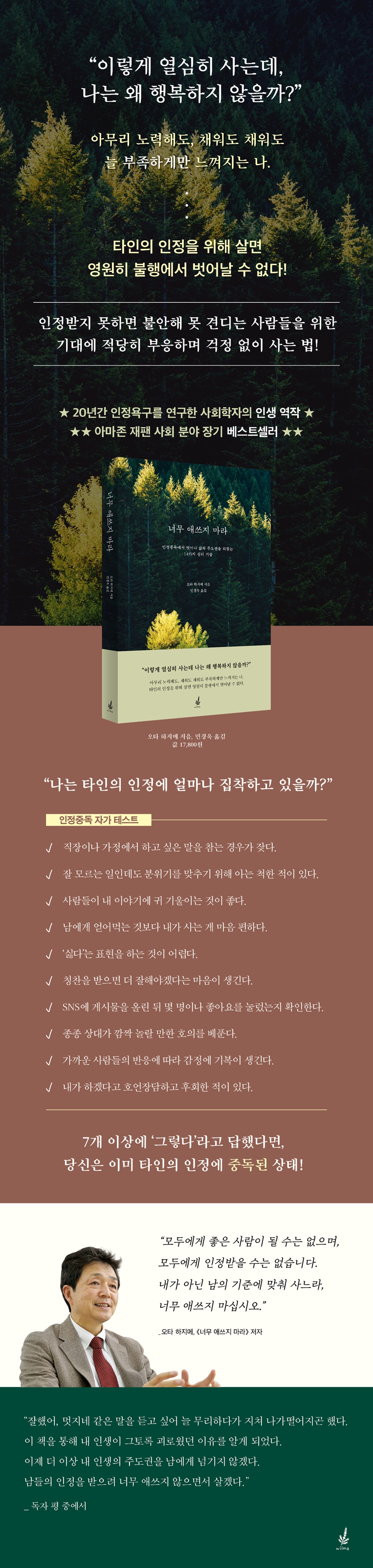
Book Introduction
★ Amazon Social Category Bestseller ★
★★ A masterpiece by a sociologist who has studied the desire for recognition for 20 years! ★★
“Don’t waste your life trying to show off to others.”
Much of human unhappiness stems from the desire for recognition.
A psychological solution for those who are unhappy because they are concerned about what others think!
The desire to hear others say, "Well done," "That's cool," or "That's okay," whether consciously or unconsciously, is the need for recognition.
The need for recognition is essential for a better life, but when it becomes excessive, it can lead to stress or burnout, making it difficult to even carry on with daily life.
This book presents various cases of approval addiction and points out that even behaviors we may not have thought were due to approval are fundamentally related to approval.
This reveals how pervasive and deeply rooted our obsession with recognition is in our work and lives, and how dangerous it is.
Furthermore, it tells us how to avoid shackling ourselves and trapping others in our need for recognition.
You can't be a good person to everyone, and you can't be accepted by everyone.
Through this book, let's reflect on our current state and think about how to healthily deal with the huge monster called the desire for recognition that hides within the human heart.
★★ A masterpiece by a sociologist who has studied the desire for recognition for 20 years! ★★
“Don’t waste your life trying to show off to others.”
Much of human unhappiness stems from the desire for recognition.
A psychological solution for those who are unhappy because they are concerned about what others think!
The desire to hear others say, "Well done," "That's cool," or "That's okay," whether consciously or unconsciously, is the need for recognition.
The need for recognition is essential for a better life, but when it becomes excessive, it can lead to stress or burnout, making it difficult to even carry on with daily life.
This book presents various cases of approval addiction and points out that even behaviors we may not have thought were due to approval are fundamentally related to approval.
This reveals how pervasive and deeply rooted our obsession with recognition is in our work and lives, and how dangerous it is.
Furthermore, it tells us how to avoid shackling ourselves and trapping others in our need for recognition.
You can't be a good person to everyone, and you can't be accepted by everyone.
Through this book, let's reflect on our current state and think about how to healthily deal with the huge monster called the desire for recognition that hides within the human heart.
- You can preview some of the book's contents.
Preview
index
Introductory remarks.
To you who is struggling to be recognized today too
Chapter 1.
The saying, "Praise makes even a whale dance" is wrong.
1.
The positive aspects of recognition and praise
The effect of a single flower / Measuring the effect of recognition / Praise vs. recognition / Everyone likes praise / The confidence that 'I can do it' / 'Words of recognition' that fill the gap in personnel evaluation / Positive effects of recognition / The more recognition you receive, the more anxious you become
2.
Why do people want to be recognized?
People driven by a desire for recognition / The sweet reward of recognition makes us addicted to it.
3.
People who risk their lives to be recognized
Creating Stories to Get Approved / Pathological Approval Addiction / Why Great Parents Have So Many Wrong Children / Taking Risks to Get Approved / Controlling the Need for Approval
Chapter 2.
When 'I want to be recognized' changes to 'I must be recognized'
1.
The desire for recognition drives us into a corner.
Why high-performing employees don't stay long / The 'praise scam' that controls us / One in three students has experienced the praise prison / Sometimes, praise is more dangerous than reprimand / Expectations from those around us increase the anxiety of 'needing to be recognized' / The saying 'you can overcome pressure when you get used to it' is false / The more you struggle, the deeper you fall into the 'praise ant hell' / There is pressure behind the jinx
2.
The misfortune of a recognized person
Dream come true.
What's next? / The pressure of 'winning is a given' / The story of a baseball player who lived only for 'wanting to be recognized' / Another misfortune brought about by acting consciously of others' expectations / Pretending to be someone different from myself in order to be recognized / The misfortune brought about by three Michelin stars / No one wants to lose the reputation they've earned.
3.
Why We're Obsessed with Recognition
When you lose recognition, your motivation and confidence disappear, and your grades drop. / You can never let go of recognition once you've earned it. / Asking for help means losing recognition. / Why do I keep getting sick before an important exam? / Don't expect anything from me. / The higher your position, the stronger your need for recognition. / Are famous and successful people free from the desire for recognition?
Chapter 3.
The tragedy brought about by the desire for recognition
1.
Praise drives us into a corner
Lessons from the death of a 24-year-old rookie employee / People who overwork themselves to be recognized / Unable to rest because they are too concerned about what others think / The more they overwork themselves, the more recognized they become / Why no matter how good the system is, it is useless / The desire for recognition is a good prey for passion pay / How do entrepreneurs exploit the desire for recognition / The obsession with recognition is the cause of depression / The better a person is, the more he or she cannot escape the prison called 'recognition' / Three factors that lead to the obsession with recognition
2.
The harder a person works, the more obsessed he or she becomes with recognition.
Frustrated by not being able to live up to rising expectations / Frustrated by the uselessness of previously recognized talents / Frustrated by not being able to lower expectations
3.
The need for recognition turns smart, honest people into troublemakers.
The constant desire for recognition pushes elites into a criminal trap / The gap between others' expectations of one's ability and one's actual ability / A structure that forces us to cling to evaluations and reputations within the organization / We lower ourselves to be recognized without being told to / Is it okay to cover up the wrongdoings committed to be recognized? / How does the pressure to achieve results lead to deviance / When everyone struggles with the desire for recognition, the entire organization falls into corruption / The worst consequences of the desire for recognition
4.
The desire for recognition leads to moral laxity.
People who are forced to rely on others' recognition for fear that if they are not recognized now, they will not get another chance / People who have no choice but to rely on others' recognition / The desire for recognition exerts a much greater power than strict punishment regulations / Success is achieved by relying on people, but problems cannot be solved by relying on people
Chapter 4.
Be free from the need for recognition
1.
How to avoid being crushed by the weight of other people's expectations
Letting go of the burden of 'I'll do better' / When individual effort and institutional reform come together / Let's recognize with monetary rewards, not words / We can eliminate unnecessary consideration through clear systems / Performance-based pay also includes 'the freedom to work moderately' / The courage not to be promoted
2.
Regaining Self-Efficacy
Success comes in many forms / Acknowledging and praising specific facts / Acknowledging and praising potential
3.
Think 'it's nothing'
Moving beyond immediate goals and envisioning a larger, more distant future / Being honest about your weaknesses / The role of a leader in reducing burdens / Seeking diversity in relationships
4.
Breaking free from communitarianism
No more 'family-like' companies / Become professionals who don't care about what others think / Break free from the obsession with being recognized
Conclusion.
Thinking about the darkness that lies beneath the desire to be recognized
To you who is struggling to be recognized today too
Chapter 1.
The saying, "Praise makes even a whale dance" is wrong.
1.
The positive aspects of recognition and praise
The effect of a single flower / Measuring the effect of recognition / Praise vs. recognition / Everyone likes praise / The confidence that 'I can do it' / 'Words of recognition' that fill the gap in personnel evaluation / Positive effects of recognition / The more recognition you receive, the more anxious you become
2.
Why do people want to be recognized?
People driven by a desire for recognition / The sweet reward of recognition makes us addicted to it.
3.
People who risk their lives to be recognized
Creating Stories to Get Approved / Pathological Approval Addiction / Why Great Parents Have So Many Wrong Children / Taking Risks to Get Approved / Controlling the Need for Approval
Chapter 2.
When 'I want to be recognized' changes to 'I must be recognized'
1.
The desire for recognition drives us into a corner.
Why high-performing employees don't stay long / The 'praise scam' that controls us / One in three students has experienced the praise prison / Sometimes, praise is more dangerous than reprimand / Expectations from those around us increase the anxiety of 'needing to be recognized' / The saying 'you can overcome pressure when you get used to it' is false / The more you struggle, the deeper you fall into the 'praise ant hell' / There is pressure behind the jinx
2.
The misfortune of a recognized person
Dream come true.
What's next? / The pressure of 'winning is a given' / The story of a baseball player who lived only for 'wanting to be recognized' / Another misfortune brought about by acting consciously of others' expectations / Pretending to be someone different from myself in order to be recognized / The misfortune brought about by three Michelin stars / No one wants to lose the reputation they've earned.
3.
Why We're Obsessed with Recognition
When you lose recognition, your motivation and confidence disappear, and your grades drop. / You can never let go of recognition once you've earned it. / Asking for help means losing recognition. / Why do I keep getting sick before an important exam? / Don't expect anything from me. / The higher your position, the stronger your need for recognition. / Are famous and successful people free from the desire for recognition?
Chapter 3.
The tragedy brought about by the desire for recognition
1.
Praise drives us into a corner
Lessons from the death of a 24-year-old rookie employee / People who overwork themselves to be recognized / Unable to rest because they are too concerned about what others think / The more they overwork themselves, the more recognized they become / Why no matter how good the system is, it is useless / The desire for recognition is a good prey for passion pay / How do entrepreneurs exploit the desire for recognition / The obsession with recognition is the cause of depression / The better a person is, the more he or she cannot escape the prison called 'recognition' / Three factors that lead to the obsession with recognition
2.
The harder a person works, the more obsessed he or she becomes with recognition.
Frustrated by not being able to live up to rising expectations / Frustrated by the uselessness of previously recognized talents / Frustrated by not being able to lower expectations
3.
The need for recognition turns smart, honest people into troublemakers.
The constant desire for recognition pushes elites into a criminal trap / The gap between others' expectations of one's ability and one's actual ability / A structure that forces us to cling to evaluations and reputations within the organization / We lower ourselves to be recognized without being told to / Is it okay to cover up the wrongdoings committed to be recognized? / How does the pressure to achieve results lead to deviance / When everyone struggles with the desire for recognition, the entire organization falls into corruption / The worst consequences of the desire for recognition
4.
The desire for recognition leads to moral laxity.
People who are forced to rely on others' recognition for fear that if they are not recognized now, they will not get another chance / People who have no choice but to rely on others' recognition / The desire for recognition exerts a much greater power than strict punishment regulations / Success is achieved by relying on people, but problems cannot be solved by relying on people
Chapter 4.
Be free from the need for recognition
1.
How to avoid being crushed by the weight of other people's expectations
Letting go of the burden of 'I'll do better' / When individual effort and institutional reform come together / Let's recognize with monetary rewards, not words / We can eliminate unnecessary consideration through clear systems / Performance-based pay also includes 'the freedom to work moderately' / The courage not to be promoted
2.
Regaining Self-Efficacy
Success comes in many forms / Acknowledging and praising specific facts / Acknowledging and praising potential
3.
Think 'it's nothing'
Moving beyond immediate goals and envisioning a larger, more distant future / Being honest about your weaknesses / The role of a leader in reducing burdens / Seeking diversity in relationships
4.
Breaking free from communitarianism
No more 'family-like' companies / Become professionals who don't care about what others think / Break free from the obsession with being recognized
Conclusion.
Thinking about the darkness that lies beneath the desire to be recognized
Detailed image
Into the book
I heard this story from a company I happened to visit.
One day, the president stopped by the factory for an inspection and praised the work attitude of a young employee who was skillfully operating the machine.
And as we parted ways, she patted his shoulder and said, "I'm looking forward to it, so do your best."
After that, he got the attention of his colleagues and arrived at work earlier than anyone else, prepared thoroughly, and then got to work.
But after a while, he took a leave of absence, claiming mental problems.
--- From "Introductory Remarks"
There are times when we cannot control our own need for recognition.
At first, you may have been able to control it, but then it becomes uncontrollable, or you may have thought that you had nothing to do with the need for recognition, but in reality, you may be secretly struggling with the need for recognition.
All of them are obsessed with the need for recognition, or are obsessed with the need for recognition.
It is more dangerous because it is something that we cannot control ourselves, and anyone can easily fall into it without being aware of it.
For example, in terms of diseases, cancer and arteriosclerosis progress quietly within the body.
Therefore, fundamental treatment, not symptomatic treatment, is needed.
--- 「Chapter 1.
The saying, “Praise makes even a whale dance” is wrong.
The first thing to keep in mind is that most of what is gained through recognition is lost without recognition.
We have previously shown that recognition increases intrinsic motivation, self-efficacy, increases satisfaction with performance and evaluation, improves work performance, and even has the effect of inhibiting job change.
Conversely, if you lose recognition, all of these effects disappear.
A decrease in intrinsic motivation means that things or activities that used to be enjoyable every day are no longer enjoyable.
--- Chapter 2.
From "When I Want to Be Recognized" to "I Must Be Recognized"
We secretly hope that if we are recognized for our contributions to the company or our superiors, we will have an advantage in performance evaluations, future promotions, and transfers.
I wonder if it would have a negative impact on my performance if I left work early or used up all my vacation days instead of working overtime.
The problem, as explained above, is that, unlike the exchange in economics, the relationship between gifts and benefits is not equivalent and uncertain, so there is no standard for how much one should contribute (donate).
So sometimes we find ourselves in situations where we have to work indefinitely.
If workers cannot abandon this mentality, no matter how much the government recommends efficient work methods or advocates for reduced working hours, it will not be very effective.
Therefore, it is more important to establish a way for efficient work to be recognized and connected than to create a tight-knit system.
Then, ‘work style reform’ will naturally take place.
--- From "Chapter 3: The Tragedy Caused by the Desire to Be Recognized"
Simply put, if you want to be free from burdens, just stop expecting things of yourself.
Of course, it's not as simple as it sounds.
If you completely abandon the expectations you worked so hard to achieve, the trust and reputation you've built up can crumble overnight.
The reason we become obsessed in the first place is because we are afraid of such situations.
Therefore, the first thing we must do to break free from the obsession with recognition is to adjust our expectations, which have become too high, to a level that matches our abilities.
Giving monetary compensation according to contribution or achievement is so-called performance-based pay.
When we think of performance-based pay, we usually think of a horse running forward with only its goal in mind, like a carrot dangling in front of its nose.
From a personal perspective, performance-based pay has the image of being a system where you get a big reward when you work hard and achieve results.
However, I would like to note that there is an opposite side to the original performance-based system.
Pure performance-based pay also includes the freedom to lower your own performance and receive compensation commensurate with it.
Self-employed people who live by the ultimate performance-based system are free to work and rest.
When you don't have the confidence to live up to expectations, the more you think, "This is all I have," or "I have nowhere to run," the more burden you feel.
Conversely, if you think, “I have many other things that are important to me,” or “It’s okay to run away for a while now,” the burden will be reduced.
Also, showing your weaknesses can help you overcome your fears and become mentally stronger.
In that sense, the ‘experience of failure’ is important.
One day, the president stopped by the factory for an inspection and praised the work attitude of a young employee who was skillfully operating the machine.
And as we parted ways, she patted his shoulder and said, "I'm looking forward to it, so do your best."
After that, he got the attention of his colleagues and arrived at work earlier than anyone else, prepared thoroughly, and then got to work.
But after a while, he took a leave of absence, claiming mental problems.
--- From "Introductory Remarks"
There are times when we cannot control our own need for recognition.
At first, you may have been able to control it, but then it becomes uncontrollable, or you may have thought that you had nothing to do with the need for recognition, but in reality, you may be secretly struggling with the need for recognition.
All of them are obsessed with the need for recognition, or are obsessed with the need for recognition.
It is more dangerous because it is something that we cannot control ourselves, and anyone can easily fall into it without being aware of it.
For example, in terms of diseases, cancer and arteriosclerosis progress quietly within the body.
Therefore, fundamental treatment, not symptomatic treatment, is needed.
--- 「Chapter 1.
The saying, “Praise makes even a whale dance” is wrong.
The first thing to keep in mind is that most of what is gained through recognition is lost without recognition.
We have previously shown that recognition increases intrinsic motivation, self-efficacy, increases satisfaction with performance and evaluation, improves work performance, and even has the effect of inhibiting job change.
Conversely, if you lose recognition, all of these effects disappear.
A decrease in intrinsic motivation means that things or activities that used to be enjoyable every day are no longer enjoyable.
--- Chapter 2.
From "When I Want to Be Recognized" to "I Must Be Recognized"
We secretly hope that if we are recognized for our contributions to the company or our superiors, we will have an advantage in performance evaluations, future promotions, and transfers.
I wonder if it would have a negative impact on my performance if I left work early or used up all my vacation days instead of working overtime.
The problem, as explained above, is that, unlike the exchange in economics, the relationship between gifts and benefits is not equivalent and uncertain, so there is no standard for how much one should contribute (donate).
So sometimes we find ourselves in situations where we have to work indefinitely.
If workers cannot abandon this mentality, no matter how much the government recommends efficient work methods or advocates for reduced working hours, it will not be very effective.
Therefore, it is more important to establish a way for efficient work to be recognized and connected than to create a tight-knit system.
Then, ‘work style reform’ will naturally take place.
--- From "Chapter 3: The Tragedy Caused by the Desire to Be Recognized"
Simply put, if you want to be free from burdens, just stop expecting things of yourself.
Of course, it's not as simple as it sounds.
If you completely abandon the expectations you worked so hard to achieve, the trust and reputation you've built up can crumble overnight.
The reason we become obsessed in the first place is because we are afraid of such situations.
Therefore, the first thing we must do to break free from the obsession with recognition is to adjust our expectations, which have become too high, to a level that matches our abilities.
Giving monetary compensation according to contribution or achievement is so-called performance-based pay.
When we think of performance-based pay, we usually think of a horse running forward with only its goal in mind, like a carrot dangling in front of its nose.
From a personal perspective, performance-based pay has the image of being a system where you get a big reward when you work hard and achieve results.
However, I would like to note that there is an opposite side to the original performance-based system.
Pure performance-based pay also includes the freedom to lower your own performance and receive compensation commensurate with it.
Self-employed people who live by the ultimate performance-based system are free to work and rest.
When you don't have the confidence to live up to expectations, the more you think, "This is all I have," or "I have nowhere to run," the more burden you feel.
Conversely, if you think, “I have many other things that are important to me,” or “It’s okay to run away for a while now,” the burden will be reduced.
Also, showing your weaknesses can help you overcome your fears and become mentally stronger.
In that sense, the ‘experience of failure’ is important.
--- From "Chapter 4: Freeing Yourself from the Need for Recognition"
Publisher's Review
“I work so hard, but why am I not happy?”
No matter how hard I try, no matter how much I fill myself up, I still feel like it's not enough.
If you live your life worrying about what others think and seeking their approval, you will never be able to escape unhappiness!
You may have seen someone who has reached the top of their field fall into misery trying to maintain it and wondered, "Why do they go to such lengths to meet the evaluations and expectations of those around them?"
People gain strength from the recognition of those around them, whether they are conscious of it or not.
So, without realizing it, I become obsessed with formless recognition.
Above all, the things we gain through recognition disappear like smoke the moment we lose recognition, which creates another source of anxiety.
Even in our daily lives, we are swayed by petty desires for recognition.
People who buy clothes that are much more expensive than they expected because of the compliments from the salesperson, people who force themselves to do work they hate because their friends praise them, people who cannot resist excessive work to meet the expectations of the company and their boss and end up quitting due to burnout, people who give up on tests or neglect their studies because they do not have confidence in their ability, athletes who commit dangerous fouls to get the approval of their coaches, leaders who have no choice but to depend on the approval of their students, and even people who commit 'random murder' to show off their presence.
The need for recognition controls our actions and lives without us even realizing it.
To those who feel anxious and can't stand not being recognized,
A scholar who has studied human desire for recognition for 20 years tells us
How to live up to expectations
There is an interesting comparison in the book.
A company awarded a prize and award to an employee who had worked there for 10 years.
The Japanese and Korean employees said, “Thank you, sir.
He is said to have replied, “I will work harder in the future and achieve good results.”
However, employees at the US and Southeast Asian branches said this.
"Do you recognize my contributions to this company over the past ten years? You should also give me a raise."
Their attitude towards recognition from others is completely different.
When Koreans receive recognition, they feel pressured to do better in the future, thinking, "I don't want to lose that recognition," or "I've been recognized in front of so many people."
You can never be happy like this.
Whether you live well or poorly, you feel dissatisfied and driven.
Most of the unhappy feelings we feel come from this ‘recognition from others.’
Why can't we acknowledge ourselves and say, "I did this well"? Fundamentally, why do we judge our lives through the eyes of others?
‘Recognition’ is something that depends on the will of others in the first place!
“Don’t try too hard” to live up to other people’s standards, not your own.
People have a nature to cling to recognition the more they receive.
However, the social atmosphere is further strengthening this nature.
Especially as we become more able to observe other people's lives more frequently and in more detail through social media, the instincts of 'recognition' and 'comparison' become more entangled in us.
They want to show off the body they worked hard to build, so they post pictures on social media and get a lot of likes. Then, to meet people's expectations, they exercise more and lose weight.
Since you were selected as the best employee of the year, you overwork yourself and say you have to do better next year, and you end up burning out.
People who only post photos on social media that have been heavily decorated with filters, people who risk their lives standing on the edge of cliffs to take extraordinary travel photos, and people who end up at the center of controversy by exaggerating their careers or exaggerating themselves in public places.
I blame them, but on the other hand, I don't completely understand their feelings.
It's just that there are differences in severity, but none of us are free from the 'desire for recognition'.
The desire to hear others say, "Well done," "That's cool," or "That's okay," whether consciously or unconsciously, is the need for recognition.
The need for recognition is essential for a better life, but when it becomes excessive, it can lead to stress or burnout, making it difficult to even carry on with daily life.
In the first place, recognition depends on the other person's will.
No matter how much you want to be recognized, no matter how hard you try, if the other person does not recognize you, your need for recognition will not be fulfilled.
No matter how powerful one's power and economic might are, one cannot gain recognition through force.
Of course, there are times when you receive unilateral recognition from others even though you didn't want it.
In this way, it is a need that requires the existence of others and is fulfilled through mutual dependence.
So the reason we are suffering now is not because we are ‘not doing well’, ‘not working hard’, ‘not earning enough money’, or ‘not fulfilling our responsibilities’.
It's just that others don't look at me and don't acknowledge me as much as I expected.
Just by consciously thinking, "This is okay, isn't it?" in everything, you can become much more free.
This book presents various cases of 'recognition addiction' and points out that even behaviors that we did not think were due to the need for recognition are fundamentally related to the need for recognition.
This reveals how pervasive and deeply rooted our obsession with recognition is in our work and lives, and how dangerous it is.
Furthermore, it tells us how to avoid shackling ourselves and trapping others in our need for recognition.
You can't be a good person to everyone, and you can't be accepted by everyone.
Through this book, let's reflect on our current state and think about how to healthily deal with the huge monster called the desire for recognition that hides within the human heart.
“It is so absurd and sad that such wonderful human qualities as a strong sense of responsibility and consideration for others become weaknesses.
“Aren’t you always sacrificing too much?”
No matter how hard I try, no matter how much I fill myself up, I still feel like it's not enough.
If you live your life worrying about what others think and seeking their approval, you will never be able to escape unhappiness!
You may have seen someone who has reached the top of their field fall into misery trying to maintain it and wondered, "Why do they go to such lengths to meet the evaluations and expectations of those around them?"
People gain strength from the recognition of those around them, whether they are conscious of it or not.
So, without realizing it, I become obsessed with formless recognition.
Above all, the things we gain through recognition disappear like smoke the moment we lose recognition, which creates another source of anxiety.
Even in our daily lives, we are swayed by petty desires for recognition.
People who buy clothes that are much more expensive than they expected because of the compliments from the salesperson, people who force themselves to do work they hate because their friends praise them, people who cannot resist excessive work to meet the expectations of the company and their boss and end up quitting due to burnout, people who give up on tests or neglect their studies because they do not have confidence in their ability, athletes who commit dangerous fouls to get the approval of their coaches, leaders who have no choice but to depend on the approval of their students, and even people who commit 'random murder' to show off their presence.
The need for recognition controls our actions and lives without us even realizing it.
To those who feel anxious and can't stand not being recognized,
A scholar who has studied human desire for recognition for 20 years tells us
How to live up to expectations
There is an interesting comparison in the book.
A company awarded a prize and award to an employee who had worked there for 10 years.
The Japanese and Korean employees said, “Thank you, sir.
He is said to have replied, “I will work harder in the future and achieve good results.”
However, employees at the US and Southeast Asian branches said this.
"Do you recognize my contributions to this company over the past ten years? You should also give me a raise."
Their attitude towards recognition from others is completely different.
When Koreans receive recognition, they feel pressured to do better in the future, thinking, "I don't want to lose that recognition," or "I've been recognized in front of so many people."
You can never be happy like this.
Whether you live well or poorly, you feel dissatisfied and driven.
Most of the unhappy feelings we feel come from this ‘recognition from others.’
Why can't we acknowledge ourselves and say, "I did this well"? Fundamentally, why do we judge our lives through the eyes of others?
‘Recognition’ is something that depends on the will of others in the first place!
“Don’t try too hard” to live up to other people’s standards, not your own.
People have a nature to cling to recognition the more they receive.
However, the social atmosphere is further strengthening this nature.
Especially as we become more able to observe other people's lives more frequently and in more detail through social media, the instincts of 'recognition' and 'comparison' become more entangled in us.
They want to show off the body they worked hard to build, so they post pictures on social media and get a lot of likes. Then, to meet people's expectations, they exercise more and lose weight.
Since you were selected as the best employee of the year, you overwork yourself and say you have to do better next year, and you end up burning out.
People who only post photos on social media that have been heavily decorated with filters, people who risk their lives standing on the edge of cliffs to take extraordinary travel photos, and people who end up at the center of controversy by exaggerating their careers or exaggerating themselves in public places.
I blame them, but on the other hand, I don't completely understand their feelings.
It's just that there are differences in severity, but none of us are free from the 'desire for recognition'.
The desire to hear others say, "Well done," "That's cool," or "That's okay," whether consciously or unconsciously, is the need for recognition.
The need for recognition is essential for a better life, but when it becomes excessive, it can lead to stress or burnout, making it difficult to even carry on with daily life.
In the first place, recognition depends on the other person's will.
No matter how much you want to be recognized, no matter how hard you try, if the other person does not recognize you, your need for recognition will not be fulfilled.
No matter how powerful one's power and economic might are, one cannot gain recognition through force.
Of course, there are times when you receive unilateral recognition from others even though you didn't want it.
In this way, it is a need that requires the existence of others and is fulfilled through mutual dependence.
So the reason we are suffering now is not because we are ‘not doing well’, ‘not working hard’, ‘not earning enough money’, or ‘not fulfilling our responsibilities’.
It's just that others don't look at me and don't acknowledge me as much as I expected.
Just by consciously thinking, "This is okay, isn't it?" in everything, you can become much more free.
This book presents various cases of 'recognition addiction' and points out that even behaviors that we did not think were due to the need for recognition are fundamentally related to the need for recognition.
This reveals how pervasive and deeply rooted our obsession with recognition is in our work and lives, and how dangerous it is.
Furthermore, it tells us how to avoid shackling ourselves and trapping others in our need for recognition.
You can't be a good person to everyone, and you can't be accepted by everyone.
Through this book, let's reflect on our current state and think about how to healthily deal with the huge monster called the desire for recognition that hides within the human heart.
“It is so absurd and sad that such wonderful human qualities as a strong sense of responsibility and consideration for others become weaknesses.
“Aren’t you always sacrificing too much?”
GOODS SPECIFICS
- Date of issue: January 8, 2025
- Page count, weight, size: 272 pages | 306g | 125*188*16mm
- ISBN13: 9791198889515
- ISBN10: 1198889519
You may also like
카테고리
korean


korean

![GQ KOREA Mark (Monthly): December [2025]](http://librairie.coreenne.fr/cdn/shop/files/8ef265dbbfbf186523ed75ba7319009d.jpg?v=1765340328&width=3840)


