

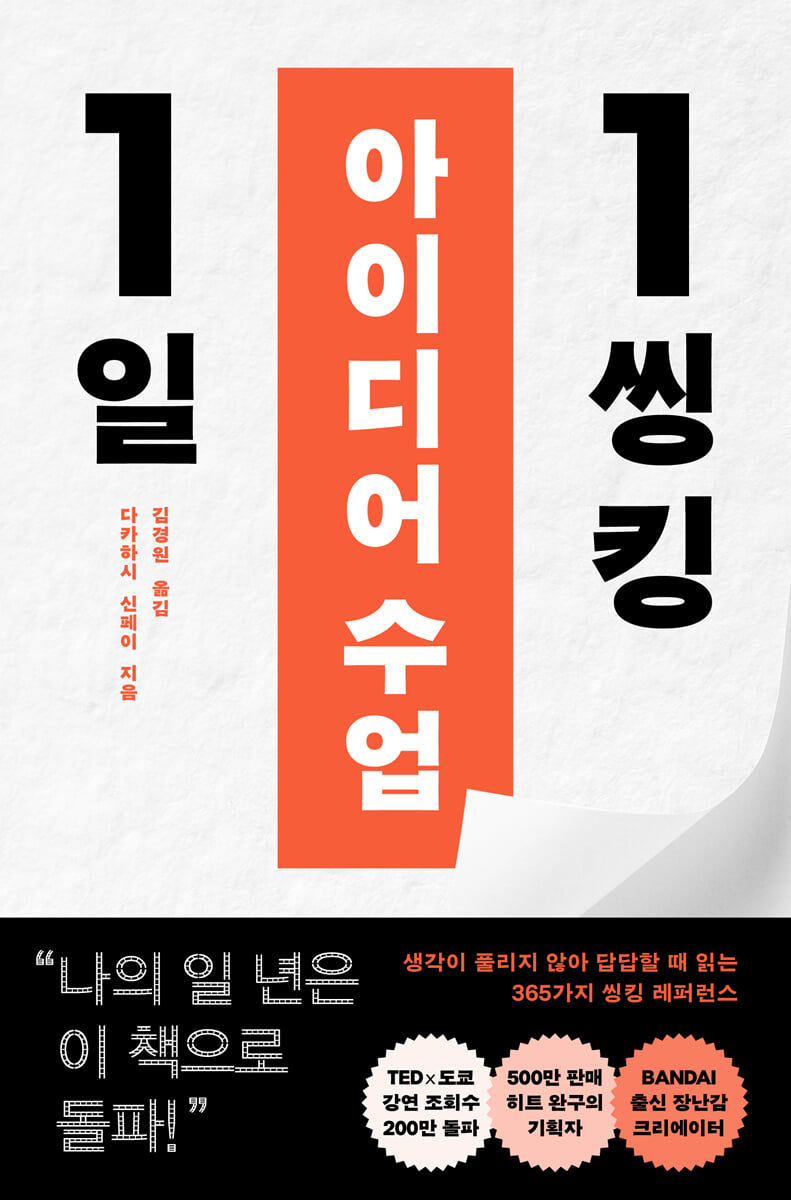
1 Thinking Idea a Day Class
 |
Description
Book Introduction
*** 365 Thinking References to Read One Page a Day When You're Feeling Stuck and Feeling Frustrated
*** Creative thinking from a toy creator from the hobby/entertainment company BANDAI
*** Lonely Gourmet, Attack on Titan, Asahi Draft Beer… Innovative ideas in Japan's unique cultural products.
A self-help book has been published to replenish the brains of planners, marketers, writers, and creators who have been struggling to come up with new ideas every day, only to find themselves exhausted and depleted.
This is the "1 Thinking Idea Class a Day" written by a famous Japanese toy and game developer.
The author is known to have developed the hit toy 'Infinite Bubble Wrap', which sold over 5 million units worldwide for Bandai Corporation.
This toy was inspired by the sight of people endlessly popping bubble wrap with their fingers, and was created to replicate that sensation and pleasure with silicone, allowing users to pop bubble wrap infinitely.
Adults who can't resist fidgeting with pens and cell phones, worship him! The author won the grand prize in the Trendy Toy category at the 1st Japan Toy Awards, and his idea generation lecture at TEDxTokyo has surpassed 2 million views.
You can learn all about the author's creative toy planning and marketing skills in this book.
“I wish I had Doraemon’s magic pouch.” 『1 Thinking Idea Class a Day』 is a storehouse of ideas and a box of inspiration for those who always need to create new content or products.
In particular, the author finds familiar yet advanced ideas in unique Japanese cultural products.
Learn work ethic from the drama "The Solitary Gourmet," break through the limitations of your imagination by reading the manga "Attack on Titan," and master contextual marketing from Asahi draft beer cans.
The various stories about gacha gacha (capsule toys), kendama (rice balls), yakitori (chicken skewers), ekiben (lunch boxes), etc. provide an experience as if you were traveling to every corner of Japan and getting inspiration.
With the motto, "Find one idea a day and your life will change," this book organizes numerous ideas discovered or thought of by the author in various fields such as work/study/family/hobbies/love/money/career path, one page at a time, so that each can be read in one minute.
Let's start the year off fresh by reading 365 chapters with a light heart, one page a day.
*** Creative thinking from a toy creator from the hobby/entertainment company BANDAI
*** Lonely Gourmet, Attack on Titan, Asahi Draft Beer… Innovative ideas in Japan's unique cultural products.
A self-help book has been published to replenish the brains of planners, marketers, writers, and creators who have been struggling to come up with new ideas every day, only to find themselves exhausted and depleted.
This is the "1 Thinking Idea Class a Day" written by a famous Japanese toy and game developer.
The author is known to have developed the hit toy 'Infinite Bubble Wrap', which sold over 5 million units worldwide for Bandai Corporation.
This toy was inspired by the sight of people endlessly popping bubble wrap with their fingers, and was created to replicate that sensation and pleasure with silicone, allowing users to pop bubble wrap infinitely.
Adults who can't resist fidgeting with pens and cell phones, worship him! The author won the grand prize in the Trendy Toy category at the 1st Japan Toy Awards, and his idea generation lecture at TEDxTokyo has surpassed 2 million views.
You can learn all about the author's creative toy planning and marketing skills in this book.
“I wish I had Doraemon’s magic pouch.” 『1 Thinking Idea Class a Day』 is a storehouse of ideas and a box of inspiration for those who always need to create new content or products.
In particular, the author finds familiar yet advanced ideas in unique Japanese cultural products.
Learn work ethic from the drama "The Solitary Gourmet," break through the limitations of your imagination by reading the manga "Attack on Titan," and master contextual marketing from Asahi draft beer cans.
The various stories about gacha gacha (capsule toys), kendama (rice balls), yakitori (chicken skewers), ekiben (lunch boxes), etc. provide an experience as if you were traveling to every corner of Japan and getting inspiration.
With the motto, "Find one idea a day and your life will change," this book organizes numerous ideas discovered or thought of by the author in various fields such as work/study/family/hobbies/love/money/career path, one page at a time, so that each can be read in one minute.
Let's start the year off fresh by reading 365 chapters with a light heart, one page a day.
- You can preview some of the book's contents.
Preview
index
Introduction: One Idea a Day to Dramatically Change Your Life
January: Easing the Burden of Ideas
February: Break common sense first.
March: Actually, the first thought might be the best.
April: Pros pursue persistent wandering, not perfection.
May: Creativity Has Its Answers
June: How to Attract Unexpected Luck
July: Easy enough for a child to understand
August: Don't keep your plans a secret.
September: Accidents and incidents are golden opportunities.
October: The idea is teamwork.
November: Only one core customer
December: Let's start small and raise them big.
Conclusion: 11 Key Ideas
Index by purpose
January: Easing the Burden of Ideas
February: Break common sense first.
March: Actually, the first thought might be the best.
April: Pros pursue persistent wandering, not perfection.
May: Creativity Has Its Answers
June: How to Attract Unexpected Luck
July: Easy enough for a child to understand
August: Don't keep your plans a secret.
September: Accidents and incidents are golden opportunities.
October: The idea is teamwork.
November: Only one core customer
December: Let's start small and raise them big.
Conclusion: 11 Key Ideas
Index by purpose
Detailed image

Into the book
The market for toys sold from vending machines, called capsule toys (gacha gacha), is said to be a huge business market worth approximately 45 billion yen as of 2021, and you can see vending machines lined up in large numbers in shopping facilities and other places.
It is.
Capsule toys are a great invention because they allow you to buy fun toys anywhere for just a few coins, but what makes them truly great is that they are a system that allows for an infinite number of product ideas.
--- p.37, from “The Greatness of Capsule Toys, Where Ideas Proliferate Infinitely” on January 8th
There's a simple idea generation technique I can recommend to anyone.
It's a method of thinking called 'Nikoichi' where when one idea comes to mind, you must pair it with an idea that is the reverse of that idea.
For example, if you were trying to think of a title for a book that teaches you how to speak well, you might think of "How to Become a Better Speaker." But you might also come up with a title that is paradoxical and counterintuitive: "Why You Inadvertently Speak Wrong."
Then the idea is divided into two.
It's very simple.
--- p.76, from “Nikoichi’s Idea Creation Method that Doubles Your Ideas on February 15th”
I'm thinking of a product idea called 'AB Type Notebook'.
This is a special note for people with blood type AB.
The left and right pages are divided into 'Side A' and 'Side B'. When thinking of something, write down your serious and meticulously thought-out ideas on Side A, and write down your free-spirited ideas on Side B.
And the balanced idea is written in the middle.
This allows you to come up with ideas that are subtle, yet bold and fun.
--- p.111, from “Let’s think about a product exclusively for type AB on March 20th”
When I was a company employee, I planned, developed, and sold a toy called "300 Million Yen."
This is a figure of a wad of money containing a whopping 300 million yen.
This miniature figure contains 30 1,000,000 yen bill bundle figures in a duralumin case bag. You can take out the bill bundles and display them or play with them.
You might be wondering, 'What on earth is the purpose of this product?', but as soon as this product was released, fans of various character figures started posting pictures of themselves using the money bundles on the Internet.
--- p.126, from "Learning Marketing Mindset with the 300 Million Yen Figure on April 3rd"
There is a store called 'King's Idea' that was founded in 1965 and has captivated countless people and is now an online mail-order site.
The products that the King's Idea deals with are 'non-essentials' that are mostly just for laughter and enjoyment.
There are piggy banks that can collect 1 million yen, drinking birds that can drink water endlessly, and moras that move between your fingers, etc.
Does the world really need such strange products? Why do creators continue to create them?
--- p.177, from "May 22nd Useless General Store 'The King's Idea'"
When I buy horseradish and mustard in tube containers, I always choose S&B's "Honnama Series."
There are a few minor reasons.
The differences in the contents include that the horseradish is not made from Western horseradish, the mustard is made by 'grinding' rather than cracking, the gold-plated packaging box, and the emphasis on being number one in the food category.
But the first reason I instinctively choose this product is because the food pictured on the packaging looks delicious.
--- p.213, from “The Importance of Visual Information Learned from Wasabi Packaging on June 26”
Businessmen always try to think of 'what will sell'.
I would advise such a person to think about what is 'something that will never sell'.
Imagine developing a new product called a 'dirty, smelly rag'.
You might think that no one would buy something like that, but it might sell for a piece or two as a valuable item used in a shocking project for a television entertainment program.
It's surprisingly difficult to think of a product that will never sell.
--- p.223, from "A Breakthrough in July 4th Marketing: Think of Things That Won't Sell at All"
Kawakami Sangyo Co., Ltd.'s bubble wrap sheet, used to package fragile items, is now common knowledge.
By the way, do you know about the new product 'Bakbak-i (Spaspaspaspa)', which can be said to be an evolution of Bapbak-i?
Bubble wrap has round air particles, while pakbak has square air particles arranged in a checkerboard pattern. If you tear it by hand along the gaps between the particles, you can cut it in a straight line.
--- p.256, from “The idea of ‘Parkbak-i’, born from the evolution of ‘Bubble Wrap’ on August 8”
There is an unforgettable episode in Daisuke Terasawa's manga "Mr. Sushi King," which I was obsessed with reading when I was in high school.
While rolling out hundreds of kimbap rolls for delivery, the chef scolds me for making one poorly made roll.
“For the person who eats that one piece, that kimbap is everything!” There is a good chance that something like this will happen while you are working.
--- p.297, from “Learning the Basics of Kimchi Sushi from Mr. Sushi King on September 14th”
Pilot's Friction Ball, familiar as an "erasable ballpoint pen," has become a must-have for many people.
I've been using it for a long time too.
I remember when I was a child and tried to erase the words I wrote on paper with a ballpoint pen with an eraser, my mother taught me, “You can’t erase with a ballpoint pen.”
Because it was an idea that broke the common sense that has been ingrained in our minds since childhood, that is, “Once you use a ballpoint pen, you can’t erase it,” people must have exclaimed “I want one!” with excited hearts.
--- p.335, from “Two Common Sense Changed by Friction Ball on October 20th”
I've introduced a method of thinking called "idea tail biting," and I've been using it in my work, such as planning and development, and recommending it to others.
First, if there is a topic you want to think of ideas for, don't think of anything and play a word game alone.
Write down the ideas that come to mind on paper, using the words that will come next as hints.
Let me give you a simple example.
When thinking about what to do with your family on holidays, you might think of a word chain game like this: Ringo (apple) → Gorilla (gorilla) → Ratpa (trumpet)... and so on.
--- p.362, from “The Best Idea Generation Method of November 15: ‘Biting the Tail of Ideas’”
For the Lunar New Year in 2022, our company developed a product called "Omamoyashi" and sold it for a limited time.
This is a miscellaneous item that contains an extremely realistic bean sprout (moyashi) figure in a case that holds an omamori (talisman).
I grew up with a very thin body, and my parents and classmates told me I looked like a bean sprout.
At the time, I was sad, but when I grew up and did some research, I found out that bean sprouts have many characteristics that indicate good omens.
It is.
Capsule toys are a great invention because they allow you to buy fun toys anywhere for just a few coins, but what makes them truly great is that they are a system that allows for an infinite number of product ideas.
--- p.37, from “The Greatness of Capsule Toys, Where Ideas Proliferate Infinitely” on January 8th
There's a simple idea generation technique I can recommend to anyone.
It's a method of thinking called 'Nikoichi' where when one idea comes to mind, you must pair it with an idea that is the reverse of that idea.
For example, if you were trying to think of a title for a book that teaches you how to speak well, you might think of "How to Become a Better Speaker." But you might also come up with a title that is paradoxical and counterintuitive: "Why You Inadvertently Speak Wrong."
Then the idea is divided into two.
It's very simple.
--- p.76, from “Nikoichi’s Idea Creation Method that Doubles Your Ideas on February 15th”
I'm thinking of a product idea called 'AB Type Notebook'.
This is a special note for people with blood type AB.
The left and right pages are divided into 'Side A' and 'Side B'. When thinking of something, write down your serious and meticulously thought-out ideas on Side A, and write down your free-spirited ideas on Side B.
And the balanced idea is written in the middle.
This allows you to come up with ideas that are subtle, yet bold and fun.
--- p.111, from “Let’s think about a product exclusively for type AB on March 20th”
When I was a company employee, I planned, developed, and sold a toy called "300 Million Yen."
This is a figure of a wad of money containing a whopping 300 million yen.
This miniature figure contains 30 1,000,000 yen bill bundle figures in a duralumin case bag. You can take out the bill bundles and display them or play with them.
You might be wondering, 'What on earth is the purpose of this product?', but as soon as this product was released, fans of various character figures started posting pictures of themselves using the money bundles on the Internet.
--- p.126, from "Learning Marketing Mindset with the 300 Million Yen Figure on April 3rd"
There is a store called 'King's Idea' that was founded in 1965 and has captivated countless people and is now an online mail-order site.
The products that the King's Idea deals with are 'non-essentials' that are mostly just for laughter and enjoyment.
There are piggy banks that can collect 1 million yen, drinking birds that can drink water endlessly, and moras that move between your fingers, etc.
Does the world really need such strange products? Why do creators continue to create them?
--- p.177, from "May 22nd Useless General Store 'The King's Idea'"
When I buy horseradish and mustard in tube containers, I always choose S&B's "Honnama Series."
There are a few minor reasons.
The differences in the contents include that the horseradish is not made from Western horseradish, the mustard is made by 'grinding' rather than cracking, the gold-plated packaging box, and the emphasis on being number one in the food category.
But the first reason I instinctively choose this product is because the food pictured on the packaging looks delicious.
--- p.213, from “The Importance of Visual Information Learned from Wasabi Packaging on June 26”
Businessmen always try to think of 'what will sell'.
I would advise such a person to think about what is 'something that will never sell'.
Imagine developing a new product called a 'dirty, smelly rag'.
You might think that no one would buy something like that, but it might sell for a piece or two as a valuable item used in a shocking project for a television entertainment program.
It's surprisingly difficult to think of a product that will never sell.
--- p.223, from "A Breakthrough in July 4th Marketing: Think of Things That Won't Sell at All"
Kawakami Sangyo Co., Ltd.'s bubble wrap sheet, used to package fragile items, is now common knowledge.
By the way, do you know about the new product 'Bakbak-i (Spaspaspaspa)', which can be said to be an evolution of Bapbak-i?
Bubble wrap has round air particles, while pakbak has square air particles arranged in a checkerboard pattern. If you tear it by hand along the gaps between the particles, you can cut it in a straight line.
--- p.256, from “The idea of ‘Parkbak-i’, born from the evolution of ‘Bubble Wrap’ on August 8”
There is an unforgettable episode in Daisuke Terasawa's manga "Mr. Sushi King," which I was obsessed with reading when I was in high school.
While rolling out hundreds of kimbap rolls for delivery, the chef scolds me for making one poorly made roll.
“For the person who eats that one piece, that kimbap is everything!” There is a good chance that something like this will happen while you are working.
--- p.297, from “Learning the Basics of Kimchi Sushi from Mr. Sushi King on September 14th”
Pilot's Friction Ball, familiar as an "erasable ballpoint pen," has become a must-have for many people.
I've been using it for a long time too.
I remember when I was a child and tried to erase the words I wrote on paper with a ballpoint pen with an eraser, my mother taught me, “You can’t erase with a ballpoint pen.”
Because it was an idea that broke the common sense that has been ingrained in our minds since childhood, that is, “Once you use a ballpoint pen, you can’t erase it,” people must have exclaimed “I want one!” with excited hearts.
--- p.335, from “Two Common Sense Changed by Friction Ball on October 20th”
I've introduced a method of thinking called "idea tail biting," and I've been using it in my work, such as planning and development, and recommending it to others.
First, if there is a topic you want to think of ideas for, don't think of anything and play a word game alone.
Write down the ideas that come to mind on paper, using the words that will come next as hints.
Let me give you a simple example.
When thinking about what to do with your family on holidays, you might think of a word chain game like this: Ringo (apple) → Gorilla (gorilla) → Ratpa (trumpet)... and so on.
--- p.362, from “The Best Idea Generation Method of November 15: ‘Biting the Tail of Ideas’”
For the Lunar New Year in 2022, our company developed a product called "Omamoyashi" and sold it for a limited time.
This is a miscellaneous item that contains an extremely realistic bean sprout (moyashi) figure in a case that holds an omamori (talisman).
I grew up with a very thin body, and my parents and classmates told me I looked like a bean sprout.
At the time, I was sad, but when I grew up and did some research, I found out that bean sprouts have many characteristics that indicate good omens.
--- p.389, from “The Real Reason for Developing the Bean Sprout Figure on December 10th”
Publisher's Review
“Taking a break on Mondays is a great way to work!”
A refreshing idea to cool your head after a hard day's work.
Every working person hates Mondays.
If you look closely, you can see that I hate Mondays.
Even though I've been working for a long time, I still hate Mondays.
Shinpei Takahashi, author of “One Thinking Idea Class a Day,” is also like that.
In this book, the toy developer and idea facilitator from Bandai introduces four ways to beat the Monday blues.
One of them is to plan your work week with a 'Friday bias'.
It's a way to find a good work rhythm, such as putting in 80 percent effort on Mondays and then pushing yourself to 120 percent on Fridays. (What other ways to combat Monday blues are there? Check out the book!)
This book offers a small, witty, and heartwarming story for those who find themselves overwhelmed while trying to come up with creative ideas.
The old joke riddle, “What animal is cold?” is a bit chilling but makes you chuckle, and the advice to hop on one leg to calm your bubbling anger dispels anxiety and nervousness (so the answer to the riddle? A loach…).
Many people think that when they hear the word 'idea', it is difficult and tricky to come up with, or that only smart people can come up with the right answer.
However, the author says that ideas are a way to fulfill desires, solve problems, and 'make what you want to do come true.'
In everyday life, it could be 'I want to think of a cool way to store things,' or in interpersonal relationships, it could be 'I want to be close to that person.'
The book contains 365 ideas applicable to various fields, one page per day starting January 1st.
Let's read a little bit every day, develop our creative thinking, and enjoy the joy of coming up with ideas and trying them out on various topics in life and solving problems.
'A spoon that soaks your clothes', 'A cuckoo clock that someone else rings', 'A cat figure with a shrimp back', ...
The ideas behind Japan's unique and inspiring products and toys
Top 3 innovative ideas from Japan, the toy paradise!
① A spoon that gets your clothes wet: This spoon has a unique shape for the upper part that you use to scoop up food, so when you wash it, water splashes all over it.
You might think, "What good is this?", but it's actually fun to play with a water fountain! Let's build a happy family by playing with it in the bathhouse with your child.
② OQTA Cuckoo Clock: This cuckoo clock does not chime three times when it is three o'clock.
You can ring your watch from the other side of the world at any time by pressing a button on your smartphone.
“I should leave an Okuta at my parents’ house.” If you make it ring every time you think of your parents, you can give them the joy of knowing that “my son/daughter is thinking of me.”
③ Nekoze (Cat's Back) Figure: This is a capsule toy of a cat with a horribly hunched back that walks on two legs like a human.
Perfect for office workers who suffer from forward head posture! Stick it on your desk and it'll warn you every time you look at it, "Brace yourself!"
In addition to these, various other products are introduced in this book.
If you're looking for great references for innovative product development, content planning, and design, open up your bookshelf.
The author has packed in ideas he discovered from cultural products he developed or referenced.
There are countless sources of inspiration, including toys like Beyblade and Tamiya minicars, comics like Fist of the North Star and Mr. Sushi King, and brands like King's Idea and Kumon.
Marketing Breakthrough: Think of Something That Won't Sell
An idea that will increase your work performance by 200 percent
This book presents business ideas derived from the author's ten years of experience working in a large corporation, covering everything from planning and presentations to marketing, sales, and management, as well as over ten years of business operations and consulting experience.
It's full of great tips for a smart work life, including "Nikoichi's ideation method that doubles your ideas," "The one question that makes an inherited project a success," and "A leader's attitude for building a creative team."
For example, there is a reverse thinking strategy.
The author advises businesspeople who are always thinking about things that sell to think about things that will never sell.
"No one will buy a dirty, smelly rag." Is that really true? Perhaps they'll sell a few as a penalty item on a variety show.
In other words, a ‘unsellable feature’ can become a sharp individuality that someone strongly desires.
By adjusting this in the direction desired by the majority, a breakthrough in marketing can be made.
Another appealing aspect of this book is that its advice is not at all authoritative.
The author, who has developed toys that delight both adults and children, has meticulously crafted sentences that are both practical and pure.
This book, which inspires people who want to become 'good workers' in various positions, from job seekers looking for what they want to do, to new employees trying to do their own thing, to team leaders leading an organization, and even to businessmen taking on new challenges, is also a self-development textbook that shows how seniors who 'want to give advice to juniors but don't want to be old-fashioned' should speak up.
A refreshing idea to cool your head after a hard day's work.
Every working person hates Mondays.
If you look closely, you can see that I hate Mondays.
Even though I've been working for a long time, I still hate Mondays.
Shinpei Takahashi, author of “One Thinking Idea Class a Day,” is also like that.
In this book, the toy developer and idea facilitator from Bandai introduces four ways to beat the Monday blues.
One of them is to plan your work week with a 'Friday bias'.
It's a way to find a good work rhythm, such as putting in 80 percent effort on Mondays and then pushing yourself to 120 percent on Fridays. (What other ways to combat Monday blues are there? Check out the book!)
This book offers a small, witty, and heartwarming story for those who find themselves overwhelmed while trying to come up with creative ideas.
The old joke riddle, “What animal is cold?” is a bit chilling but makes you chuckle, and the advice to hop on one leg to calm your bubbling anger dispels anxiety and nervousness (so the answer to the riddle? A loach…).
Many people think that when they hear the word 'idea', it is difficult and tricky to come up with, or that only smart people can come up with the right answer.
However, the author says that ideas are a way to fulfill desires, solve problems, and 'make what you want to do come true.'
In everyday life, it could be 'I want to think of a cool way to store things,' or in interpersonal relationships, it could be 'I want to be close to that person.'
The book contains 365 ideas applicable to various fields, one page per day starting January 1st.
Let's read a little bit every day, develop our creative thinking, and enjoy the joy of coming up with ideas and trying them out on various topics in life and solving problems.
'A spoon that soaks your clothes', 'A cuckoo clock that someone else rings', 'A cat figure with a shrimp back', ...
The ideas behind Japan's unique and inspiring products and toys
Top 3 innovative ideas from Japan, the toy paradise!
① A spoon that gets your clothes wet: This spoon has a unique shape for the upper part that you use to scoop up food, so when you wash it, water splashes all over it.
You might think, "What good is this?", but it's actually fun to play with a water fountain! Let's build a happy family by playing with it in the bathhouse with your child.
② OQTA Cuckoo Clock: This cuckoo clock does not chime three times when it is three o'clock.
You can ring your watch from the other side of the world at any time by pressing a button on your smartphone.
“I should leave an Okuta at my parents’ house.” If you make it ring every time you think of your parents, you can give them the joy of knowing that “my son/daughter is thinking of me.”
③ Nekoze (Cat's Back) Figure: This is a capsule toy of a cat with a horribly hunched back that walks on two legs like a human.
Perfect for office workers who suffer from forward head posture! Stick it on your desk and it'll warn you every time you look at it, "Brace yourself!"
In addition to these, various other products are introduced in this book.
If you're looking for great references for innovative product development, content planning, and design, open up your bookshelf.
The author has packed in ideas he discovered from cultural products he developed or referenced.
There are countless sources of inspiration, including toys like Beyblade and Tamiya minicars, comics like Fist of the North Star and Mr. Sushi King, and brands like King's Idea and Kumon.
Marketing Breakthrough: Think of Something That Won't Sell
An idea that will increase your work performance by 200 percent
This book presents business ideas derived from the author's ten years of experience working in a large corporation, covering everything from planning and presentations to marketing, sales, and management, as well as over ten years of business operations and consulting experience.
It's full of great tips for a smart work life, including "Nikoichi's ideation method that doubles your ideas," "The one question that makes an inherited project a success," and "A leader's attitude for building a creative team."
For example, there is a reverse thinking strategy.
The author advises businesspeople who are always thinking about things that sell to think about things that will never sell.
"No one will buy a dirty, smelly rag." Is that really true? Perhaps they'll sell a few as a penalty item on a variety show.
In other words, a ‘unsellable feature’ can become a sharp individuality that someone strongly desires.
By adjusting this in the direction desired by the majority, a breakthrough in marketing can be made.
Another appealing aspect of this book is that its advice is not at all authoritative.
The author, who has developed toys that delight both adults and children, has meticulously crafted sentences that are both practical and pure.
This book, which inspires people who want to become 'good workers' in various positions, from job seekers looking for what they want to do, to new employees trying to do their own thing, to team leaders leading an organization, and even to businessmen taking on new challenges, is also a self-development textbook that shows how seniors who 'want to give advice to juniors but don't want to be old-fashioned' should speak up.
GOODS SPECIFICS
- Date of issue: January 9, 2025
- Page count, weight, size: 432 pages | 602g | 145*220*27mm
- ISBN13: 9791155817780
- ISBN10: 1155817788
You may also like
카테고리
korean


korean

![GQ KOREA Mark (Monthly): December [2025]](http://librairie.coreenne.fr/cdn/shop/files/8ef265dbbfbf186523ed75ba7319009d.jpg?v=1765340328&width=3840)


