

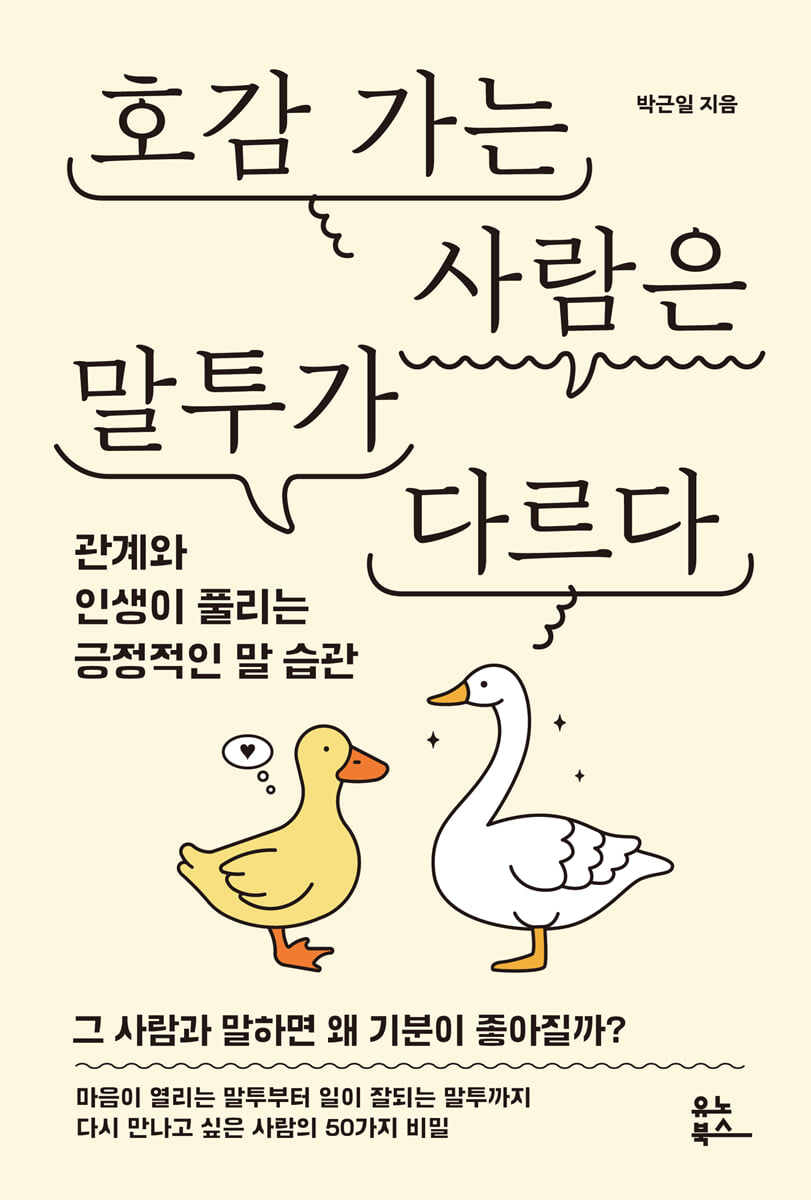
People you like have a different way of speaking.
 |
Description
Book Introduction
Why do I feel better when I talk to that person?
From a heart-opening tone to a successful tone
50 Secrets of People You Want to See Again
There are people around us who particularly capture people's hearts.
Talking makes me feel better, and working together seems to make things go better.
What's the secret to being liked, performing well at work, positively influencing those around you, and never hurting or causing harm? And why do the same words sometimes sound different? The answer lies in the tone of voice.
People who are likable read the other person's emotions and speak to them in a positive tone of voice that empathizes with them.
You may have experienced this at work or during conversations with friends.
I remember how my heart felt warm and I gained strength from the words, “You’ve worked really hard.”
Hearing, “Thank you, things went well,” can also motivate you to do better next time.
As a Salvation Army officer, career counselor, parent coach, and character education expert, the author has interacted with a wide range of people and realized that most of our worries arise from interpersonal relationships, and that these relationships are influenced by the way we speak.
He emphasizes that speech is an important factor in forming relationships with others, and supports this with research in psychology, sociology, and brain science, as well as specific examples.
This book contains the secrets of likable people that the author discovered through direct observation and research of various conversational moments.
The book is divided into five chapters, written in a warm and gentle tone.
Chapter 1 discusses how to avoid uncomfortable speech that makes others nervous, Chapter 2 discusses comfortable speech that makes you feel good when you meet someone, Chapter 3 discusses affectionate speech that attracts people, Chapter 4 discusses smart speech that makes things easier, and Chapter 5 discusses healthy speech that boosts self-esteem.
Anyone can learn to speak in a likeable way.
This is because speaking does not require any special skills, but is based on an attitude of consideration for the other person and an attempt to convey positive energy.
Let's avoid unnecessary whining or a nervous tone and speak in a way that makes the other person feel valued.
Instead of saying, “Why can’t you do this?”, say something encouraging like, “You’ll be able to do better if you just give yourself some time.”
Instead of using the negative language you've been using without thinking, let's learn how to strengthen our relationships with others.
If you practice just one of the secrets of speaking discussed in this book every day, you will not only be remembered as a likable person, but you will also experience your relationships and life improving.
From a heart-opening tone to a successful tone
50 Secrets of People You Want to See Again
There are people around us who particularly capture people's hearts.
Talking makes me feel better, and working together seems to make things go better.
What's the secret to being liked, performing well at work, positively influencing those around you, and never hurting or causing harm? And why do the same words sometimes sound different? The answer lies in the tone of voice.
People who are likable read the other person's emotions and speak to them in a positive tone of voice that empathizes with them.
You may have experienced this at work or during conversations with friends.
I remember how my heart felt warm and I gained strength from the words, “You’ve worked really hard.”
Hearing, “Thank you, things went well,” can also motivate you to do better next time.
As a Salvation Army officer, career counselor, parent coach, and character education expert, the author has interacted with a wide range of people and realized that most of our worries arise from interpersonal relationships, and that these relationships are influenced by the way we speak.
He emphasizes that speech is an important factor in forming relationships with others, and supports this with research in psychology, sociology, and brain science, as well as specific examples.
This book contains the secrets of likable people that the author discovered through direct observation and research of various conversational moments.
The book is divided into five chapters, written in a warm and gentle tone.
Chapter 1 discusses how to avoid uncomfortable speech that makes others nervous, Chapter 2 discusses comfortable speech that makes you feel good when you meet someone, Chapter 3 discusses affectionate speech that attracts people, Chapter 4 discusses smart speech that makes things easier, and Chapter 5 discusses healthy speech that boosts self-esteem.
Anyone can learn to speak in a likeable way.
This is because speaking does not require any special skills, but is based on an attitude of consideration for the other person and an attempt to convey positive energy.
Let's avoid unnecessary whining or a nervous tone and speak in a way that makes the other person feel valued.
Instead of saying, “Why can’t you do this?”, say something encouraging like, “You’ll be able to do better if you just give yourself some time.”
Instead of using the negative language you've been using without thinking, let's learn how to strengthen our relationships with others.
If you practice just one of the secrets of speaking discussed in this book every day, you will not only be remembered as a likable person, but you will also experience your relationships and life improving.
- You can preview some of the book's contents.
Preview
index
prolog
All results depend on the tone of speech.
Chapter 1: Uncomfortable speech that makes the other person nervous
The number one annoying Korean habit, no!
Why are you so sensitive to the sharp language of passive aggression?
Ignoring that distorts memories, gaslighting that distorts relationships
A surprisingly commanding tone of speech that undermines authority
Why People Around You Distance Yourself: Complaining is a Habit
People who always say no are really no.
If you say you're screwed, you won't be able to escape the frustration.
Don't say you're jealous, say you'll do it too.
The more you say it's not fun, the more tiring life becomes.
Control your anxiety with a single word, or let it sway you.
Chapter 2: A comfortable and pleasant way of speaking when meeting
The Secret to a First Impression Made in 7 Seconds
I remember my tone more than what I said.
Be specific and praise the person you are praising.
When expressing gratitude, think about sincerity, specificity, and timing.
Positive words bring tears of courage
I feel validated when I empathize with others.
People who know how to joke around look easygoing.
When I call his name, he comes to me and becomes a flower.
Just reacting well is half the success of a conversation.
Even if you don't take my word for it, I'll naturally develop a liking for it.
Chapter 3: Affectionate speech that attracts the heart
How to speak so that everyone wins
How to avoid losing direction in a conversation
Speak in a way that makes the other person feel understood.
Use polite language with dignity, and use informal language with consideration.
When emotions are running high, use 'I' rather than 'you'
If you wait 15 seconds, your anger will disappear.
When apologizing, state specific reasons and reflect on your actions.
Speak in a way that makes the other person feel acknowledged.
Put your soul into even a simple nod
If you add 'please', they will even grant you something you would normally refuse.
Chapter 4: Smart Talk That Makes Work Easier
Specifically, comprehension increases by 30%.
Even if I say it in detail, only seven words remain in my head.
"Please do it" is stronger than "Do it"
Good things, tell me specifically 'how' they are good.
Do as you say and say as you act.
Even words have a 'golden time'
How Michael Jordan Reached the Top of the NBA
If you want to persuade others, prepare evidence and context.
Add spice to dull conversations with storytelling.
The power of 'No' is more important than 'Yes'
Chapter 5: Healthy speech that boosts self-esteem
What you need to say when your self-esteem is low: I can do it.
The more you say it's possible, the more likely it is.
Words that make you look forward to what comes next, there are plenty of opportunities
The words that save me when times are tough: My day will come.
The more gratitude you give and receive, the more powerful you become.
Words that make me stronger, I get better every day
People follow words of encouragement.
The saying that turns mistakes into opportunities and opportunities into growth
When comparing, set your standards for yourself.
Life becomes more relaxed, so let's try as much as we can.
All results depend on the tone of speech.
Chapter 1: Uncomfortable speech that makes the other person nervous
The number one annoying Korean habit, no!
Why are you so sensitive to the sharp language of passive aggression?
Ignoring that distorts memories, gaslighting that distorts relationships
A surprisingly commanding tone of speech that undermines authority
Why People Around You Distance Yourself: Complaining is a Habit
People who always say no are really no.
If you say you're screwed, you won't be able to escape the frustration.
Don't say you're jealous, say you'll do it too.
The more you say it's not fun, the more tiring life becomes.
Control your anxiety with a single word, or let it sway you.
Chapter 2: A comfortable and pleasant way of speaking when meeting
The Secret to a First Impression Made in 7 Seconds
I remember my tone more than what I said.
Be specific and praise the person you are praising.
When expressing gratitude, think about sincerity, specificity, and timing.
Positive words bring tears of courage
I feel validated when I empathize with others.
People who know how to joke around look easygoing.
When I call his name, he comes to me and becomes a flower.
Just reacting well is half the success of a conversation.
Even if you don't take my word for it, I'll naturally develop a liking for it.
Chapter 3: Affectionate speech that attracts the heart
How to speak so that everyone wins
How to avoid losing direction in a conversation
Speak in a way that makes the other person feel understood.
Use polite language with dignity, and use informal language with consideration.
When emotions are running high, use 'I' rather than 'you'
If you wait 15 seconds, your anger will disappear.
When apologizing, state specific reasons and reflect on your actions.
Speak in a way that makes the other person feel acknowledged.
Put your soul into even a simple nod
If you add 'please', they will even grant you something you would normally refuse.
Chapter 4: Smart Talk That Makes Work Easier
Specifically, comprehension increases by 30%.
Even if I say it in detail, only seven words remain in my head.
"Please do it" is stronger than "Do it"
Good things, tell me specifically 'how' they are good.
Do as you say and say as you act.
Even words have a 'golden time'
How Michael Jordan Reached the Top of the NBA
If you want to persuade others, prepare evidence and context.
Add spice to dull conversations with storytelling.
The power of 'No' is more important than 'Yes'
Chapter 5: Healthy speech that boosts self-esteem
What you need to say when your self-esteem is low: I can do it.
The more you say it's possible, the more likely it is.
Words that make you look forward to what comes next, there are plenty of opportunities
The words that save me when times are tough: My day will come.
The more gratitude you give and receive, the more powerful you become.
Words that make me stronger, I get better every day
People follow words of encouragement.
The saying that turns mistakes into opportunities and opportunities into growth
When comparing, set your standards for yourself.
Life becomes more relaxed, so let's try as much as we can.
Detailed image

Into the book
We often experience how a single, careless word can change our thoughts, alter our attitude, and change the direction of our lives.
Positive words go beyond just making us feel good; they are like keys that open new paths for us.
Conversely, negative words can weaken confidence and the will to challenge, and can even become a trap that predicts failure.
The simple phrase “I can do it” is the first step to success and happiness.
It can be.
--- p.39, from “People who always say no are really no”
Boredom is an inevitable part of our lives, but how we accept and express it can become a turning point.
A positive attitude and tone of voice that says, “I need this time now” turns boredom into an opportunity to recharge.
Set small goals, encourage yourself, and take steps toward them.
After all, boredom is just a brief pause on your way to a better future.
Your tone and attitude will turn that comma into the start of a new sentence, not a period.
--- p.56, from “The more you say it’s not fun, the more tiring life becomes”
In his 1946 experiments on personality impression formation, he found that information provided early in a person's life significantly influenced their later judgments.
He presented participants with two personality descriptions.
Intelligent, hard-working, impulsive and stubborn.
Stubborn, impulsive, diligent and intelligent.
The two descriptions have the same content, but the order in which they are listed is different.
As a result, it was found that the words that came first, that is, the information presented initially, had a greater influence on people's impression formation.
People evaluate others based on first impressions, and subsequent information is used to complement or reinforce those first impressions.
--- p.66, from “The Secret of a First Impression Determined in 7 Seconds”
In psychology, reaction is closely related to 'active listening'.
Active listening means paying attention to what the other person is saying and responding appropriately.
Research shows that people who receive positive feedback feel more accepted and more satisfied with their relationships.
For example, if a friend tells you they've started a new hobby, you can react with something like, "That sounds fun! How did you get started?" This will make them feel like you're getting noticed.
Conversely, if you respond indifferently with, “Oh, really?”, the conversation will quickly cool down.
--- p.102, from “Half of the conversation is successful if you just react well”
From a psychological perspective, polite speech is effective in building trust and leaving a positive impression on people.
According to research from Stanford University, polite language plays a crucial role in increasing others' willingness to cooperate and reducing conflict.
When using honorifics, you should be formal and convey sincerity and warmth to maximize the effect.
For example, instead of saying, "Please finish this by today," say, "I would appreciate it if you could get this done by today." This conveys a message of cooperation rather than a request.
These differences affect not only the outcome of the conversation but also the quality of the relationship.
--- p.124, from “Use formal language with dignity, use informal language with consideration”
It is a good idea to end all requests with “Thank you” or “I appreciate it.”
The same applies when a request is denied.
This is an important factor in making the other person feel sincere and increasing their motivation to accept your request.
To make an effective request, it's important to first clearly understand your needs.
A specific and clear request reduces the burden on the other person rather than a vague request.
It should also be basic to use a tone of voice that approaches the request from the perspective of the person receiving the request.
--- p.156, from “If you add ‘please’, you will be granted even things you would normally refuse”
In the workplace, feedback is essential not only for getting work done, but also for teamwork and personal growth.
To give effective feedback, it's important to balance the other person's positive points with areas for improvement.
Then, the person receiving the feedback will be able to understand a clear direction to move forward without becoming defensive.
Your attitude when receiving feedback is also very important.
A short answer like “Yes, I understand” can seem a bit passive, so try something like “Thank you for the advice.
An effective response is one that expresses gratitude and a will to improve, such as, “I will pay more attention in the future.”
A positive attitude toward feedback makes you appear as someone with great potential for growth.
In the long run, it can also have a positive impact on your career development.
--- p.171, from “Tell me specifically how good things are good”
To effectively utilize storytelling, it is important to choose material that the other person can relate to.
For example, when requesting resources, rather than saying, "The reason we need this is simple," it's more persuasive to say, "We had success with this resource on a similar project last year."
Additionally, it is more effective to shift the focus of the story away from the speaker and toward the listener and the community.
Rather than starting with “What I did…”, it’s more effective to approach it with “What we all get out of it…”
--- p.196, from “Add spice to dull conversations with storytelling”
Every morning, look in the mirror and say to yourself, “I am worthy.”
It may feel awkward at first, but this repetition is a powerful starting point for building self-esteem.
Using positive language instead of negative language is a habit.
As habits are repeated, self-esteem naturally grows.
Your words define your worth.
So which word would you choose?
--- p.208, from “What you must say when your self-esteem is low: I can do it”
To practice speaking without comparing yourself to others, you must first acknowledge your own pace and goals.
If a colleague who joined the company at the same time as you gets promoted faster than you, instead of saying, "Why am I the only one who's been promoted so late?", encourage yourself by saying, "I'm also progressing at the pace I've prepared for."
This will boost your self-esteem and allow you to focus on your own path.
It's also important to acknowledge small accomplishments with your words.
Rather than thinking, "I still have a long way to go," praise yourself by saying, "I've accomplished so far, and that's amazing." This will free you from the pressure of comparison and allow you to walk your own path.
Positive words go beyond just making us feel good; they are like keys that open new paths for us.
Conversely, negative words can weaken confidence and the will to challenge, and can even become a trap that predicts failure.
The simple phrase “I can do it” is the first step to success and happiness.
It can be.
--- p.39, from “People who always say no are really no”
Boredom is an inevitable part of our lives, but how we accept and express it can become a turning point.
A positive attitude and tone of voice that says, “I need this time now” turns boredom into an opportunity to recharge.
Set small goals, encourage yourself, and take steps toward them.
After all, boredom is just a brief pause on your way to a better future.
Your tone and attitude will turn that comma into the start of a new sentence, not a period.
--- p.56, from “The more you say it’s not fun, the more tiring life becomes”
In his 1946 experiments on personality impression formation, he found that information provided early in a person's life significantly influenced their later judgments.
He presented participants with two personality descriptions.
Intelligent, hard-working, impulsive and stubborn.
Stubborn, impulsive, diligent and intelligent.
The two descriptions have the same content, but the order in which they are listed is different.
As a result, it was found that the words that came first, that is, the information presented initially, had a greater influence on people's impression formation.
People evaluate others based on first impressions, and subsequent information is used to complement or reinforce those first impressions.
--- p.66, from “The Secret of a First Impression Determined in 7 Seconds”
In psychology, reaction is closely related to 'active listening'.
Active listening means paying attention to what the other person is saying and responding appropriately.
Research shows that people who receive positive feedback feel more accepted and more satisfied with their relationships.
For example, if a friend tells you they've started a new hobby, you can react with something like, "That sounds fun! How did you get started?" This will make them feel like you're getting noticed.
Conversely, if you respond indifferently with, “Oh, really?”, the conversation will quickly cool down.
--- p.102, from “Half of the conversation is successful if you just react well”
From a psychological perspective, polite speech is effective in building trust and leaving a positive impression on people.
According to research from Stanford University, polite language plays a crucial role in increasing others' willingness to cooperate and reducing conflict.
When using honorifics, you should be formal and convey sincerity and warmth to maximize the effect.
For example, instead of saying, "Please finish this by today," say, "I would appreciate it if you could get this done by today." This conveys a message of cooperation rather than a request.
These differences affect not only the outcome of the conversation but also the quality of the relationship.
--- p.124, from “Use formal language with dignity, use informal language with consideration”
It is a good idea to end all requests with “Thank you” or “I appreciate it.”
The same applies when a request is denied.
This is an important factor in making the other person feel sincere and increasing their motivation to accept your request.
To make an effective request, it's important to first clearly understand your needs.
A specific and clear request reduces the burden on the other person rather than a vague request.
It should also be basic to use a tone of voice that approaches the request from the perspective of the person receiving the request.
--- p.156, from “If you add ‘please’, you will be granted even things you would normally refuse”
In the workplace, feedback is essential not only for getting work done, but also for teamwork and personal growth.
To give effective feedback, it's important to balance the other person's positive points with areas for improvement.
Then, the person receiving the feedback will be able to understand a clear direction to move forward without becoming defensive.
Your attitude when receiving feedback is also very important.
A short answer like “Yes, I understand” can seem a bit passive, so try something like “Thank you for the advice.
An effective response is one that expresses gratitude and a will to improve, such as, “I will pay more attention in the future.”
A positive attitude toward feedback makes you appear as someone with great potential for growth.
In the long run, it can also have a positive impact on your career development.
--- p.171, from “Tell me specifically how good things are good”
To effectively utilize storytelling, it is important to choose material that the other person can relate to.
For example, when requesting resources, rather than saying, "The reason we need this is simple," it's more persuasive to say, "We had success with this resource on a similar project last year."
Additionally, it is more effective to shift the focus of the story away from the speaker and toward the listener and the community.
Rather than starting with “What I did…”, it’s more effective to approach it with “What we all get out of it…”
--- p.196, from “Add spice to dull conversations with storytelling”
Every morning, look in the mirror and say to yourself, “I am worthy.”
It may feel awkward at first, but this repetition is a powerful starting point for building self-esteem.
Using positive language instead of negative language is a habit.
As habits are repeated, self-esteem naturally grows.
Your words define your worth.
So which word would you choose?
--- p.208, from “What you must say when your self-esteem is low: I can do it”
To practice speaking without comparing yourself to others, you must first acknowledge your own pace and goals.
If a colleague who joined the company at the same time as you gets promoted faster than you, instead of saying, "Why am I the only one who's been promoted so late?", encourage yourself by saying, "I'm also progressing at the pace I've prepared for."
This will boost your self-esteem and allow you to focus on your own path.
It's also important to acknowledge small accomplishments with your words.
Rather than thinking, "I still have a long way to go," praise yourself by saying, "I've accomplished so far, and that's amazing." This will free you from the pressure of comparison and allow you to walk your own path.
--- p.239, from “When comparing, set the standard for yourself”
Publisher's Review
A person I like
The tone is different
People form first impressions within seconds of meeting each other.
In this brief moment, what is just as important as your appearance or attitude is your tone of voice.
Because speech is a key element that reveals a person's inner self and values.
Even if you say the same thing, depending on how you express it, it can either be the key to opening the other person's heart or, conversely, it can be the cause of building a wall.
People who make a good impression on others even with a short conversation have one thing in common: they use a warm and gentle tone of voice.
Sharp words like “Do it like this” trigger a defense mechanism, cut off communication, and worsen the relationship, but considerate words like “It would be better if you did it like this” open the heart.
People who are liked communicate in a positive tone like this.
So, as we talk, I find myself feeling better without even realizing it.
『People You Like Speak Differently』 is a book written by Park Geun-il, a Salvation Army officer, career guidance instructor, and character education expert, that contains the importance of speech that he discovered while meeting people of various age groups.
Based on the fact that many of the difficulties we experience in interpersonal relationships stem from our speech patterns, he compiled 50 secrets of people who use positive speech patterns.
The book is supported by cutting-edge research from psychology, sociology, and brain science, and helps anyone learn and identify the characteristics of people they find attractive through the various conversations we have in our daily lives.
From a heart-opening tone to a successful tone
The secret of the person I want to meet again
The book warmly and gently unfolds the secrets of positive speech used by likeable people in five chapters.
First, they do not use uncomfortable language that makes the other person nervous.
Irritated words, a sarcastic tone, a dismissive attitude, and an authoritarian, commanding tone can easily create a wall between people.
Negative expressions like “It won’t work” or “It’s ruined” can demoralize others and cause fatigue.
On the other hand, expressions like “This part is difficult, but I’m sure we can find another way” elicit empathy from the other person and create a positive atmosphere.
Second, they speak in a comfortable tone that makes you feel good when you meet them.
Warm and sincere compliments, nodding in sympathy with the other person's story, appropriate jokes, and friendly reactions can all raise the temperature of a conversation.
In particular, calling the other person's name often increases trust.
Compliments like “Ms. ○○, you did a great job on this part!” have more power than just words.
Third, they use a sweet, appealing tone of voice.
Affectionate speech conveys the message, “I respect you.”
Instead of “Why did you do that?” say, “I guess I didn’t understand.”
Let's say, "Can you tell me what the situation was?"
Fourth, they use clever language that makes things easy.
Being specific and clear greatly increases the success of communication.
Request-like language like “please do it” gives the other person a choice while also making things happen more efficiently.
Also, “I think it would be better if we did it this way.
Expressions like “Could you please try it?” convey both persuasiveness and gentleness.
Fifth, they use healthy speech that boosts self-esteem.
Positive self-talk has a huge impact on your mind.
Instead of saying, “I can’t do it,” encourage yourself by saying, “Even if I’m not good enough now, I can get better.”
The affirmation, “I am getting better every day,” is one of the best words to boost your confidence and courage.
Relationships and life unravel
Positive speaking habits
Chapter 1 of the book talks about how to avoid uncomfortable speech that makes others nervous, Chapter 2 talks about comfortable speech that makes you feel good when you meet someone, Chapter 3 talks about affectionate speech that attracts people, Chapter 4 talks about smart speech that makes things easier, and Chapter 5 talks about healthy speech that boosts self-esteem.
Ultimately, people who are liked communicate with each other in a warm and gentle tone rather than a tone that makes both parties uncomfortable, and they truly understand and respect each other and develop their relationships and lives.
People remember tone of voice more clearly than words.
A positive tone of voice can make a lasting impression in just one conversation and help build long-lasting relationships.
On the other hand, a negative tone of voice can make the other person feel distant.
So, if you want to maintain a relationship, you need to get into the habit of using warm and positive words.
A change in your speech can make a big difference with little effort.
Let's consciously use positive expressions like "like" and "thank you" in our daily lives.
This boosts my self-esteem and enriches and enriches my relationships with those around me. Speech isn't just a communication skill; it's an expression of my attitude toward life.
Let's start making an effort to change the way we speak today.
It's about saying something warm at least once a day.
As small changes accumulate, you will soon find yourself becoming someone you want to meet again and talk to.
Let's make our lives and the lives of others happier with positive words.
The tone is different
People form first impressions within seconds of meeting each other.
In this brief moment, what is just as important as your appearance or attitude is your tone of voice.
Because speech is a key element that reveals a person's inner self and values.
Even if you say the same thing, depending on how you express it, it can either be the key to opening the other person's heart or, conversely, it can be the cause of building a wall.
People who make a good impression on others even with a short conversation have one thing in common: they use a warm and gentle tone of voice.
Sharp words like “Do it like this” trigger a defense mechanism, cut off communication, and worsen the relationship, but considerate words like “It would be better if you did it like this” open the heart.
People who are liked communicate in a positive tone like this.
So, as we talk, I find myself feeling better without even realizing it.
『People You Like Speak Differently』 is a book written by Park Geun-il, a Salvation Army officer, career guidance instructor, and character education expert, that contains the importance of speech that he discovered while meeting people of various age groups.
Based on the fact that many of the difficulties we experience in interpersonal relationships stem from our speech patterns, he compiled 50 secrets of people who use positive speech patterns.
The book is supported by cutting-edge research from psychology, sociology, and brain science, and helps anyone learn and identify the characteristics of people they find attractive through the various conversations we have in our daily lives.
From a heart-opening tone to a successful tone
The secret of the person I want to meet again
The book warmly and gently unfolds the secrets of positive speech used by likeable people in five chapters.
First, they do not use uncomfortable language that makes the other person nervous.
Irritated words, a sarcastic tone, a dismissive attitude, and an authoritarian, commanding tone can easily create a wall between people.
Negative expressions like “It won’t work” or “It’s ruined” can demoralize others and cause fatigue.
On the other hand, expressions like “This part is difficult, but I’m sure we can find another way” elicit empathy from the other person and create a positive atmosphere.
Second, they speak in a comfortable tone that makes you feel good when you meet them.
Warm and sincere compliments, nodding in sympathy with the other person's story, appropriate jokes, and friendly reactions can all raise the temperature of a conversation.
In particular, calling the other person's name often increases trust.
Compliments like “Ms. ○○, you did a great job on this part!” have more power than just words.
Third, they use a sweet, appealing tone of voice.
Affectionate speech conveys the message, “I respect you.”
Instead of “Why did you do that?” say, “I guess I didn’t understand.”
Let's say, "Can you tell me what the situation was?"
Fourth, they use clever language that makes things easy.
Being specific and clear greatly increases the success of communication.
Request-like language like “please do it” gives the other person a choice while also making things happen more efficiently.
Also, “I think it would be better if we did it this way.
Expressions like “Could you please try it?” convey both persuasiveness and gentleness.
Fifth, they use healthy speech that boosts self-esteem.
Positive self-talk has a huge impact on your mind.
Instead of saying, “I can’t do it,” encourage yourself by saying, “Even if I’m not good enough now, I can get better.”
The affirmation, “I am getting better every day,” is one of the best words to boost your confidence and courage.
Relationships and life unravel
Positive speaking habits
Chapter 1 of the book talks about how to avoid uncomfortable speech that makes others nervous, Chapter 2 talks about comfortable speech that makes you feel good when you meet someone, Chapter 3 talks about affectionate speech that attracts people, Chapter 4 talks about smart speech that makes things easier, and Chapter 5 talks about healthy speech that boosts self-esteem.
Ultimately, people who are liked communicate with each other in a warm and gentle tone rather than a tone that makes both parties uncomfortable, and they truly understand and respect each other and develop their relationships and lives.
People remember tone of voice more clearly than words.
A positive tone of voice can make a lasting impression in just one conversation and help build long-lasting relationships.
On the other hand, a negative tone of voice can make the other person feel distant.
So, if you want to maintain a relationship, you need to get into the habit of using warm and positive words.
A change in your speech can make a big difference with little effort.
Let's consciously use positive expressions like "like" and "thank you" in our daily lives.
This boosts my self-esteem and enriches and enriches my relationships with those around me. Speech isn't just a communication skill; it's an expression of my attitude toward life.
Let's start making an effort to change the way we speak today.
It's about saying something warm at least once a day.
As small changes accumulate, you will soon find yourself becoming someone you want to meet again and talk to.
Let's make our lives and the lives of others happier with positive words.
GOODS SPECIFICS
- Date of issue: December 27, 2024
- Page count, weight, size: 244 pages | 336g | 142*210*16mm
- ISBN13: 9791171830787
- ISBN10: 1171830785
You may also like
카테고리
korean


korean

![GQ KOREA Mark (Monthly): December [2025]](http://librairie.coreenne.fr/cdn/shop/files/8ef265dbbfbf186523ed75ba7319009d.jpg?v=1765340328&width=3840)


