

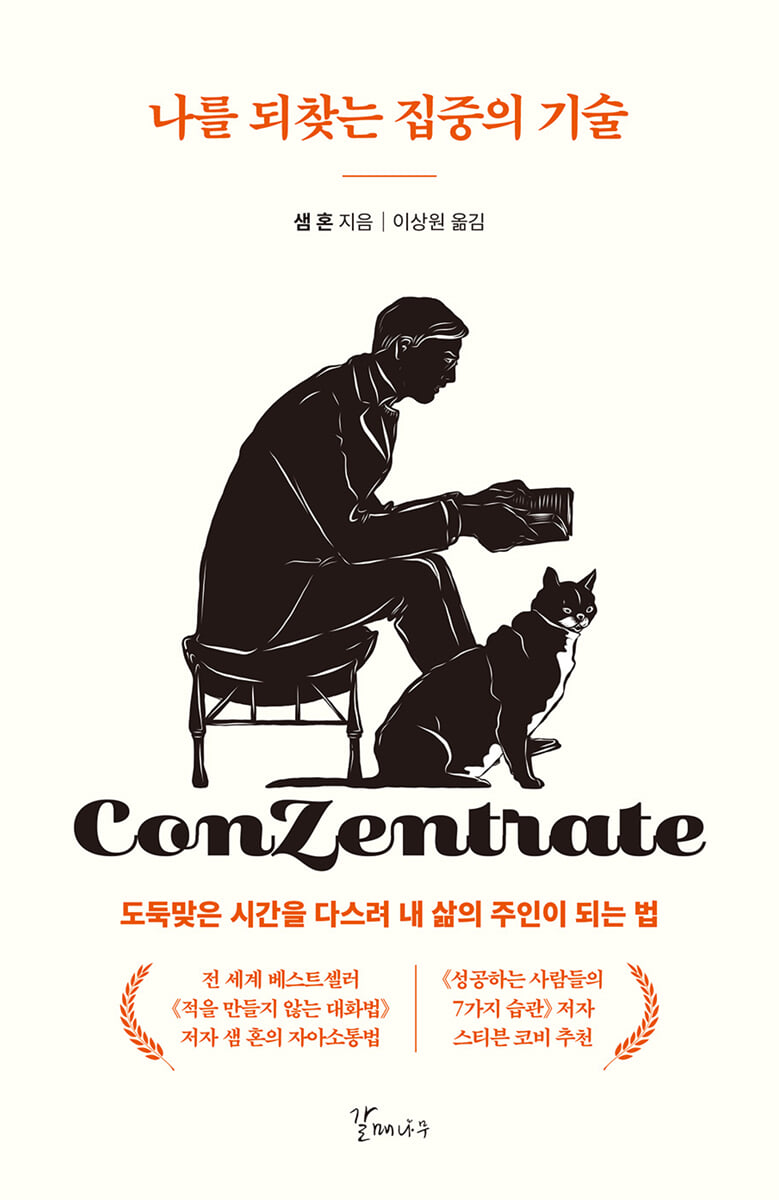
The art of concentration that brings me back
 |
Description
Book Introduction
"When the world falls apart, the focus that will lift me up again"
There is nothing more important than 'Know Thyself'
Know this moment, now!
Author of the best-selling book "How to Talk Without Making Enemies"
The Essentials of Focus from World-Class Communication Coach Sam Horn
The number of adults diagnosed with attention deficit hyperactivity disorder (ADHD) has reportedly increased fivefold over the past five years (from 2018 to 2023) (Health Insurance Review & Assessment Service). In particular, the prevalence rate by age group is 7.7% for those in their 20s and 3.1% for those in their 30s, which is estimated to be nearly four times higher for those in their 20s and 30s than for those in their 60s and older, at 1.1%.
In fact, for modern people, the problem of concentration is not a one-day or two-day homework.
Moreover, while we all know that the online environment is accelerating, it's also true that digital detox alone is not enough to overcome it.
This is why today's multifaceted approach is taking place, from individual self-motivation efforts to analyzing the dark shadows of the information society system.
Sam Horn, author of the world-famous bestseller "How to Talk Without Making Enemies," has been running ConZentration workshops (a combination of Concentrate and Zen) since early on, reminding us that "concentration means focusing on life."
As a communication expert coach, it was a process of giving and receiving feedback with participants with a focus on communication with the self, and the book 『ConZentrate: The Art of Concentration to Reclaim Myself』 (original title) is a compilation of stories and methodologies of countless modern people who cannot escape reality who have gone through this process to regain themselves and turn their lives around.
Who and what is our life about?
It depends on whether you pour TIME into it.
The question Sam Horn poses can be summarized in one word: “How will you spend your TIME?”
This keyword, which is associated with 'time', means Thoughts, Interest, Moments, and Emotions.
Based on the wisdom of Zen—not fighting thoughts, simplifying attention, immersing yourself in the moment, and noticing emotions—this text is structured to help you review your daily routine of thought and action using a specific checklist.
From the art of dedication to breaking the habit of procrastination to the ecstasy of complete absorption, Sam Horn's philosophical yet practical advice will help you discover a life lived in the here and now.
It would be a good practice to ponder or even copy down the numerous quotes cited in the text.
We hope that this will be a wonderful gift for readers who are tired of their hectic and distracting daily lives to end the year and welcome the new year.
There is nothing more important than 'Know Thyself'
Know this moment, now!
Author of the best-selling book "How to Talk Without Making Enemies"
The Essentials of Focus from World-Class Communication Coach Sam Horn
The number of adults diagnosed with attention deficit hyperactivity disorder (ADHD) has reportedly increased fivefold over the past five years (from 2018 to 2023) (Health Insurance Review & Assessment Service). In particular, the prevalence rate by age group is 7.7% for those in their 20s and 3.1% for those in their 30s, which is estimated to be nearly four times higher for those in their 20s and 30s than for those in their 60s and older, at 1.1%.
In fact, for modern people, the problem of concentration is not a one-day or two-day homework.
Moreover, while we all know that the online environment is accelerating, it's also true that digital detox alone is not enough to overcome it.
This is why today's multifaceted approach is taking place, from individual self-motivation efforts to analyzing the dark shadows of the information society system.
Sam Horn, author of the world-famous bestseller "How to Talk Without Making Enemies," has been running ConZentration workshops (a combination of Concentrate and Zen) since early on, reminding us that "concentration means focusing on life."
As a communication expert coach, it was a process of giving and receiving feedback with participants with a focus on communication with the self, and the book 『ConZentrate: The Art of Concentration to Reclaim Myself』 (original title) is a compilation of stories and methodologies of countless modern people who cannot escape reality who have gone through this process to regain themselves and turn their lives around.
Who and what is our life about?
It depends on whether you pour TIME into it.
The question Sam Horn poses can be summarized in one word: “How will you spend your TIME?”
This keyword, which is associated with 'time', means Thoughts, Interest, Moments, and Emotions.
Based on the wisdom of Zen—not fighting thoughts, simplifying attention, immersing yourself in the moment, and noticing emotions—this text is structured to help you review your daily routine of thought and action using a specific checklist.
From the art of dedication to breaking the habit of procrastination to the ecstasy of complete absorption, Sam Horn's philosophical yet practical advice will help you discover a life lived in the here and now.
It would be a good practice to ponder or even copy down the numerous quotes cited in the text.
We hope that this will be a wonderful gift for readers who are tired of their hectic and distracting daily lives to end the year and welcome the new year.
- You can preview some of the book's contents.
Preview
index
Prologue You can focus as much as you want, whenever you want!
Chapter 1.
What are you spending your time on now?
1.
Concentration is TIME
Management
2.
12 Reasons You're Having Trouble Concentrating
3.
Is the mind our enemy or our friend?
THOUGHTS: How to Stop Fighting Your Thoughts
Chapter 2.
Immersion, a magical moment of complete captivation
4.
It feels like everything is going smoothly
5.
Visualize your desired outcome in advance
6.
Why do we need to prepare for emergencies first?
7.
Create a keyword that gathers hearts
8.
Three Rules for Maintaining Immersion
9.
The Secret to Focus That Benefits Your Relationships
10.
15 minutes to recharge your brain
INTEREST: How to Manage Interest
Chapter 3.
Mindfulness: The Secret to Organizing Your Chaotic Daily Life
11.
You need to lighten your body first
12.
What is my 20%?
13.
Six Systems for Organization
14.
You can't please everyone
15.
The most effective study technique
16.
Things to remember VS.
Things to forget
MOMENTS: How to Seize the Moment
Chapter 4.
Practice dedication and breaking the habit of procrastination
17.
5 minutes of brain training a day
18.
Narrowing and broadening one's field of vision
19.
Should we stay on the path or change?
20.
The obsession with forgetting is more harmful
21.
Act now, feel later
22.
Set intermediate goals
23.
Do you believe that tomorrow always comes?
24.
How to Deal with Skepticism: 'Unlike the Past, Now'
EMOTIONS: How to Control Your Emotions
Chapter 5.
Awareness, the training to not be consumed by feelings
25.
If you know your heart, choosing is not difficult.
26.
How to shake off worry and anxiety?
27.
Questions to Ask When the Reason for Grief Is Ambiguous
28.
You can't let your anger remain unchecked.
29.
The biggest crisis in life comes at any time.
30.
When one door closes, another opens.
Chapter 6.
The power to exist as me, right now, in this moment
31.
I am here, now
32.
How to stay still while moving
33.
It depends on which way you look
34.
What do I say to my body?
35.
The three most important things in my life
36.
You can live as your heart desires.
Epilogue: The future begins today, not tomorrow.
Chapter 1.
What are you spending your time on now?
1.
Concentration is TIME
Management
2.
12 Reasons You're Having Trouble Concentrating
3.
Is the mind our enemy or our friend?
THOUGHTS: How to Stop Fighting Your Thoughts
Chapter 2.
Immersion, a magical moment of complete captivation
4.
It feels like everything is going smoothly
5.
Visualize your desired outcome in advance
6.
Why do we need to prepare for emergencies first?
7.
Create a keyword that gathers hearts
8.
Three Rules for Maintaining Immersion
9.
The Secret to Focus That Benefits Your Relationships
10.
15 minutes to recharge your brain
INTEREST: How to Manage Interest
Chapter 3.
Mindfulness: The Secret to Organizing Your Chaotic Daily Life
11.
You need to lighten your body first
12.
What is my 20%?
13.
Six Systems for Organization
14.
You can't please everyone
15.
The most effective study technique
16.
Things to remember VS.
Things to forget
MOMENTS: How to Seize the Moment
Chapter 4.
Practice dedication and breaking the habit of procrastination
17.
5 minutes of brain training a day
18.
Narrowing and broadening one's field of vision
19.
Should we stay on the path or change?
20.
The obsession with forgetting is more harmful
21.
Act now, feel later
22.
Set intermediate goals
23.
Do you believe that tomorrow always comes?
24.
How to Deal with Skepticism: 'Unlike the Past, Now'
EMOTIONS: How to Control Your Emotions
Chapter 5.
Awareness, the training to not be consumed by feelings
25.
If you know your heart, choosing is not difficult.
26.
How to shake off worry and anxiety?
27.
Questions to Ask When the Reason for Grief Is Ambiguous
28.
You can't let your anger remain unchecked.
29.
The biggest crisis in life comes at any time.
30.
When one door closes, another opens.
Chapter 6.
The power to exist as me, right now, in this moment
31.
I am here, now
32.
How to stay still while moving
33.
It depends on which way you look
34.
What do I say to my body?
35.
The three most important things in my life
36.
You can live as your heart desires.
Epilogue: The future begins today, not tomorrow.
Detailed image

Into the book
William James, an American psychologist and philosopher, said, "Attention is experience."
In other words, paying attention is our life.
When you focus on what is meaningful and positive, you will live a meaningful and positive life.
On the other hand, if you focus on meaningless and negative things, your life will be meaningless and negative.
Isn't it really simple?
Buddha also said that everything has a mind.
That is, existence comes from thought.
--- p.16, from “Your life is what you think about all day long”
What do you do when things don't go your way? Do you lose your cool and throw everything you're holding? Or do you use anger as a catalyst to focus your practice? ... When we make a mistake, we can choose one of two paths: punishing the past or preparing for the future.
But the moment you get caught up in the thought that you shouldn't have done that, things go wrong.
…you must envision the behavior you want, not the behavior you need to abandon.
Promising yourself that you won't do something again, despite your intentions, only serves to solidify that behavior and lead to more mistakes.
Instead, say, “Next time, I should ~.”
--- p.66, from “Create a keyword that gathers hearts”
Before you start your day each morning, pick out the seven most important tasks you need to accomplish that day from your to-do list.
Why seven? Because that's the maximum number of items the brain can store in short-term memory.
Also, if there are too many things to do, more than ten, it is not appropriate because it can make you feel helpless and like you will never be able to finish them.
…Concentrated practice is a state of focusing on what needs to be done and ignoring unnecessary things.
What needs to be done next week is not necessary in today's situation.
Setting a list of seven things to do today will help you avoid getting distracted.
--- p.111, from “Six Systems for Organization”
If you want to achieve focused practice no matter how many distractions there are, the focusing techniques explained from now on will be helpful.
The basic principle of concentration practice begins with the fact that we humans pay attention to what we see.
…How can we focus our minds? Simply focus on one object and let everything else fade from view.
It is useful to use your hands to narrow your field of vision.
…Let’s practice this process of focusing our gaze and mind on one object repeatedly.
Experience firsthand how much easier it is to focus your mind when you physically block out your surroundings using your hands.
--- pp. 161-164, from "Want to Change Your Mindset? Narrowing and Broadening Your Vision"
Thinking to yourself 'not to think' about something has the effect of immediately turning your attention to that thought.
…our minds are fundamentally predisposed to think about things we are told not to think about.
Our brain works like a computer.
They take the words at face value and do not consider the intention.
…by engraving in your mind the very behavior you want to stop doing, you are blocking your chances of success.
So what should we do now? Replace, reinterpret, and delete harmful images and ideas.
--- p.175, from “The obsession with forgetting is more harmful”
If you find yourself doing a hundred things at once and not being able to do any of them properly, stop for a moment.
Close your thoughts and open your senses.
Forget your worries, sit still, do nothing, and surrender to your senses.
…be where you are now.
So, what do you think? Isn't it much better?
In other words, paying attention is our life.
When you focus on what is meaningful and positive, you will live a meaningful and positive life.
On the other hand, if you focus on meaningless and negative things, your life will be meaningless and negative.
Isn't it really simple?
Buddha also said that everything has a mind.
That is, existence comes from thought.
--- p.16, from “Your life is what you think about all day long”
What do you do when things don't go your way? Do you lose your cool and throw everything you're holding? Or do you use anger as a catalyst to focus your practice? ... When we make a mistake, we can choose one of two paths: punishing the past or preparing for the future.
But the moment you get caught up in the thought that you shouldn't have done that, things go wrong.
…you must envision the behavior you want, not the behavior you need to abandon.
Promising yourself that you won't do something again, despite your intentions, only serves to solidify that behavior and lead to more mistakes.
Instead, say, “Next time, I should ~.”
--- p.66, from “Create a keyword that gathers hearts”
Before you start your day each morning, pick out the seven most important tasks you need to accomplish that day from your to-do list.
Why seven? Because that's the maximum number of items the brain can store in short-term memory.
Also, if there are too many things to do, more than ten, it is not appropriate because it can make you feel helpless and like you will never be able to finish them.
…Concentrated practice is a state of focusing on what needs to be done and ignoring unnecessary things.
What needs to be done next week is not necessary in today's situation.
Setting a list of seven things to do today will help you avoid getting distracted.
--- p.111, from “Six Systems for Organization”
If you want to achieve focused practice no matter how many distractions there are, the focusing techniques explained from now on will be helpful.
The basic principle of concentration practice begins with the fact that we humans pay attention to what we see.
…How can we focus our minds? Simply focus on one object and let everything else fade from view.
It is useful to use your hands to narrow your field of vision.
…Let’s practice this process of focusing our gaze and mind on one object repeatedly.
Experience firsthand how much easier it is to focus your mind when you physically block out your surroundings using your hands.
--- pp. 161-164, from "Want to Change Your Mindset? Narrowing and Broadening Your Vision"
Thinking to yourself 'not to think' about something has the effect of immediately turning your attention to that thought.
…our minds are fundamentally predisposed to think about things we are told not to think about.
Our brain works like a computer.
They take the words at face value and do not consider the intention.
…by engraving in your mind the very behavior you want to stop doing, you are blocking your chances of success.
So what should we do now? Replace, reinterpret, and delete harmful images and ideas.
--- p.175, from “The obsession with forgetting is more harmful”
If you find yourself doing a hundred things at once and not being able to do any of them properly, stop for a moment.
Close your thoughts and open your senses.
Forget your worries, sit still, do nothing, and surrender to your senses.
…be where you are now.
So, what do you think? Isn't it much better?
--- p.288, from “Don’t Rush, Be Happy Now”
Publisher's Review
“You can focus whenever you want!”
What are you spending your time (TIME) on?
When you have a mountain of work to do and feel overwhelmed by the anxiety that you will never be able to finish it, you suddenly find yourself asking yourself this question:
'Why can't I focus?' But at least once in our lives, we all experience a 'moment of perfect immersion.'
You probably remember a time in your past when you were so absorbed in a game, exercise, or movie that you completely forgot about your surroundings.
Looking back on that moment, we realize that it wasn't that we lacked focus, we simply lost it.
So, how can we regain our lost focus? asks author Sam Horn.
The problem is that we cannot exist in the 'here and now', and we must start by focusing on ourselves in this very moment, rather than on the object of our focus.
This book suggests 'Concentration' for modern people who want to minimize unnecessary things in their daily lives and work and focus only on what is truly important in life. First, it recommends thinking about 'time'.
And he summarizes his realization and what he wants to emphasize into just one question.
“How will you spend your TIME?” That is, thoughts, interests.
Moments.
By managing and controlling your emotions well, you can focus your distracted mind and achieve true immersion, thereby improving your quality of life.
In the process of defining the concept of concentration, I came to an interesting conclusion.
Redefining our concept of time can free us from the pressure of having to race through life.
Instead of feeling like we don't have enough time, let's recognize the time we have in this very moment. Then we realize that the best use of time is to enjoy the present moment.
_Page 16 ('Concentration, TIME
(From 'Management')
"Knowing where and when to focus will increase your resolution in life!"
Concentration: How to immerse yourself in the "here and now" with the wisdom of Zen.
How to not fight your thoughts, immerse yourself
How to manage your interest, mindfulness
Moments How to seize the moment, dedication
Emotions: How to Manage Your Emotions, Awareness
The present moment is crucial! The happiness we seek, the life we long for, is possible anytime, anywhere.
If you just focus your mind on this moment and experience it fully.
But we often overlook this fact.
Too many choices, too much worry and anxiety, too much laziness and impatience prevent us from being in the 'here and now', but rather in the past that has passed, the future that has not yet arrived, here and there.
Such a confused mind robs us of moments of immersion and turns the 'here and now' into hell.
Our minds are like untrained dogs.
They are constantly moving around, looking for things to do, and they do whatever they want even when told to stay still.
Even if we command our minds to "put down your smartphone and start studying now," isn't it similar to how they can spiral out of control? Sam Horne draws on the wisdom of Zen because he knows that concentration ultimately begins with mastering the mind.
However, the 'concentrated practice' mentioned in this book does not mean that we should practice the Tao with our eyes closed.
The author emphasizes that just as we learn how to tie our shoelaces, we must also learn how to maintain a state of focused attention in our daily lives.
For example, the concentration practice called '5-minute brain training a day' is a way to greatly improve concentration by investing a short time before going to bed.
It consists of a few easy steps that you can follow anytime, anywhere.
First, find a place where you can be alone without being disturbed and start by repeating a simple, positive statement, such as "I am good at concentrating."
Then, focus on this sentence for exactly 5 minutes, and when any distracting thoughts arise, think, "No!" and then return your attention to the instruction.
The important thing is not to beat yourself up for being distracted or to keep telling yourself not to let your mind wander.
If you keep repeating this process and discipline your mind so that it doesn't rebel unnecessarily, you will eventually reach a point where you can do it automatically without even thinking about it.
The book also contains a variety of other practical concentration exercises.
For example, you can learn ways to manage a distracted mind through routines that focus on the moment, such as training to narrow your expansive field of vision and focus on a desired area, training to redirect your thoughts by inserting a stick into your mind, and training to correct unwanted thoughts by replacing, reinterpreting, or deleting them.
This type of focused practice will greatly help you regain your composure and lead a satisfying life, not only when faced with everyday chaos or conflict, but also when faced with life's crises.
Are you saving something for a tough day? We often procrastinate intentionally, not out of laziness or anxiety, but with quite reasonable excuses.
The problem is that if you don't act when the opportunity arises, you risk losing it all.
…don’t procrastinate and keep procrastinating, and don’t be swept away by the waves of life.
You must take action today to make your life more meaningful.
Page 215 (from "How to Deal with Skepticism")
"Let's get back to myself by clarifying my priorities in life!"
The magic that helps us overcome the crises and conflicts, big and small, that we face.
Sam Horn has traveled the world counseling countless people who have lost control of their minds and been distracted by their "minds."
The stories in the book, such as those of office workers who neglect their own work while wasting all their time on colleagues or customers looking for them, and parents who waste the only time they have with their children during the day while thinking about the next day's work schedule, give readers the feeling of receiving indirect counseling, helping them reflect on their current worries and problems.
Also, on a separate page, we have compiled questions that allow readers to look specifically into what they are pouring their thoughts, interests, and emotions into at what moment (thoughts and actions that should not be done VS.
It helps you use it as a checklist for focused practice (thoughts and actions to take).
Even in the quotes scattered throughout the text, the inner strength and insight of concentration that permeates their lives are fully conveyed.
“There is no use in blaming the physical, mental, emotional, and spiritual factors that distract me.
“‘Returning to ourselves’ is a magical way to overcome the crises and conflicts, big and small, that we face every day, every year, and throughout our lives.” (Dan Wakefield, author) _Page 160 (from ‘5 Minutes of Brain Training a Day’)
We feel the need for focus, but we don't realize that it affects literally every aspect of our lives, from our confidence to our quality of life.
When you've lost the strength to do your best at what's truly important, whether through emotional trauma or a life crisis, you're on the path to clarifying your priorities and returning to yourself. "I hope that through the intensive practice recommended in this book, you can continue to live a life filled with excitement." (Sam Horne)
What are you spending your time (TIME) on?
When you have a mountain of work to do and feel overwhelmed by the anxiety that you will never be able to finish it, you suddenly find yourself asking yourself this question:
'Why can't I focus?' But at least once in our lives, we all experience a 'moment of perfect immersion.'
You probably remember a time in your past when you were so absorbed in a game, exercise, or movie that you completely forgot about your surroundings.
Looking back on that moment, we realize that it wasn't that we lacked focus, we simply lost it.
So, how can we regain our lost focus? asks author Sam Horn.
The problem is that we cannot exist in the 'here and now', and we must start by focusing on ourselves in this very moment, rather than on the object of our focus.
This book suggests 'Concentration' for modern people who want to minimize unnecessary things in their daily lives and work and focus only on what is truly important in life. First, it recommends thinking about 'time'.
And he summarizes his realization and what he wants to emphasize into just one question.
“How will you spend your TIME?” That is, thoughts, interests.
Moments.
By managing and controlling your emotions well, you can focus your distracted mind and achieve true immersion, thereby improving your quality of life.
In the process of defining the concept of concentration, I came to an interesting conclusion.
Redefining our concept of time can free us from the pressure of having to race through life.
Instead of feeling like we don't have enough time, let's recognize the time we have in this very moment. Then we realize that the best use of time is to enjoy the present moment.
_Page 16 ('Concentration, TIME
(From 'Management')
"Knowing where and when to focus will increase your resolution in life!"
Concentration: How to immerse yourself in the "here and now" with the wisdom of Zen.
How to not fight your thoughts, immerse yourself
How to manage your interest, mindfulness
Moments How to seize the moment, dedication
Emotions: How to Manage Your Emotions, Awareness
The present moment is crucial! The happiness we seek, the life we long for, is possible anytime, anywhere.
If you just focus your mind on this moment and experience it fully.
But we often overlook this fact.
Too many choices, too much worry and anxiety, too much laziness and impatience prevent us from being in the 'here and now', but rather in the past that has passed, the future that has not yet arrived, here and there.
Such a confused mind robs us of moments of immersion and turns the 'here and now' into hell.
Our minds are like untrained dogs.
They are constantly moving around, looking for things to do, and they do whatever they want even when told to stay still.
Even if we command our minds to "put down your smartphone and start studying now," isn't it similar to how they can spiral out of control? Sam Horne draws on the wisdom of Zen because he knows that concentration ultimately begins with mastering the mind.
However, the 'concentrated practice' mentioned in this book does not mean that we should practice the Tao with our eyes closed.
The author emphasizes that just as we learn how to tie our shoelaces, we must also learn how to maintain a state of focused attention in our daily lives.
For example, the concentration practice called '5-minute brain training a day' is a way to greatly improve concentration by investing a short time before going to bed.
It consists of a few easy steps that you can follow anytime, anywhere.
First, find a place where you can be alone without being disturbed and start by repeating a simple, positive statement, such as "I am good at concentrating."
Then, focus on this sentence for exactly 5 minutes, and when any distracting thoughts arise, think, "No!" and then return your attention to the instruction.
The important thing is not to beat yourself up for being distracted or to keep telling yourself not to let your mind wander.
If you keep repeating this process and discipline your mind so that it doesn't rebel unnecessarily, you will eventually reach a point where you can do it automatically without even thinking about it.
The book also contains a variety of other practical concentration exercises.
For example, you can learn ways to manage a distracted mind through routines that focus on the moment, such as training to narrow your expansive field of vision and focus on a desired area, training to redirect your thoughts by inserting a stick into your mind, and training to correct unwanted thoughts by replacing, reinterpreting, or deleting them.
This type of focused practice will greatly help you regain your composure and lead a satisfying life, not only when faced with everyday chaos or conflict, but also when faced with life's crises.
Are you saving something for a tough day? We often procrastinate intentionally, not out of laziness or anxiety, but with quite reasonable excuses.
The problem is that if you don't act when the opportunity arises, you risk losing it all.
…don’t procrastinate and keep procrastinating, and don’t be swept away by the waves of life.
You must take action today to make your life more meaningful.
Page 215 (from "How to Deal with Skepticism")
"Let's get back to myself by clarifying my priorities in life!"
The magic that helps us overcome the crises and conflicts, big and small, that we face.
Sam Horn has traveled the world counseling countless people who have lost control of their minds and been distracted by their "minds."
The stories in the book, such as those of office workers who neglect their own work while wasting all their time on colleagues or customers looking for them, and parents who waste the only time they have with their children during the day while thinking about the next day's work schedule, give readers the feeling of receiving indirect counseling, helping them reflect on their current worries and problems.
Also, on a separate page, we have compiled questions that allow readers to look specifically into what they are pouring their thoughts, interests, and emotions into at what moment (thoughts and actions that should not be done VS.
It helps you use it as a checklist for focused practice (thoughts and actions to take).
Even in the quotes scattered throughout the text, the inner strength and insight of concentration that permeates their lives are fully conveyed.
“There is no use in blaming the physical, mental, emotional, and spiritual factors that distract me.
“‘Returning to ourselves’ is a magical way to overcome the crises and conflicts, big and small, that we face every day, every year, and throughout our lives.” (Dan Wakefield, author) _Page 160 (from ‘5 Minutes of Brain Training a Day’)
We feel the need for focus, but we don't realize that it affects literally every aspect of our lives, from our confidence to our quality of life.
When you've lost the strength to do your best at what's truly important, whether through emotional trauma or a life crisis, you're on the path to clarifying your priorities and returning to yourself. "I hope that through the intensive practice recommended in this book, you can continue to live a life filled with excitement." (Sam Horne)
GOODS SPECIFICS
- Date of issue: December 20, 2024
- Page count, weight, size: 308 pages | 376g | 133*205*20mm
- ISBN13: 9791191842777
- ISBN10: 1191842770
You may also like
카테고리
korean


korean

![GQ KOREA Mark (Monthly): December [2025]](http://librairie.coreenne.fr/cdn/shop/files/8ef265dbbfbf186523ed75ba7319009d.jpg?v=1765340328&width=3840)


