![Magazine B (Monthly): December [2017]](http://librairie.coreenne.fr/cdn/shop/files/185fee294e49fb265b81d6d4e6cf2ac7.jpg?v=1765330316&width=3840)

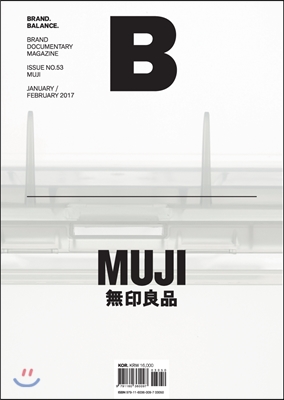
Magazine B (Monthly): January and February [2017]
 |
Description
index
02 Intro
12 Editor's Letter
16 Store
Consumers visiting Muji and media comments surrounding Muji
22 Opinions
Professor Ken Kusunoki offers a multifaceted analysis of the lifestyle goods brand Muji.
26 Inner Space
Muji's consumer suggestions, with over 7,000 items.
46 Partners
Memories and influences of external experts who experienced specific Muji projects.
54 Opinion
A Comprehensive Interpretation of Muji House, Advisory Board and Designer Kenya Hara
60 Muji House
Muji House, a modern residential proposal inspired by containers for miscellaneous goods.
74 Opinion
The phenomenon and interpretation of the Muji style, representative of the Method, Yamada Yu
78 Muji Style
People from various cities sharing the 'style' that the brand talks about.
94 Mujirer
Actual scenes of people using Muji products
98 Found Muji
Project Pound Muji: Bringing out the "Muji-ness"
102 B's Cut
Observe the characteristic scenes of the main products
112 Brand Story
The birth and growth story of Muji
122 100 Good Things
Real-life examples of Muji's contributions to the community and environment.
124 HQ
Muji's Japanese headquarters, embodying the brand's philosophy
126 Advisory Board
A core advisory board of five external creators
134 Communication
The History of Muji as Seen Through Ground-Based Advertising with a Message
140 Abroad
Interview with an executive in charge of overseas sales expansion strategies and experiences.
144 Masaaki Kanai
Masaaki Kanai, Chairman of Mujirushi Ryohin Keikaku
148 Figures
Various numerical data related to Muji
150 Outro
12 Editor's Letter
16 Store
Consumers visiting Muji and media comments surrounding Muji
22 Opinions
Professor Ken Kusunoki offers a multifaceted analysis of the lifestyle goods brand Muji.
26 Inner Space
Muji's consumer suggestions, with over 7,000 items.
46 Partners
Memories and influences of external experts who experienced specific Muji projects.
54 Opinion
A Comprehensive Interpretation of Muji House, Advisory Board and Designer Kenya Hara
60 Muji House
Muji House, a modern residential proposal inspired by containers for miscellaneous goods.
74 Opinion
The phenomenon and interpretation of the Muji style, representative of the Method, Yamada Yu
78 Muji Style
People from various cities sharing the 'style' that the brand talks about.
94 Mujirer
Actual scenes of people using Muji products
98 Found Muji
Project Pound Muji: Bringing out the "Muji-ness"
102 B's Cut
Observe the characteristic scenes of the main products
112 Brand Story
The birth and growth story of Muji
122 100 Good Things
Real-life examples of Muji's contributions to the community and environment.
124 HQ
Muji's Japanese headquarters, embodying the brand's philosophy
126 Advisory Board
A core advisory board of five external creators
134 Communication
The History of Muji as Seen Through Ground-Based Advertising with a Message
140 Abroad
Interview with an executive in charge of overseas sales expansion strategies and experiences.
144 Masaaki Kanai
Masaaki Kanai, Chairman of Mujirushi Ryohin Keikaku
148 Figures
Various numerical data related to Muji
150 Outro
Detailed image

Publisher's Review
Magazine <B> is an ad-free monthly magazine that introduces one well-balanced brand from around the world each month, discovered from JOH's perspective.
A serious yet readable magazine for everyone interested in brands, from brand executives contemplating new business ventures to those seeking to develop a sense of branding.
This is the 53rd magazine, “B.”
Muji (English name: Muji) is a brand that sells daily necessities.
We offer almost every product used in our lives, from toothbrushes to beds, tables, and home appliances.
Personally, this is the brand I look for first when I need light tools for use around the house.
It's because of the affordable price and the 'moderateness' that doesn't hurt even if it doesn't exactly follow your taste.
There are many brands on the market that have similar concepts and styles to Muji, so it seems that many people are confused.
In the late 1970s, when Muji first appeared on the market, Japan was experiencing a period of extreme consumerism and the standards for so-called "brand value" were vague.
To capitalize on this, large distribution companies produced their own low-priced daily necessities and quickly distributed them.
Seiyu, a discount retailer of Sejong Group, also entered the market in 1980, but with a different concept.
It is not only cheap, but also high quality and contains the right ideas.
At the time, Seiji Tsutsumi, the chairman who led the Sejong Group, including Seiyu, gathered experts from various fields to plan Muji.
Ikko Tanaka, a godfather of Japanese graphic design, was one of them, and he clearly defined Muji's unwavering direction.
It was just as the name implies: ‘unstamped’ and ‘good quality.’
Since then, the brand message that started with "It's cheap for a reason" has continued through the ages to "This is enough" and continues to this day.
Furthermore, Muji, which initially introduced around 40 types of products, currently handles around 7,000 items and is expanding its interest into the housing business through the Muji House Project.
Consumer interest in Muji stems primarily from its brand philosophy and design.
Muji has a lot of fans who follow its ideas because its methods of establishing and promoting them are so unique.
However, during the reporting process, I felt that there was a kind of solid teamwork at Muji that couldn't be explained by just a "great story."
Muji suffered from management difficulties due to declining sales in the 2000s, but then-president Tadamitsu Matsui, who overcame these difficulties, stated, “Muji is 90% structure.”
He is known to have rearmed his employees by reorganizing everything related to 'field operations' and 'work attitude' to normalize the company.
Our brand strategy and creative control, led by an advisory board comprised of five of Japan's top creators, are also unrivaled.
The current chairman, Masaaki Kanai, played a crucial role in accepting the opinions of these outsiders as core messages of the company for a long time and encouraging employees to turn them into actual products.
Of course, a great brand concept and well-organized presentation are also important.
But getting people together and maintaining consistency to make this happen is a much more difficult and important challenge.
If there is no one to understand and execute the concept, the organization will not last long.
I want to emphasize that a 'brand' is not something that is created, but rather something that is built through love and constant attention.
While someone's "smart talk" might temporarily dazzle many, if their words and actions don't match, consumers will eventually notice.
We must realize that the true value of Muji lies in the ‘people’ who can align their thoughts and actions.
Let's rethink the meaning of Chairman Masaaki Kanai's words, "Let's live a little more diligently."
Perhaps we can find answers to the questions of what makes a good brand and what makes a good life by putting a little more effort and care into them.
Editor-in-Chief Choi Tae-hyuk
A serious yet readable magazine for everyone interested in brands, from brand executives contemplating new business ventures to those seeking to develop a sense of branding.
This is the 53rd magazine, “B.”
Muji (English name: Muji) is a brand that sells daily necessities.
We offer almost every product used in our lives, from toothbrushes to beds, tables, and home appliances.
Personally, this is the brand I look for first when I need light tools for use around the house.
It's because of the affordable price and the 'moderateness' that doesn't hurt even if it doesn't exactly follow your taste.
There are many brands on the market that have similar concepts and styles to Muji, so it seems that many people are confused.
In the late 1970s, when Muji first appeared on the market, Japan was experiencing a period of extreme consumerism and the standards for so-called "brand value" were vague.
To capitalize on this, large distribution companies produced their own low-priced daily necessities and quickly distributed them.
Seiyu, a discount retailer of Sejong Group, also entered the market in 1980, but with a different concept.
It is not only cheap, but also high quality and contains the right ideas.
At the time, Seiji Tsutsumi, the chairman who led the Sejong Group, including Seiyu, gathered experts from various fields to plan Muji.
Ikko Tanaka, a godfather of Japanese graphic design, was one of them, and he clearly defined Muji's unwavering direction.
It was just as the name implies: ‘unstamped’ and ‘good quality.’
Since then, the brand message that started with "It's cheap for a reason" has continued through the ages to "This is enough" and continues to this day.
Furthermore, Muji, which initially introduced around 40 types of products, currently handles around 7,000 items and is expanding its interest into the housing business through the Muji House Project.
Consumer interest in Muji stems primarily from its brand philosophy and design.
Muji has a lot of fans who follow its ideas because its methods of establishing and promoting them are so unique.
However, during the reporting process, I felt that there was a kind of solid teamwork at Muji that couldn't be explained by just a "great story."
Muji suffered from management difficulties due to declining sales in the 2000s, but then-president Tadamitsu Matsui, who overcame these difficulties, stated, “Muji is 90% structure.”
He is known to have rearmed his employees by reorganizing everything related to 'field operations' and 'work attitude' to normalize the company.
Our brand strategy and creative control, led by an advisory board comprised of five of Japan's top creators, are also unrivaled.
The current chairman, Masaaki Kanai, played a crucial role in accepting the opinions of these outsiders as core messages of the company for a long time and encouraging employees to turn them into actual products.
Of course, a great brand concept and well-organized presentation are also important.
But getting people together and maintaining consistency to make this happen is a much more difficult and important challenge.
If there is no one to understand and execute the concept, the organization will not last long.
I want to emphasize that a 'brand' is not something that is created, but rather something that is built through love and constant attention.
While someone's "smart talk" might temporarily dazzle many, if their words and actions don't match, consumers will eventually notice.
We must realize that the true value of Muji lies in the ‘people’ who can align their thoughts and actions.
Let's rethink the meaning of Chairman Masaaki Kanai's words, "Let's live a little more diligently."
Perhaps we can find answers to the questions of what makes a good brand and what makes a good life by putting a little more effort and care into them.
Editor-in-Chief Choi Tae-hyuk
GOODS SPECIFICS
- Date of issue: January 7, 2017
- Page count, weight, size: 164 pages | 170*240*20mm
- ISBN13: 9791160360097
- ISBN10: 116036009X
You may also like
카테고리
korean


korean

![GQ KOREA Mark (Monthly): December [2025]](http://librairie.coreenne.fr/cdn/shop/files/8ef265dbbfbf186523ed75ba7319009d.jpg?v=1765340328&width=3840)


