

Two School Room Dialogue
 |
Description
Book Introduction
Suffering cannot take happiness away from a virtuous person.
-A philosophy of fundamental healing and comfort for the human soul
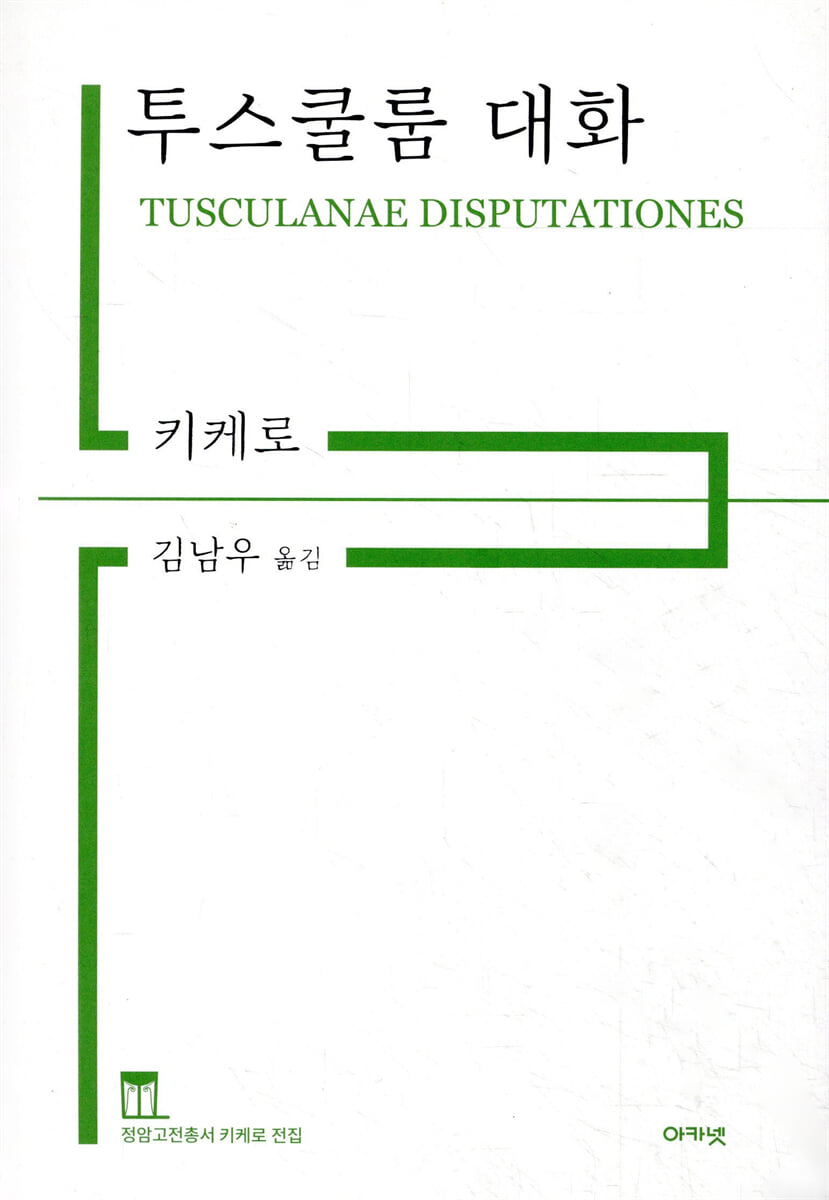
What are essential for a happy life? How can we accept and comfort the death, pain, heartbreak, and emotional passions that threaten a happy life? Cicero, the greatest orator, philosopher, and writer of ancient Rome, wrote the Tusculum Dialogue, a book that explores philosophy as a fundamental healing and solace for the human soul.
Cicero was a man who tried to defend the republic until the end against the dictator Caesar at the end of the republic. During this process, he was politically persecuted and suffered many misfortunes, including the death of his daughter and divorce from his wife.
However, Cicero is a very important figure who shows the process by which Greek philosophies were accepted in Rome and Greek philosophical terms were translated into Latin.
The philosophical writings he left behind, including the Tusculum Dialogue, such as On the Supreme Good and Evil, On Duty, On Friendship, On Old Age, and The Academy, are important sources of Greek philosophy from the Hellenistic period that have not been accurately handed down to us today.
-A philosophy of fundamental healing and comfort for the human soul
What are essential for a happy life? How can we accept and comfort the death, pain, heartbreak, and emotional passions that threaten a happy life? Cicero, the greatest orator, philosopher, and writer of ancient Rome, wrote the Tusculum Dialogue, a book that explores philosophy as a fundamental healing and solace for the human soul.
Cicero was a man who tried to defend the republic until the end against the dictator Caesar at the end of the republic. During this process, he was politically persecuted and suffered many misfortunes, including the death of his daughter and divorce from his wife.
However, Cicero is a very important figure who shows the process by which Greek philosophies were accepted in Rome and Greek philosophical terms were translated into Latin.
The philosophical writings he left behind, including the Tusculum Dialogue, such as On the Supreme Good and Evil, On Duty, On Friendship, On Old Age, and The Academy, are important sources of Greek philosophy from the Hellenistic period that have not been accurately handed down to us today.
- You can preview some of the book's contents.
Preview
index
Publishing the ‘Jeongam Classics Series’
Publishing the ‘Jeongam Classics Series Cicero Complete Works’
Note
text
Book 1: Death is not evil
Book 2: Overcoming Pain
Book 3: Heartbreak is caused by prejudice
Book 4: Passion is born of prejudice
Book 5: The Virtuous Man is Happy
Work Guide
References
Search
human life
concept
Translator's Note
Publishing the ‘Jeongam Classics Series Cicero Complete Works’
Note
text
Book 1: Death is not evil
Book 2: Overcoming Pain
Book 3: Heartbreak is caused by prejudice
Book 4: Passion is born of prejudice
Book 5: The Virtuous Man is Happy
Work Guide
References
Search
human life
concept
Translator's Note
Into the book
Separating the soul from the body is nothing other than learning to die.
Therefore, let us practice this as I say and detach ourselves from the body.
In other words, let's get used to death.
In this way, even while living on earth, we will imitate the life of heaven, and the soul's journey there will be less delayed when it leaves the prison of the body.
---From "Philosophy is the practice of death"
Virtue (virtus) comes from the word vir (man).
What is more peculiar to man than anything else is courage, and the two greatest tasks of courage are to take death and suffering lightly.
Therefore, if one wishes to be virtuous, or rather, if one wishes to become a 'man' since virtue is derived from the word 'man', one must show a lightness toward death and suffering.
---From "A virtuous person is brave in overcoming suffering"
The first remedy would be to teach that the evils thought to be evils are not evils at all, or are very small; the second would be to teach the general conditions of life, or the special conditions of the mourner, if we must discuss them; and the third would be to teach that it is the greatest folly to grieve in vain, knowing that it will do no good.
Therefore, let us practice this as I say and detach ourselves from the body.
In other words, let's get used to death.
In this way, even while living on earth, we will imitate the life of heaven, and the soul's journey there will be less delayed when it leaves the prison of the body.
---From "Philosophy is the practice of death"
Virtue (virtus) comes from the word vir (man).
What is more peculiar to man than anything else is courage, and the two greatest tasks of courage are to take death and suffering lightly.
Therefore, if one wishes to be virtuous, or rather, if one wishes to become a 'man' since virtue is derived from the word 'man', one must show a lightness toward death and suffering.
---From "A virtuous person is brave in overcoming suffering"
The first remedy would be to teach that the evils thought to be evils are not evils at all, or are very small; the second would be to teach the general conditions of life, or the special conditions of the mourner, if we must discuss them; and the third would be to teach that it is the greatest folly to grieve in vain, knowing that it will do no good.
---From "Consolation of Sorrow"
Publisher's Review
A philosophical dialogue for the healing and comfort of suffering souls.
- Five days of questions and answers about the fear of death and physical pain, passions, and external evils.
The Tusculum Dialogues, written in 45 BC, are a five-volume philosophical dialogue that, like Plato's dialogues, features dramatic devices.
It is a compilation of conversations between virtual interlocutors that took place over five days. One of the interlocutors is a student and the other is a teacher, and the conversation takes the form of the teacher answering the student's questions.
45 BC was the height of Caesar's dictatorship.
It was natural that Cicero, who supported the republic politically, was forced to step down from the political front.
Personally, Cicero had to witness the death of his beloved daughter, Tullia, in addition to these political trials.
In this suffering, Cicero completed two books on the subject of 'happiness'.
These are 『Dialogues of the Tusculum』 and 『Theory of the Supreme Good and Evil』.
Therefore, 『On the Supreme Good and Evil』 and 『The Tusculum Dialogues』 have continuity in the topics they cover.
If 『On the Supreme Good and Evil』 deals with the proposition that 'a virtuous person is happy,' 『The Tusculum Dialogue』 discusses the proposition that 'pain cannot take happiness away from a virtuous person.'
Book 1 deals with the fear of death, Book 2 with the fear of physical pain, Books 3 and 4 with the passions, and Book 5 with external evils.
It differs from Plato's dialogues in that it is an asymmetrical dialogue.
A preface appealing to the Romans' interest in philosophy
『Tusculum Dialogues』, which records conversations over five days, features two interlocutors in each volume.
However, if we look at the extent to which the two people involved in the discussion participate in the discussion, it is very different from Plato's dialogues.
In effect, one person leads the discussion, while the other has a very small role, only asking the other person the first question as needed to progress the discussion.
Also, a preliminary discussion begins before the main topic, followed by a long lecture by the discussion leader, forming the main part of each volume.
Meanwhile, each book of the Tusculum Dialogues includes a 'preface' before the fictional dialogue, appealing to the Romans' interest in and importance of philosophy.
In the preface to Book I, Cicero states that the Romans surpass the Greeks in many respects, but that the Greeks excel in literature and education, and that he now turns his attention to philosophy.
In Book 2, Cicero argues that Greek literature and philosophy should be actively accepted in Rome and that philosophical writings should be produced in the Latin language. In Book 3, he argues that efforts should be made to develop philosophy to treat diseases of the soul. In Book 4, he explains that the Romans learned philosophy from the Greeks and began to study philosophy in earnest. In Book 5, he comprehensively explains the history of philosophy, which dates back to the pre-Socratic period, including astronomy and natural science, and the philosophy that paid more attention to humans and the state after Socrates.
- Five days of questions and answers about the fear of death and physical pain, passions, and external evils.
The Tusculum Dialogues, written in 45 BC, are a five-volume philosophical dialogue that, like Plato's dialogues, features dramatic devices.
It is a compilation of conversations between virtual interlocutors that took place over five days. One of the interlocutors is a student and the other is a teacher, and the conversation takes the form of the teacher answering the student's questions.
45 BC was the height of Caesar's dictatorship.
It was natural that Cicero, who supported the republic politically, was forced to step down from the political front.
Personally, Cicero had to witness the death of his beloved daughter, Tullia, in addition to these political trials.
In this suffering, Cicero completed two books on the subject of 'happiness'.
These are 『Dialogues of the Tusculum』 and 『Theory of the Supreme Good and Evil』.
Therefore, 『On the Supreme Good and Evil』 and 『The Tusculum Dialogues』 have continuity in the topics they cover.
If 『On the Supreme Good and Evil』 deals with the proposition that 'a virtuous person is happy,' 『The Tusculum Dialogue』 discusses the proposition that 'pain cannot take happiness away from a virtuous person.'
Book 1 deals with the fear of death, Book 2 with the fear of physical pain, Books 3 and 4 with the passions, and Book 5 with external evils.
It differs from Plato's dialogues in that it is an asymmetrical dialogue.
A preface appealing to the Romans' interest in philosophy
『Tusculum Dialogues』, which records conversations over five days, features two interlocutors in each volume.
However, if we look at the extent to which the two people involved in the discussion participate in the discussion, it is very different from Plato's dialogues.
In effect, one person leads the discussion, while the other has a very small role, only asking the other person the first question as needed to progress the discussion.
Also, a preliminary discussion begins before the main topic, followed by a long lecture by the discussion leader, forming the main part of each volume.
Meanwhile, each book of the Tusculum Dialogues includes a 'preface' before the fictional dialogue, appealing to the Romans' interest in and importance of philosophy.
In the preface to Book I, Cicero states that the Romans surpass the Greeks in many respects, but that the Greeks excel in literature and education, and that he now turns his attention to philosophy.
In Book 2, Cicero argues that Greek literature and philosophy should be actively accepted in Rome and that philosophical writings should be produced in the Latin language. In Book 3, he argues that efforts should be made to develop philosophy to treat diseases of the soul. In Book 4, he explains that the Romans learned philosophy from the Greeks and began to study philosophy in earnest. In Book 5, he comprehensively explains the history of philosophy, which dates back to the pre-Socratic period, including astronomy and natural science, and the philosophy that paid more attention to humans and the state after Socrates.
GOODS SPECIFICS
- Date of issue: January 3, 2022
- Format: Hardcover book binding method guide
- Page count, weight, size: 436 pages | 544g | 127*187*30mm
- ISBN13: 9788957337677
- ISBN10: 8957337679
You may also like
카테고리
korean


korean

![GQ KOREA Mark (Monthly): December [2025]](http://librairie.coreenne.fr/cdn/shop/files/8ef265dbbfbf186523ed75ba7319009d.jpg?v=1765340328&width=3840)


