

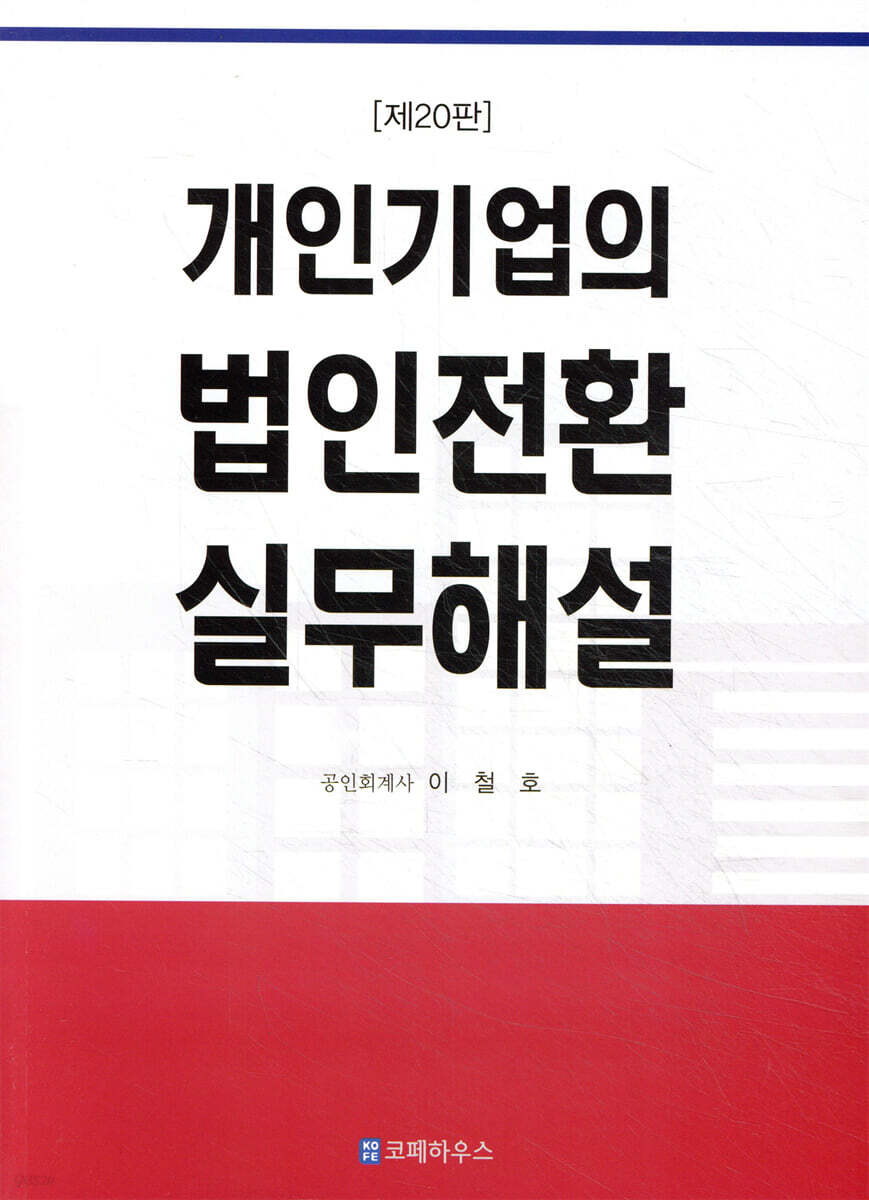
Practical Guide to Converting a Private Business to a Corporation
 |
Description
Book Introduction
『Practical Guide to the Conversion of Private Enterprises into Corporations』 is a practical guide to the conversion of private enterprises into corporations, based on the author's practical experience and know-how accumulated over 20 years of experience in the conversion of private enterprises into corporations.
First, this revised edition (20th edition) includes the latest tax laws, case law, and interpretations regarding the conversion of private businesses into corporations.
Second, the types and methods of converting a private enterprise into a corporation, procedures and practices, and related regulations were explained in detail.
Third, the tax support content and requirements for each method of converting a private enterprise to a corporation, as well as tax review matters, were explained in detail.
Fourth, we have included information on the costs involved in converting a private enterprise to a corporation and practical considerations for converting a corporation to help you make informed decisions about converting to a corporation.
Fifth, examples of practical matters such as selection of a case-by-case corporate conversion method, tax support requirements and corporate conversion costs, and tax reporting were provided so that the corporate conversion process can be carried out with reference to these.
First, this revised edition (20th edition) includes the latest tax laws, case law, and interpretations regarding the conversion of private businesses into corporations.
Second, the types and methods of converting a private enterprise into a corporation, procedures and practices, and related regulations were explained in detail.
Third, the tax support content and requirements for each method of converting a private enterprise to a corporation, as well as tax review matters, were explained in detail.
Fourth, we have included information on the costs involved in converting a private enterprise to a corporation and practical considerations for converting a corporation to help you make informed decisions about converting to a corporation.
Fifth, examples of practical matters such as selection of a case-by-case corporate conversion method, tax support requirements and corporate conversion costs, and tax reporting were provided so that the corporate conversion process can be carried out with reference to these.
index
Part 1: Methods and Effects of Converting a Private Business into a Corporation
Chapter 1 Overview of Conversion from a Sole Proprietorship to a Corporation
Section 1 Individual and corporate enterprises
1.
outline
2.
Differences between individuals and corporations
Section 2 Effects of Conversion of a Private Business into a Corporation
1.
Concept of corporate conversion
2.
Effects of corporate conversion
3.
Restrictions on corporate conversion
4.
Support for corporate conversion
Section 3: Confirmation of Honest Reporting and Conversion to Corporation
1.
Individual businesses subject to verification of honest reporting
2.
Corporations subject to verification of honest reporting
3.
Exemption from verification of honest reporting
Chapter 2 Decision-making on converting a sole proprietorship to a corporation
Section 1 Matters concerning the decision to convert to a corporation
1.
Matters of decision
2.
Decision on whether to convert to a corporation
3.
Corporate environment and whether to convert to a corporation
4.
Business succession support system and whether to convert to a corporation
Section 2 Corporate Form of the Converted Corporation
1.
Types of conversion corporations
2.
Types of companies under commercial law
3.
Comparison of joint-stock and limited companies
4.
Incorporation and corporate form
Section 3: Choosing a method for incorporation
1.
Types of corporate conversion methods
2.
Choosing a method of corporate conversion
3.
Case studies on the method of corporate conversion
Section 4 Determination of the timing of corporate conversion
1.
Strategic Timing: The Year of Incorporation
2.
Tactical Timing: The Month and Day of Incorporation
Chapter 3 Tax Effects of Conversion from a Sole Proprietorship to a Corporation
Section 1 Comparison of corporate conversion tax burden
1.
A simple comparison of the three burdens
2.
Comparison of tax burdens on disposable income
3.
Comparison of the three burdens on disposable resources
Section 2: Differences in taxation systems between individual and corporate enterprises
1.
Concept and scope of taxable income
2.
Method of determining tax claims
3.
Reporting and Payment Schedule
4.
Surtax and income disposal
5.
Case study on tax burden when sales are omitted
Section 3 Differences in Local Income Tax Law
1.
Tax base and tax rate
2.
Deductions and reductions
3.
Reporting and Payment
Section 4 Effects under the Inheritance Tax Act and Gift Tax Act
1.
Business Succession Support System and Incorporation
2.
Valuation of inherited property and conversion to a corporation
3.
Effect of carryover of capital gains tax
Part 2: Practical Guide to Incorporation through General Business Transfer
Chapter 1 Overview of Business Transfer
1.
Significance of business transfer
2.
Effect of business transfer
3.
Business transfer procedures
4.
Restrictions on self-dealing under commercial law
Chapter 2: Establishment of a Corporation for Business Transfer
Section 1. Establishment by promotion and establishment by recruitment
1.
Classification of stock purchasers
2.
Classification of establishment history and investigation report
3.
Comparison of establishment procedures
Section 2 Common procedures for establishment by promotion and establishment by recruitment
1.
Composition of promoters
2.
Preparation and effect of articles of incorporation
3.
Certification of Articles of Incorporation
4.
Decision on stock issuance
Section 3 Procedure for forming a stock company
1.
Procedure for establishment by promotion
2.
Procedure for establishment through recruitment
Section 4 Registration of Incorporation
1.
Applicant for establishment registration
2.
Period of establishment registration
3.
Establishment registration details
4.
Documents attached to registration of establishment
Chapter 3 General Business Transfer and Incorporation Procedures and Practices
Section 1. Procedure and schedule for corporate conversion
1.
Procedure for conversion to a corporation
2.
Establishment of a schedule for corporate conversion
Section 2: Practice by procedure for corporate conversion
1.
Establishment of a corporation
2.
Business transfer contract
3.
Incorporation report and business registration application
4.
Asset valuation
5.
Settlement of private enterprise accounts
6.
Report of closure of a private business
7.
Value-added tax final report
8.
Follow-up measures such as transfer of title
Chapter 4: Case Study of Business Transfer and Incorporation
Section 1. Cases of review for corporate conversion
1.
Overview of companies under review for incorporation
2.
Case of decision on review of corporate conversion
3.
Accounting treatment upon conversion to a corporation
Section 2: Cases related to corporate conversion
Part 3: Practical Guide to Incorporation through In-Kind Contribution
Chapter 1 Overview of In-Kind Conversion of a Subsidiary and Tax Support
Section 1: Overview of the Conversion of In-Kind Contributions into a Corporation
1.
The concept of contribution in kind
2.
Comprehensive scope of the Commercial Act and Special Act
3.
Pros and Cons
Section 2 Tax support for conversion of in-kind contribution to corporation, etc.
1.
Transfer income tax, etc. carryover tax
2.
Acquisition tax reduction, etc.
3.
Exemption from purchase of National Housing Bonds
4.
Succession of tax reductions, etc. for private enterprises
Section 3: Case Study of Conversion of In-Kind Contribution into a Corporation
1.
Transfer income tax carryforward tax
2.
Calculation of acquisition tax
3.
Calculation of special tax for rural and fishing villages
4.
Exemption from purchasing national housing bonds
Section 4. Regulations related to tax support
Chapter 2 Tax Support Requirements for Conversion of In-Kind Contributions into a Corporation
Section 1. Target of tax support
1.
Industry: Exclusion requirements for consumer service industries
2.
In-kind Contributor: Resident Requirement
3.
Succession Business: Continuity and Identity Requirements
4.
Target Assets: Business Fixed Asset Requirements
5.
Capital of a newly established corporation: Requirement of net asset value or more
Section 2 Application for tax support
1.
Timing of contribution in kind
2.
Application for carryover taxation of capital gains tax
3.
Application for carryover taxation of personal local income tax
4.
Confirmation of acquisition tax reduction
5.
Examples of regulations related to tax support applications
Section 3 Post-tax support management
1.
Post-management of capital gains tax
2.
Post-management of personal local income tax
3.
Collection of acquisition tax
Chapter 3: Procedures and Practices for Conversion of In-Kind Contributions into a Corporation
Section 1 Procedures and schedule for corporate conversion
1.
Procedure for conversion of in-kind contribution to a corporation
2.
Establishment of a schedule for the conversion of a corporation to a contribution-in-kind
Section 2: Procedure-by-procedure practical procedures for converting a corporation to a contribution-in-kind
1.
Preparation for incorporation
2.
Preparation of a contribution-in-kind contract
3.
Application for business registration
4.
Asset valuation
5.
Settlement of private enterprise accounts
6.
Certified Public Accountant's Accounting Audit
7.
Value-added tax determination report and business closure report for individual businesses
8.
Determination of contribution in kind and corporate capital
9.
Preparation and certification of articles of incorporation
10.
Corporate structure of a stock company
11.
In-kind contribution investigation report and court review
12.
Incorporation registration
13.
Follow-up measures such as transfer of title
Chapter 4: Case Study of Preparing an Appraisal Report on In-Kind Contributions
1.
Case of a private real estate rental company
2.
Stock Company Establishment Appraisal Report
3.
Limited Company Establishment Appraisal Report
Part 4: Practical Guide to Incorporation through Tax-Reduced Business Transfer
Chapter 1 Overview of Tax Reduction Business Transfer and Incorporation
Section 1. Characteristics of corporate conversion
1.
Characteristics of corporate conversion
2.
Effects of tax support
Section 2 Tax support upon conversion to a corporation
1.
Comparison of tax support
2.
Transfer income tax carryforward tax
3.
Personal local income tax carryover tax
4.
Acquisition tax reduction
5.
Purchase of National Housing Bonds
6.
Succession of tax reductions for individual businesses
7.
Tax support related regulations and examples
Chapter 2 Tax Support Requirements for Tax Reduction Business Transfer and Incorporation
Section 1 Comparison of Tax Support
Section 2. Target of Tax Support
1.
Industry: Exclusion requirements for consumer service industries
2.
Sole Proprietor: Residency Requirements
3.
Target Assets: Business Fixed Asset Requirements
4.
Capital of a newly established corporation: Requirement of net asset value or more
5.
Shareholders: Individual business owners and promoters must participate
6.
Investment amount of individual business owners: Requirement to be equal to or greater than the individual business's net asset value
7.
Comprehensive transfer period: Within 3 months from the date of incorporation
Section 3 Application for tax support, etc.
1.
Application for carryover taxation of capital gains tax
2.
Application for carryover taxation of personal local income tax
3.
Confirmation of acquisition tax reduction
4.
Application for carryover taxation, etc.
Section 4 Post-Tax Support Management
1.
Post-management of capital gains tax, etc.
2.
Collection of acquisition tax
3.
Post-management related regulations and examples
Chapter 3 Tax Reduction Business Transfer and Incorporation Procedures and Practices
Section 1. Procedure and schedule for corporate conversion
1.
Procedure for conversion to a corporation
2.
Establishment of a schedule for corporate conversion
Section 2: Practice by procedure for corporate conversion
1.
Estimation of net asset value of a private enterprise
2.
Determination of corporate capital and establishment of a corporation
3.
Business transfer contract
4.
Incorporation report and business registration application
5.
Asset valuation
6.
Settlement of private enterprise accounts
7.
VAT confirmation report and business closure report
8.
Follow-up measures such as transfer of title
Section 3 Regulations related to corporate conversion procedures
Part 5: Practical Guide to Incorporation through Small and Medium-Sized Enterprise Integration
Chapter 1 Overview of the Consolidation of Small and Medium-sized Enterprises into Incorporation
Section 1: Understanding Small and Medium Enterprise Integration
1.
Understanding corporate structures
2.
Understanding Corporate Mergers and Integrations
Section 2 Types of Corporate Integration and Incorporation
1.
Types of corporate integration
2.
Incorporation through corporate integration
Section 3: Tax Support for Small and Medium Enterprise Integration
1.
Comparison of tax support
2.
Transfer income tax carryforward tax
3.
Carryover taxation of personal local income tax
4.
Acquisition tax reduction
5.
Succession of tax reductions for private enterprises
Chapter 2 Tax Support Requirements for Consolidation of Small and Medium-sized Enterprises into Incorporation
Section 1. Target of tax support
1.
Industry: Exclusion requirements for consumer service industries
2.
Parties to be integrated: Small and medium-sized enterprises (SMEs)
3.
Small and Medium Business Owners of Discontinued Businesses: Requirements for Shareholders of the Incorporated Corporation
4.
Acquisition price: Requirement to be greater than or equal to net asset value
Section 2 Integrated scope of tax support
1.
Requirements for integration by business unit
2.
Requirements for succession of major assets
3.
Requirements for maintaining business identity
4.
Exceptions to integration
5.
Case studies related to the scope of tax support integration
Section 3 Application for tax support
1.
Application for carryover taxation of capital gains tax
2.
Application for carryover taxation of personal local income tax
3.
Confirmation of acquisition tax reduction
Section 4 Post-Tax Support Management
1.
Post-management of capital gains tax, etc.
2.
Collection of acquisition tax
Chapter 3: Procedures and Practices for Conversion of Small and Medium-Sized Enterprises into Incorporated Corporations
Section 1: Determination of the method of integrating small and medium-sized enterprises
1.
Types of SME integration
2.
Integration of individual small and medium-sized enterprises
3.
Newly established through the integration of private and corporate enterprises
4.
Merger of a private enterprise into a corporate enterprise
Section 2 Procedures and schedule for conversion to a consolidated corporation for small and medium-sized enterprises
1.
Overview of the corporate conversion process
2.
Procedures for converting small and medium-sized enterprises into integrated corporations
3.
Establishment of a schedule for the conversion of small and medium-sized enterprises into integrated corporations
Section 3: Practice by procedure for converting small and medium-sized enterprises into integrated corporations
1.
Preparation of an integrated contract for small and medium-sized enterprises
2.
Application for business registration
3.
Asset valuation
4.
Settlement of private enterprise accounts
5.
Certified Public Accountant's Accounting Audit
6.
Value-added tax finalization report and business closure report for individual businesses
7.
Determination of the contribution amount in kind and the subscription amount for new shares
8.
Preparation for issuance and subscription of new stocks
9.
In-kind contribution investigation report and court review
10.
Performance of investment
11.
Registration of capital change
12.
Follow-up measures such as transfer of title
Chapter 4: Case Study of Consolidation of Small and Medium-Sized Enterprises into Incorporation
1.
(Case) Integrating a private real estate rental business into a corporate entity
2.
(Commentary) Costs required for incorporation using the SME integration method and the in-kind contribution method
3.
(Written) In-kind contribution appraisal report for small and medium-sized enterprise integration
Part 6: Review of the Costs Required for Incorporation
Chapter 1 Costs Required by Incorporation Method
Section 1 Comparison of costs required by each method of corporate conversion
Section 2 Characteristics of costs required by each method of corporate conversion
1.
Cost of general business transfer and conversion to corporation
2.
Cost of converting a contribution-in-kind corporation
3.
Cost of tax-exempt business transfer and conversion to corporation
4.
Cost of consolidation of small and medium-sized enterprises
Chapter 2 Capital Gains Tax
Section 1. Incorporation and Capital Gains Tax
1.
Overview of Capital Gains Tax
2.
Scope of assets subject to capital gains tax
3.
Timing of transfer and acquisition
4.
Capital gains tax calculation structure
Section 2 Determination of capital gains
1.
Transfer amount
2.
Necessary expenses
3.
Calculation of capital gains
Section 3 Calculation of transfer income amount
1.
Transfer income amount
2.
Long-term holding special deduction
Section 4 Tax Calculation, Reporting, and Payment
1.
Basic deduction for capital gains
2.
Tax rate on capital gains
3.
Scheduled report
4.
Confirmation report
Chapter 3 Registration License Tax
Section 1. Incorporation and registration license tax
1.
Overview of registration license tax
2.
Taxpayer
3.
Corporate registration license tax
Section 2 Registration License Tax Base and Rate
1.
Registration license tax base
2.
Real estate registration tax rate
3.
Tax rates on ships, vehicles, etc.
4.
Corporate registration tax rate
5.
Tax rates for mutual registration, etc.
Section 3: Heavy taxation on corporate registration in large cities
1.
Heavy taxation content
2.
The scope of the metropolitan area
3.
Exception to heavy taxation
Chapter 4 Acquisition Tax
Section 1. Incorporation and Acquisition Tax
1.
Acquisition tax
2.
Tax base
3.
tariff
4.
High tax rate
5.
Exception to heavy taxation
6.
Incorporation and acquisition tax
Section 2 Timing of acquisition and reporting
1.
Timing of acquisition
2.
Reporting and Payment
Chapter 5 Local Education Tax, Local Income Tax, and Rural Special Tax
1.
Local education tax on acquisition tax, etc.
2.
Local income tax on capital gains tax
3.
Special tax for rural and fishing villages
Chapter 6: Purchase of National Housing Bonds
1.
Purchase of National Housing Bonds
2.
Purchase rate of National Housing Bonds
3.
Partial exemption from purchasing national housing bonds
Chapter 7 Various fees, including accounting audits
Part 7: Practical Considerations for Incorporation
Chapter 1: Review of Advice and Education
1.
Expert advice
2.
Training of practitioners
Chapter 2: Review of Denial of Unfair Act Calculation
Section 1: Incorporation and Denial of Unfair Acts
1.
outline
2.
Overestimation of the transfer price
3.
Overvaluation of the contribution in kind
4.
Underestimation of the transfer price and contribution in kind
Section 2 Denial of Unfair Acts in Taxation
1.
Denial of unfair calculation under the Corporate Tax Act
2.
Denial of unfair calculation under the Income Tax Act
3.
Regulations related to denial of unfair calculations
Chapter 3: Review of Comprehensive Business Transfer
Section 1. Incorporation and Value Added Tax
Section 2 Requirements for Comprehensive Business Transfer
1.
Overview of Business Transfer
2.
Business succession by workplace
3.
All rights and obligations regarding the business
4.
Comprehensive succession of rights and obligations
5.
Regulations related to comprehensive business transfer
Chapter 4 Tax Review of Shareholder Structure
Section 1 Tax Issues of Majority Shareholders
1.
Incorporation and majority shareholders
2.
Secondary tax payment obligations for national and local taxes
3.
Double taxation of acquisition tax
4.
Regulations related to majority shareholders
Section 2: Investigation of the source of funds of the stock purchaser
1.
Investigation of the source of funds
2.
In case of presumption of gift
3.
Details of the tax office's investigation into the source of funds
Section 3. Gift theory for acquisition of stocks in the name of a third party
1.
bestowal
2.
Non-gift
3.
Judgment on change of name
Chapter 5: Review of market valuation upon conversion to a corporation
Section 1: The Need for Market Valuation
1.
fair investment
2.
Investigation and reporting obligations under commercial law
3.
Review of denial of unfair calculation
4.
Tax support requirements
Section 2 Legal provisions related to market price upon conversion to a corporation
1.
Commercial law provisions
2.
Provisions of the Special Tax Exceptions and Restrictions Act and the Local Tax Special Tax Exceptions and Restrictions Act
3.
Corporate Tax Act provisions
4.
Income Tax Act provisions
5.
Inheritance Tax and Gift Tax Act Provisions
Section 3: Market Value Assessment under the Inheritance Tax and Gift Tax Act
1.
Principles of market valuation
2.
Valuation of real estate, etc.
3.
Valuation of ships and other tangible assets
4.
Evaluation of intangible property rights, etc.
5.
Special provisions for property valuation with mortgages, etc.
Section 4: The Importance of Market Value Evaluation When Converting to a Corporation
1.
Market price of real estate, etc.
2.
Appraised value of real estate, etc.
3.
Valuation of goodwill
4.
Regulations related to market valuation
Chapter 6: Income Tax Reporting and Bank Transaction Verification for Self-Employed Individuals
1.
Income tax return
2.
Confirmation of banking transactions
Part 8: Comprehensive Case Study on Incorporation
Chapter 1: Choosing a Method of Incorporation
1.
If you are engaged in manufacturing and wholesale/retail business at your own business
2.
If you lease a factory and do manufacturing
3.
In case of conducting consumer service business at one's own business
4.
In case of manufacturing under the wife's name at a factory owned by the husband
5.
If you have been in the real estate rental business and have been manufacturing at the same business location for less than 1 year
6.
In the case of construction business without real estate or acquisition taxable items
7.
If you conduct passenger transportation business exceeding the size of a small or medium-sized enterprise at your own business location
8.
When consumer services and manufacturing are conducted in different locations
9.
If you are in the real estate rental business
10.
If you have been running a small or medium-sized individual manufacturing business or a joint-stock company manufacturing business for more than one year
11.
If the stock company was established two months prior to opening
Chapter 2 Tax Support Requirements and Incorporation Costs
1.
Confirmation of tax support requirements
2.
Determination of contribution in kind and corporate capital
3.
Calculation of capital gains tax
4.
Calculation of acquisition tax, etc. when transferring real estate or vehicle ownership
5.
Calculation of registration license tax and local education tax when registering corporate establishment
6.
Preparation of a comparison table of costs required for corporate conversion
Chapter 3 Tax Reporting
1.
Preparation of corporate establishment report, etc.
2.
Preparation of depreciation method and inventory asset valuation method report forms, etc.
3.
Writing a business closure report
4.
Reporting of capital gains tax
[Reference] Reference materials related to corporate conversion
1.
Reference forms for articles of incorporation and corporate conversion
2.
Special Tax Exceptions and Restrictions Act on Corporate Conversion, etc.
3.
Local Tax Special Cases Restriction Act on Conversion to Corporation, etc.
4.
National Housing Bond Purchase Target and Amount, etc.
Chapter 1 Overview of Conversion from a Sole Proprietorship to a Corporation
Section 1 Individual and corporate enterprises
1.
outline
2.
Differences between individuals and corporations
Section 2 Effects of Conversion of a Private Business into a Corporation
1.
Concept of corporate conversion
2.
Effects of corporate conversion
3.
Restrictions on corporate conversion
4.
Support for corporate conversion
Section 3: Confirmation of Honest Reporting and Conversion to Corporation
1.
Individual businesses subject to verification of honest reporting
2.
Corporations subject to verification of honest reporting
3.
Exemption from verification of honest reporting
Chapter 2 Decision-making on converting a sole proprietorship to a corporation
Section 1 Matters concerning the decision to convert to a corporation
1.
Matters of decision
2.
Decision on whether to convert to a corporation
3.
Corporate environment and whether to convert to a corporation
4.
Business succession support system and whether to convert to a corporation
Section 2 Corporate Form of the Converted Corporation
1.
Types of conversion corporations
2.
Types of companies under commercial law
3.
Comparison of joint-stock and limited companies
4.
Incorporation and corporate form
Section 3: Choosing a method for incorporation
1.
Types of corporate conversion methods
2.
Choosing a method of corporate conversion
3.
Case studies on the method of corporate conversion
Section 4 Determination of the timing of corporate conversion
1.
Strategic Timing: The Year of Incorporation
2.
Tactical Timing: The Month and Day of Incorporation
Chapter 3 Tax Effects of Conversion from a Sole Proprietorship to a Corporation
Section 1 Comparison of corporate conversion tax burden
1.
A simple comparison of the three burdens
2.
Comparison of tax burdens on disposable income
3.
Comparison of the three burdens on disposable resources
Section 2: Differences in taxation systems between individual and corporate enterprises
1.
Concept and scope of taxable income
2.
Method of determining tax claims
3.
Reporting and Payment Schedule
4.
Surtax and income disposal
5.
Case study on tax burden when sales are omitted
Section 3 Differences in Local Income Tax Law
1.
Tax base and tax rate
2.
Deductions and reductions
3.
Reporting and Payment
Section 4 Effects under the Inheritance Tax Act and Gift Tax Act
1.
Business Succession Support System and Incorporation
2.
Valuation of inherited property and conversion to a corporation
3.
Effect of carryover of capital gains tax
Part 2: Practical Guide to Incorporation through General Business Transfer
Chapter 1 Overview of Business Transfer
1.
Significance of business transfer
2.
Effect of business transfer
3.
Business transfer procedures
4.
Restrictions on self-dealing under commercial law
Chapter 2: Establishment of a Corporation for Business Transfer
Section 1. Establishment by promotion and establishment by recruitment
1.
Classification of stock purchasers
2.
Classification of establishment history and investigation report
3.
Comparison of establishment procedures
Section 2 Common procedures for establishment by promotion and establishment by recruitment
1.
Composition of promoters
2.
Preparation and effect of articles of incorporation
3.
Certification of Articles of Incorporation
4.
Decision on stock issuance
Section 3 Procedure for forming a stock company
1.
Procedure for establishment by promotion
2.
Procedure for establishment through recruitment
Section 4 Registration of Incorporation
1.
Applicant for establishment registration
2.
Period of establishment registration
3.
Establishment registration details
4.
Documents attached to registration of establishment
Chapter 3 General Business Transfer and Incorporation Procedures and Practices
Section 1. Procedure and schedule for corporate conversion
1.
Procedure for conversion to a corporation
2.
Establishment of a schedule for corporate conversion
Section 2: Practice by procedure for corporate conversion
1.
Establishment of a corporation
2.
Business transfer contract
3.
Incorporation report and business registration application
4.
Asset valuation
5.
Settlement of private enterprise accounts
6.
Report of closure of a private business
7.
Value-added tax final report
8.
Follow-up measures such as transfer of title
Chapter 4: Case Study of Business Transfer and Incorporation
Section 1. Cases of review for corporate conversion
1.
Overview of companies under review for incorporation
2.
Case of decision on review of corporate conversion
3.
Accounting treatment upon conversion to a corporation
Section 2: Cases related to corporate conversion
Part 3: Practical Guide to Incorporation through In-Kind Contribution
Chapter 1 Overview of In-Kind Conversion of a Subsidiary and Tax Support
Section 1: Overview of the Conversion of In-Kind Contributions into a Corporation
1.
The concept of contribution in kind
2.
Comprehensive scope of the Commercial Act and Special Act
3.
Pros and Cons
Section 2 Tax support for conversion of in-kind contribution to corporation, etc.
1.
Transfer income tax, etc. carryover tax
2.
Acquisition tax reduction, etc.
3.
Exemption from purchase of National Housing Bonds
4.
Succession of tax reductions, etc. for private enterprises
Section 3: Case Study of Conversion of In-Kind Contribution into a Corporation
1.
Transfer income tax carryforward tax
2.
Calculation of acquisition tax
3.
Calculation of special tax for rural and fishing villages
4.
Exemption from purchasing national housing bonds
Section 4. Regulations related to tax support
Chapter 2 Tax Support Requirements for Conversion of In-Kind Contributions into a Corporation
Section 1. Target of tax support
1.
Industry: Exclusion requirements for consumer service industries
2.
In-kind Contributor: Resident Requirement
3.
Succession Business: Continuity and Identity Requirements
4.
Target Assets: Business Fixed Asset Requirements
5.
Capital of a newly established corporation: Requirement of net asset value or more
Section 2 Application for tax support
1.
Timing of contribution in kind
2.
Application for carryover taxation of capital gains tax
3.
Application for carryover taxation of personal local income tax
4.
Confirmation of acquisition tax reduction
5.
Examples of regulations related to tax support applications
Section 3 Post-tax support management
1.
Post-management of capital gains tax
2.
Post-management of personal local income tax
3.
Collection of acquisition tax
Chapter 3: Procedures and Practices for Conversion of In-Kind Contributions into a Corporation
Section 1 Procedures and schedule for corporate conversion
1.
Procedure for conversion of in-kind contribution to a corporation
2.
Establishment of a schedule for the conversion of a corporation to a contribution-in-kind
Section 2: Procedure-by-procedure practical procedures for converting a corporation to a contribution-in-kind
1.
Preparation for incorporation
2.
Preparation of a contribution-in-kind contract
3.
Application for business registration
4.
Asset valuation
5.
Settlement of private enterprise accounts
6.
Certified Public Accountant's Accounting Audit
7.
Value-added tax determination report and business closure report for individual businesses
8.
Determination of contribution in kind and corporate capital
9.
Preparation and certification of articles of incorporation
10.
Corporate structure of a stock company
11.
In-kind contribution investigation report and court review
12.
Incorporation registration
13.
Follow-up measures such as transfer of title
Chapter 4: Case Study of Preparing an Appraisal Report on In-Kind Contributions
1.
Case of a private real estate rental company
2.
Stock Company Establishment Appraisal Report
3.
Limited Company Establishment Appraisal Report
Part 4: Practical Guide to Incorporation through Tax-Reduced Business Transfer
Chapter 1 Overview of Tax Reduction Business Transfer and Incorporation
Section 1. Characteristics of corporate conversion
1.
Characteristics of corporate conversion
2.
Effects of tax support
Section 2 Tax support upon conversion to a corporation
1.
Comparison of tax support
2.
Transfer income tax carryforward tax
3.
Personal local income tax carryover tax
4.
Acquisition tax reduction
5.
Purchase of National Housing Bonds
6.
Succession of tax reductions for individual businesses
7.
Tax support related regulations and examples
Chapter 2 Tax Support Requirements for Tax Reduction Business Transfer and Incorporation
Section 1 Comparison of Tax Support
Section 2. Target of Tax Support
1.
Industry: Exclusion requirements for consumer service industries
2.
Sole Proprietor: Residency Requirements
3.
Target Assets: Business Fixed Asset Requirements
4.
Capital of a newly established corporation: Requirement of net asset value or more
5.
Shareholders: Individual business owners and promoters must participate
6.
Investment amount of individual business owners: Requirement to be equal to or greater than the individual business's net asset value
7.
Comprehensive transfer period: Within 3 months from the date of incorporation
Section 3 Application for tax support, etc.
1.
Application for carryover taxation of capital gains tax
2.
Application for carryover taxation of personal local income tax
3.
Confirmation of acquisition tax reduction
4.
Application for carryover taxation, etc.
Section 4 Post-Tax Support Management
1.
Post-management of capital gains tax, etc.
2.
Collection of acquisition tax
3.
Post-management related regulations and examples
Chapter 3 Tax Reduction Business Transfer and Incorporation Procedures and Practices
Section 1. Procedure and schedule for corporate conversion
1.
Procedure for conversion to a corporation
2.
Establishment of a schedule for corporate conversion
Section 2: Practice by procedure for corporate conversion
1.
Estimation of net asset value of a private enterprise
2.
Determination of corporate capital and establishment of a corporation
3.
Business transfer contract
4.
Incorporation report and business registration application
5.
Asset valuation
6.
Settlement of private enterprise accounts
7.
VAT confirmation report and business closure report
8.
Follow-up measures such as transfer of title
Section 3 Regulations related to corporate conversion procedures
Part 5: Practical Guide to Incorporation through Small and Medium-Sized Enterprise Integration
Chapter 1 Overview of the Consolidation of Small and Medium-sized Enterprises into Incorporation
Section 1: Understanding Small and Medium Enterprise Integration
1.
Understanding corporate structures
2.
Understanding Corporate Mergers and Integrations
Section 2 Types of Corporate Integration and Incorporation
1.
Types of corporate integration
2.
Incorporation through corporate integration
Section 3: Tax Support for Small and Medium Enterprise Integration
1.
Comparison of tax support
2.
Transfer income tax carryforward tax
3.
Carryover taxation of personal local income tax
4.
Acquisition tax reduction
5.
Succession of tax reductions for private enterprises
Chapter 2 Tax Support Requirements for Consolidation of Small and Medium-sized Enterprises into Incorporation
Section 1. Target of tax support
1.
Industry: Exclusion requirements for consumer service industries
2.
Parties to be integrated: Small and medium-sized enterprises (SMEs)
3.
Small and Medium Business Owners of Discontinued Businesses: Requirements for Shareholders of the Incorporated Corporation
4.
Acquisition price: Requirement to be greater than or equal to net asset value
Section 2 Integrated scope of tax support
1.
Requirements for integration by business unit
2.
Requirements for succession of major assets
3.
Requirements for maintaining business identity
4.
Exceptions to integration
5.
Case studies related to the scope of tax support integration
Section 3 Application for tax support
1.
Application for carryover taxation of capital gains tax
2.
Application for carryover taxation of personal local income tax
3.
Confirmation of acquisition tax reduction
Section 4 Post-Tax Support Management
1.
Post-management of capital gains tax, etc.
2.
Collection of acquisition tax
Chapter 3: Procedures and Practices for Conversion of Small and Medium-Sized Enterprises into Incorporated Corporations
Section 1: Determination of the method of integrating small and medium-sized enterprises
1.
Types of SME integration
2.
Integration of individual small and medium-sized enterprises
3.
Newly established through the integration of private and corporate enterprises
4.
Merger of a private enterprise into a corporate enterprise
Section 2 Procedures and schedule for conversion to a consolidated corporation for small and medium-sized enterprises
1.
Overview of the corporate conversion process
2.
Procedures for converting small and medium-sized enterprises into integrated corporations
3.
Establishment of a schedule for the conversion of small and medium-sized enterprises into integrated corporations
Section 3: Practice by procedure for converting small and medium-sized enterprises into integrated corporations
1.
Preparation of an integrated contract for small and medium-sized enterprises
2.
Application for business registration
3.
Asset valuation
4.
Settlement of private enterprise accounts
5.
Certified Public Accountant's Accounting Audit
6.
Value-added tax finalization report and business closure report for individual businesses
7.
Determination of the contribution amount in kind and the subscription amount for new shares
8.
Preparation for issuance and subscription of new stocks
9.
In-kind contribution investigation report and court review
10.
Performance of investment
11.
Registration of capital change
12.
Follow-up measures such as transfer of title
Chapter 4: Case Study of Consolidation of Small and Medium-Sized Enterprises into Incorporation
1.
(Case) Integrating a private real estate rental business into a corporate entity
2.
(Commentary) Costs required for incorporation using the SME integration method and the in-kind contribution method
3.
(Written) In-kind contribution appraisal report for small and medium-sized enterprise integration
Part 6: Review of the Costs Required for Incorporation
Chapter 1 Costs Required by Incorporation Method
Section 1 Comparison of costs required by each method of corporate conversion
Section 2 Characteristics of costs required by each method of corporate conversion
1.
Cost of general business transfer and conversion to corporation
2.
Cost of converting a contribution-in-kind corporation
3.
Cost of tax-exempt business transfer and conversion to corporation
4.
Cost of consolidation of small and medium-sized enterprises
Chapter 2 Capital Gains Tax
Section 1. Incorporation and Capital Gains Tax
1.
Overview of Capital Gains Tax
2.
Scope of assets subject to capital gains tax
3.
Timing of transfer and acquisition
4.
Capital gains tax calculation structure
Section 2 Determination of capital gains
1.
Transfer amount
2.
Necessary expenses
3.
Calculation of capital gains
Section 3 Calculation of transfer income amount
1.
Transfer income amount
2.
Long-term holding special deduction
Section 4 Tax Calculation, Reporting, and Payment
1.
Basic deduction for capital gains
2.
Tax rate on capital gains
3.
Scheduled report
4.
Confirmation report
Chapter 3 Registration License Tax
Section 1. Incorporation and registration license tax
1.
Overview of registration license tax
2.
Taxpayer
3.
Corporate registration license tax
Section 2 Registration License Tax Base and Rate
1.
Registration license tax base
2.
Real estate registration tax rate
3.
Tax rates on ships, vehicles, etc.
4.
Corporate registration tax rate
5.
Tax rates for mutual registration, etc.
Section 3: Heavy taxation on corporate registration in large cities
1.
Heavy taxation content
2.
The scope of the metropolitan area
3.
Exception to heavy taxation
Chapter 4 Acquisition Tax
Section 1. Incorporation and Acquisition Tax
1.
Acquisition tax
2.
Tax base
3.
tariff
4.
High tax rate
5.
Exception to heavy taxation
6.
Incorporation and acquisition tax
Section 2 Timing of acquisition and reporting
1.
Timing of acquisition
2.
Reporting and Payment
Chapter 5 Local Education Tax, Local Income Tax, and Rural Special Tax
1.
Local education tax on acquisition tax, etc.
2.
Local income tax on capital gains tax
3.
Special tax for rural and fishing villages
Chapter 6: Purchase of National Housing Bonds
1.
Purchase of National Housing Bonds
2.
Purchase rate of National Housing Bonds
3.
Partial exemption from purchasing national housing bonds
Chapter 7 Various fees, including accounting audits
Part 7: Practical Considerations for Incorporation
Chapter 1: Review of Advice and Education
1.
Expert advice
2.
Training of practitioners
Chapter 2: Review of Denial of Unfair Act Calculation
Section 1: Incorporation and Denial of Unfair Acts
1.
outline
2.
Overestimation of the transfer price
3.
Overvaluation of the contribution in kind
4.
Underestimation of the transfer price and contribution in kind
Section 2 Denial of Unfair Acts in Taxation
1.
Denial of unfair calculation under the Corporate Tax Act
2.
Denial of unfair calculation under the Income Tax Act
3.
Regulations related to denial of unfair calculations
Chapter 3: Review of Comprehensive Business Transfer
Section 1. Incorporation and Value Added Tax
Section 2 Requirements for Comprehensive Business Transfer
1.
Overview of Business Transfer
2.
Business succession by workplace
3.
All rights and obligations regarding the business
4.
Comprehensive succession of rights and obligations
5.
Regulations related to comprehensive business transfer
Chapter 4 Tax Review of Shareholder Structure
Section 1 Tax Issues of Majority Shareholders
1.
Incorporation and majority shareholders
2.
Secondary tax payment obligations for national and local taxes
3.
Double taxation of acquisition tax
4.
Regulations related to majority shareholders
Section 2: Investigation of the source of funds of the stock purchaser
1.
Investigation of the source of funds
2.
In case of presumption of gift
3.
Details of the tax office's investigation into the source of funds
Section 3. Gift theory for acquisition of stocks in the name of a third party
1.
bestowal
2.
Non-gift
3.
Judgment on change of name
Chapter 5: Review of market valuation upon conversion to a corporation
Section 1: The Need for Market Valuation
1.
fair investment
2.
Investigation and reporting obligations under commercial law
3.
Review of denial of unfair calculation
4.
Tax support requirements
Section 2 Legal provisions related to market price upon conversion to a corporation
1.
Commercial law provisions
2.
Provisions of the Special Tax Exceptions and Restrictions Act and the Local Tax Special Tax Exceptions and Restrictions Act
3.
Corporate Tax Act provisions
4.
Income Tax Act provisions
5.
Inheritance Tax and Gift Tax Act Provisions
Section 3: Market Value Assessment under the Inheritance Tax and Gift Tax Act
1.
Principles of market valuation
2.
Valuation of real estate, etc.
3.
Valuation of ships and other tangible assets
4.
Evaluation of intangible property rights, etc.
5.
Special provisions for property valuation with mortgages, etc.
Section 4: The Importance of Market Value Evaluation When Converting to a Corporation
1.
Market price of real estate, etc.
2.
Appraised value of real estate, etc.
3.
Valuation of goodwill
4.
Regulations related to market valuation
Chapter 6: Income Tax Reporting and Bank Transaction Verification for Self-Employed Individuals
1.
Income tax return
2.
Confirmation of banking transactions
Part 8: Comprehensive Case Study on Incorporation
Chapter 1: Choosing a Method of Incorporation
1.
If you are engaged in manufacturing and wholesale/retail business at your own business
2.
If you lease a factory and do manufacturing
3.
In case of conducting consumer service business at one's own business
4.
In case of manufacturing under the wife's name at a factory owned by the husband
5.
If you have been in the real estate rental business and have been manufacturing at the same business location for less than 1 year
6.
In the case of construction business without real estate or acquisition taxable items
7.
If you conduct passenger transportation business exceeding the size of a small or medium-sized enterprise at your own business location
8.
When consumer services and manufacturing are conducted in different locations
9.
If you are in the real estate rental business
10.
If you have been running a small or medium-sized individual manufacturing business or a joint-stock company manufacturing business for more than one year
11.
If the stock company was established two months prior to opening
Chapter 2 Tax Support Requirements and Incorporation Costs
1.
Confirmation of tax support requirements
2.
Determination of contribution in kind and corporate capital
3.
Calculation of capital gains tax
4.
Calculation of acquisition tax, etc. when transferring real estate or vehicle ownership
5.
Calculation of registration license tax and local education tax when registering corporate establishment
6.
Preparation of a comparison table of costs required for corporate conversion
Chapter 3 Tax Reporting
1.
Preparation of corporate establishment report, etc.
2.
Preparation of depreciation method and inventory asset valuation method report forms, etc.
3.
Writing a business closure report
4.
Reporting of capital gains tax
[Reference] Reference materials related to corporate conversion
1.
Reference forms for articles of incorporation and corporate conversion
2.
Special Tax Exceptions and Restrictions Act on Corporate Conversion, etc.
3.
Local Tax Special Cases Restriction Act on Conversion to Corporation, etc.
4.
National Housing Bond Purchase Target and Amount, etc.
GOODS SPECIFICS
- Date of issue: February 14, 2025
- Page count, weight, size: 624 pages | 190*260*35mm
- ISBN13: 9788993835885
- ISBN10: 8993835888
You may also like
카테고리
korean


korean

![ELLE 엘르 스페셜 에디션 A형 : 12월 [2025]](http://librairie.coreenne.fr/cdn/shop/files/b8e27a3de6c9538896439686c6b0e8fb.jpg?v=1766436872&width=3840)


