

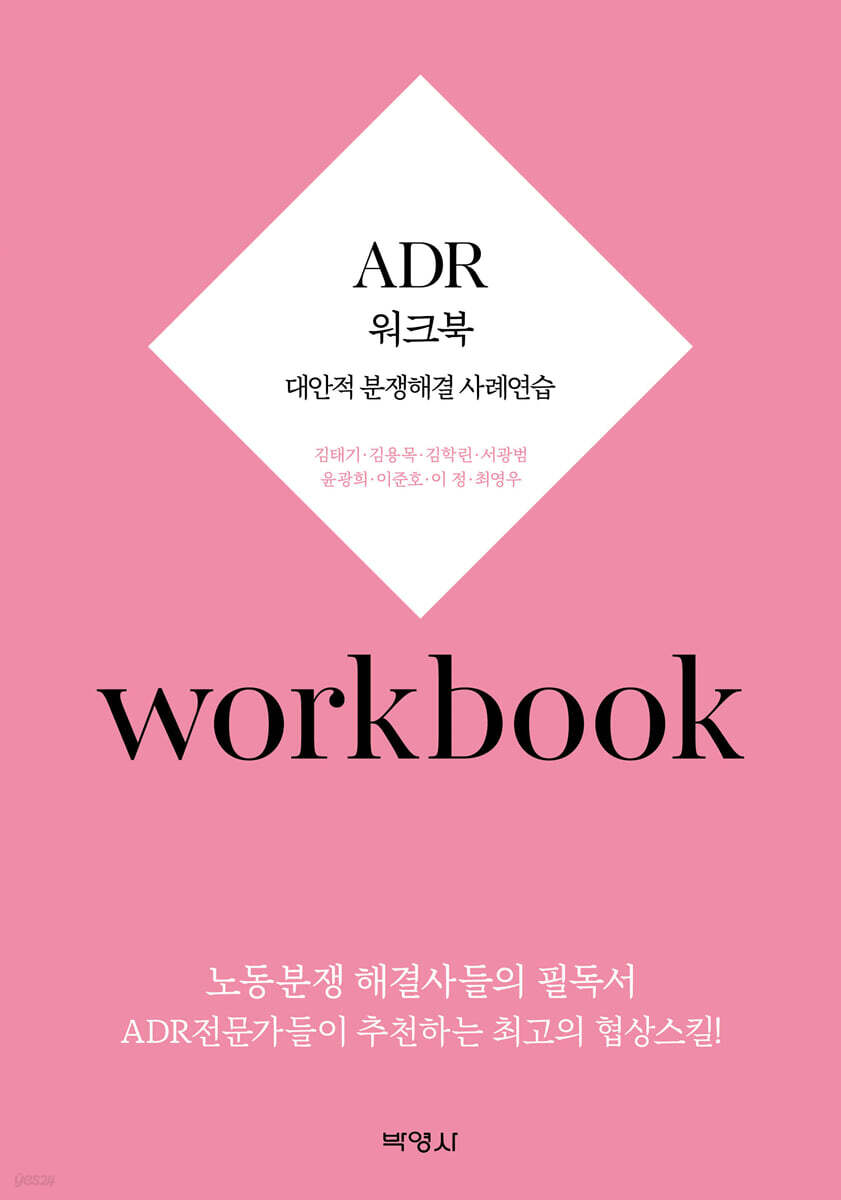
ADR Workbook
 |
Description
Book Introduction
In order to utilize ADR techniques in practice, theoretical knowledge is important, but hands-on practice of solving hypothetical cases to be able to apply them appropriately in real-life situations is also very important.
Accordingly, the workbook aims to help students acquire the skills and abilities to resolve typical conflicts and disputes that occur daily in industrial settings using ADR techniques.
In particular, this workbook is designed to enable ADR program participants to experience the process of exploring modules for wisely resolving conflicts and disputes through role-playing from the perspectives of stakeholders and mediators.
Accordingly, the workbook aims to help students acquire the skills and abilities to resolve typical conflicts and disputes that occur daily in industrial settings using ADR techniques.
In particular, this workbook is designed to enable ADR program participants to experience the process of exploring modules for wisely resolving conflicts and disputes through role-playing from the perspectives of stakeholders and mediators.
index
Chapter 01 Employment Conflicts and Negotiation 6
Chairman Kim Tae-gi (Central Labor Committee)
Chapter 02: Communication in Employment Conflicts 24
Former Professor Lee Jun-ho (Nazareth University)
Chapter 03 Employment Disputes and the Use of Reconciliation 38
Seo Gwang-beom, Public Interest Commissioner (Gyeonggi Regional Labor Relations Commission)
Chapter 04: Resolving Workplace Grievances and Communication 58
Yoon Gwang-hee, Public Interest Commissioner (Chungbuk Regional Labor Relations Commission)
Chapter 05: Success Principles of Collective Bargaining 82
Former Dean Yongmok Kim (Korea Polytechnic University, Asan Campus)
Chapter 06 Labor Dispute Mediation and Arbitration 102
Professor Kim Hak-rin (Dankook University)
Chapter 07 Individual Labor Relations Law 120
Professor Lee Jeong (Hankuk University of Foreign Studies)
Chapter 08 Collective Labor Relations Law 130
Director Choi Young-woo (Central Economic HR Training Institute)
Chairman Kim Tae-gi (Central Labor Committee)
Chapter 02: Communication in Employment Conflicts 24
Former Professor Lee Jun-ho (Nazareth University)
Chapter 03 Employment Disputes and the Use of Reconciliation 38
Seo Gwang-beom, Public Interest Commissioner (Gyeonggi Regional Labor Relations Commission)
Chapter 04: Resolving Workplace Grievances and Communication 58
Yoon Gwang-hee, Public Interest Commissioner (Chungbuk Regional Labor Relations Commission)
Chapter 05: Success Principles of Collective Bargaining 82
Former Dean Yongmok Kim (Korea Polytechnic University, Asan Campus)
Chapter 06 Labor Dispute Mediation and Arbitration 102
Professor Kim Hak-rin (Dankook University)
Chapter 07 Individual Labor Relations Law 120
Professor Lee Jeong (Hankuk University of Foreign Studies)
Chapter 08 Collective Labor Relations Law 130
Director Choi Young-woo (Central Economic HR Training Institute)
Detailed image

Publisher's Review
The effectiveness of alternative dispute resolution (ADR) has already been proven in advanced countries, and it is now one of the most common dispute resolution systems.
In particular, since disputes surrounding employment relationships involve complex interests and diverse issues, it goes without saying that it is most desirable for the parties to take the initiative in resolving the issue through mediation of their interests using ADR rather than an all-or-nothing approach.
Unfortunately, however, in Korea, there are almost no theoretical or practical books that systematically introduce ADR, perhaps due to a lack of publicity and understanding of the subject.
Accordingly, starting last year, experts in each field formed a study group and held heated discussions almost every week. This spring, Park Young-sa published the basic theory book on ADR, “ADR Alternative Dispute Resolution System” (Basic Edition). This time, along with the “Advanced Edition” which further upgraded the contents of the “Basic Edition,” they also published the “ADR Workbook” so that it can be used as a supplementary textbook during practice.
In order to utilize ADR techniques in practice, theoretical knowledge is important, but hands-on practice of solving hypothetical cases to be able to apply them appropriately in real-life situations is also very important.
Accordingly, the workbook aims to help students acquire the skills and abilities to resolve typical conflicts and disputes that occur daily in industrial settings using ADR techniques.
In particular, this workbook is designed to enable ADR program participants to experience the process of exploring modules for wisely resolving conflicts and disputes through role-playing from the perspectives of stakeholders and mediators.
I would like to express my gratitude to Dr. Kim Seong-hwan, Dr. Son Dong-hee, Dr. Lee Gong-hee, and Dr. Choi Hong-gi of the Korea Employment and Labor Education Institute for their thoughtful consideration and comments in the preparation of this practice workbook.
I sincerely hope that this workbook will help you acquire ADR techniques for effectively resolving conflicts and disputes through case studies and apply them in your practice.
Summer 2024
All writers
In particular, since disputes surrounding employment relationships involve complex interests and diverse issues, it goes without saying that it is most desirable for the parties to take the initiative in resolving the issue through mediation of their interests using ADR rather than an all-or-nothing approach.
Unfortunately, however, in Korea, there are almost no theoretical or practical books that systematically introduce ADR, perhaps due to a lack of publicity and understanding of the subject.
Accordingly, starting last year, experts in each field formed a study group and held heated discussions almost every week. This spring, Park Young-sa published the basic theory book on ADR, “ADR Alternative Dispute Resolution System” (Basic Edition). This time, along with the “Advanced Edition” which further upgraded the contents of the “Basic Edition,” they also published the “ADR Workbook” so that it can be used as a supplementary textbook during practice.
In order to utilize ADR techniques in practice, theoretical knowledge is important, but hands-on practice of solving hypothetical cases to be able to apply them appropriately in real-life situations is also very important.
Accordingly, the workbook aims to help students acquire the skills and abilities to resolve typical conflicts and disputes that occur daily in industrial settings using ADR techniques.
In particular, this workbook is designed to enable ADR program participants to experience the process of exploring modules for wisely resolving conflicts and disputes through role-playing from the perspectives of stakeholders and mediators.
I would like to express my gratitude to Dr. Kim Seong-hwan, Dr. Son Dong-hee, Dr. Lee Gong-hee, and Dr. Choi Hong-gi of the Korea Employment and Labor Education Institute for their thoughtful consideration and comments in the preparation of this practice workbook.
I sincerely hope that this workbook will help you acquire ADR techniques for effectively resolving conflicts and disputes through case studies and apply them in your practice.
Summer 2024
All writers
GOODS SPECIFICS
- Date of issue: July 23, 2024
- Page count, weight, size: 144 pages | 176*248*20mm
- ISBN13: 9791130347981
- ISBN10: 1130347982
You may also like
카테고리
korean


korean

![GQ KOREA Mark (Monthly): December [2025]](http://librairie.coreenne.fr/cdn/shop/files/8ef265dbbfbf186523ed75ba7319009d.jpg?v=1765340328&width=3840)


