

World Politics
 |
Description
Book Introduction
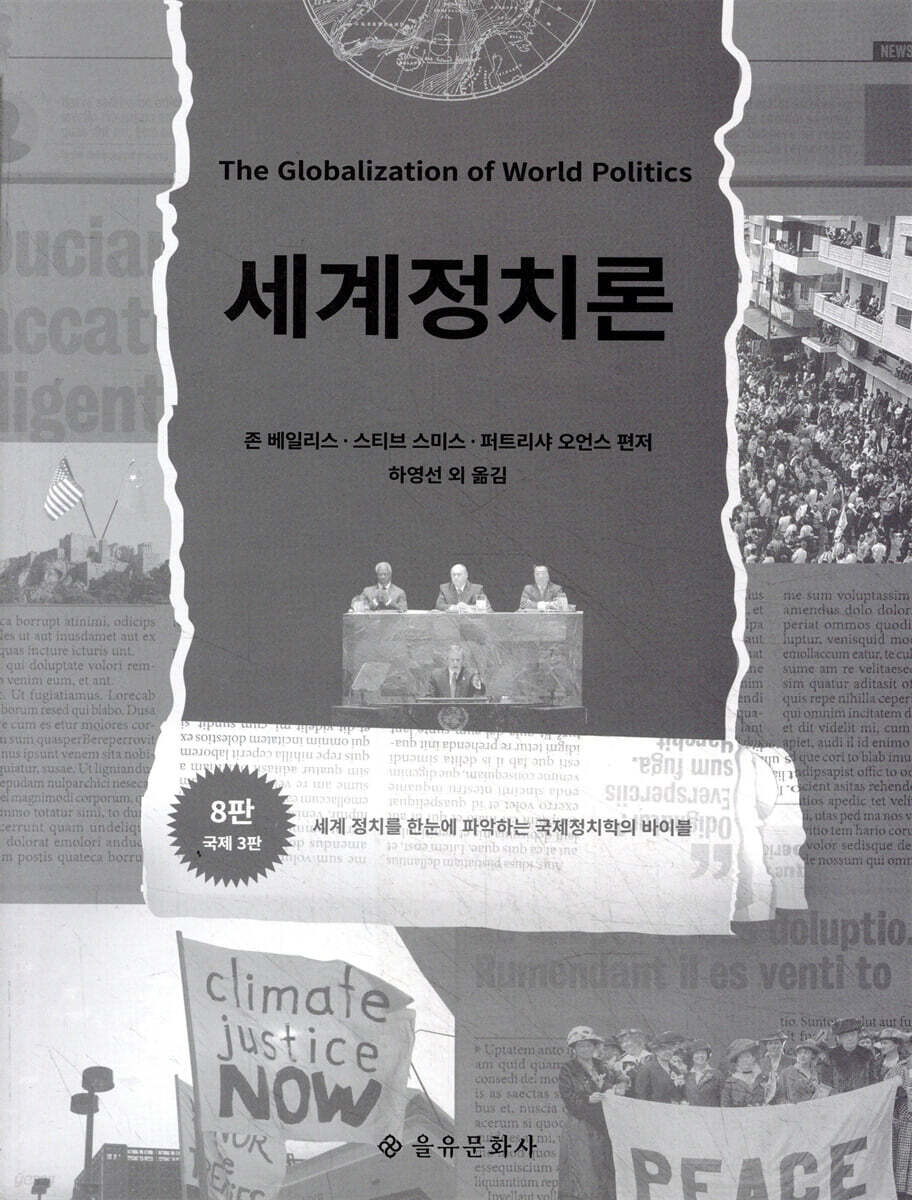
Since the first edition was published in 1997, the 8th edition (3rd international edition) of 『World Politics』, which has been established as a standard textbook at major universities around the world by comprehensively covering the history and theory, structure and process, and major issues of world politics, has been published.
Previously, we translated and introduced the Standard Edition (existing version) of 『World Politics』 published by Oxford University Press, but from this edition onwards, we followed the copyright holder's principle of publishing an International Edition (International Edition) based on the Standard Edition and modified to suit the local circumstances when publishing in a country other than the United States or the United Kingdom.
However, to avoid confusion among existing domestic readers, both “8th edition” and “International 3rd edition” were indicated simultaneously.
Previously, we translated and introduced the Standard Edition (existing version) of 『World Politics』 published by Oxford University Press, but from this edition onwards, we followed the copyright holder's principle of publishing an International Edition (International Edition) based on the Standard Edition and modified to suit the local circumstances when publishing in a country other than the United States or the United Kingdom.
However, to avoid confusion among existing domestic readers, both “8th edition” and “International 3rd edition” were indicated simultaneously.
index
introduction
Praise for "World Politics"
Acknowledgements
What's new in the new edition
Introduction From International Politics to World Politics
From International Politics to World Politics | International Relations Studies | Theories of World Politics | Theory and Globalization | Globalization: Myth or Reality?
Chapter 1 Globalization and Global Politics
Preface | Understanding Globalization | Globalization and the Crisis of the Liberal World Order | Globalization and the Evolution of World Politics | Conclusion
Part 1: Foundations of International Relations
Chapter 2: The Emergence of the Modern International Order
Preface | A History of the International Order | How Did the Modern International Order Emerge? | Consequences of Global Change | Conclusion
Chapter 3: A History of International Relations in the 20th Century
Preface | Modern Total War | The End of Empire | The Cold War | Conclusion
Chapter 4: From the End of the Cold War to a New World of Disorder?
Foreword | The United States: Managing a Unipolar Moment | After the Collapse of the Soviet Union: From Yeltsin to Putin | Europe: Rise and Decline? | A New Asian Century? | A New Global South | From 9/11 to the Arab Spring | From Obama to Trump | Conclusion
Chapter 5: Rising Nations and the Emerging Global Order
Preface | The Post-Cold War Order | The Challenges of the US-Centric Order | Three Questions About the Power of Rising States | The Debate on the Influence of Rising States in International Relations | Beyond BRICS | Conclusion: Rising States and the Globalization of World Politics
Chapter 6 Realism
Preface | Realism in Context | One or Many Realisms? | The Core of Realism | Conclusion
Chapter 7 Liberal Internationalism
Introduction and Context | Foundational Ideas of 19th-Century Liberal Internationalism | Internationalism and Institutionalism: Peace Through Law | Challenges Facing Liberal Internationalism | Conclusion: Imperfect but Indispensable Internationalism
Chapter 8 Marxist International Relations Theory
Preface | Core Elements of Marxist World Politics | Internationalized Marx: From Imperialism to World-Systems Theory | Gramscianism | Critical Theory | Neo-Marxism | Conclusion
Chapter 9 Social Constructivism
Preface | The Rise of Constructivism | Constructivism | Constructivism and Global Change | Conclusion
Chapter 10: Postcolonial and Decolonial Approaches
Preface | What are postcolonial and decolonial approaches? | Where do the concepts of postcolonial and decolonialism come from? | What are the key concepts underpinning postcolonial and decolonial thought? | Postcolonial and decolonial approaches to the study of world politics | Decolonization: Is the struggle continuing? | Conclusion
Chapter 11 Feminism
Preface | What is Feminism? | What is Feminist International Relations Theory? | Gender and Power | Four Feminist International Relations Theories | Conclusion
Structure and Process of the Second District
Chapter 12 War and World Politics
Foreword | Defining War | War: International and Global Aspects | Clausewitz's Philosophy of War | War, State, and Society in the West | War, State, and Society in the Global South | Conclusion
Chapter 13: Global Political Economy
Preface | Approaches to International Political Economy | Drivers of Globalization | Who Are the Winners and Losers of Globalization? | The Future of Globalization | Conclusion
Chapter 14 International Security and Global Security
Preface | What is the Concept of Security? | Traditional Approaches to National Security | Alternative Approaches | Globalization and the Resurgence of Geopolitics | Conclusion
Chapter 15 International Law
Preface | Order and Institutions | The Modern International Legal System | From International Law to Transnational Law? | The Law of War | Theoretical Approaches to International Law | Conclusion
Chapter 16: International Organizations in World Politics
Introduction | What are international organizations? | Why are international organizations important? | Why do states create international organizations? | How can we analyze the actions of international organizations? | Conclusion
Chapter 17 The United Nations
Preface | Brief History of the United Nations and Its Key Organizations | The United Nations and the Maintenance of International Peace and Security | The United Nations and Economic and Social Issues | Conclusion
Chapter 18 Regionalism in International Relations
Introduction | Regional Cooperation and Regional Integration | Regional Cooperation in a Global Context | The European Integration Process | Conclusion
Chapter 19 Gender
Foreword | Gender and Sex in International Political Perspectives | Gender Relations on the Planet | The Gendering of Global Politics | The Gendering of Global Security | The Gendering of the Global Economy | Conclusion
Chapter 20: The Question of Race in World Politics
Preface | A History of Race in World Politics | Thinking Through Race | Issues of Race in Contemporary World Politics | Conclusion
Part 3: Challenges of the 21st Century
Chapter 21: Poverty, Hunger, and Development
Preface | Poverty | Hunger | Development | Conclusion
Chapter 22: Global Trade and Global Finance
Preface | Globalization of Trade and Finance | Regulation of Global Trade | Regulation of Global Finance | Conclusion
Chapter 23 Environmental Issues
Preface | Environmental Issues as an International Agenda: A Historical Overview | The Functions of International Environmental Cooperation | Climate Change | Environment and International Relations Theory | Conclusion
Chapter 24: Refugees and Forced Migration
Introduction | Conceptual Production and the Politics of International Protection | Types of Forced Migration | International Refugee Regimes and Institutionalized Racism | Conclusion
Chapter 25 Human Rights
Introduction | The Global Human Rights Framework | Core Assumptions of Human Rights | Human Rights Advocacy in Practice | Conclusion
Chapter 26: Nationalism, Self-Determination, and International Relations
Preface | Nationalism, Nation-States, and Global Politics | The Changing Meanings of National Self-Determination Since 1918 | Conclusion
Chapter 27: Terrorism and Globalization
Foreword | Definition | From Transnational to Global (1968–2001) | The Impact of Globalization | Globalization, Technology, and Terrorism | The Fight against Terrorism | Conclusion
About the writers
Translator's Note for the 8th Edition
Translator's Note for the 7th Edition
Translator's Note for the 6th Edition
Translator's Note for the Fifth Edition
Translator's Note on the Fourth Edition
Translator's Note on the Third Edition
Translator's Note for the Second Edition
References
Glossary of Terms
Search
Into the book
If history is the basis of all knowledge, then theory is a kind of simplifying device that allows us to decide which facts are important and which are not.
Theory can be likened to tinted glasses with different colored lenses.
The world appears red when you wear red glasses, and yellow when you wear yellow glasses.
The world is not different at all, it just looks different.
The same goes for theory.
We will summarize the theoretical views that dominate the study of world politics.
Thus, readers will learn in what ‘color’ these theories portray world politics.
--- p.17
The existence of war is recorded throughout history.
War predates not only the world of globalization but also the world of sovereign states.
War is a very old and common phenomenon.
War will continue to be with us.
If war is in some ways a historical constant, in others it is constantly changing.
War takes many forms, from violent conflicts between local tribes to the world wars of the 20th century.
--- p.234
According to the Office of the United Nations High Commissioner for Refugees, refugee status is declarative.
A person who qualifies as a refugee is a refugee by virtue of that fact, regardless of whether the country that receives them has formally recognized them.
But as discussed elsewhere in this book, the reality of a world where national sovereignty is held in such high regard is entirely different from the United Nations' ideals.
In reality, asylum seekers are only recognized as refugees and granted related rights if they can demonstrate to an asylum judge or official in the country receiving them that their country is unable or unwilling to protect them from political persecution based on race, ethnicity, nationality, religion, political opinion, or membership in a particular social group.
Theory can be likened to tinted glasses with different colored lenses.
The world appears red when you wear red glasses, and yellow when you wear yellow glasses.
The world is not different at all, it just looks different.
The same goes for theory.
We will summarize the theoretical views that dominate the study of world politics.
Thus, readers will learn in what ‘color’ these theories portray world politics.
--- p.17
The existence of war is recorded throughout history.
War predates not only the world of globalization but also the world of sovereign states.
War is a very old and common phenomenon.
War will continue to be with us.
If war is in some ways a historical constant, in others it is constantly changing.
War takes many forms, from violent conflicts between local tribes to the world wars of the 20th century.
--- p.234
According to the Office of the United Nations High Commissioner for Refugees, refugee status is declarative.
A person who qualifies as a refugee is a refugee by virtue of that fact, regardless of whether the country that receives them has formally recognized them.
But as discussed elsewhere in this book, the reality of a world where national sovereignty is held in such high regard is entirely different from the United Nations' ideals.
In reality, asylum seekers are only recognized as refugees and granted related rights if they can demonstrate to an asylum judge or official in the country receiving them that their country is unable or unwilling to protect them from political persecution based on race, ethnicity, nationality, religion, political opinion, or membership in a particular social group.
--- p.458
Publisher's Review
Boasting the world's highest authority
A classic of international politics
『World Politics』 is widely known as an introductory book on international politics that is recognized as authoritative worldwide.
Since its first publication, this book has comprehensively covered the history and theory, structure and process, and major issues of world politics, establishing itself as the bible and standard textbook in the field. It is constantly being revised to reflect the rapidly changing global situation.
The biggest difference in this edition is that, starting with the 8th edition, the translation is based on the International Edition rather than the Standard Edition (previous edition).
This is because the copyright holder, Oxford University Press, has changed its policy to use the International Edition, which has modified the chapter order and case studies of the Standard Edition to suit the political situation in the region, when publishing 『World Politics』 in countries other than the English-speaking world.
The basic framework of this book is to first examine the historical background and various theoretical approaches to properly analyze the globalization of contemporary world politics, then to elucidate the structure and process of 21st-century world politics and conduct an in-depth analysis of current international issues.
Part 1, "Foundations of International Relations," provides a balanced introduction to world political theories such as realism, liberalism, Marxism, social constructivism, postcolonialism, decolonialism, and feminism, providing a historical background for understanding globalization and a framework for analyzing world politics.
Part 2, "Global Structures and Processes," introduces the key structures and processes that form the core of current world politics, including global political economy, international security, war, gender, and race. Part 3, "Challenges of the 21st Century," provides an overview of various issues in contemporary world politics, including poverty and hunger, global trade and finance, the environment, refugees and forced migration, human rights, and terrorism.
What's new in the 8th edition (International 3rd edition)
This edition was revised and published after three years, maximizing its inclusion of international political realities and appropriately incorporating reviews from relevant experts and student feedback.
The following are key revisions to this edition, which reflect the feedback from readers worldwide, the opinions of teachers and scholars teaching international relations, and a detailed critique by Oxford University Press regarding the seventh edition.
In addition to the newly added chapters, information reflecting the latest world situation has been added to the existing chapters.
New chapters were added, including “Postcolonialism and Decolonial Approaches” and “Refugees and Forced Migration.”
New chapters on “Globalization and Global Politics” and “Human Rights” were written.
In every chapter, we carefully examine non-Western approaches, especially perspectives from the Global South, to enable us to view international relations from a variety of perspectives.
The learning aspects, such as case studies and key points, have been strengthened compared to previous editions to deliver the content more efficiently.
Features of this book
A comprehensive introductory book that covers all topics in the field of international politics from a balanced perspective.
Professional topics for students are systematically organized by leading authorities in each field.
Effective use of various diagrams, boxes, tables, case studies, and bullet points
Provides a wealth of references and diverse discussion topics for your learning convenience.
Includes a glossary of terms that clearly summarizes key terms in international politics.
A classic of international politics
『World Politics』 is widely known as an introductory book on international politics that is recognized as authoritative worldwide.
Since its first publication, this book has comprehensively covered the history and theory, structure and process, and major issues of world politics, establishing itself as the bible and standard textbook in the field. It is constantly being revised to reflect the rapidly changing global situation.
The biggest difference in this edition is that, starting with the 8th edition, the translation is based on the International Edition rather than the Standard Edition (previous edition).
This is because the copyright holder, Oxford University Press, has changed its policy to use the International Edition, which has modified the chapter order and case studies of the Standard Edition to suit the political situation in the region, when publishing 『World Politics』 in countries other than the English-speaking world.
The basic framework of this book is to first examine the historical background and various theoretical approaches to properly analyze the globalization of contemporary world politics, then to elucidate the structure and process of 21st-century world politics and conduct an in-depth analysis of current international issues.
Part 1, "Foundations of International Relations," provides a balanced introduction to world political theories such as realism, liberalism, Marxism, social constructivism, postcolonialism, decolonialism, and feminism, providing a historical background for understanding globalization and a framework for analyzing world politics.
Part 2, "Global Structures and Processes," introduces the key structures and processes that form the core of current world politics, including global political economy, international security, war, gender, and race. Part 3, "Challenges of the 21st Century," provides an overview of various issues in contemporary world politics, including poverty and hunger, global trade and finance, the environment, refugees and forced migration, human rights, and terrorism.
What's new in the 8th edition (International 3rd edition)
This edition was revised and published after three years, maximizing its inclusion of international political realities and appropriately incorporating reviews from relevant experts and student feedback.
The following are key revisions to this edition, which reflect the feedback from readers worldwide, the opinions of teachers and scholars teaching international relations, and a detailed critique by Oxford University Press regarding the seventh edition.
In addition to the newly added chapters, information reflecting the latest world situation has been added to the existing chapters.
New chapters were added, including “Postcolonialism and Decolonial Approaches” and “Refugees and Forced Migration.”
New chapters on “Globalization and Global Politics” and “Human Rights” were written.
In every chapter, we carefully examine non-Western approaches, especially perspectives from the Global South, to enable us to view international relations from a variety of perspectives.
The learning aspects, such as case studies and key points, have been strengthened compared to previous editions to deliver the content more efficiently.
Features of this book
A comprehensive introductory book that covers all topics in the field of international politics from a balanced perspective.
Professional topics for students are systematically organized by leading authorities in each field.
Effective use of various diagrams, boxes, tables, case studies, and bullet points
Provides a wealth of references and diverse discussion topics for your learning convenience.
Includes a glossary of terms that clearly summarizes key terms in international politics.
GOODS SPECIFICS
- Publication date: August 30, 2022
- Page count, weight, size: 632 pages | 1,190g | 188*245*35mm
- ISBN13: 9788932474762
- ISBN10: 8932474761
You may also like
카테고리
korean


korean

![ELLE 엘르 스페셜 에디션 A형 : 12월 [2025]](http://librairie.coreenne.fr/cdn/shop/files/b8e27a3de6c9538896439686c6b0e8fb.jpg?v=1766436872&width=3840)


