

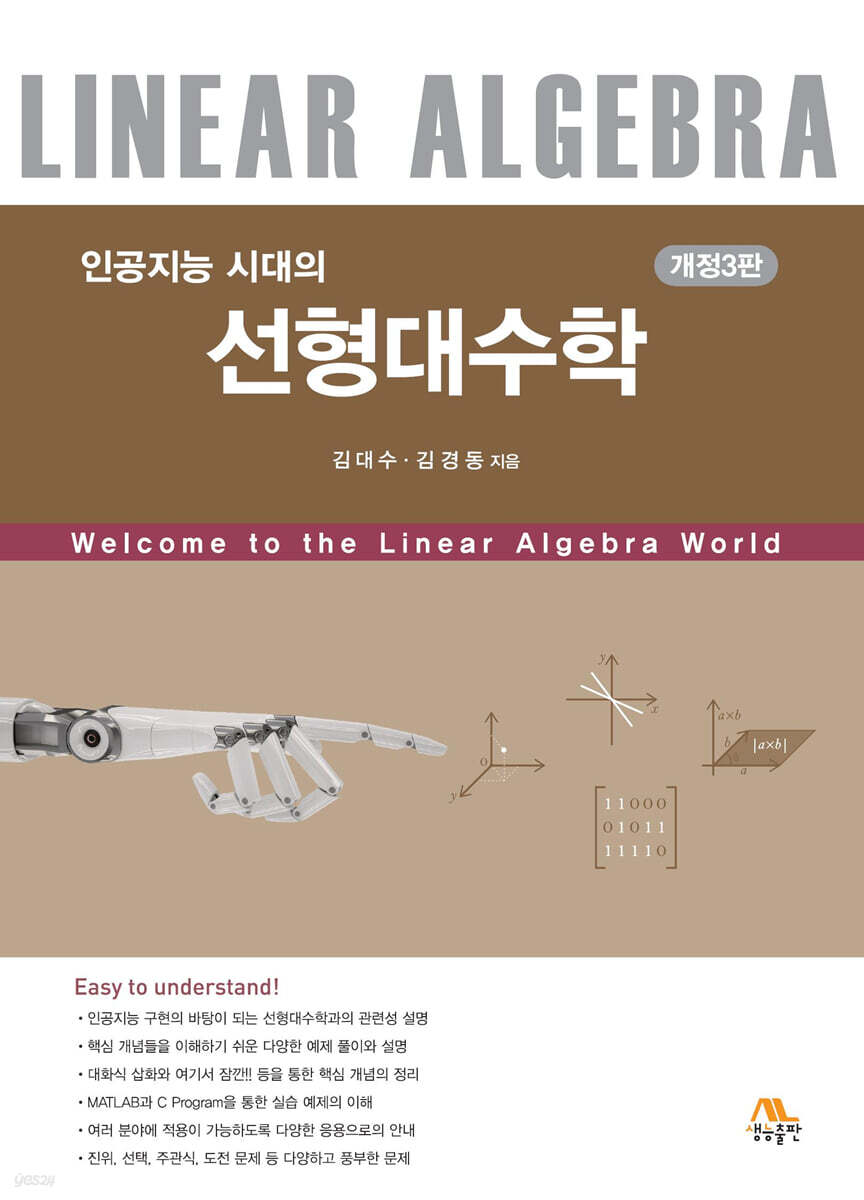
Linear Algebra in the Age of Artificial Intelligence
 |
Description
Book Introduction
The world has been changing rapidly in recent years.
The digital world is becoming more advanced and entering the world of the metaverse, including artificial intelligence.
Knowledge of linear algebra is essential for understanding artificial intelligence.
Linear algebra is a field of study that excludes complex mathematical systems and explores the limited field of linearity.
Therefore, a more user-friendly, easy-to-access, and efficient methodology is required, as it can be usefully utilized in engineering, natural science, and social science fields.
One of the goals of "Linear Algebra in the Age of Artificial Intelligence" is to provide a foundation for understanding the fundamentals of linear algebra and applying them in relation to it, rather than providing logical proofs.
Therefore, rather than focusing on the contents of a thick book, we focus on making it easier to understand what we absolutely need to know.
The author's extensive experience in linear algebra in the United States and Korea, along with a considerable amount of preparation, has provided a step-by-step explanation of the fundamental concepts, supplementary explanations, and illustrations so that many college students can more easily learn and apply linear algebra.
The digital world is becoming more advanced and entering the world of the metaverse, including artificial intelligence.
Knowledge of linear algebra is essential for understanding artificial intelligence.
Linear algebra is a field of study that excludes complex mathematical systems and explores the limited field of linearity.
Therefore, a more user-friendly, easy-to-access, and efficient methodology is required, as it can be usefully utilized in engineering, natural science, and social science fields.
One of the goals of "Linear Algebra in the Age of Artificial Intelligence" is to provide a foundation for understanding the fundamentals of linear algebra and applying them in relation to it, rather than providing logical proofs.
Therefore, rather than focusing on the contents of a thick book, we focus on making it easier to understand what we absolutely need to know.
The author's extensive experience in linear algebra in the United States and Korea, along with a considerable amount of preparation, has provided a step-by-step explanation of the fundamental concepts, supplementary explanations, and illustrations so that many college students can more easily learn and apply linear algebra.
index
CHAPTER 01 Linear Algebra and Linear Equations
1.1 Linear Algebra and Linear Systems
1.1.1 Linear Algebra
1.1.2 Linear equations and linear systems
Practice Problem 1.1
1.2 Elimination of linear equations
1.2.1 Elimination method for linear equations with two variables
1.2.2 Gaussian elimination
1.2.3 Gauss-Jordan elimination
Practice Problem 1.2
1.3 Linear Algebra and Artificial Intelligence
1.3.1 Artificial Intelligence Overview
1.3.2 Artificial Intelligence and Linear Algebra
CHAPTER 02 MATRIX
2.1 Matrices and Matrix Operations
2.1.1 Matrix
2.1.2 Matrix sum and scalar product
2.1.3 Matrix multiplication
Practice Problem 2.1
2.2 Special matrices
2.2.1 Diagonal matrix
2.2.2 Identity matrix and zero matrix
2.2.3 Transpose matrix
2.2.4 Symmetric and alternating matrices
2.2.5 Triangular matrix
Practice Problem 2.2
2.3 Basic operations on matrices and trapezoids
2.3.1 Basic Matrix Operations
2.3.2 Echelon Form
2.3.3 Rank
2.3.4 Representation and Application of Matrices
Practice Problem 2.3
2.4 Computation by computer program
2.4.1 Operations by C programs
2.4.2 Operations using MATLAB
2.5 Artificial Intelligence and Matrices
2.5.1 Matrices in Artificial Intelligence
2.5.2 Applications of matrices in artificial intelligence
CHAPTER 03 Determinant
3.1 Concept of determinant and cofactor
3.1.1 Concept of determinant
3.1.2 Calculating the determinant by cofactors
Practice Problem 3.1
3.2 General properties of determinants
3.2.1 Properties of determinants
3.2.2 Calculating the determinant using basic row operations
Practice Problem 3.2
3.3 Inverse matrix
3.3.1 Definition and properties of inverse matrix
3.3.2 How to find the inverse matrix
3.3.3 Inverse matrix by adjoint matrix
Practice Problem 3.3
3.4 Solution of linear equations
3.4.1 Solving linear equations using inverse matrices
3.4.2 Solution of linear equations using Cramer's rule
3.4.3 Applications of determinants
Practice Problem 3.4
3.5 Computation by computer program
3.5.1 Operations by C programs
3.5.2 Operations using MATLAB
CHAPTER 04 Solutions and Applications of Linear Equations
4.1 Solution of linear equations using Gaussian elimination
4.1.1 Representation as an augmented matrix
4.1.2 Solution of linear equations by Gauss-Jordan elimination
4.1.3 Solution of linear equations by LU decomposition
Practice Problem 4.1
4.2 Various applications of linear equations
4.2.1 Various applications
4.2.2 Application to chemical equations
4.2.3 Application to traffic flow
4.2.4 Application to Markov Chains
4.2.5 Application to Decryption
4.2.6 Application to Kirchhoff's laws
Practice Problem 4.2
4.3 Solving linear equations using C programs (Gaussian-Jordan elimination)
CHAPTER 05 Vectors
5.1 Concept and representation of vectors
5.1.1 Vector Concept and Notation
5.1.2 Vectors on the Plane
5.1.3 Magnitude and Geometric Representation of Vectors
5.1.4 Unit vectors and unit coordinate vectors
Practice Problem 5.1
5.2 Vector Operations
5.2.1 Sum and Difference of Vectors
5.2.2 Scalar product of vectors
5.2.3 Properties of vectors
5.2.4 Applications of Vectors
Practice Problem 5.2
5.3 Operations using MATLAB
CHAPTER 06 Vector Space
6.1 Vector Spaces and Linear Independence
6.1.1 Vector spaces and subspaces
6.1.2 Linear independence and linear dependence
Practice Problem 6.1
6.2 Generation, Basis, and Dimension
6.2.1 Creation
6.2.2 Base
6.2.3 Dimension
Practice Problem 6.2
CHAPTER 07 Eigenvalues and Eigenvectors
7.1 Eigenvalues and Eigenvectors
7.1.1 Characteristic polynomials and eigenvalues
7.1.2 Eigenvalues and Eigenvectors
Practice Problem 7.1
7.2 Properties and Applications of Eigenvalues
7.2.1 Properties of eigenvalues
7.2.2 Similarity matrices and eigenvalues
7.2.3 Applications of Eigenvalues and Eigenvectors
Practice Problem 7.2
7.3 Operations using MATLAB
CHAPTER 08 Inner and outer products of vectors
8.1 Inner product
8.1.1 Definition of inner product
8.1.2 Properties of the inner product and orthogonality
Practice Problem 8.1
8.2 External product
8.2.1 Definition of the cross product
8.2.2 Properties of the cross product
8.2.3 Applications of the cross product
Practice Problem 8.2
8.3 Operations using MATLAB
8.4 Vector Dot Product and Artificial Intelligence
8.4.1 Artificial Intelligence and the Inner Product of Vectors
8.4.2 Distance Concept and Artificial Intelligence Applications
CHAPTER 09 Linear Transformations
9.1 Concepts and functions of linear transformations
9.1.1 Definition of linear transformation
9.1.2 Functions and Linear Transformations
9.1.3 Various linear transformations
9.1.4 Standard matrix of transformation
Practice Problem 9.1
9.2 Applications of linear transformations
9.2.1 Industrial Applications
9.2.2 Application to Graphics Conversion
9.2.3 Applications of layer shearing in computer graphics
Practice Problem Answers
References
1.1 Linear Algebra and Linear Systems
1.1.1 Linear Algebra
1.1.2 Linear equations and linear systems
Practice Problem 1.1
1.2 Elimination of linear equations
1.2.1 Elimination method for linear equations with two variables
1.2.2 Gaussian elimination
1.2.3 Gauss-Jordan elimination
Practice Problem 1.2
1.3 Linear Algebra and Artificial Intelligence
1.3.1 Artificial Intelligence Overview
1.3.2 Artificial Intelligence and Linear Algebra
CHAPTER 02 MATRIX
2.1 Matrices and Matrix Operations
2.1.1 Matrix
2.1.2 Matrix sum and scalar product
2.1.3 Matrix multiplication
Practice Problem 2.1
2.2 Special matrices
2.2.1 Diagonal matrix
2.2.2 Identity matrix and zero matrix
2.2.3 Transpose matrix
2.2.4 Symmetric and alternating matrices
2.2.5 Triangular matrix
Practice Problem 2.2
2.3 Basic operations on matrices and trapezoids
2.3.1 Basic Matrix Operations
2.3.2 Echelon Form
2.3.3 Rank
2.3.4 Representation and Application of Matrices
Practice Problem 2.3
2.4 Computation by computer program
2.4.1 Operations by C programs
2.4.2 Operations using MATLAB
2.5 Artificial Intelligence and Matrices
2.5.1 Matrices in Artificial Intelligence
2.5.2 Applications of matrices in artificial intelligence
CHAPTER 03 Determinant
3.1 Concept of determinant and cofactor
3.1.1 Concept of determinant
3.1.2 Calculating the determinant by cofactors
Practice Problem 3.1
3.2 General properties of determinants
3.2.1 Properties of determinants
3.2.2 Calculating the determinant using basic row operations
Practice Problem 3.2
3.3 Inverse matrix
3.3.1 Definition and properties of inverse matrix
3.3.2 How to find the inverse matrix
3.3.3 Inverse matrix by adjoint matrix
Practice Problem 3.3
3.4 Solution of linear equations
3.4.1 Solving linear equations using inverse matrices
3.4.2 Solution of linear equations using Cramer's rule
3.4.3 Applications of determinants
Practice Problem 3.4
3.5 Computation by computer program
3.5.1 Operations by C programs
3.5.2 Operations using MATLAB
CHAPTER 04 Solutions and Applications of Linear Equations
4.1 Solution of linear equations using Gaussian elimination
4.1.1 Representation as an augmented matrix
4.1.2 Solution of linear equations by Gauss-Jordan elimination
4.1.3 Solution of linear equations by LU decomposition
Practice Problem 4.1
4.2 Various applications of linear equations
4.2.1 Various applications
4.2.2 Application to chemical equations
4.2.3 Application to traffic flow
4.2.4 Application to Markov Chains
4.2.5 Application to Decryption
4.2.6 Application to Kirchhoff's laws
Practice Problem 4.2
4.3 Solving linear equations using C programs (Gaussian-Jordan elimination)
CHAPTER 05 Vectors
5.1 Concept and representation of vectors
5.1.1 Vector Concept and Notation
5.1.2 Vectors on the Plane
5.1.3 Magnitude and Geometric Representation of Vectors
5.1.4 Unit vectors and unit coordinate vectors
Practice Problem 5.1
5.2 Vector Operations
5.2.1 Sum and Difference of Vectors
5.2.2 Scalar product of vectors
5.2.3 Properties of vectors
5.2.4 Applications of Vectors
Practice Problem 5.2
5.3 Operations using MATLAB
CHAPTER 06 Vector Space
6.1 Vector Spaces and Linear Independence
6.1.1 Vector spaces and subspaces
6.1.2 Linear independence and linear dependence
Practice Problem 6.1
6.2 Generation, Basis, and Dimension
6.2.1 Creation
6.2.2 Base
6.2.3 Dimension
Practice Problem 6.2
CHAPTER 07 Eigenvalues and Eigenvectors
7.1 Eigenvalues and Eigenvectors
7.1.1 Characteristic polynomials and eigenvalues
7.1.2 Eigenvalues and Eigenvectors
Practice Problem 7.1
7.2 Properties and Applications of Eigenvalues
7.2.1 Properties of eigenvalues
7.2.2 Similarity matrices and eigenvalues
7.2.3 Applications of Eigenvalues and Eigenvectors
Practice Problem 7.2
7.3 Operations using MATLAB
CHAPTER 08 Inner and outer products of vectors
8.1 Inner product
8.1.1 Definition of inner product
8.1.2 Properties of the inner product and orthogonality
Practice Problem 8.1
8.2 External product
8.2.1 Definition of the cross product
8.2.2 Properties of the cross product
8.2.3 Applications of the cross product
Practice Problem 8.2
8.3 Operations using MATLAB
8.4 Vector Dot Product and Artificial Intelligence
8.4.1 Artificial Intelligence and the Inner Product of Vectors
8.4.2 Distance Concept and Artificial Intelligence Applications
CHAPTER 09 Linear Transformations
9.1 Concepts and functions of linear transformations
9.1.1 Definition of linear transformation
9.1.2 Functions and Linear Transformations
9.1.3 Various linear transformations
9.1.4 Standard matrix of transformation
Practice Problem 9.1
9.2 Applications of linear transformations
9.2.1 Industrial Applications
9.2.2 Application to Graphics Conversion
9.2.3 Applications of layer shearing in computer graphics
Practice Problem Answers
References
Publisher's Review
Features of this book
First, in the era of artificial intelligence, the relationship between linear algebra and artificial intelligence was explained.
In particular, the revised third edition additionally covers topics such as linear algebra and artificial intelligence, artificial intelligence and matrices, and vector inner products and artificial intelligence.
Second, it was explained in relatively detail through easy and diverse example solutions and supplementary explanations.
We have tried to make it accessible by explaining difficult mathematical terms in detail and providing easy and appropriate examples.
Third, the key topics in solving linear equations were explained in an easy-to-understand manner using the pivot concept.
Since the problems that appear in almost all chapters are consistently explained using the pivot concept, it is relatively easy to solve the problems.
Fourth, by presenting a variety of rich problems, including true-false, multiple-choice, subjective, and challenge questions, we increased the familiarity of problem-solving.
Fifth, we have covered various and appropriate application examples so that they can be applied to various fields.
It has broadened its scope with applications in various fields such as sociology, economics, electricity and electronics, and chemistry.
Sixth, we have included practical examples using C programs and MATLAB to efficiently solve linear problems.
By utilizing software instead of calculating everything by hand, it will be possible to utilize it in various ways.
Contents of this book
Chapter 1 covers linear algebra and linear equations.
The necessity and application fields of learning linear algebra are summarized, linear combinations, solution sets, linear systems, and homogeneous systems are defined, and in particular, three cases of solutions through graphs are explained, and Gaussian elimination and Gauss-Jordan elimination are examined.
Also, artificial intelligence related to linear algebra was explained.
Chapter 2 covers general topics related to matrices.
We defined matrices and looked at matrix operations, special matrices, basic operations and row echelon form of matrices, coefficients, matrix representations and applications, etc., and examined operations using C programs and MATLAB.
Also, the matrix related to artificial intelligence was explained.
Chapter 3 covers matters related to determinants.
We explained the concept of determinant and its cofactor, and looked at the general properties of determinants.
We examined the inverse matrix and its use in solving linear equations, applications using Cramer's rule, and operations using C programs and MATLAB.
Chapter 4 deals with the solution and application of linear equations.
We looked at a method to solve linear equations using augmented matrices using Gaussian elimination.
In addition, various applications of linear equations such as chemical equations, traffic flow, and Markov chains were examined, and the Gauss-Jordan elimination method was practiced using a C program.
Chapter 5 covers general topics related to vectors.
First, we explain the concept and expression of vectors, and then examine the geometric expression of vectors on a plane.
Also, in vector operations, we define the sum and difference of vectors, and scalar values, and look at application examples of vectors.
We also practice vector operations using MATLAB.
Chapter 6 covers major topics related to vector spaces.
We examined the meaning of subspaces and linear independence and linear dependence in vector spaces and provided examples to help readers approach the essential concepts.
We also covered generation, basis, and dimension in vector spaces.
Chapter 7 covers general topics related to eigenvalues and eigenvectors.
We looked at examples of how to find eigenvalues and eigenvectors using characteristic polynomials and characteristic equations, and examined applications of eigenvalues and eigenvectors.
We also looked at how to obtain eigenvalues and eigenvectors using MATLAB.
Chapter 8 focuses on topics related to the inner and outer products of vectors.
We defined the inner product and learned about the properties and orthogonality of the inner product.
We also covered the definition and applications of vector outer products, looked at finding inner products using MATLAB, and explained the relationship between vector inner products and artificial intelligence.
Chapter 9 explains topics related to linear transformations.
The concept of linear transformation was defined through functions, and various linear transformations and transformations using standard matrices were examined.
In addition, we examined applications of linear transformation, including industrial applications, graphic transformation applications, and layer shearing applications.
First, in the era of artificial intelligence, the relationship between linear algebra and artificial intelligence was explained.
In particular, the revised third edition additionally covers topics such as linear algebra and artificial intelligence, artificial intelligence and matrices, and vector inner products and artificial intelligence.
Second, it was explained in relatively detail through easy and diverse example solutions and supplementary explanations.
We have tried to make it accessible by explaining difficult mathematical terms in detail and providing easy and appropriate examples.
Third, the key topics in solving linear equations were explained in an easy-to-understand manner using the pivot concept.
Since the problems that appear in almost all chapters are consistently explained using the pivot concept, it is relatively easy to solve the problems.
Fourth, by presenting a variety of rich problems, including true-false, multiple-choice, subjective, and challenge questions, we increased the familiarity of problem-solving.
Fifth, we have covered various and appropriate application examples so that they can be applied to various fields.
It has broadened its scope with applications in various fields such as sociology, economics, electricity and electronics, and chemistry.
Sixth, we have included practical examples using C programs and MATLAB to efficiently solve linear problems.
By utilizing software instead of calculating everything by hand, it will be possible to utilize it in various ways.
Contents of this book
Chapter 1 covers linear algebra and linear equations.
The necessity and application fields of learning linear algebra are summarized, linear combinations, solution sets, linear systems, and homogeneous systems are defined, and in particular, three cases of solutions through graphs are explained, and Gaussian elimination and Gauss-Jordan elimination are examined.
Also, artificial intelligence related to linear algebra was explained.
Chapter 2 covers general topics related to matrices.
We defined matrices and looked at matrix operations, special matrices, basic operations and row echelon form of matrices, coefficients, matrix representations and applications, etc., and examined operations using C programs and MATLAB.
Also, the matrix related to artificial intelligence was explained.
Chapter 3 covers matters related to determinants.
We explained the concept of determinant and its cofactor, and looked at the general properties of determinants.
We examined the inverse matrix and its use in solving linear equations, applications using Cramer's rule, and operations using C programs and MATLAB.
Chapter 4 deals with the solution and application of linear equations.
We looked at a method to solve linear equations using augmented matrices using Gaussian elimination.
In addition, various applications of linear equations such as chemical equations, traffic flow, and Markov chains were examined, and the Gauss-Jordan elimination method was practiced using a C program.
Chapter 5 covers general topics related to vectors.
First, we explain the concept and expression of vectors, and then examine the geometric expression of vectors on a plane.
Also, in vector operations, we define the sum and difference of vectors, and scalar values, and look at application examples of vectors.
We also practice vector operations using MATLAB.
Chapter 6 covers major topics related to vector spaces.
We examined the meaning of subspaces and linear independence and linear dependence in vector spaces and provided examples to help readers approach the essential concepts.
We also covered generation, basis, and dimension in vector spaces.
Chapter 7 covers general topics related to eigenvalues and eigenvectors.
We looked at examples of how to find eigenvalues and eigenvectors using characteristic polynomials and characteristic equations, and examined applications of eigenvalues and eigenvectors.
We also looked at how to obtain eigenvalues and eigenvectors using MATLAB.
Chapter 8 focuses on topics related to the inner and outer products of vectors.
We defined the inner product and learned about the properties and orthogonality of the inner product.
We also covered the definition and applications of vector outer products, looked at finding inner products using MATLAB, and explained the relationship between vector inner products and artificial intelligence.
Chapter 9 explains topics related to linear transformations.
The concept of linear transformation was defined through functions, and various linear transformations and transformations using standard matrices were examined.
In addition, we examined applications of linear transformation, including industrial applications, graphic transformation applications, and layer shearing applications.
GOODS SPECIFICS
- Publication date: January 21, 2022
- Page count, weight, size: 520 pages | 188*257*35mm
- ISBN13: 9788970505329
- ISBN10: 8970505326
You may also like
카테고리
korean


korean

![ELLE 엘르 스페셜 에디션 A형 : 12월 [2025]](http://librairie.coreenne.fr/cdn/shop/files/b8e27a3de6c9538896439686c6b0e8fb.jpg?v=1766436872&width=3840)


