

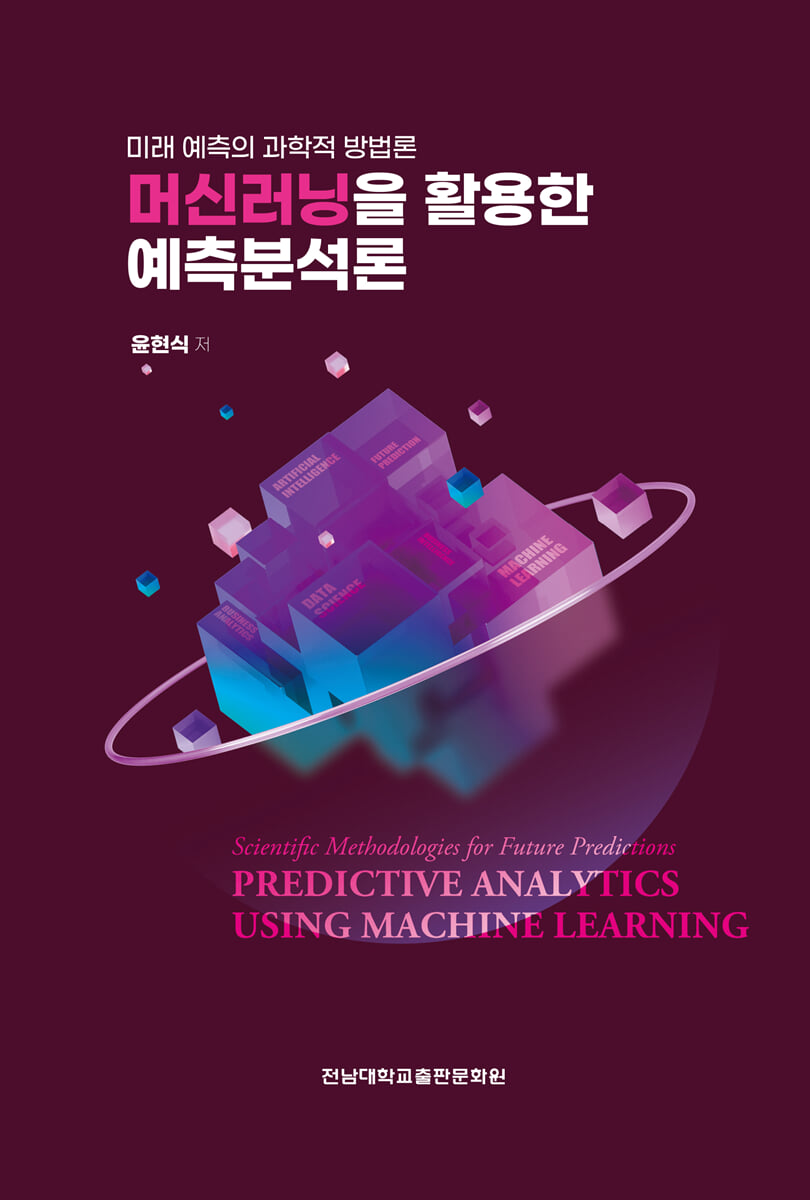
Predictive analytics using machine learning: a scientific methodology for predicting the future
 |
Description
Book Introduction
This book contains three main contents.
First, we examine the theoretical foundations and historical development of predictive analytics.
This will help readers understand that predictions are not simply a recent technological trend, but an extension of scientific research that has accumulated since the past.
Second, we will explain various machine learning algorithms.
It explains representative techniques such as regression analysis, decision trees, random forests, and neural networks in an easy-to-understand manner, and guides readers to develop the ability to apply them directly in practice.
Third, we discuss how predictive analytics and data analytics can be utilized and what impact they can have in real-world society and industrial settings.
This highlights that predictions can go beyond mere academic research and contribute to solving social problems.
In particular, this book seeks to strike a balance between academic rigor and practical applicability.
We hope it will serve as a systematic textbook for undergraduate and graduate students, a guide to applied cases for researchers, and a practical tool for practitioners.
First, we examine the theoretical foundations and historical development of predictive analytics.
This will help readers understand that predictions are not simply a recent technological trend, but an extension of scientific research that has accumulated since the past.
Second, we will explain various machine learning algorithms.
It explains representative techniques such as regression analysis, decision trees, random forests, and neural networks in an easy-to-understand manner, and guides readers to develop the ability to apply them directly in practice.
Third, we discuss how predictive analytics and data analytics can be utilized and what impact they can have in real-world society and industrial settings.
This highlights that predictions can go beyond mere academic research and contribute to solving social problems.
In particular, this book seeks to strike a balance between academic rigor and practical applicability.
We hope it will serve as a systematic textbook for undergraduate and graduate students, a guide to applied cases for researchers, and a practical tool for practitioners.
index
Preface / 06
1.
Why is predictive analytics important?
1.1.
Meaning in Terms / 16
1.2.
The Difference Between Analytics and Analysis / 20
1.3.
Where does data mining fit in? / 20
1.4.
Why Analytics and Data Science Are Suddenly Getting So Much Attention / 21
1.5.
Applications of Analytics / 24
1.6.
Key Challenges in Analytics / 25
*Summary / 31
2.
Taxonomy of Business Analysis
*Summary / 48
3.
Predictive Analytics and Data Mining
3.1.
What is Data Mining? / 55
3.2.
What is not data mining? / 58
3.3.
Common Data Mining Applications / 60
3.4.
Types of Patterns Discovered Through Data Mining / 66
3.5.
Classification of Learning Methods in Data Mining / 68
3.6.
The Shadow of Data Mining: Privacy Violations / 73
*Summary / 78
4.
Standardized procedures for predictive analytics
4.1. KDD (Knowledge Discovery in Databases) Process / 81
4.2. CRISP-DM: A Universal Data Mining Standard Process / 82
4.3. SEMMA / 94
4.4. Comparison of SEMMA and CRISP-DM / 99
4.5.
Six Sigma for Data Mining / 100
4.6.
Which methodology is best? / 103
*Summary / 103
5.
Standardized procedures for predictive analytics
5.1.
The Nature of Data in Data Analysis / 107
5.2.
Characteristics of Categorical and Numeric Data / 108
5.3.
Data Preprocessing for Analysis / 113
5.4.
Data Mining Techniques / 121
5.5.
Overview of Classification Techniques / 137
5.6.
Myths and Realities of Data Mining and Predictive Analytics / 160
*Summary / 164
6.
Training of machine learning models
6.1.
Regression and Classification Models / 166
6.2.
Cost Functions and Machine Learning Model Training / 170
6.3.
Maximum likelihood estimation / 172
6.4.
Gradient-Based Learning / 174
6.5.
Performance Evaluation in Regression and Classification Tasks / 179
*Summary / 182
7.
Standardized procedures for predictive analytics
7.1.
Naive Bayes / 187
7.2.
k-Nearest Neighbor (k-NN) / 193
7.3.
Artificial Neural Networks (ANN) / 199
7.4.
Support Vector Machines (SVM) / 205
7.5.
Linear Regression / 211
7.6.
Logistic Regression / 218
7.7.
Time-Series Forecasting / 220
*Summary / 222
8.
Text analysis, topic modeling, and sentiment analysis
8.1.
Natural Language Processing (NLP) / 231
8.2.
Text Mining Process / 238
8.3.
Topic Modeling / 248
8.4.
Sentiment Analysis / 253
*Summary / 264
1.
Why is predictive analytics important?
1.1.
Meaning in Terms / 16
1.2.
The Difference Between Analytics and Analysis / 20
1.3.
Where does data mining fit in? / 20
1.4.
Why Analytics and Data Science Are Suddenly Getting So Much Attention / 21
1.5.
Applications of Analytics / 24
1.6.
Key Challenges in Analytics / 25
*Summary / 31
2.
Taxonomy of Business Analysis
*Summary / 48
3.
Predictive Analytics and Data Mining
3.1.
What is Data Mining? / 55
3.2.
What is not data mining? / 58
3.3.
Common Data Mining Applications / 60
3.4.
Types of Patterns Discovered Through Data Mining / 66
3.5.
Classification of Learning Methods in Data Mining / 68
3.6.
The Shadow of Data Mining: Privacy Violations / 73
*Summary / 78
4.
Standardized procedures for predictive analytics
4.1. KDD (Knowledge Discovery in Databases) Process / 81
4.2. CRISP-DM: A Universal Data Mining Standard Process / 82
4.3. SEMMA / 94
4.4. Comparison of SEMMA and CRISP-DM / 99
4.5.
Six Sigma for Data Mining / 100
4.6.
Which methodology is best? / 103
*Summary / 103
5.
Standardized procedures for predictive analytics
5.1.
The Nature of Data in Data Analysis / 107
5.2.
Characteristics of Categorical and Numeric Data / 108
5.3.
Data Preprocessing for Analysis / 113
5.4.
Data Mining Techniques / 121
5.5.
Overview of Classification Techniques / 137
5.6.
Myths and Realities of Data Mining and Predictive Analytics / 160
*Summary / 164
6.
Training of machine learning models
6.1.
Regression and Classification Models / 166
6.2.
Cost Functions and Machine Learning Model Training / 170
6.3.
Maximum likelihood estimation / 172
6.4.
Gradient-Based Learning / 174
6.5.
Performance Evaluation in Regression and Classification Tasks / 179
*Summary / 182
7.
Standardized procedures for predictive analytics
7.1.
Naive Bayes / 187
7.2.
k-Nearest Neighbor (k-NN) / 193
7.3.
Artificial Neural Networks (ANN) / 199
7.4.
Support Vector Machines (SVM) / 205
7.5.
Linear Regression / 211
7.6.
Logistic Regression / 218
7.7.
Time-Series Forecasting / 220
*Summary / 222
8.
Text analysis, topic modeling, and sentiment analysis
8.1.
Natural Language Processing (NLP) / 231
8.2.
Text Mining Process / 238
8.3.
Topic Modeling / 248
8.4.
Sentiment Analysis / 253
*Summary / 264
Into the book
1.
Why is predictive analytics important?
Predictive analytics, the core topic of this book, plays a very important role in business analytics.
The primary purpose of predictive analytics is to anticipate future events and situations, helping decision-makers seize upcoming opportunities in a timely manner, prevent problems before they occur, or minimize their impact (Dada et al., 2024).
Predictive analytics sits between descriptive analytics, which focuses on analyzing past events, and prescriptive analytics, which proactively guides future decisions.
Predictive analytics uses historical information and patterns provided by technical analysis to predict likely future outcomes. This information is then used for prescriptive analysis, providing insights for optimal decision-making.
Compared to business intelligence, business analytics is a relatively new term that is rapidly gaining attention in real-world industrial settings (Adaga et al., 2024).
In general, analytics is a technology that utilizes complex mathematical models, diverse data, and expert knowledge to discover meaningful insights and support accurate and timely decision-making based on these insights.
In other words, analysis can be said to be the entire process for decision-making and problem-solving.
Today, we live in an era of data deluge, where massive amounts of data exist, and analytics that sort and process large amounts of diverse and complex data are becoming increasingly important.
While predictive analytics is often data-driven, there are also analytics projects that run without data.
They are not data-driven, but rely on process technologies or expert knowledge, utilizing mathematical or symbolic models (e.g., optimization, simulation, expert systems, case-based analysis, etc.).
Therefore, the more specific term 'data analytics' emerged to clearly distinguish which analyses were actually based on data.
Meanwhile, business analysis refers to applying these analytical tools, techniques, and principles to complex business problems (Kim Soo-kyung, 2024).
In particular, organizations are applying analytical techniques in data-rich fields to explain, predict, and find optimal solutions for performance in the following ways:
·Improving customer relationships (customer acquisition, retention, value increase, etc.)
· Reduce costs and improve performance by detecting fraudulent transactions or undesirable behavior/outcomes.
·Improving product and service features and pricing to increase customer satisfaction and loyalty and improve profitability.
·Predict demand for specific products or services to prevent inventory depletion in advance, thereby achieving operational efficiency.
·Optimize your marketing and advertising campaigns to reach more customers with the right message at the lowest cost.
· Pursuing efficient operational management and resource allocation through simulation and optimization, and reducing costs.
·Provide information and insights to enable employees to make faster and more accurate decisions during customer service.
The term analytics has grown rapidly in popularity in recent years, replacing many previously widely used terms.
For example, 'business intelligence' is changing to 'business analytics', 'customer intelligence' is changing to 'customer analytics', 'web mining' is changing to 'web analytics', and 'knowledge discovery' is changing to 'data analytics'.
As the word "analysis" becomes more widely used, various new terms such as "data science," "big data analysis," and "applied machine learning" are emerging, making the terminology system more complex.
This rapid shift in terminology is also evidence of companies' growing interest in the value they can create through business analytics.
1.1.
Meaning in terms
It is also a well-known fact that as new words are constantly being created, it is becoming increasingly difficult to distinguish between conceptual similarities and differences between various terms.
Commonly confused terms include 'business intelligence,' 'business analytics,' and 'data science,' while other widely used terms include 'big data,' 'machine learning,' and 'natural language processing (NLP).'
To organize this complex terminology, we present a simple conceptual diagram (Figure 1.1).
According to this conceptual diagram, 'business intelligence' is fully embedded within 'business analysis', which means that 'business intelligence' is a technical analysis stage of 'business analysis'.
Additionally, 'business analytics' is partially subsumed under 'data science'.
This is because 'business analytics' includes not only analysis methods that use data, but also analysis methods based on the representation and utilization of business processes or expert knowledge.
Among the terms shown in [Figure 1.1], big data, machine learning, and natural language processing refer to three core terms: data science, business analytics, and technologies that enable business intelligence.
The term big data sometimes refers to big data analytics, but the correct definition is based on the volume, variety, and velocity of information (Ayyalasomayajula, 2025).
These characteristics are elevating the capabilities of business analytics and data science to unprecedented levels.
While business intelligence deals with structured data (data stored in rows and columns in a database or Excel spreadsheet), business analytics and data science deal with both structured and unstructured data.
Big data includes not only structured data but also unstructured data such as text and multimedia, creating new value in the fields of analytics and data science.
Why is predictive analytics important?
Predictive analytics, the core topic of this book, plays a very important role in business analytics.
The primary purpose of predictive analytics is to anticipate future events and situations, helping decision-makers seize upcoming opportunities in a timely manner, prevent problems before they occur, or minimize their impact (Dada et al., 2024).
Predictive analytics sits between descriptive analytics, which focuses on analyzing past events, and prescriptive analytics, which proactively guides future decisions.
Predictive analytics uses historical information and patterns provided by technical analysis to predict likely future outcomes. This information is then used for prescriptive analysis, providing insights for optimal decision-making.
Compared to business intelligence, business analytics is a relatively new term that is rapidly gaining attention in real-world industrial settings (Adaga et al., 2024).
In general, analytics is a technology that utilizes complex mathematical models, diverse data, and expert knowledge to discover meaningful insights and support accurate and timely decision-making based on these insights.
In other words, analysis can be said to be the entire process for decision-making and problem-solving.
Today, we live in an era of data deluge, where massive amounts of data exist, and analytics that sort and process large amounts of diverse and complex data are becoming increasingly important.
While predictive analytics is often data-driven, there are also analytics projects that run without data.
They are not data-driven, but rely on process technologies or expert knowledge, utilizing mathematical or symbolic models (e.g., optimization, simulation, expert systems, case-based analysis, etc.).
Therefore, the more specific term 'data analytics' emerged to clearly distinguish which analyses were actually based on data.
Meanwhile, business analysis refers to applying these analytical tools, techniques, and principles to complex business problems (Kim Soo-kyung, 2024).
In particular, organizations are applying analytical techniques in data-rich fields to explain, predict, and find optimal solutions for performance in the following ways:
·Improving customer relationships (customer acquisition, retention, value increase, etc.)
· Reduce costs and improve performance by detecting fraudulent transactions or undesirable behavior/outcomes.
·Improving product and service features and pricing to increase customer satisfaction and loyalty and improve profitability.
·Predict demand for specific products or services to prevent inventory depletion in advance, thereby achieving operational efficiency.
·Optimize your marketing and advertising campaigns to reach more customers with the right message at the lowest cost.
· Pursuing efficient operational management and resource allocation through simulation and optimization, and reducing costs.
·Provide information and insights to enable employees to make faster and more accurate decisions during customer service.
The term analytics has grown rapidly in popularity in recent years, replacing many previously widely used terms.
For example, 'business intelligence' is changing to 'business analytics', 'customer intelligence' is changing to 'customer analytics', 'web mining' is changing to 'web analytics', and 'knowledge discovery' is changing to 'data analytics'.
As the word "analysis" becomes more widely used, various new terms such as "data science," "big data analysis," and "applied machine learning" are emerging, making the terminology system more complex.
This rapid shift in terminology is also evidence of companies' growing interest in the value they can create through business analytics.
1.1.
Meaning in terms
It is also a well-known fact that as new words are constantly being created, it is becoming increasingly difficult to distinguish between conceptual similarities and differences between various terms.
Commonly confused terms include 'business intelligence,' 'business analytics,' and 'data science,' while other widely used terms include 'big data,' 'machine learning,' and 'natural language processing (NLP).'
To organize this complex terminology, we present a simple conceptual diagram (Figure 1.1).
According to this conceptual diagram, 'business intelligence' is fully embedded within 'business analysis', which means that 'business intelligence' is a technical analysis stage of 'business analysis'.
Additionally, 'business analytics' is partially subsumed under 'data science'.
This is because 'business analytics' includes not only analysis methods that use data, but also analysis methods based on the representation and utilization of business processes or expert knowledge.
Among the terms shown in [Figure 1.1], big data, machine learning, and natural language processing refer to three core terms: data science, business analytics, and technologies that enable business intelligence.
The term big data sometimes refers to big data analytics, but the correct definition is based on the volume, variety, and velocity of information (Ayyalasomayajula, 2025).
These characteristics are elevating the capabilities of business analytics and data science to unprecedented levels.
While business intelligence deals with structured data (data stored in rows and columns in a database or Excel spreadsheet), business analytics and data science deal with both structured and unstructured data.
Big data includes not only structured data but also unstructured data such as text and multimedia, creating new value in the fields of analytics and data science.
--- From the text
GOODS SPECIFICS
- Date of issue: September 26, 2025
- Page count, weight, size: 227 pages | 153*225*20mm
- ISBN13: 9791194716259
- ISBN10: 1194716253
You may also like
카테고리
korean


korean

![ELLE 엘르 스페셜 에디션 A형 : 12월 [2025]](http://librairie.coreenne.fr/cdn/shop/files/b8e27a3de6c9538896439686c6b0e8fb.jpg?v=1766436872&width=3840)


