

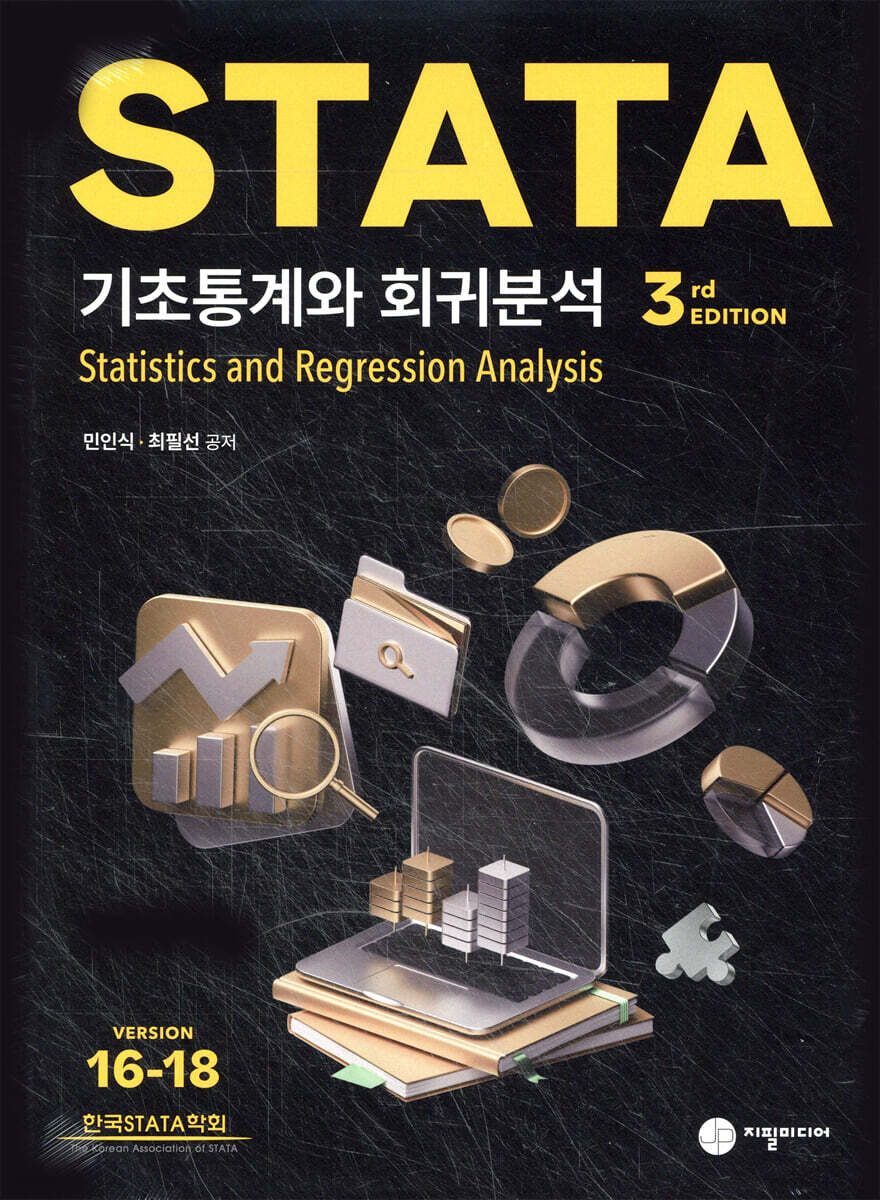
STATA Basic Statistics and Regression Analysis
 |
Description
Book Introduction
"STATA Basic Statistics and Regression Analysis" focuses on combining statistical theory with practical data analysis to develop readers' ability to analyze and interpret data based on statistical thinking.
index
01 Random variables and probability distributions
02 Hypothesis testing for mean, variance, and proportion
03 Analysis of Variance
04 Reliability Analysis
05 Nonparametric test
06 Linear Regression Analysis (1)
07 Linear Regression Analysis (2)
08 Regression model including categorical variables
09 Understanding Regression Analysis Using Graphs
10 Endogeneity of explanatory variables and instrumental variable estimation (1)
11 Endogeneity of explanatory variables and instrumental variable estimation (2)
12 Nonlinear Regression Analysis
13 Growth Model
14. Regulatory Regression Analysis
15 Binomial dependent variable model
02 Hypothesis testing for mean, variance, and proportion
03 Analysis of Variance
04 Reliability Analysis
05 Nonparametric test
06 Linear Regression Analysis (1)
07 Linear Regression Analysis (2)
08 Regression model including categorical variables
09 Understanding Regression Analysis Using Graphs
10 Endogeneity of explanatory variables and instrumental variable estimation (1)
11 Endogeneity of explanatory variables and instrumental variable estimation (2)
12 Nonlinear Regression Analysis
13 Growth Model
14. Regulatory Regression Analysis
15 Binomial dependent variable model
Publisher's Review
Even in an era where AI assists with statistical learning and coding, studying specialized packages for statistics and statistical analysis remains essential. While AI automates massive data processing and complex calculations, saving significant time, a deep understanding of statistical thinking and methodology remains essential to correctly interpreting these results and making decisions based on them. To effectively utilize AI tools, users must be able to clearly understand the context of the data and the implications of the analysis process, a skill that should be acquired through university education.
This book focuses on combining statistical theory with practical data analysis to develop readers' ability to analyze and interpret data based on statistical thinking.
Many existing statistics textbooks provide in-depth explanations of theories, but do not sufficiently cover the specific use of statistical software required for practical training. Conversely, they often only explain how to use statistical software and omit discussions of the theoretical background.
Accordingly, learners sometimes experience difficulties due to the gap between theory and practice.
The completely revised edition of Stata Basic Statistics and Regression Analysis has been redesigned to fill this gap.
Statistical concepts and theories are explained with a focus on core concepts, and the course is structured to enable systematic learning of practical data analysis processes using Stata.
In particular, this revised edition has been significantly revised and supplemented to reflect the latest trends in statistics and data analysis.
Key features of this revised edition include:
New topics and analysis techniques added: Reflecting the current state of modern statistics, topics not covered in previous editions include growth models, regularized regression (Ridge, Lasso, ElasticNet), nonlinear regression, and binomial dependent variable models.
Integrated provision of Stata commands and practice data: All Stata commands required for the examples and practice covered in each chapter are clearly presented, and the last section collects the commands used in the analysis process and organizes them in do-file format.
Reflecting the latest Stata 18 version: We have explained the features and updates of the latest Stata version and enabled readers to practice using example data.
This revised edition is a textbook that focuses on the use of statistical software based on statistical theory, making it suitable for use as a textbook for undergraduate-level lectures and will also be useful as a reference book for statistical analysis practitioners.
This book focuses on combining statistical theory with practical data analysis to develop readers' ability to analyze and interpret data based on statistical thinking.
Many existing statistics textbooks provide in-depth explanations of theories, but do not sufficiently cover the specific use of statistical software required for practical training. Conversely, they often only explain how to use statistical software and omit discussions of the theoretical background.
Accordingly, learners sometimes experience difficulties due to the gap between theory and practice.
The completely revised edition of Stata Basic Statistics and Regression Analysis has been redesigned to fill this gap.
Statistical concepts and theories are explained with a focus on core concepts, and the course is structured to enable systematic learning of practical data analysis processes using Stata.
In particular, this revised edition has been significantly revised and supplemented to reflect the latest trends in statistics and data analysis.
Key features of this revised edition include:
New topics and analysis techniques added: Reflecting the current state of modern statistics, topics not covered in previous editions include growth models, regularized regression (Ridge, Lasso, ElasticNet), nonlinear regression, and binomial dependent variable models.
Integrated provision of Stata commands and practice data: All Stata commands required for the examples and practice covered in each chapter are clearly presented, and the last section collects the commands used in the analysis process and organizes them in do-file format.
Reflecting the latest Stata 18 version: We have explained the features and updates of the latest Stata version and enabled readers to practice using example data.
This revised edition is a textbook that focuses on the use of statistical software based on statistical theory, making it suitable for use as a textbook for undergraduate-level lectures and will also be useful as a reference book for statistical analysis practitioners.
GOODS SPECIFICS
- Date of issue: February 28, 2025
- Page count, weight, size: 324 pages | 188*257*30mm
- ISBN13: 9791193187647
- ISBN10: 1193187648
You may also like
카테고리
korean


korean

![GQ KOREA Mark (Monthly): December [2025]](http://librairie.coreenne.fr/cdn/shop/files/8ef265dbbfbf186523ed75ba7319009d.jpg?v=1765340328&width=3840)


