

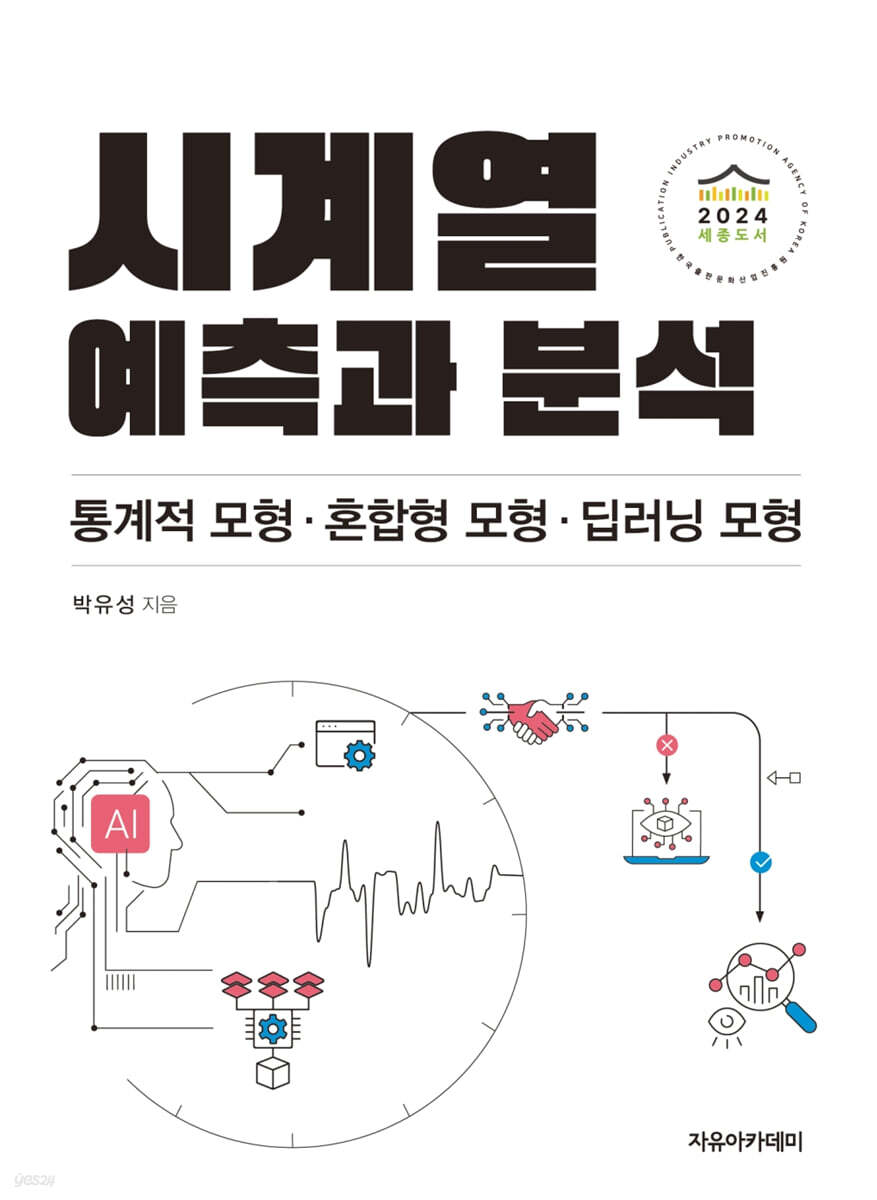
Time series forecasting and analysis
 |
Description
Book Introduction
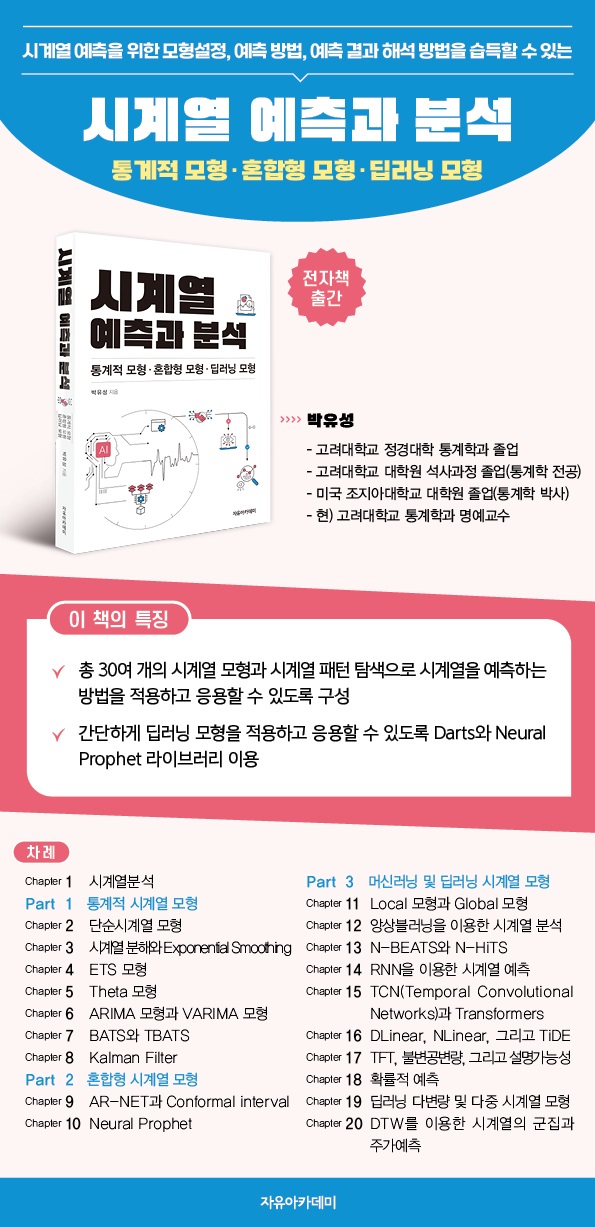
『Time Series Forecasting and Analysis』 is designed to enable the application and use of time series forecasting methods using approximately 30 time series models and time series pattern exploration.
Selecting two or more hyperparameters or model assumptions for a single model means that at least 60 models can be applied to the given time series data.
By mastering the contents of this book, you will acquire the model setup, forecasting methods, and forecast result interpretation methods for better time series forecasting, and you will have the ability to build your own ensemble time series model by fitting dozens of models to a single time series data.
Selecting two or more hyperparameters or model assumptions for a single model means that at least 60 models can be applied to the given time series data.
By mastering the contents of this book, you will acquire the model setup, forecasting methods, and forecast result interpretation methods for better time series forecasting, and you will have the ability to build your own ensemble time series model by fitting dozens of models to a single time series data.
- You can preview some of the book's contents.
Preview
index
Part 1 Statistical Time Series Models
Chapter 1 Time Series Analysis
1.1 Format of time series data
1.2 Sample composition of time series data
1.3 Summary
1.4 Library for time series analysis
Chapter 2 Simple Time Series Model
2.1 Naive prediction model
2.2 Application of the Naive Model
Chapter 3 Time Series Decomposition and Exponential Smoothing
3.1 Classical time series decomposition
3.2 Exponential smoothing
Chapter 4 ETS Model
4.1 Parameter estimation of the ETS model
4.2 Selection and Prediction of ETS Models
4.3 Application of the ETS Model
Chapter 5 Theta Model
5.1 Structure of the Theta Model
5.2 Application of the Theta Model
Chapter 6 ARIMA and VARIMA Models
6.1 ARIMA model
6.2 SARIMA model
6.3 Setting up the SARIMA model, Parameter estimation, and prediction
6.4 Analysis Procedures for Automatic ARIMA and ARIMA Models
6.5 Application of the SARIMA model
6.6 VARIMA model
Chapter 7 BATS and TBATS
7.1 BATS model
7.2 TBATS model
7.3 Application and Use of BATS and TBATS
Chapter 8 Kalman Filter
8.1 Understanding the Kalman Filter
8.2 Linear Projection
8.3 Derivation of Kalman Filter
8.4 Parameter Estimation and Prediction of Kalman Filter
Part 2 Mixed Time Series Models
Chapter 9 AR-NET and Conformal interval
9.1 AR-NET
9.2 Conformal interval
Chapter 10 Neural Prophet
10.1 Trends
10.2 Seasonality
10.3 Autoregressive models and past covariate regression models
10.4 Future Covariate Regression and Event and Holiday Effects
10.5 Neural Prophet's Loss Function, Regularization, and Data Pre-Cleaning Process
10.6 Global and Local Models
10.7 Cross-validation and forecasting of time series models
10.8 Conformal interval estimation
Part 3 Machine Learning and Deep Learning Time Series Models
Chapter 11 Local and Global Models
11.1 Structure of multiple time series and global time series model
11.2 Multivariate Time Series and Multiple Time Series
11.3 Time series forecasting using regression models
Chapter 12 Time Series Analysis Using Ensemble Learning
12.1 Time Series Analysis Based on Ensemble Learning
Chapter 13 N-BEATS and N-HiTS
13.1 N-BEATS
13.2 N-HiTS
13.3 Application of N-BEATS and N-HiTS
Chapter 14 Time Series Prediction Using RNNs
14.1 RNN model
14.2 Application of RNN time series models
Chapter 15 Temporal Convolutional Networks (TCN) and Transformers
15.1 TCN time series model
15.2 Transformer Time Series Model
Chapter 16 DLinear, NLinear, and TiDE
16.1 LTSF-Linear Model
16.2 TiDE
16.3 Nonstationary time series in deep learning time series models
16.4 Applications and Applications of DLinear, NLinear, and TiDE
Chapter 17 TFT, Invariant Covariance, and Explainability
17.1 TFT structure
17.2 Applications and Applications of TFT
17.3 Conditional global model using invariant covariates
17.4 Explanation Possibility of TFT
Chapter 18 Probabilistic Prediction
18.1 Probabilistic Prediction
18.2 Probabilistic Prediction in Deep Learning Models
18.3 Probabilistic forecast using Darts
Chapter 19 Deep Learning Multivariate and Multi-Time Series Models
19.1 Multi-Time Series and Multivariate Time Series Analysis Using Deep Learning Time Series Models
19.2 KOSPI, KOSDAQ Forecasting and Multivariate Time Series Forecasting
Chapter 20: Clustering of Time Series and Stock Price Prediction Using DTW
20.1 DTW (Dynamic Time Warp) and Warping Path
20.2 Clustering of time series and clustering effects
20.3 Stock price prediction by pattern search
Chapter 1 Time Series Analysis
1.1 Format of time series data
1.2 Sample composition of time series data
1.3 Summary
1.4 Library for time series analysis
Chapter 2 Simple Time Series Model
2.1 Naive prediction model
2.2 Application of the Naive Model
Chapter 3 Time Series Decomposition and Exponential Smoothing
3.1 Classical time series decomposition
3.2 Exponential smoothing
Chapter 4 ETS Model
4.1 Parameter estimation of the ETS model
4.2 Selection and Prediction of ETS Models
4.3 Application of the ETS Model
Chapter 5 Theta Model
5.1 Structure of the Theta Model
5.2 Application of the Theta Model
Chapter 6 ARIMA and VARIMA Models
6.1 ARIMA model
6.2 SARIMA model
6.3 Setting up the SARIMA model, Parameter estimation, and prediction
6.4 Analysis Procedures for Automatic ARIMA and ARIMA Models
6.5 Application of the SARIMA model
6.6 VARIMA model
Chapter 7 BATS and TBATS
7.1 BATS model
7.2 TBATS model
7.3 Application and Use of BATS and TBATS
Chapter 8 Kalman Filter
8.1 Understanding the Kalman Filter
8.2 Linear Projection
8.3 Derivation of Kalman Filter
8.4 Parameter Estimation and Prediction of Kalman Filter
Part 2 Mixed Time Series Models
Chapter 9 AR-NET and Conformal interval
9.1 AR-NET
9.2 Conformal interval
Chapter 10 Neural Prophet
10.1 Trends
10.2 Seasonality
10.3 Autoregressive models and past covariate regression models
10.4 Future Covariate Regression and Event and Holiday Effects
10.5 Neural Prophet's Loss Function, Regularization, and Data Pre-Cleaning Process
10.6 Global and Local Models
10.7 Cross-validation and forecasting of time series models
10.8 Conformal interval estimation
Part 3 Machine Learning and Deep Learning Time Series Models
Chapter 11 Local and Global Models
11.1 Structure of multiple time series and global time series model
11.2 Multivariate Time Series and Multiple Time Series
11.3 Time series forecasting using regression models
Chapter 12 Time Series Analysis Using Ensemble Learning
12.1 Time Series Analysis Based on Ensemble Learning
Chapter 13 N-BEATS and N-HiTS
13.1 N-BEATS
13.2 N-HiTS
13.3 Application of N-BEATS and N-HiTS
Chapter 14 Time Series Prediction Using RNNs
14.1 RNN model
14.2 Application of RNN time series models
Chapter 15 Temporal Convolutional Networks (TCN) and Transformers
15.1 TCN time series model
15.2 Transformer Time Series Model
Chapter 16 DLinear, NLinear, and TiDE
16.1 LTSF-Linear Model
16.2 TiDE
16.3 Nonstationary time series in deep learning time series models
16.4 Applications and Applications of DLinear, NLinear, and TiDE
Chapter 17 TFT, Invariant Covariance, and Explainability
17.1 TFT structure
17.2 Applications and Applications of TFT
17.3 Conditional global model using invariant covariates
17.4 Explanation Possibility of TFT
Chapter 18 Probabilistic Prediction
18.1 Probabilistic Prediction
18.2 Probabilistic Prediction in Deep Learning Models
18.3 Probabilistic forecast using Darts
Chapter 19 Deep Learning Multivariate and Multi-Time Series Models
19.1 Multi-Time Series and Multivariate Time Series Analysis Using Deep Learning Time Series Models
19.2 KOSPI, KOSDAQ Forecasting and Multivariate Time Series Forecasting
Chapter 20: Clustering of Time Series and Stock Price Prediction Using DTW
20.1 DTW (Dynamic Time Warp) and Warping Path
20.2 Clustering of time series and clustering effects
20.3 Stock price prediction by pattern search
Detailed image
Publisher's Review
'Time series forecasting methods can be divided into (1) statistical methods, (2) hybrid methods, and (3) deep learning-based methods.
Representative statistical methods include time series decomposition, ARIMA, and VARIMA, and hybrid methods are time series forecasting techniques that combine statistical methods and deep learning-based methods, such as Prophet and Neural Prophet.
Time series models based on deep learning have dramatically improved and refined the predictive power of time series based on the three major architectures of deep learning: MLP, RNN, and CNN. Representative examples include BlockRNN, TCN, N-HiTs, Transformer, DLinear, TiDE, and TFT.
The author has been teaching statistical time series models in the classroom for the past 30 years, and has been teaching machine learning, deep learning, reinforcement learning, and XAI (explainable AI) for the past 7 years, so he has thought that the emergence of high-level time series models using deep learning is only a matter of time.
In particular, deep learning time series models published over the past 3-4 years have shown remarkable results both quantitatively and qualitatively.
Accurate time series forecasting plays a crucial role in finance, logistics, marketing, human resources, economic planning, and decision-making.
There are tens of thousands of items in large supermarkets, and the sales of these items are recorded in real time.
Using this data to accurately predict sales of items provides important information for decision-making on production, distribution, staffing, placement and display of products, selective promotion, advertising, etc.
This type of data is called multiple data, and since it is big data with many time series observations for each item and a very large number of items, the application of a time series model based on deep learning is essential.
However, in order to apply deep learning time series models, there is a significant obstacle that requires in-depth prior knowledge of deep learning and acquisition of programming languages such as TensorFlow or PyTorch.
To avoid this, the author used Darts and a library called Neural Prophet to easily apply and implement deep learning models.
The authors believe that deep learning-based time series models and hybrid time series models will quickly replace conventional statistical time series models in time series forecasting.
This is because the library makes it easier to apply deep learning models than statistical time series models, and its processing capabilities for large-scale time series data and prediction accuracy are far superior to those of statistical time series models. In addition, it is possible to explain the reasons for the prediction results and the contribution of explanatory variables.
This book is designed to enable the application and use of methods for predicting time series using approximately 30 time series models and time series pattern exploration.
Selecting two or more hyperparameters or model assumptions for a single model means that at least 60 models can be applied to the given time series data.
By mastering the contents of this book, you will acquire the model setup, forecasting methods, and forecast result interpretation methods for better time series forecasting, and you will have the ability to build your own ensemble time series model by fitting dozens of models to a single time series data.
Although we have tried to make a good book, there may be some shortcomings.
We ask for your understanding on this matter. Any revisions that may occur after publication will be provided in the data room of the Free Academy website (www.freeaca.com), so please refer to it.
Finally, I would like to express my gratitude to Jinse Park, who helped me with the conceptual design and proofreading of this book, and to my loving family, who always support and encourage me.
Representative statistical methods include time series decomposition, ARIMA, and VARIMA, and hybrid methods are time series forecasting techniques that combine statistical methods and deep learning-based methods, such as Prophet and Neural Prophet.
Time series models based on deep learning have dramatically improved and refined the predictive power of time series based on the three major architectures of deep learning: MLP, RNN, and CNN. Representative examples include BlockRNN, TCN, N-HiTs, Transformer, DLinear, TiDE, and TFT.
The author has been teaching statistical time series models in the classroom for the past 30 years, and has been teaching machine learning, deep learning, reinforcement learning, and XAI (explainable AI) for the past 7 years, so he has thought that the emergence of high-level time series models using deep learning is only a matter of time.
In particular, deep learning time series models published over the past 3-4 years have shown remarkable results both quantitatively and qualitatively.
Accurate time series forecasting plays a crucial role in finance, logistics, marketing, human resources, economic planning, and decision-making.
There are tens of thousands of items in large supermarkets, and the sales of these items are recorded in real time.
Using this data to accurately predict sales of items provides important information for decision-making on production, distribution, staffing, placement and display of products, selective promotion, advertising, etc.
This type of data is called multiple data, and since it is big data with many time series observations for each item and a very large number of items, the application of a time series model based on deep learning is essential.
However, in order to apply deep learning time series models, there is a significant obstacle that requires in-depth prior knowledge of deep learning and acquisition of programming languages such as TensorFlow or PyTorch.
To avoid this, the author used Darts and a library called Neural Prophet to easily apply and implement deep learning models.
The authors believe that deep learning-based time series models and hybrid time series models will quickly replace conventional statistical time series models in time series forecasting.
This is because the library makes it easier to apply deep learning models than statistical time series models, and its processing capabilities for large-scale time series data and prediction accuracy are far superior to those of statistical time series models. In addition, it is possible to explain the reasons for the prediction results and the contribution of explanatory variables.
This book is designed to enable the application and use of methods for predicting time series using approximately 30 time series models and time series pattern exploration.
Selecting two or more hyperparameters or model assumptions for a single model means that at least 60 models can be applied to the given time series data.
By mastering the contents of this book, you will acquire the model setup, forecasting methods, and forecast result interpretation methods for better time series forecasting, and you will have the ability to build your own ensemble time series model by fitting dozens of models to a single time series data.
Although we have tried to make a good book, there may be some shortcomings.
We ask for your understanding on this matter. Any revisions that may occur after publication will be provided in the data room of the Free Academy website (www.freeaca.com), so please refer to it.
Finally, I would like to express my gratitude to Jinse Park, who helped me with the conceptual design and proofreading of this book, and to my loving family, who always support and encourage me.
GOODS SPECIFICS
- Date of issue: April 5, 2024
- Page count, weight, size: 492 pages | 188*257*30mm
- ISBN13: 9791158086046
- ISBN10: 1158086040
You may also like
카테고리
korean


korean

![ELLE 엘르 스페셜 에디션 A형 : 12월 [2025]](http://librairie.coreenne.fr/cdn/shop/files/b8e27a3de6c9538896439686c6b0e8fb.jpg?v=1766436872&width=3840)


