

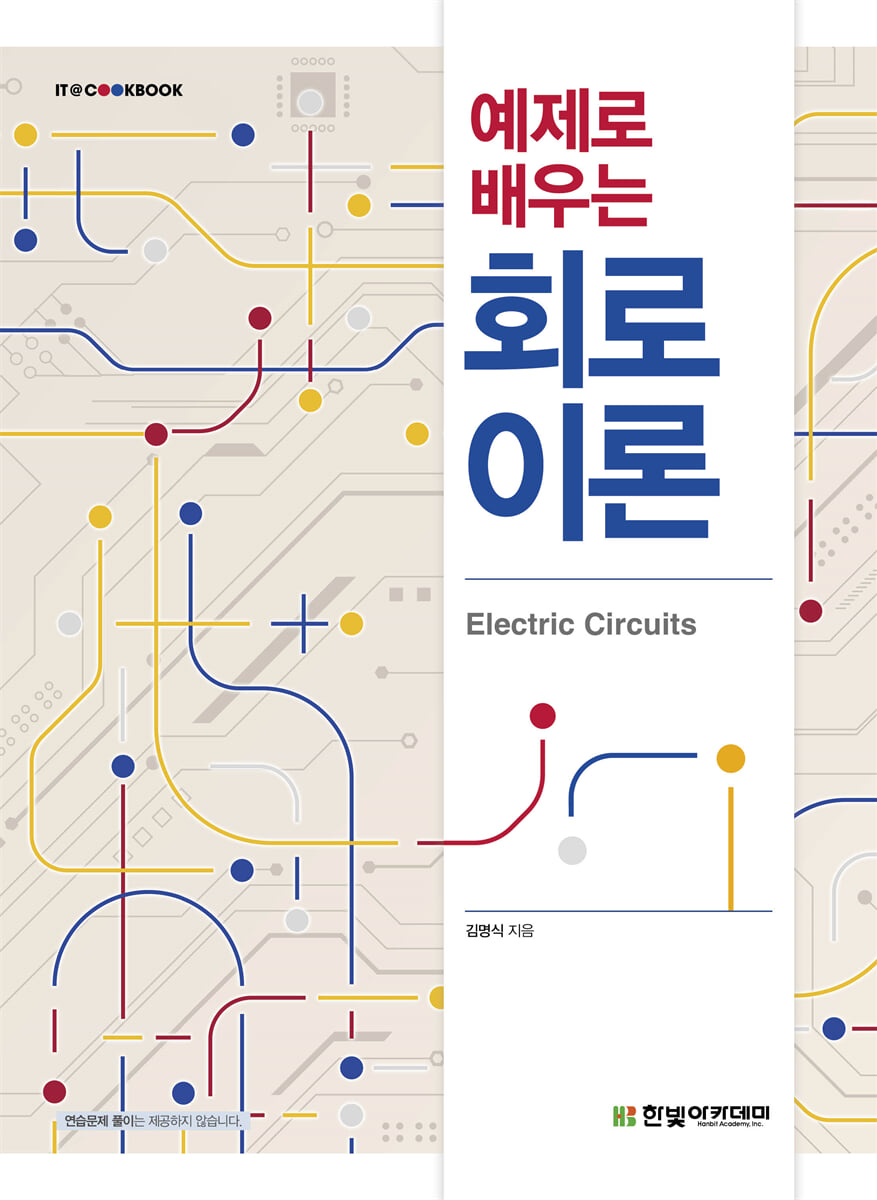
Circuit theory through examples
 |
Description
Book Introduction
From basic concepts to 4-terminal network circuits
Improve your circuit analysis skills with various examples!
This book is intended for students in electrical and electronic engineering departments, and contains information on circuits, the most fundamental subject.
After laying the foundation for circuit analysis for direct current, we will learn about circuit analysis methods when the applied power is a function of time, and then move on to circuit analysis for alternating current signals.
Additionally, it clearly explains key concepts and provides abundant examples and practical problems corresponding to each theory, enabling students to develop the ability to properly analyze circuits.
* This book was developed as a textbook for university lectures, so it does not provide solutions to practice problems.
*The author provides video lectures related to the text on his YouTube channel.
https://lrl.kr/fGnf
Improve your circuit analysis skills with various examples!
This book is intended for students in electrical and electronic engineering departments, and contains information on circuits, the most fundamental subject.
After laying the foundation for circuit analysis for direct current, we will learn about circuit analysis methods when the applied power is a function of time, and then move on to circuit analysis for alternating current signals.
Additionally, it clearly explains key concepts and provides abundant examples and practical problems corresponding to each theory, enabling students to develop the ability to properly analyze circuits.
* This book was developed as a textbook for university lectures, so it does not provide solutions to practice problems.
*The author provides video lectures related to the text on his YouTube channel.
https://lrl.kr/fGnf
- You can preview some of the book's contents.
Preview
index
CHAPTER 01 Understanding Basic Concepts
1.1 Circuit elements and unit systems
1.2 Charge and Current
1.3 Voltage
1.4 Power
1.5 Circuit elements
Practice problems
CHAPTER 02 Resistance Circuit Analysis
2.1 Basic laws required for circuit analysis
2.2 Equivalent circuit
2.3 Series and parallel circuits of resistors
2.4 Bridge circuit
2.5 Interconversion between △-type circuit and Y-type circuit
Practice problems
CHAPTER 03 Circuit Analysis
3.1 Overview of circuit analysis methods
3.2 Node interpretation method (node interpretation method)
3.3 Loop analysis method (network analysis method)
3.4 Comparison of node analysis and loop analysis
Practice problems
CHAPTER 04 Circuit Network Summary
4.1 Linearity
4.2 The principle of superposition
4.3 Characteristic equation of a two-terminal network
4.4 Power Conversion
4.5 Thevenin Equivalent Circuit and Norton Equivalent Circuit
4.6 Maximum power delivery
Practice problems
CHAPTER 05 Operational Amplifier Circuit Analysis
5.1 Operational Amplifier
5.2 Inverting and non-inverting amplifiers
5.3 Addition amplifier
5.4 Differential amplifier
5.5 Analysis of Cascaded Operational Amplifier Circuits
Practice problems
CHAPTER 06 Laplace Transform
6.1 Introduction to the Laplace Transform
6.2 Definition of the Laplace transform
6.3 Laplace transform of singular functions
6.4 Properties of the Laplace Transform
6.5 Inverse Laplace Transform
6.6 Applications of the Laplace Transform
Practice problems
CHAPTER 07 Capacitors and Inductors
7.1 Capacitors
7.2 Inductor
7.3 Laplace Transform of Circuit Elements
Practice problems
CHAPTER 08 1st Circuit
8.1 First-order circuit analysis method
8.2 Natural response (intrinsic response)
8.3 Forced response
8.4 Complete response
8.5 Summary of first-order circuit analysis
8.6 Primary circuit using operational amplifier
Practice problems
CHAPTER 09 Secondary Circuit
9.1 Secondary Circuit Concept
9.2 RLC series circuit
9.3 RLC Parallel Circuit
9.4 Response of other secondary circuits
Practice problems
CHAPTER 10 SINE WAVES AND PHASERS
10.1 Sinusoidal signals
10.2 Forced response of sinusoidal input signal
10.3 Phaser Theory
10.4 Circuit Analysis in the Frequency Domain
10.5 Relationship between impedance and admittance
10.6 Synthesis of Impedance
Practice problems
CHAPTER 11 Steady-state analysis of sinusoidal waves
11.1 Node interpretation method (node interpretation method)
11.2 Loop analysis method (network analysis method)
11.3 The principle of superposition
11.4 Characteristic equations of linear circuits
11.5 Thevenin and Norton Equivalent Circuits
11.6 Analysis of operational amplifier circuits for AC power
Practice problems
CHAPTER 12 AC POWER AND ACTUAL VALUES
12.1 Instantaneous power and average power
12.2 Maximum power delivery
12.3 Actual value of AC power
12.4 Complex power
12.5 AC Power Conservation
12.6 Power factor improvement
Practice problems
CHAPTER 13 FREQUENCY CHARACTERISTICS OF CIRCUIT
13.1 Transfer function
13.2 Poles and zeros in the s-plane
13.3 Bode Lead
13.4 Resonance
13.5 Filter
13.6 scaling
Practice problems
CHAPTER 14 Magnetically Coupled Circuits
14.1 Mutual inductance
14.2 Energy storage in magnetically coupled circuits
14.3 Linear transformer
14.4 Transformer or higher
Single-phase transformer of 14.5 or higher
Practice problems
CHAPTER 15 Understanding Four-Terminal Network Circuits
15.1 Concept of a four-terminal network
15.2 Characteristic equation model of a four-terminal network
15.3 Relationships between parameters
15.4 Reversible circuits
15.5 Connection between 4-terminal networks
Appendix A Formula Table
Appendix B: Practice Questions and Answers
1.1 Circuit elements and unit systems
1.2 Charge and Current
1.3 Voltage
1.4 Power
1.5 Circuit elements
Practice problems
CHAPTER 02 Resistance Circuit Analysis
2.1 Basic laws required for circuit analysis
2.2 Equivalent circuit
2.3 Series and parallel circuits of resistors
2.4 Bridge circuit
2.5 Interconversion between △-type circuit and Y-type circuit
Practice problems
CHAPTER 03 Circuit Analysis
3.1 Overview of circuit analysis methods
3.2 Node interpretation method (node interpretation method)
3.3 Loop analysis method (network analysis method)
3.4 Comparison of node analysis and loop analysis
Practice problems
CHAPTER 04 Circuit Network Summary
4.1 Linearity
4.2 The principle of superposition
4.3 Characteristic equation of a two-terminal network
4.4 Power Conversion
4.5 Thevenin Equivalent Circuit and Norton Equivalent Circuit
4.6 Maximum power delivery
Practice problems
CHAPTER 05 Operational Amplifier Circuit Analysis
5.1 Operational Amplifier
5.2 Inverting and non-inverting amplifiers
5.3 Addition amplifier
5.4 Differential amplifier
5.5 Analysis of Cascaded Operational Amplifier Circuits
Practice problems
CHAPTER 06 Laplace Transform
6.1 Introduction to the Laplace Transform
6.2 Definition of the Laplace transform
6.3 Laplace transform of singular functions
6.4 Properties of the Laplace Transform
6.5 Inverse Laplace Transform
6.6 Applications of the Laplace Transform
Practice problems
CHAPTER 07 Capacitors and Inductors
7.1 Capacitors
7.2 Inductor
7.3 Laplace Transform of Circuit Elements
Practice problems
CHAPTER 08 1st Circuit
8.1 First-order circuit analysis method
8.2 Natural response (intrinsic response)
8.3 Forced response
8.4 Complete response
8.5 Summary of first-order circuit analysis
8.6 Primary circuit using operational amplifier
Practice problems
CHAPTER 09 Secondary Circuit
9.1 Secondary Circuit Concept
9.2 RLC series circuit
9.3 RLC Parallel Circuit
9.4 Response of other secondary circuits
Practice problems
CHAPTER 10 SINE WAVES AND PHASERS
10.1 Sinusoidal signals
10.2 Forced response of sinusoidal input signal
10.3 Phaser Theory
10.4 Circuit Analysis in the Frequency Domain
10.5 Relationship between impedance and admittance
10.6 Synthesis of Impedance
Practice problems
CHAPTER 11 Steady-state analysis of sinusoidal waves
11.1 Node interpretation method (node interpretation method)
11.2 Loop analysis method (network analysis method)
11.3 The principle of superposition
11.4 Characteristic equations of linear circuits
11.5 Thevenin and Norton Equivalent Circuits
11.6 Analysis of operational amplifier circuits for AC power
Practice problems
CHAPTER 12 AC POWER AND ACTUAL VALUES
12.1 Instantaneous power and average power
12.2 Maximum power delivery
12.3 Actual value of AC power
12.4 Complex power
12.5 AC Power Conservation
12.6 Power factor improvement
Practice problems
CHAPTER 13 FREQUENCY CHARACTERISTICS OF CIRCUIT
13.1 Transfer function
13.2 Poles and zeros in the s-plane
13.3 Bode Lead
13.4 Resonance
13.5 Filter
13.6 scaling
Practice problems
CHAPTER 14 Magnetically Coupled Circuits
14.1 Mutual inductance
14.2 Energy storage in magnetically coupled circuits
14.3 Linear transformer
14.4 Transformer or higher
Single-phase transformer of 14.5 or higher
Practice problems
CHAPTER 15 Understanding Four-Terminal Network Circuits
15.1 Concept of a four-terminal network
15.2 Characteristic equation model of a four-terminal network
15.3 Relationships between parameters
15.4 Reversible circuits
15.5 Connection between 4-terminal networks
Appendix A Formula Table
Appendix B: Practice Questions and Answers
Detailed image

Publisher's Review
Part 1: Basic Concepts and Circuit Elements (Chapters 1-5)
This is a circuit analysis for direct current, where the magnitude of the applied power remains constant regardless of time, and it covers the most basic contents of circuit analysis.
Part 2: Time-domain analysis of RLC circuits (Chapters 6-9)
This course covers circuit analysis when the applied power is a function of time, Laplace transform, and inverse transform.
It also covers the characteristics of energy storage devices and the interpretation of primary and secondary circuits.
Part 3: AC Circuit Analysis (Chapters 10-15)
Circuit analysis for AC signals covers AC power, actual values of power sources, and frequency characteristics of circuits.
Finally, we cover self-coupled circuits and four-terminal network circuits.
This is a circuit analysis for direct current, where the magnitude of the applied power remains constant regardless of time, and it covers the most basic contents of circuit analysis.
Part 2: Time-domain analysis of RLC circuits (Chapters 6-9)
This course covers circuit analysis when the applied power is a function of time, Laplace transform, and inverse transform.
It also covers the characteristics of energy storage devices and the interpretation of primary and secondary circuits.
Part 3: AC Circuit Analysis (Chapters 10-15)
Circuit analysis for AC signals covers AC power, actual values of power sources, and frequency characteristics of circuits.
Finally, we cover self-coupled circuits and four-terminal network circuits.
GOODS SPECIFICS
- Date of issue: December 10, 2023
- Page count, weight, size: 696 pages | 188*257*28mm
- ISBN13: 9791156640042
You may also like
카테고리
korean


korean

![GQ KOREA Mark (Monthly): December [2025]](http://librairie.coreenne.fr/cdn/shop/files/8ef265dbbfbf186523ed75ba7319009d.jpg?v=1765340328&width=3840)


