

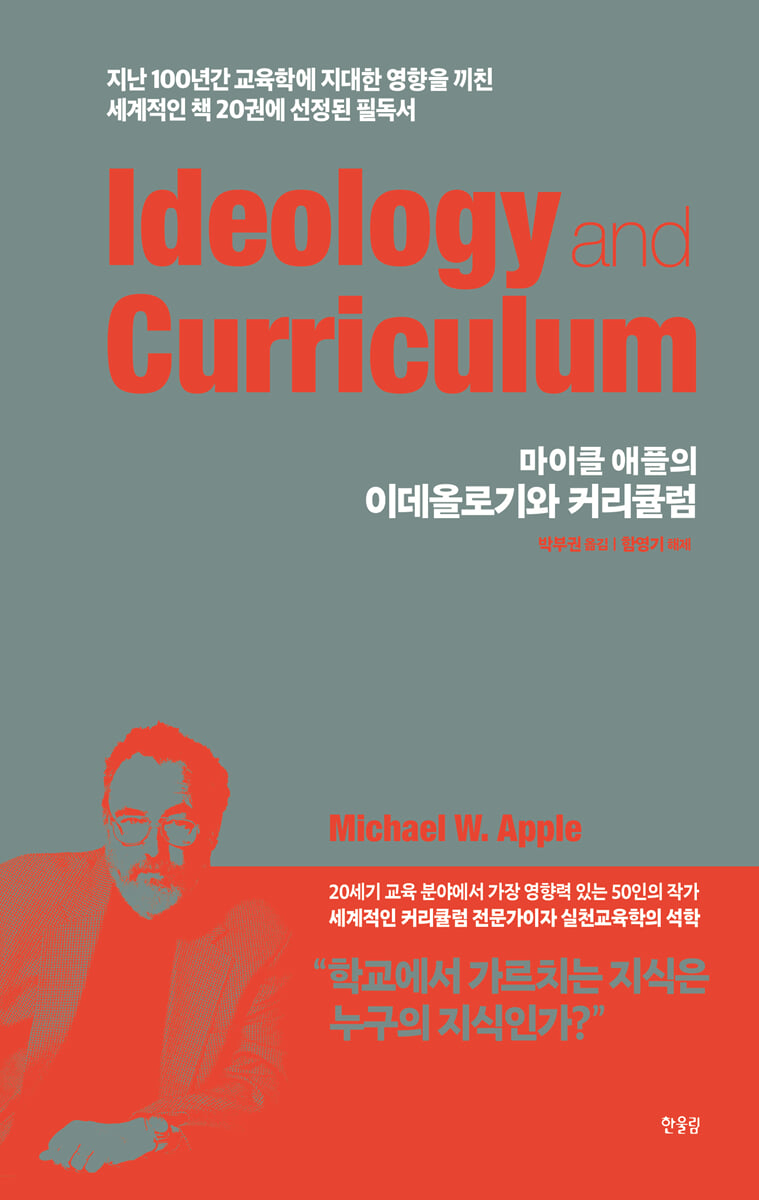
Ideology and Curriculum
 |
Description
Book Introduction
Whose knowledge is taught in school, and whose is the knowledge not taught?
What are schools doing now? What can't they do?
What can schools do? What can teachers do?
Professor Michael Apple, a world-renowned scholar of 'practical education' and curriculum expert, is considered one of the 50 most influential authors in the field of education over the past 100 years.
His landmark work, "Ideology and Curriculum," which first appeared in 1979, explores cultural and economic power relations in education and has been selected as one of the top 20 internationally recognized educational masterpieces that have had a profound impact on 20th-century education.
In this book, Professor Apple examines the relationship between education and economic structure, and the link between knowledge and power, from a critical perspective grounded in neo-Marxism, and demonstrates in detail how school education contributes to economic and cultural reproduction in an unequal society.
Furthermore, we delve into school curricula to uncover the ideological content latent within them, in order to discover how the ruling class continuously organizes people's consciousness through schools to maintain social control without necessarily revealing the ruling mechanism.
What are schools doing now? What can't they do?
What can schools do? What can teachers do?
Professor Michael Apple, a world-renowned scholar of 'practical education' and curriculum expert, is considered one of the 50 most influential authors in the field of education over the past 100 years.
His landmark work, "Ideology and Curriculum," which first appeared in 1979, explores cultural and economic power relations in education and has been selected as one of the top 20 internationally recognized educational masterpieces that have had a profound impact on 20th-century education.
In this book, Professor Apple examines the relationship between education and economic structure, and the link between knowledge and power, from a critical perspective grounded in neo-Marxism, and demonstrates in detail how school education contributes to economic and cultural reproduction in an unequal society.
Furthermore, we delve into school curricula to uncover the ideological content latent within them, in order to discover how the ruling class continuously organizes people's consciousness through schools to maintain social control without necessarily revealing the ruling mechanism.
- You can preview some of the book's contents.
Preview
index
To our Korean readers:
Author's Preface: To the Fourth Edition
Translator's Preface
prolog
Hegemony Analysis · 23
On Analyzing Hegemony
Hegemony Analysis | Neutrality and Justice | Traditions and Positioning in Pedagogy
The Essence of Ideology | Book Structure
Chapter 1
Ideology and Cultural and Economic Reproduction · 67
Ideology and Cultural and Economic Reproduction
Cultural and Economic Reproduction | Traditions of Achievement and Socialization
The Sociology and Economics of School Knowledge | The Relative Status of Knowledge
Hegemony and Reproduction | Some Questions to Consider
Chapter 2
Economics and Control in School Life · 97
Economics and Control in Everyday School Life
School Education and Cultural Capital | The Meaning and Control of the Curriculum Through History
The Use of Ideology and Curriculum | Beyond Investigative Humanism
Chapter 3
History of Curriculum and Social Control · 127
Curricular History and Social Control
From Agricultural Capital to Industrial Capital | The Present Seen Through the Eyes of History | Power and Culture |
Urbanization and the Historical Function of Schooling | The Social Function of the Curriculum | Social Homogeneity and Social Issues
Social Control and Social Issues | Curriculum and Social Issues | Curriculum Differentiation and Social Issues | Ethnicity, Intelligence, and Society | Conclusion
Chapter 4
The Nature of Potential Curriculum and Conflict · 165
The Hidden Curriculum and the Nature of Conflict
Conflict and Potential Curriculum | Ground Rules and Implicit Assumptions
Conflict in the Science Community | Conflict in Social Studies
How to Implement This in a Program | Conclusion
Chapter 5
Systems Management and Control Ideology · 203
Systems Management and the Ideology of Control
The Curriculum Area | Systems and Technical Controls
The Rhetorical Language of Systematic Methods | Systems, Science, Consensus | Exploring Alternatives
Chapter 6
Common Sense Categories and the Politics of Stigma · 237
Commonsense Categories and the Politics of Labeling
Ethics, Ideology, and Theory | The Need for Critical Consciousness
Are Things Really What They Seem? | Institutional Language and Ethical Responsibility
Power and Stigmatization | Clinical Language, Experts, and Social Control | Common Sense and Ideological
Chapter 7
Beyond the Reproduction of Ideology · 293
Beyond Ideological Reproduction
True Knowledge and True Power | Beyond Reproduction | Where is the Curriculum?
Epilogue
Ideology and Education After 9/11 · 317
Ideology and Education after September 11
After 9/11 | Patriotism, Flag, and School Control
In lieu of the translator's note: German Idealism and Ideology _ Park Bu-kwon
Release: 'Cultural Reproduction' and 'Spoon Class Theory'_ Ham Young-gi
Note · 380
Author's Preface: To the Fourth Edition
Translator's Preface
prolog
Hegemony Analysis · 23
On Analyzing Hegemony
Hegemony Analysis | Neutrality and Justice | Traditions and Positioning in Pedagogy
The Essence of Ideology | Book Structure
Chapter 1
Ideology and Cultural and Economic Reproduction · 67
Ideology and Cultural and Economic Reproduction
Cultural and Economic Reproduction | Traditions of Achievement and Socialization
The Sociology and Economics of School Knowledge | The Relative Status of Knowledge
Hegemony and Reproduction | Some Questions to Consider
Chapter 2
Economics and Control in School Life · 97
Economics and Control in Everyday School Life
School Education and Cultural Capital | The Meaning and Control of the Curriculum Through History
The Use of Ideology and Curriculum | Beyond Investigative Humanism
Chapter 3
History of Curriculum and Social Control · 127
Curricular History and Social Control
From Agricultural Capital to Industrial Capital | The Present Seen Through the Eyes of History | Power and Culture |
Urbanization and the Historical Function of Schooling | The Social Function of the Curriculum | Social Homogeneity and Social Issues
Social Control and Social Issues | Curriculum and Social Issues | Curriculum Differentiation and Social Issues | Ethnicity, Intelligence, and Society | Conclusion
Chapter 4
The Nature of Potential Curriculum and Conflict · 165
The Hidden Curriculum and the Nature of Conflict
Conflict and Potential Curriculum | Ground Rules and Implicit Assumptions
Conflict in the Science Community | Conflict in Social Studies
How to Implement This in a Program | Conclusion
Chapter 5
Systems Management and Control Ideology · 203
Systems Management and the Ideology of Control
The Curriculum Area | Systems and Technical Controls
The Rhetorical Language of Systematic Methods | Systems, Science, Consensus | Exploring Alternatives
Chapter 6
Common Sense Categories and the Politics of Stigma · 237
Commonsense Categories and the Politics of Labeling
Ethics, Ideology, and Theory | The Need for Critical Consciousness
Are Things Really What They Seem? | Institutional Language and Ethical Responsibility
Power and Stigmatization | Clinical Language, Experts, and Social Control | Common Sense and Ideological
Chapter 7
Beyond the Reproduction of Ideology · 293
Beyond Ideological Reproduction
True Knowledge and True Power | Beyond Reproduction | Where is the Curriculum?
Epilogue
Ideology and Education After 9/11 · 317
Ideology and Education after September 11
After 9/11 | Patriotism, Flag, and School Control
In lieu of the translator's note: German Idealism and Ideology _ Park Bu-kwon
Release: 'Cultural Reproduction' and 'Spoon Class Theory'_ Ham Young-gi
Note · 380
Into the book
According to John Rawls, for a society to be just, its principles and actions must prioritize the interests of the weakest.
That is, the structural relations of society must be equal not only in terms of access to cultural, social, and especially economic institutions, but also in terms of actual control over those institutions.
And to do this, we need to restructure existing institutions and fundamentally change the social contract that binds people.
---From "Prologue: Hegemony Analysis"
Bourdieu focuses on students' ability to deal with so-called 'middle-class culture'.
According to his argument, the cultural capital accumulated by schools serves as an effective filter, reproducing the hierarchical social structure.
For example, schools, through their seemingly neutral processes of choice and education, partially recreate social and economic hierarchies.
We take for granted the middle-class cultural capital, habitus, and teach it as if all children have equal access to it.
---From “Chapter 1: Ideology and Cultural and Economic Reproduction”
If we view schools as institutions that embody collective traditions and human will, then they are products of socio-economic ideologies.
Therefore, the following question would be an appropriate starting point for discussion:
“Whose meaning is collected and distributed through the explicit and implicit curriculum of the school?” To borrow Marx’s expression, reality does not wander around with labels.
The school curriculum represents and speaks for ideologies and cultural capital that come from somewhere.
However, it does not represent the vision of all groups, nor does it speak for the will of all groups.
So what are schools doing to distribute this cultural capital? Whose realities are "roaming" the hallways and classrooms of schools?
---From "Chapter 2: Economy and Control in School Life"
The fact that schools are being used for the purpose of maintaining hegemony is evident in the following two functions that schools perform.
One function is to teach cultural and economic values and tendencies, which schools naturally believe should be 'shared by everyone'.
Another function is to 'guarantee' a high level of education by selecting only a limited number of students who are deemed to have the 'ability' to maximize the production of the technical knowledge that the economy demands.
---From "Chapter 3: History of Curriculum and Social Control"
The dominant school perspective teaches that all elements of society—from the postman and firefighter in first-grade textbooks to the imperfect institutions covered in high school civics courses—are functionally interconnected and that each element contributes to the maintenance of society.
And this view holds that internal discord and conflict within society inherently hinder the smooth functioning of social order.
This tendency is also evident in the educational experience, which implicitly emphasizes students as value transmitters and recipients rather than value creators.
---From "Chapter 4: Potential Curriculum and the Nature of Conflict"
The fundamental and unchanging goal of system management techniques is to impose rules on human behavior, and while they respect 'individual differences,' they actually ignore them.
Treating individual differences that clearly exist as if they do not exist is essentially nothing more than a forced manipulation.
This idea that human behavior needs to be manipulated was already inherent in the pursuit of certainty.
Through these manipulations, an abstract individual is born.
---From Chapter 5, System Management and Control Ideology
Labeling students in various ways is an act of a certain social group making a value judgment about the appropriate or inappropriate behavior of another group.
If this view is correct, much research is needed to support it.
Research should reveal that when the ideological and hegemonic structures of dominant social groups with widespread ethical, political, and social influence are imposed on schools, schools help to classify students along lines of class, race, and gender.
---From "Chapter 6: Common Sense Categories and the Politics of Stigma"
As Marx clearly stated in The German Ideology, “the ruling class gives its ideas universality and presents them as the only rational and universally valid ideas.” Therefore, this perspective can be used as a starting point for explaining the relationship between knowledge, ideology, and power.
In other words, no matter how complex the analysis, the fundamental principle guiding such inquiry is to reveal how the dominant ideas of society relate to the interests of specific classes and groups.
---From "Chapter 7 Beyond the Reproduction of Ideology"
We live in an age where a new historical reality is unfolding before our eyes.
The relationship of dominance and subordination is being re-established in surprising ways.
The horrific events of 9/11, the creation of a new version of the national security system, the weakening of long-standing civil rights struggles, the US invasion of Iraq without UN sanctions despite opposition from most countries, the continued suppression of those who oppose and criticize clear wrongdoings, the construction of an arrogant American empire, and so on.
Everything in this endless list is strongly related to one another.
That is, the structural relations of society must be equal not only in terms of access to cultural, social, and especially economic institutions, but also in terms of actual control over those institutions.
And to do this, we need to restructure existing institutions and fundamentally change the social contract that binds people.
---From "Prologue: Hegemony Analysis"
Bourdieu focuses on students' ability to deal with so-called 'middle-class culture'.
According to his argument, the cultural capital accumulated by schools serves as an effective filter, reproducing the hierarchical social structure.
For example, schools, through their seemingly neutral processes of choice and education, partially recreate social and economic hierarchies.
We take for granted the middle-class cultural capital, habitus, and teach it as if all children have equal access to it.
---From “Chapter 1: Ideology and Cultural and Economic Reproduction”
If we view schools as institutions that embody collective traditions and human will, then they are products of socio-economic ideologies.
Therefore, the following question would be an appropriate starting point for discussion:
“Whose meaning is collected and distributed through the explicit and implicit curriculum of the school?” To borrow Marx’s expression, reality does not wander around with labels.
The school curriculum represents and speaks for ideologies and cultural capital that come from somewhere.
However, it does not represent the vision of all groups, nor does it speak for the will of all groups.
So what are schools doing to distribute this cultural capital? Whose realities are "roaming" the hallways and classrooms of schools?
---From "Chapter 2: Economy and Control in School Life"
The fact that schools are being used for the purpose of maintaining hegemony is evident in the following two functions that schools perform.
One function is to teach cultural and economic values and tendencies, which schools naturally believe should be 'shared by everyone'.
Another function is to 'guarantee' a high level of education by selecting only a limited number of students who are deemed to have the 'ability' to maximize the production of the technical knowledge that the economy demands.
---From "Chapter 3: History of Curriculum and Social Control"
The dominant school perspective teaches that all elements of society—from the postman and firefighter in first-grade textbooks to the imperfect institutions covered in high school civics courses—are functionally interconnected and that each element contributes to the maintenance of society.
And this view holds that internal discord and conflict within society inherently hinder the smooth functioning of social order.
This tendency is also evident in the educational experience, which implicitly emphasizes students as value transmitters and recipients rather than value creators.
---From "Chapter 4: Potential Curriculum and the Nature of Conflict"
The fundamental and unchanging goal of system management techniques is to impose rules on human behavior, and while they respect 'individual differences,' they actually ignore them.
Treating individual differences that clearly exist as if they do not exist is essentially nothing more than a forced manipulation.
This idea that human behavior needs to be manipulated was already inherent in the pursuit of certainty.
Through these manipulations, an abstract individual is born.
---From Chapter 5, System Management and Control Ideology
Labeling students in various ways is an act of a certain social group making a value judgment about the appropriate or inappropriate behavior of another group.
If this view is correct, much research is needed to support it.
Research should reveal that when the ideological and hegemonic structures of dominant social groups with widespread ethical, political, and social influence are imposed on schools, schools help to classify students along lines of class, race, and gender.
---From "Chapter 6: Common Sense Categories and the Politics of Stigma"
As Marx clearly stated in The German Ideology, “the ruling class gives its ideas universality and presents them as the only rational and universally valid ideas.” Therefore, this perspective can be used as a starting point for explaining the relationship between knowledge, ideology, and power.
In other words, no matter how complex the analysis, the fundamental principle guiding such inquiry is to reveal how the dominant ideas of society relate to the interests of specific classes and groups.
---From "Chapter 7 Beyond the Reproduction of Ideology"
We live in an age where a new historical reality is unfolding before our eyes.
The relationship of dominance and subordination is being re-established in surprising ways.
The horrific events of 9/11, the creation of a new version of the national security system, the weakening of long-standing civil rights struggles, the US invasion of Iraq without UN sanctions despite opposition from most countries, the continued suppression of those who oppose and criticize clear wrongdoings, the construction of an arrogant American empire, and so on.
Everything in this endless list is strongly related to one another.
---From "Epilogue: Ideology and Education after 9/11"
Publisher's Review
Whose knowledge is taught in school, and whose is the knowledge not taught?
What are schools doing now? What can't they do?
What can schools do? What can teachers do?
Professor Michael Apple, a world-renowned scholar of 'practical education' and curriculum expert, is considered one of the 50 most influential authors in the field of education over the past 100 years.
His book, Ideology and Curriculum, was first published in 1979 and is a groundbreaking work that addresses cultural and economic power relations in education. It has been selected as one of the 20 world-renowned educational masterpieces that had a profound influence on 20th-century education.
In this book, Professor Apple examines the relationship between education and economic structure, and the nexus between knowledge and power, from a critical perspective grounded in neo-Marxism, and demonstrates in detail how school education contributes to economic and cultural reproduction in an unequal society.
Furthermore, we delve into school curricula to uncover the ideological content latent within them, in order to discover how the ruling class continuously organizes people's consciousness through schools to maintain social control without necessarily revealing the ruling mechanism.
Education is never neutral
Michel Foucault viewed schools as a uniquely modern power apparatus, like armies, hospitals, and prisons, while Louis Althusser viewed school education as an ideological apparatus of the state that dominated modern society.
Pierre Bourdieu, Basil Bernstein, Samuel Bowles, and Herbert Gintis argued that education functions to reproduce or fix cultural, class, and social inequalities and gaps.
Michael Apple also clarifies the role of schools in a class society as powerful institutions that reproduce economic and cultural class relations and as institutions that perform ideological functions.
Education is never neutral, and the very nature of the educational system means that educators, whether consciously or not, are inevitably involved in politics.
This is because educational activities cannot be completely separated from the dominant consciousness and unequal system of advanced industrial economies.
This is the belief expressed by Professor Apple.
In the preface to the fourth edition of his book, "Ideology and Curriculum," published in 2019 to commemorate its 40th anniversary, he wrote that the United States and the world were facing a more serious political and ideological crisis after the 9/11 terrorist attacks.
And he said he was pained by the current situation, feeling that those inside and outside the educational community who had worked for so long to keep the river of democracy flowing without ceasing were being thoroughly disdained.
However, he urged, we have a history of persistent struggles to build a critical democratic society, and to fully understand the history of education, we must also examine the persistent efforts to identify and eliminate those areas of education that block the possibility of critical democracy.
In doing so, we stand on the shoulders of those who, from past to present, have acted to overcome such obstacles, and uncovering the true nature of these obstacles has been the consistent focus of this book.
'Why and how is only the culture of a certain group present in schools?
Are you teaching that it is objective and legitimate knowledge?'
In The German Ideology, Marx stated that “the ruling class gives universality to its ideas and presents them as the only rational and valid ideas for everyone.”
Professor Apple therefore took this perspective as a starting point for explaining the relationship between knowledge, ideology, and power.
To uncover how the dominant ideas of society relate to the interests of specific classes and groups.
The study of the interconnectedness between ideology and curriculum, and ideology and educational debate, has important implications not only for the field of curriculum but also for educational theory and policy in general.
Therefore, throughout this book, we critically explore the question: Why and how do schools teach that only the culture of a certain group is objective and legitimate knowledge?
Thus, through 'critical research' and 'relationship analysis,' we are revealing in detail how the knowledge taught in schools has become an ideological construct that reflects the interests of the dominant social group, and how schools justify limited and partial knowledge as truth.
What are schools doing now? What can't they do?
What can schools do? What can teachers do?
Professor Michael Apple, a world-renowned scholar of 'practical education' and curriculum expert, is considered one of the 50 most influential authors in the field of education over the past 100 years.
His book, Ideology and Curriculum, was first published in 1979 and is a groundbreaking work that addresses cultural and economic power relations in education. It has been selected as one of the 20 world-renowned educational masterpieces that had a profound influence on 20th-century education.
In this book, Professor Apple examines the relationship between education and economic structure, and the nexus between knowledge and power, from a critical perspective grounded in neo-Marxism, and demonstrates in detail how school education contributes to economic and cultural reproduction in an unequal society.
Furthermore, we delve into school curricula to uncover the ideological content latent within them, in order to discover how the ruling class continuously organizes people's consciousness through schools to maintain social control without necessarily revealing the ruling mechanism.
Education is never neutral
Michel Foucault viewed schools as a uniquely modern power apparatus, like armies, hospitals, and prisons, while Louis Althusser viewed school education as an ideological apparatus of the state that dominated modern society.
Pierre Bourdieu, Basil Bernstein, Samuel Bowles, and Herbert Gintis argued that education functions to reproduce or fix cultural, class, and social inequalities and gaps.
Michael Apple also clarifies the role of schools in a class society as powerful institutions that reproduce economic and cultural class relations and as institutions that perform ideological functions.
Education is never neutral, and the very nature of the educational system means that educators, whether consciously or not, are inevitably involved in politics.
This is because educational activities cannot be completely separated from the dominant consciousness and unequal system of advanced industrial economies.
This is the belief expressed by Professor Apple.
In the preface to the fourth edition of his book, "Ideology and Curriculum," published in 2019 to commemorate its 40th anniversary, he wrote that the United States and the world were facing a more serious political and ideological crisis after the 9/11 terrorist attacks.
And he said he was pained by the current situation, feeling that those inside and outside the educational community who had worked for so long to keep the river of democracy flowing without ceasing were being thoroughly disdained.
However, he urged, we have a history of persistent struggles to build a critical democratic society, and to fully understand the history of education, we must also examine the persistent efforts to identify and eliminate those areas of education that block the possibility of critical democracy.
In doing so, we stand on the shoulders of those who, from past to present, have acted to overcome such obstacles, and uncovering the true nature of these obstacles has been the consistent focus of this book.
'Why and how is only the culture of a certain group present in schools?
Are you teaching that it is objective and legitimate knowledge?'
In The German Ideology, Marx stated that “the ruling class gives universality to its ideas and presents them as the only rational and valid ideas for everyone.”
Professor Apple therefore took this perspective as a starting point for explaining the relationship between knowledge, ideology, and power.
To uncover how the dominant ideas of society relate to the interests of specific classes and groups.
The study of the interconnectedness between ideology and curriculum, and ideology and educational debate, has important implications not only for the field of curriculum but also for educational theory and policy in general.
Therefore, throughout this book, we critically explore the question: Why and how do schools teach that only the culture of a certain group is objective and legitimate knowledge?
Thus, through 'critical research' and 'relationship analysis,' we are revealing in detail how the knowledge taught in schools has become an ideological construct that reflects the interests of the dominant social group, and how schools justify limited and partial knowledge as truth.
GOODS SPECIFICS
- Date of issue: February 20, 2023
- Format: Hardcover book binding method guide
- Page count, weight, size: 416 pages | 624g | 135*220*28mm
- ISBN13: 9788958271437
- ISBN10: 8958271434
You may also like
카테고리
korean


korean

![GQ KOREA Mark (Monthly): December [2025]](http://librairie.coreenne.fr/cdn/shop/files/8ef265dbbfbf186523ed75ba7319009d.jpg?v=1765340328&width=3840)


