

Introduction to Economic Geography
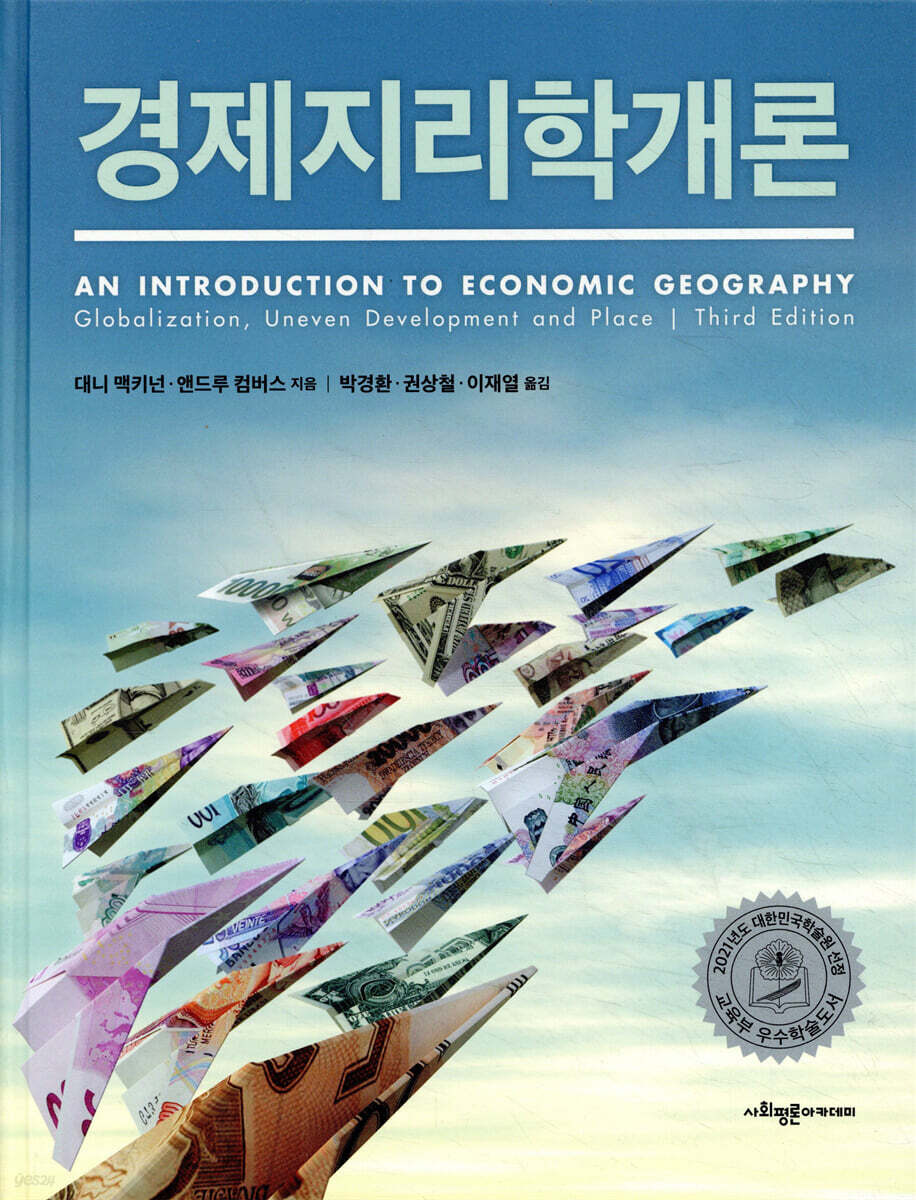 |
Description
Book Introduction
This book is a translation of the excellent economic geography book 『Economic Geography』(revised 3rd edition), which is widely read around the world.
It covers a vast range of economic geography knowledge, from traditional concerns to the rapidly changing issues of economic geography.
Filled with clear prose, plentiful learning materials, and vivid examples from around the world, this book serves as a useful and engaging introduction to economic geography.
Recommended for geography education and geography majors, teachers and civil service exam takers, urban and regional development experts and aspirants, and civil society activists.
It covers a vast range of economic geography knowledge, from traditional concerns to the rapidly changing issues of economic geography.
Filled with clear prose, plentiful learning materials, and vivid examples from around the world, this book serves as a useful and engaging introduction to economic geography.
Recommended for geography education and geography majors, teachers and civil service exam takers, urban and regional development experts and aspirants, and civil society activists.
- You can preview some of the book's contents.
Preview
index
PART 1 BASICS
Chapter 1: Overview of Economic Geography
Chapter 2 Approaches to Economic Geography
Chapter 3 From Regional Specialization to Global Integration: The Shifting Geography of Production
PART 2: Reshaping the Economic Landscape: Dynamics and Consequences
Chapter 4: Unleashed Capital? The Spatial Circulation of Finance and Investment
Chapter 5: Managing Capitalism: Evolution of State and Economic Governance
Chapter 6: Restructuring Work and Employment
Chapter 7 Developmental Geography
PART 3 RE-STRUCTURE OF URBAN AND REGIONAL ECONOMIES
Chapter 8 Connected Cities: Transport, Communications, and the Digital Economy
Chapter 9 Global Production Networks and Regional Development
Chapter 10: Urban Economy of Innovation and Creation
PART 4: Restructuring Economic Life
Chapter 11 Consumption and Retail
Chapter 12 Economic Geography and the Environment
Chapter 13 Alternative Economic Geography
PART 5 Outlook
Chapter 14 Conclusion
Chapter 1: Overview of Economic Geography
Chapter 2 Approaches to Economic Geography
Chapter 3 From Regional Specialization to Global Integration: The Shifting Geography of Production
PART 2: Reshaping the Economic Landscape: Dynamics and Consequences
Chapter 4: Unleashed Capital? The Spatial Circulation of Finance and Investment
Chapter 5: Managing Capitalism: Evolution of State and Economic Governance
Chapter 6: Restructuring Work and Employment
Chapter 7 Developmental Geography
PART 3 RE-STRUCTURE OF URBAN AND REGIONAL ECONOMIES
Chapter 8 Connected Cities: Transport, Communications, and the Digital Economy
Chapter 9 Global Production Networks and Regional Development
Chapter 10: Urban Economy of Innovation and Creation
PART 4: Restructuring Economic Life
Chapter 11 Consumption and Retail
Chapter 12 Economic Geography and the Environment
Chapter 13 Alternative Economic Geography
PART 5 Outlook
Chapter 14 Conclusion
Publisher's Review
A widely read introductory book to economic geography worldwide
A comprehensive overview of the rapidly changing economic geography in one volume.
The new book 『Introduction to Economic Geography』 from the Academy of Social Criticism is a translation of 『Economic Geography: Globalization, Uneven Development, Place』 (revised 3rd edition), which has received positive responses from many readers around the world, including students, teaching assistants, and professors.
The authors, Danny MacKinnon and Andrew Combs, are scholars with a broad academic spectrum, leading the field of evolutionary economic geography alongside geopolitical economics.
They encompass a vast body of knowledge in economic geography, encompassing traditional concerns of economic geography such as regional development, transnational corporations, and labor markets, as well as current and important issues such as the 2008-09 financial crisis, austerity politics, the restructuring of labor, deglobalization, post-neoliberal development, energy transition, and the alternative economic (geographic) movement.
This book explores capitalism and institutions, focusing on globalization, uneven development, and place.
Globalization has caused some places to prosper while others have declined or fallen into poverty.
In this respect, globalization can be said to be a process of uneven development.
Through examples of the rise and fall and uneven development of numerous regions, including Wall Street in New York, The City in London, the high-tech industrial clusters of Silicon Valley, the post-industrial regions of Northeast England, and the mining districts of the Andes, the book vividly illustrates to readers the profound relationship between the global economy and place.
This book, which seeks to understand the economy from a broad and comprehensive perspective encompassing geography, politics, and economics, is of great help in understanding the fundamental mechanisms that generate various socio-spatial problems, crises, and instabilities in modern capitalism.
Furthermore, it allows us to break away from the rigidity of (Marxist) political economy, which was solely focused on the relationship between capital and labor, and realize that the economic landscape under capitalism is dynamically changing even at this very moment.
Over 200 rich visual materials
Includes vivid examples from various regions and countries.
This book contains 132 illustrations and 56 tables.
These rich learning materials not only help you fully understand the content, but also make learning more interesting.
Additionally, over 80 interesting cases from around the world that fit the learning topic are introduced in the main text 'Box', giving readers a sense of presence and immersion similar to reading a journal article.
This book is full of vivid examples of economic geography from various countries and regions, including interviews with workers at a Ford factory in North West England, gender relations in The City, London's financial district, the suicide of a Foxconn worker who supplies parts to Apple, the globalization of Tesco and the success factors of Homeplus in Korea, the core storytelling and sales strategies of the Mall of America in the US, and the story of the urban poor who were evicted during the construction of New York's seemingly peaceful Central Park.
Transcending the limitations of dry, theory-heavy introductory books, this book invites readers into the fascinating world of economic geography, brimming with dynamism and diversity.
Easy-to-read and friendly textbook
- Additional explanations for unfamiliar or difficult terms provided by the translator.
- Deep Learning, which covers important concepts in depth
The translators of this book, who have often encountered students who struggle with and fear economic geography in geography education, have put a lot of effort into improving readability so that readers can easily understand the content.
Not only have we added supplementary explanations to unfamiliar or difficult terms to enhance learning convenience, but the Korean edition also features a special "In-Depth Learning" section to provide in-depth introductions to important concepts that readers must understand.
This book is truly a 'friendly textbook' filled with the translators' sincere heart and dedication to helping those studying economic geography.
Book structure
This book is divided into five parts (14 chapters).
Part 1, "Basics," examines the history and ideological foundations of economic geography, the book's perspective and approach, and the key characteristics of capitalism and their relevance to geography.
Part 2, "Reshaping the Economic Landscape: Dynamics and Outcomes," addresses macroeconomic issues shaping the economic landscape, including capital, finance, and the state, as well as the changing role of labor and the development of developing countries.
Part 3, "Restructuring Urban and Regional Economies," examines the topics covered in this book and their relevance to urban and regional economies, examining the specific geographical context of key issues highlighted in economic geography.
In Part 4, "Reorganization of Economic Life," we learn about changes in the nature and direction of economic relations, including consumption, the environment, and the emergence of alternative economic geographies.
The final Part 5, "Conclusion," summarizes the main points of this book and considers the geographical patterns that urban and regional development will follow in the future.
A comprehensive overview of the rapidly changing economic geography in one volume.
The new book 『Introduction to Economic Geography』 from the Academy of Social Criticism is a translation of 『Economic Geography: Globalization, Uneven Development, Place』 (revised 3rd edition), which has received positive responses from many readers around the world, including students, teaching assistants, and professors.
The authors, Danny MacKinnon and Andrew Combs, are scholars with a broad academic spectrum, leading the field of evolutionary economic geography alongside geopolitical economics.
They encompass a vast body of knowledge in economic geography, encompassing traditional concerns of economic geography such as regional development, transnational corporations, and labor markets, as well as current and important issues such as the 2008-09 financial crisis, austerity politics, the restructuring of labor, deglobalization, post-neoliberal development, energy transition, and the alternative economic (geographic) movement.
This book explores capitalism and institutions, focusing on globalization, uneven development, and place.
Globalization has caused some places to prosper while others have declined or fallen into poverty.
In this respect, globalization can be said to be a process of uneven development.
Through examples of the rise and fall and uneven development of numerous regions, including Wall Street in New York, The City in London, the high-tech industrial clusters of Silicon Valley, the post-industrial regions of Northeast England, and the mining districts of the Andes, the book vividly illustrates to readers the profound relationship between the global economy and place.
This book, which seeks to understand the economy from a broad and comprehensive perspective encompassing geography, politics, and economics, is of great help in understanding the fundamental mechanisms that generate various socio-spatial problems, crises, and instabilities in modern capitalism.
Furthermore, it allows us to break away from the rigidity of (Marxist) political economy, which was solely focused on the relationship between capital and labor, and realize that the economic landscape under capitalism is dynamically changing even at this very moment.
Over 200 rich visual materials
Includes vivid examples from various regions and countries.
This book contains 132 illustrations and 56 tables.
These rich learning materials not only help you fully understand the content, but also make learning more interesting.
Additionally, over 80 interesting cases from around the world that fit the learning topic are introduced in the main text 'Box', giving readers a sense of presence and immersion similar to reading a journal article.
This book is full of vivid examples of economic geography from various countries and regions, including interviews with workers at a Ford factory in North West England, gender relations in The City, London's financial district, the suicide of a Foxconn worker who supplies parts to Apple, the globalization of Tesco and the success factors of Homeplus in Korea, the core storytelling and sales strategies of the Mall of America in the US, and the story of the urban poor who were evicted during the construction of New York's seemingly peaceful Central Park.
Transcending the limitations of dry, theory-heavy introductory books, this book invites readers into the fascinating world of economic geography, brimming with dynamism and diversity.
Easy-to-read and friendly textbook
- Additional explanations for unfamiliar or difficult terms provided by the translator.
- Deep Learning, which covers important concepts in depth
The translators of this book, who have often encountered students who struggle with and fear economic geography in geography education, have put a lot of effort into improving readability so that readers can easily understand the content.
Not only have we added supplementary explanations to unfamiliar or difficult terms to enhance learning convenience, but the Korean edition also features a special "In-Depth Learning" section to provide in-depth introductions to important concepts that readers must understand.
This book is truly a 'friendly textbook' filled with the translators' sincere heart and dedication to helping those studying economic geography.
Book structure
This book is divided into five parts (14 chapters).
Part 1, "Basics," examines the history and ideological foundations of economic geography, the book's perspective and approach, and the key characteristics of capitalism and their relevance to geography.
Part 2, "Reshaping the Economic Landscape: Dynamics and Outcomes," addresses macroeconomic issues shaping the economic landscape, including capital, finance, and the state, as well as the changing role of labor and the development of developing countries.
Part 3, "Restructuring Urban and Regional Economies," examines the topics covered in this book and their relevance to urban and regional economies, examining the specific geographical context of key issues highlighted in economic geography.
In Part 4, "Reorganization of Economic Life," we learn about changes in the nature and direction of economic relations, including consumption, the environment, and the emergence of alternative economic geographies.
The final Part 5, "Conclusion," summarizes the main points of this book and considers the geographical patterns that urban and regional development will follow in the future.
GOODS SPECIFICS
- Publication date: February 26, 2021
- Page count, weight, size: 544 pages | 1,614g | 205*270*40mm
- ISBN13: 9791189946975
- ISBN10: 1189946971
You may also like
카테고리
korean


korean

![ELLE 엘르 스페셜 에디션 A형 : 12월 [2025]](http://librairie.coreenne.fr/cdn/shop/files/b8e27a3de6c9538896439686c6b0e8fb.jpg?v=1766436872&width=3840)


