

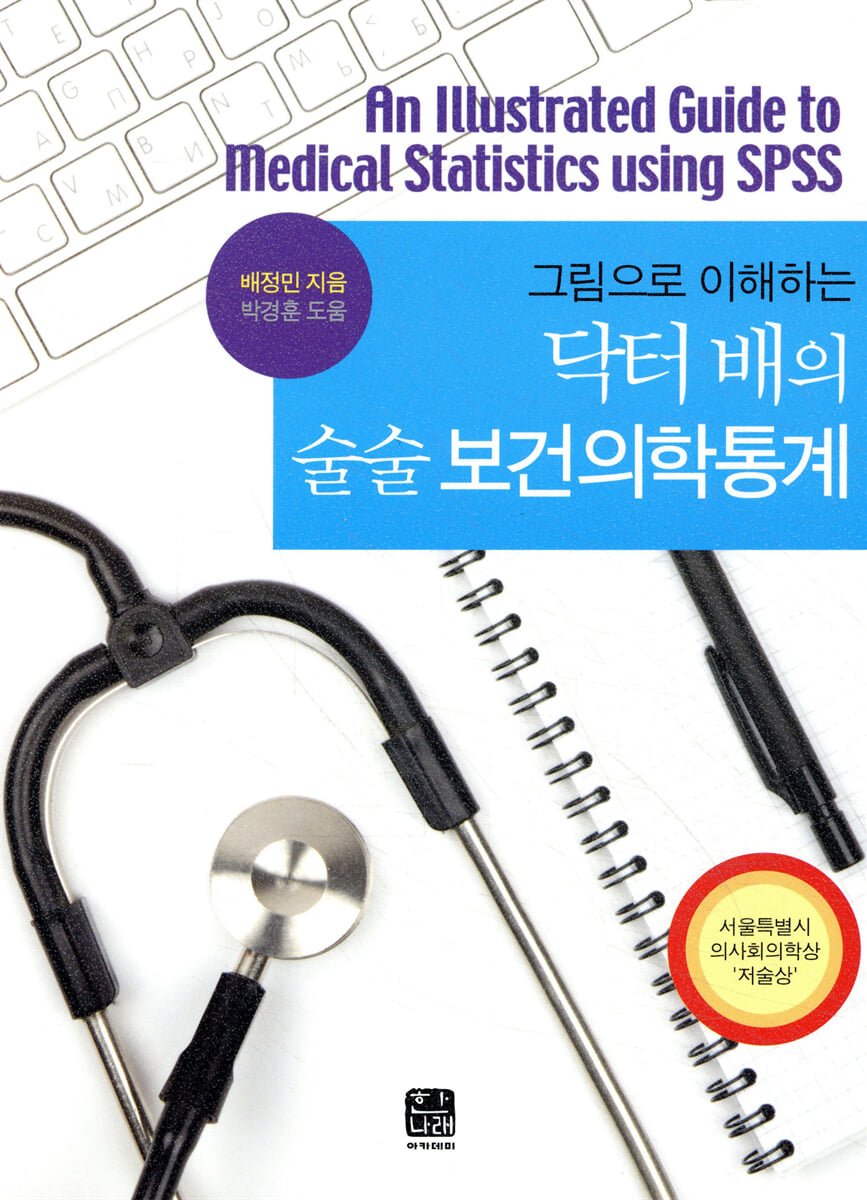
Dr. Bae's Sulsul Health and Medical Statistics
 |
Description
Book Introduction
A Beginner's Guide to Health Statistics
Statistics is a difficult field for those in the medical field, but without an understanding of statistics, it is difficult to write papers or present research.
Many statistical programs have already been developed, allowing researchers to analyze data directly. However, if researchers do not know the correct statistical analysis methods, they may produce erroneous results.
This book helps researchers without statistical knowledge learn the basic concepts of statistics.
Rather than explaining complex and difficult theories at length, it helps you understand statistics intuitively through illustrations.
Furthermore, if researchers can find and utilize the most appropriate analysis method for their research based on an understanding of these statistics, it will help them conduct more accurate analyses.
Additionally, this book uses SPSS as an example and includes SAS and R code as appendices, making it possible to learn using various statistical programs.
Statistics is a difficult field for those in the medical field, but without an understanding of statistics, it is difficult to write papers or present research.
Many statistical programs have already been developed, allowing researchers to analyze data directly. However, if researchers do not know the correct statistical analysis methods, they may produce erroneous results.
This book helps researchers without statistical knowledge learn the basic concepts of statistics.
Rather than explaining complex and difficult theories at length, it helps you understand statistics intuitively through illustrations.
Furthermore, if researchers can find and utilize the most appropriate analysis method for their research based on an understanding of these statistics, it will help them conduct more accurate analyses.
Additionally, this book uses SPSS as an example and includes SAS and R code as appendices, making it possible to learn using various statistical programs.
- You can preview some of the book's contents.
Preview
index
[Part 1_Getting Started with Health and Medical Statistics]
01 Let's start statistics by knowing these eight things.
go.
Classification of data
me.
How to test a hypothesis
all.
5% significance level and multiple comparisons
la.
degrees of freedom
mind.
Distribution and test statistics
bar.
Central limit theorem
buy.
Parametric and nonparametric methods
ah.
Exploring data and testing for normality
02 Comparison of the sizes of the two groups
go.
Independent sample t test
me.
Mann-Whitney test
03 Size comparison before and after treatment
go.
Paired Samples T-Test
me.
Wilcoxon signed rank test
Size comparison of groups 04 and above
go.
How to compare the sizes of three or more independent groups
me.
Post-mortem analysis
all.
One-way ANOVA
la.
Kruskal-Wallis test
mind.
Jonckheere-Terpstra test
05 How to compare ratios
go.
Chi-square test
me.
Fisher's exact test
all.
Linear-to-linear combination
06 Estimating linear relationships between continuous variables
go.
Pearson's correlation analysis
me.
Spearman's rank correlation analysis
all.
Simple regression analysis
la.
multiple regression analysis
07 Estimation of survival rates and comparison of survival rates across groups
go.
Preparing for survival research
me.
Kaplan-Meier survival analysis
all.
Log-rank method
[Part 2: A Taste of Intermediate Health and Medical Statistics]
08 Let's move on to intermediate statistics by learning just these eight things.
go.
95% confidence interval
me.
Relative risk and odds ratio
all.
exponential function
la.
Generalized linear model
mind.
Udo Island
bar.
Confounding variables and interactions
buy.
Setting of variable number
ah.
Univariate and multivariate analyses
09 Research on risk factors for disease
go.
Logistic regression analysis
10. How to analyze data measured repeatedly from the same subject
go.
repeated measures analysis of variance
me.
Data structure conversion
all.
Linear mixed model
la.
Generalized estimating equations
11. Research on risk factors affecting survival rates
go.
Cox's proportional hazards model
12. Study on the incidence of diseases
go.
Poisson distribution
me.
Poisson regression analysis
13. How to test the equivalence and non-inferiority of two treatments
go.
Equivalence test and non-inferiority test
me.
Non-inferiority test for size (higher is better)
all.
Non-inferiority test for size (lower is better)
la.
Non-inferiority test of proportion
[Appendix 1] SAS Code
[Appendix 2] R code
01 Let's start statistics by knowing these eight things.
go.
Classification of data
me.
How to test a hypothesis
all.
5% significance level and multiple comparisons
la.
degrees of freedom
mind.
Distribution and test statistics
bar.
Central limit theorem
buy.
Parametric and nonparametric methods
ah.
Exploring data and testing for normality
02 Comparison of the sizes of the two groups
go.
Independent sample t test
me.
Mann-Whitney test
03 Size comparison before and after treatment
go.
Paired Samples T-Test
me.
Wilcoxon signed rank test
Size comparison of groups 04 and above
go.
How to compare the sizes of three or more independent groups
me.
Post-mortem analysis
all.
One-way ANOVA
la.
Kruskal-Wallis test
mind.
Jonckheere-Terpstra test
05 How to compare ratios
go.
Chi-square test
me.
Fisher's exact test
all.
Linear-to-linear combination
06 Estimating linear relationships between continuous variables
go.
Pearson's correlation analysis
me.
Spearman's rank correlation analysis
all.
Simple regression analysis
la.
multiple regression analysis
07 Estimation of survival rates and comparison of survival rates across groups
go.
Preparing for survival research
me.
Kaplan-Meier survival analysis
all.
Log-rank method
[Part 2: A Taste of Intermediate Health and Medical Statistics]
08 Let's move on to intermediate statistics by learning just these eight things.
go.
95% confidence interval
me.
Relative risk and odds ratio
all.
exponential function
la.
Generalized linear model
mind.
Udo Island
bar.
Confounding variables and interactions
buy.
Setting of variable number
ah.
Univariate and multivariate analyses
09 Research on risk factors for disease
go.
Logistic regression analysis
10. How to analyze data measured repeatedly from the same subject
go.
repeated measures analysis of variance
me.
Data structure conversion
all.
Linear mixed model
la.
Generalized estimating equations
11. Research on risk factors affecting survival rates
go.
Cox's proportional hazards model
12. Study on the incidence of diseases
go.
Poisson distribution
me.
Poisson regression analysis
13. How to test the equivalence and non-inferiority of two treatments
go.
Equivalence test and non-inferiority test
me.
Non-inferiority test for size (higher is better)
all.
Non-inferiority test for size (lower is better)
la.
Non-inferiority test of proportion
[Appendix 1] SAS Code
[Appendix 2] R code
Publisher's Review
A Beginner's Guide to Health Statistics
Statistics is a difficult field for many medical professionals, but without an understanding of statistics, it is difficult to write papers or present research.
Additionally, statistics are a very useful tool for logically proving research topics.
Of course, the world of 'statistics' is profound and difficult, but not all of the commonly used 'statistical analysis' is difficult.
We have entered an era where excellent statistical programs have already been developed, allowing researchers to analyze data on their own.
However, statistical programs are like calculators that perform a set calculation at the push of a button, so they can produce spurious analysis results.
Studying statistics is necessary to select the right statistical analysis method, use it properly, and interpret the results correctly.
This book is a guide for just such researchers.
Dr. Bae's "Smart Health and Medical Statistics", written by Dr. Bae Jeong-min, a clinical instructor in the Department of Dermatology at Severance Hospital in Shinchon, guides researchers without statistical knowledge to learn the basic concepts of statistics.
In particular, rather than explaining complex and difficult theories at length, it helps to approach them intuitively through pictures, making statistics easier to understand.
Furthermore, if researchers can identify and utilize the most appropriate analytical methods for their research based on this understanding of statistics, it will help them conduct more accurate analyses. Furthermore, this book uses SPSS as an example and includes SAS and R code in the appendix, enabling learning using a variety of statistical programs.
Features of this book
This book is divided into seven basic sections and six intermediate sections.
After reading Chapter 1, you can move on to the basics, and if you have a good understanding of the basics, you can move on to the intermediate level after studying Chapter 8.
The book's features are as follows:
First, you can perform statistical analysis without having to know difficult terms you've never heard before.
Second, we attempted to explain the principles of statistical analysis through pictures.
Third, you can learn how to use the SPSS program and interpret the results through the actual program screen.
Fourth, intuitive examples were used.
Fifth, based on SPSS, SAS and R codes were included together.
Statistics is a difficult field for many medical professionals, but without an understanding of statistics, it is difficult to write papers or present research.
Additionally, statistics are a very useful tool for logically proving research topics.
Of course, the world of 'statistics' is profound and difficult, but not all of the commonly used 'statistical analysis' is difficult.
We have entered an era where excellent statistical programs have already been developed, allowing researchers to analyze data on their own.
However, statistical programs are like calculators that perform a set calculation at the push of a button, so they can produce spurious analysis results.
Studying statistics is necessary to select the right statistical analysis method, use it properly, and interpret the results correctly.
This book is a guide for just such researchers.
Dr. Bae's "Smart Health and Medical Statistics", written by Dr. Bae Jeong-min, a clinical instructor in the Department of Dermatology at Severance Hospital in Shinchon, guides researchers without statistical knowledge to learn the basic concepts of statistics.
In particular, rather than explaining complex and difficult theories at length, it helps to approach them intuitively through pictures, making statistics easier to understand.
Furthermore, if researchers can identify and utilize the most appropriate analytical methods for their research based on this understanding of statistics, it will help them conduct more accurate analyses. Furthermore, this book uses SPSS as an example and includes SAS and R code in the appendix, enabling learning using a variety of statistical programs.
Features of this book
This book is divided into seven basic sections and six intermediate sections.
After reading Chapter 1, you can move on to the basics, and if you have a good understanding of the basics, you can move on to the intermediate level after studying Chapter 8.
The book's features are as follows:
First, you can perform statistical analysis without having to know difficult terms you've never heard before.
Second, we attempted to explain the principles of statistical analysis through pictures.
Third, you can learn how to use the SPSS program and interpret the results through the actual program screen.
Fourth, intuitive examples were used.
Fifth, based on SPSS, SAS and R codes were included together.
GOODS SPECIFICS
- Date of issue: April 30, 2012
- Page count, weight, size: 367 pages | 188*257*30mm
- ISBN13: 9788955661286
- ISBN10: 8955661282
You may also like
카테고리
korean


korean

![ELLE 엘르 스페셜 에디션 A형 : 12월 [2025]](http://librairie.coreenne.fr/cdn/shop/files/b8e27a3de6c9538896439686c6b0e8fb.jpg?v=1766436872&width=3840)


