

Finite element analysis
 |
Description
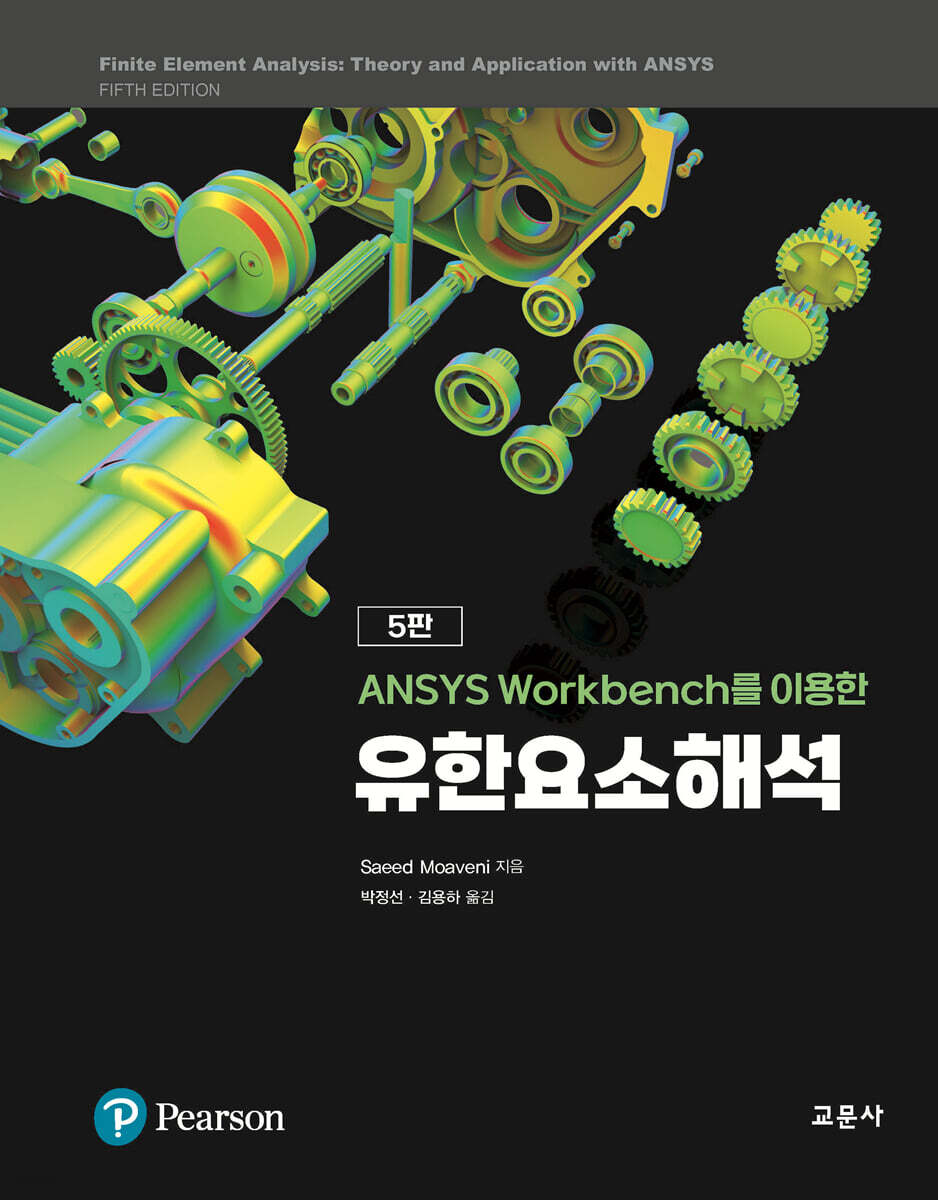
Book Introduction
The field of finite element analysis was initially a field for graduate-educated personnel, but it has now reached the stage of being included in undergraduate education and used to train design engineers.
In a reality where people blindly trust the results of numerical calculators (number crunchers) for finite element analysis programs, I found that Moaveni's finite element analysis textbook was appropriately written to meet the need to train design engineers who can use finite element analysis by providing the basics of finite element analysis theory, how to use ANSYS, and methods for verifying finite element analysis results, so I translated it.
The first edition of this textbook was translated in 1999, and now the fifth edition, a revised and expanded edition, has been translated.
In addition to the contents of the first edition, such as trusses, one-dimensional elements, two-dimensional elements, three-dimensional elements, heat transfer analysis, solid mechanics, fluid mechanics, and optimization design, this fifth edition adds instructions for using ANSYS Workbench, providing various explanations of finite element analysis and information on utilizing ANSYS Workbench.
Additionally, this translated version excludes chapters 2, 6, 8, 9, 12, 14, and 15 from the original book to fit the curriculum of a one-semester finite element analysis course.
To understand this finite element analysis, it is sufficient to have basic knowledge of undergraduate engineering mathematics, material mechanics, fluid mechanics, thermodynamics, etc., and additional knowledge of using CAD software is recommended.
To acquire more specialized and in-depth knowledge such as fatigue life evaluation, nonlinear analysis, noise analysis, boundary element analysis, fluid-structure connection analysis, reliability analysis, and optimal design, one must advance to a graduate program. However, it is believed that basic design analysis engineers and upperclassmen undergraduate students will be able to acquire basic finite element analysis knowledge efficiently enough if they take classes.
In a reality where people blindly trust the results of numerical calculators (number crunchers) for finite element analysis programs, I found that Moaveni's finite element analysis textbook was appropriately written to meet the need to train design engineers who can use finite element analysis by providing the basics of finite element analysis theory, how to use ANSYS, and methods for verifying finite element analysis results, so I translated it.
The first edition of this textbook was translated in 1999, and now the fifth edition, a revised and expanded edition, has been translated.
In addition to the contents of the first edition, such as trusses, one-dimensional elements, two-dimensional elements, three-dimensional elements, heat transfer analysis, solid mechanics, fluid mechanics, and optimization design, this fifth edition adds instructions for using ANSYS Workbench, providing various explanations of finite element analysis and information on utilizing ANSYS Workbench.
Additionally, this translated version excludes chapters 2, 6, 8, 9, 12, 14, and 15 from the original book to fit the curriculum of a one-semester finite element analysis course.
To understand this finite element analysis, it is sufficient to have basic knowledge of undergraduate engineering mathematics, material mechanics, fluid mechanics, thermodynamics, etc., and additional knowledge of using CAD software is recommended.
To acquire more specialized and in-depth knowledge such as fatigue life evaluation, nonlinear analysis, noise analysis, boundary element analysis, fluid-structure connection analysis, reliability analysis, and optimal design, one must advance to a graduate program. However, it is believed that basic design analysis engineers and upperclassmen undergraduate students will be able to acquire basic finite element analysis knowledge efficiently enough if they take classes.
index
01 Introduction
02 Truss
03 Axle members, beams, frames
04 1-dimensional elements
05 2D elements
06 Interpretation of two-dimensional solid mechanics problems
07 Dynamic Problem
08 3D elements
02 Truss
03 Axle members, beams, frames
04 1-dimensional elements
05 2D elements
06 Interpretation of two-dimensional solid mechanics problems
07 Dynamic Problem
08 3D elements
GOODS SPECIFICS
- Date of issue: February 16, 2023
- Page count, weight, size: 496 pages | 210*270*30mm
- ISBN13: 9788936324414
- ISBN10: 8936324411
You may also like
카테고리
korean


korean

![ELLE 엘르 스페셜 에디션 A형 : 12월 [2025]](http://librairie.coreenne.fr/cdn/shop/files/b8e27a3de6c9538896439686c6b0e8fb.jpg?v=1766436872&width=3840)


