

Empathy that connects
 |
Description
Book Introduction
A Teacher's Reference Book that Can Be Applied Immediately to Real-World Classes
A must-read for students that will improve their skills in all subjects, starting with Korean.
A Citizen's Guide to Social Life
A compass necessary for coexistence and cooperation with others.
The power to truly connect and communicate with the world!
ㆍWhy do I cry when I see other people suffering?
ㆍThere is a mirror in our heads that reflects the other person?
ㆍWhat is the secret to entering the hearts of others?
ㆍWhy do we hate each other so much?
ㆍCan artificial intelligence empathize?
We live in a time when empathy is more important and necessary than ever.
In the wake of the COVID-19 pandemic, modern people are living increasingly isolated and individualized lives.
Moreover, in a world stained with discrimination and hatred, conflict, discord, and confrontation continue.
The rapid development of digital technology is also a new trend of change that requires our attention to empathy.
In this hyper-connected age, where people, objects, and spaces are all easily connected, we are surprisingly experiencing disconnection and alienation in interpersonal relationships.
The emergence of generative artificial intelligence is also not easy.
This is because we are constantly asking ourselves new questions about the unique characteristics and essence of humans that distinguish them from artificial intelligence.
This aspect of our society is at the heart of today's growing emphasis on empathy, connection, solidarity, and inclusion.
This book, "Connecting Empathy," was written with the hope that it would go beyond theoretical and academic discussion and serve as a compass for readers to practice empathy in their own lives and seek ways to coexist and cooperate with others.
Empathy involves not only sharing another person's feelings, but also thinking about those feelings and being considerate of them.
In an age where artificial intelligence replaces human rationality, empathy is the process of creating a better self and a better world, and the ability to empathize is the power that enables us to survive more humanely.
A must-read for students that will improve their skills in all subjects, starting with Korean.
A Citizen's Guide to Social Life
A compass necessary for coexistence and cooperation with others.
The power to truly connect and communicate with the world!
ㆍWhy do I cry when I see other people suffering?
ㆍThere is a mirror in our heads that reflects the other person?
ㆍWhat is the secret to entering the hearts of others?
ㆍWhy do we hate each other so much?
ㆍCan artificial intelligence empathize?
We live in a time when empathy is more important and necessary than ever.
In the wake of the COVID-19 pandemic, modern people are living increasingly isolated and individualized lives.
Moreover, in a world stained with discrimination and hatred, conflict, discord, and confrontation continue.
The rapid development of digital technology is also a new trend of change that requires our attention to empathy.
In this hyper-connected age, where people, objects, and spaces are all easily connected, we are surprisingly experiencing disconnection and alienation in interpersonal relationships.
The emergence of generative artificial intelligence is also not easy.
This is because we are constantly asking ourselves new questions about the unique characteristics and essence of humans that distinguish them from artificial intelligence.
This aspect of our society is at the heart of today's growing emphasis on empathy, connection, solidarity, and inclusion.
This book, "Connecting Empathy," was written with the hope that it would go beyond theoretical and academic discussion and serve as a compass for readers to practice empathy in their own lives and seek ways to coexist and cooperate with others.
Empathy involves not only sharing another person's feelings, but also thinking about those feelings and being considerate of them.
In an age where artificial intelligence replaces human rationality, empathy is the process of creating a better self and a better world, and the ability to empathize is the power that enables us to survive more humanely.
- You can preview some of the book's contents.
Preview
index
A word from the 'Conceptual Korean Language Life' project
preface
Class 1.
What is empathy?
What is empathy?
Why do I cry when I see other people's suffering?
Empathy, what and how to do it?
How is it possible to feel another person's heart?
Is empathy something you think about or something you feel with your heart?
Is there a mirror in our heads that reflects the other person? - The discovery of mirror neurons.
What is the secret to entering another person's heart?
Class 2.
Building relationships based on empathy
How is empathy involved in forming interpersonal relationships?
How can we relate to others based on empathy?
Could empathy actually lead to hatred towards others?
In an age of hatred, how can we overcome it with empathy?
Why do we hate each other so much?
So why shouldn't we give up on empathy?
How Robots Differ from Humans: How to Become a Human Being
Can artificial intelligence empathize?
What role does empathy play in becoming a “humane person”?
Class 3.
How can we develop empathy?
Everyday Life: Empathizing with Our Everyday Lives
Why do we need empathy in our daily lives?
What qualities do we need to empathize?
How can we be more empathetic in our daily lives?
School: Empathy with Youth
Why is empathy needed in schools?
How can we be more empathetic at school?
Workplace: Generation MZ, Job Communication, and Empathy
Why is empathy necessary in the workplace?
How can we foster empathy at work? - What if a manager and a new employee swap roles?
Note
References
preface
Class 1.
What is empathy?
What is empathy?
Why do I cry when I see other people's suffering?
Empathy, what and how to do it?
How is it possible to feel another person's heart?
Is empathy something you think about or something you feel with your heart?
Is there a mirror in our heads that reflects the other person? - The discovery of mirror neurons.
What is the secret to entering another person's heart?
Class 2.
Building relationships based on empathy
How is empathy involved in forming interpersonal relationships?
How can we relate to others based on empathy?
Could empathy actually lead to hatred towards others?
In an age of hatred, how can we overcome it with empathy?
Why do we hate each other so much?
So why shouldn't we give up on empathy?
How Robots Differ from Humans: How to Become a Human Being
Can artificial intelligence empathize?
What role does empathy play in becoming a “humane person”?
Class 3.
How can we develop empathy?
Everyday Life: Empathizing with Our Everyday Lives
Why do we need empathy in our daily lives?
What qualities do we need to empathize?
How can we be more empathetic in our daily lives?
School: Empathy with Youth
Why is empathy needed in schools?
How can we be more empathetic at school?
Workplace: Generation MZ, Job Communication, and Empathy
Why is empathy necessary in the workplace?
How can we foster empathy at work? - What if a manager and a new employee swap roles?
Note
References
Detailed image
Publisher's Review
From 'What is empathy'
How to develop empathy skills
Chapter 1 explores what empathy is and how it is possible to feel the feelings of others.
The authors argue that empathy is not simply a feeling, but a holistic engagement and practice that includes emotional empathy, cognitive empathy, and empathic consideration, starting from the reason why we shed tears at the sight of others' suffering. In this way, empathy expands into the ability to feel, think, and act from another's perspective.
The authors then explain that empathy is not a matter of the mind, but a scientific phenomenon related to the neural responses of the brain's "mirror neurons" that mirror the actions and emotions of others. The authors emphasize that empathy is not a simple biological reaction, but an ability that is learned and cultivated through education and social relationships.
Chapter 2 begins with how to relate to others based on empathy, then moves on to explain, step by step, how to overcome an era of hatred and disconnection through empathy, and how empathy is a condition for becoming a truly human being.
Here, Carl Rogers' 'empathic listening' and 'empathic responsive speaking' are presented as the core of conversation that reserves judgment and accepts others as they are.
However, the authors say that if empathy remains limited to one's own group, it can lead to exclusion and hatred, so the 'radius of empathy' must be expanded to include beings different from oneself.
Furthermore, in an era where artificial intelligence mimics emotions, it is emphasized that the unique human ability to empathize and act on the suffering of others is the beginning of ethics and the power to create a better world.
Chapter 3 explores how we can develop empathy in three areas: daily life, school, and work.
The authors argue that humans cannot remain human in isolation, and that empathy stems from our instinct to connect with others.
In everyday life, listening and nonverbal communication to understand others' emotions and experiences are the starting point of empathy, and in schools, it is said that relationships can be restored through respecting the other person's position in conflict situations and through empathic conversation training such as the "I-telling method."
In the workplace, it is suggested that a culture of empathy should be created through mutual respect and programs such as 'reverse mentoring' to narrow the gap in values between generations.
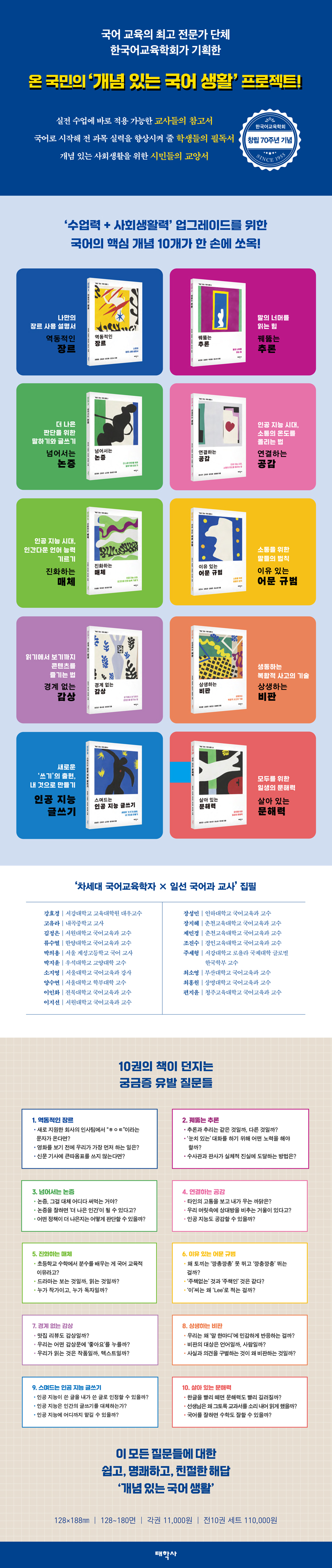
Korean Language Life with 'Concepts' (10 Volumes, Part 1)
"Conceptual Korean Language Life" is a publication by the Korean Language Education Society, Korea's first, best, and largest academic organization. To celebrate its 70th anniversary (launched as the "Korean Language Education Research Society" in 1955), the Society selects and publishes 20 of the most important "concepts" in Korean language education to summarize its academic achievements to date. The publication plan is to begin with the first 10 volumes in 2025, with the remaining 10 volumes to be completed in 2026.
This series was centered around the next generation of Korean language education scholars who will lead the Korean language education field and teachers who are leading the Korean language education field. It was planned with the goal of providing practical help not only to teachers and students in school education, but also to contribute to the language life of ordinary citizens by writing easy-to-understand content on the 'concepts' that are important in Korean language education.
How to develop empathy skills
Chapter 1 explores what empathy is and how it is possible to feel the feelings of others.
The authors argue that empathy is not simply a feeling, but a holistic engagement and practice that includes emotional empathy, cognitive empathy, and empathic consideration, starting from the reason why we shed tears at the sight of others' suffering. In this way, empathy expands into the ability to feel, think, and act from another's perspective.
The authors then explain that empathy is not a matter of the mind, but a scientific phenomenon related to the neural responses of the brain's "mirror neurons" that mirror the actions and emotions of others. The authors emphasize that empathy is not a simple biological reaction, but an ability that is learned and cultivated through education and social relationships.
Chapter 2 begins with how to relate to others based on empathy, then moves on to explain, step by step, how to overcome an era of hatred and disconnection through empathy, and how empathy is a condition for becoming a truly human being.
Here, Carl Rogers' 'empathic listening' and 'empathic responsive speaking' are presented as the core of conversation that reserves judgment and accepts others as they are.
However, the authors say that if empathy remains limited to one's own group, it can lead to exclusion and hatred, so the 'radius of empathy' must be expanded to include beings different from oneself.
Furthermore, in an era where artificial intelligence mimics emotions, it is emphasized that the unique human ability to empathize and act on the suffering of others is the beginning of ethics and the power to create a better world.
Chapter 3 explores how we can develop empathy in three areas: daily life, school, and work.
The authors argue that humans cannot remain human in isolation, and that empathy stems from our instinct to connect with others.
In everyday life, listening and nonverbal communication to understand others' emotions and experiences are the starting point of empathy, and in schools, it is said that relationships can be restored through respecting the other person's position in conflict situations and through empathic conversation training such as the "I-telling method."
In the workplace, it is suggested that a culture of empathy should be created through mutual respect and programs such as 'reverse mentoring' to narrow the gap in values between generations.
Korean Language Life with 'Concepts' (10 Volumes, Part 1)
"Conceptual Korean Language Life" is a publication by the Korean Language Education Society, Korea's first, best, and largest academic organization. To celebrate its 70th anniversary (launched as the "Korean Language Education Research Society" in 1955), the Society selects and publishes 20 of the most important "concepts" in Korean language education to summarize its academic achievements to date. The publication plan is to begin with the first 10 volumes in 2025, with the remaining 10 volumes to be completed in 2026.
This series was centered around the next generation of Korean language education scholars who will lead the Korean language education field and teachers who are leading the Korean language education field. It was planned with the goal of providing practical help not only to teachers and students in school education, but also to contribute to the language life of ordinary citizens by writing easy-to-understand content on the 'concepts' that are important in Korean language education.
GOODS SPECIFICS
- Date of issue: October 18, 2025
- Page count, weight, size: 132 pages | 128*188*20mm
- ISBN13: 9791168103832
- ISBN10: 1168103835
You may also like
카테고리
korean


korean

![ELLE 엘르 스페셜 에디션 A형 : 12월 [2025]](http://librairie.coreenne.fr/cdn/shop/files/b8e27a3de6c9538896439686c6b0e8fb.jpg?v=1766436872&width=3840)


