

Essential Python Examples for Science and Engineering Students 2
 |
Description
Book Introduction
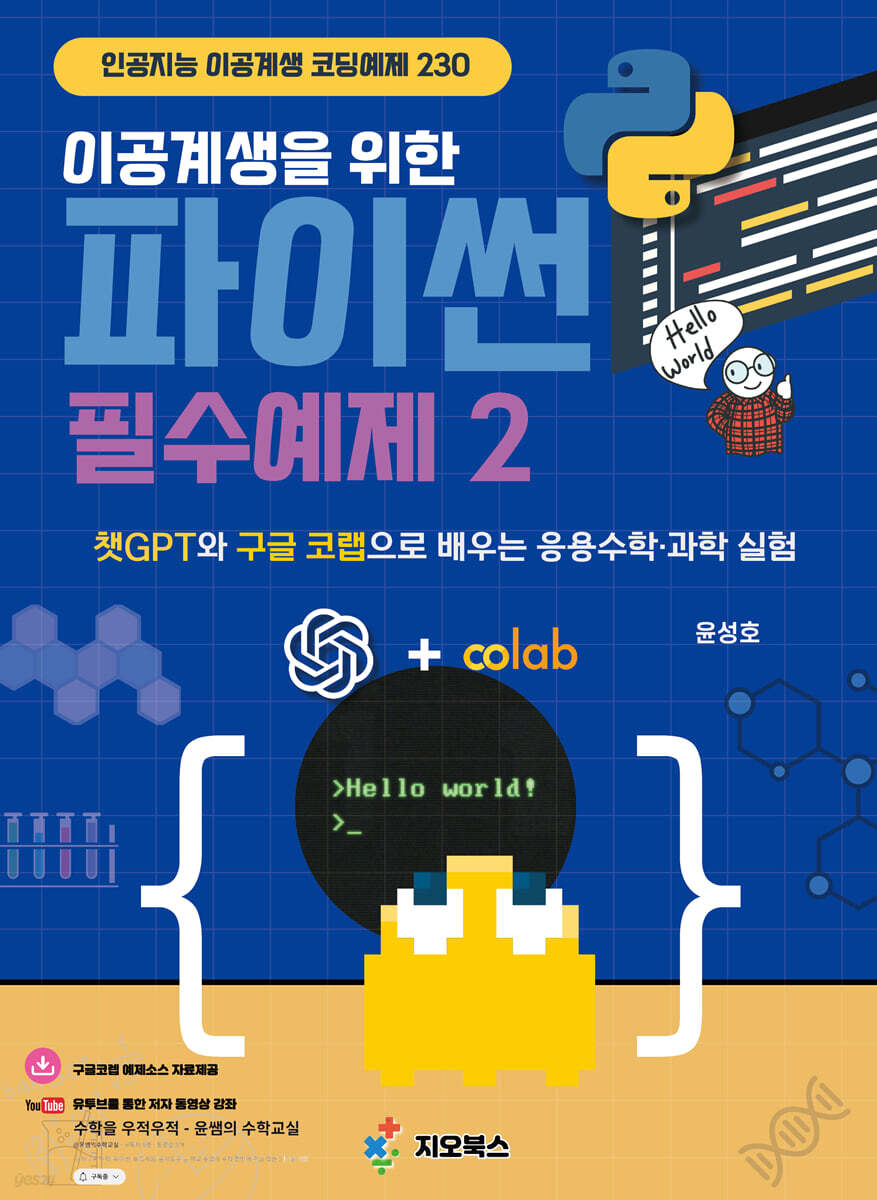
“Python Essential Examples for Science and Engineering Students 2 (Applied Mathematics and Science Experiments with ChatGPT and Google Colab)” is an in-depth coding lab book designed to help students experiment and visualize mathematics and science using Python, and develop integrated thinking and inquiry skills.
This book expands on the high school mathematics-focused experiments covered in Volume 1, and includes advanced mathematics topics such as number theory, fractal geometry, differential geometry, and differential equations. It also includes a wide range of physics, chemistry, biology, and earth science experiments covered in high school science curriculum.
It is based on Google Colaboratory, so you can practice anytime, anywhere on various devices such as laptops, tablets, and smartphones as long as you have an internet connection without any separate installation.
Part 3, 'Applied Mathematics Experiments', introduces various mathematical experiments, including shape visualization using ColabTurtlePlus and Plotly, number theory experiments, RSA encryption, curvature and torsion of space curves, vector analysis, theorems (Green's theorem and Stokes' theorem), and analytical and numerical approaches to differential equations.
Part 4, "Science Experiments," implements and visualizes core experimental content from high school science textbooks using Python code, making it practical for direct use in classes, research projects, and tax-related activities.
This book will benefit readers who:
- High school students who want to prepare for college math or experiment with advanced math concepts.
- Learners who want to implement math and science exploration topics directly through code.
- Teachers who need visual aids and simulation materials that can be used immediately in class.
- General public who wish to achieve integrated education in mathematics and science through programming
Each example is explained step-by-step, making it easy for even beginners to follow, and the structure that crosses theory and practice allows for a more vivid experience of math and science.
This book goes beyond a simple grammar-focused coding textbook; it's a guide optimized for visualizing, hands-on experimenting with, and deeply exploring complex concepts.
Python is not just a tool; it will become a language for implementing thinking for science and engineering students who will survive in the age of artificial intelligence.
This book expands on the high school mathematics-focused experiments covered in Volume 1, and includes advanced mathematics topics such as number theory, fractal geometry, differential geometry, and differential equations. It also includes a wide range of physics, chemistry, biology, and earth science experiments covered in high school science curriculum.
It is based on Google Colaboratory, so you can practice anytime, anywhere on various devices such as laptops, tablets, and smartphones as long as you have an internet connection without any separate installation.
Part 3, 'Applied Mathematics Experiments', introduces various mathematical experiments, including shape visualization using ColabTurtlePlus and Plotly, number theory experiments, RSA encryption, curvature and torsion of space curves, vector analysis, theorems (Green's theorem and Stokes' theorem), and analytical and numerical approaches to differential equations.
Part 4, "Science Experiments," implements and visualizes core experimental content from high school science textbooks using Python code, making it practical for direct use in classes, research projects, and tax-related activities.
This book will benefit readers who:
- High school students who want to prepare for college math or experiment with advanced math concepts.
- Learners who want to implement math and science exploration topics directly through code.
- Teachers who need visual aids and simulation materials that can be used immediately in class.
- General public who wish to achieve integrated education in mathematics and science through programming
Each example is explained step-by-step, making it easy for even beginners to follow, and the structure that crosses theory and practice allows for a more vivid experience of math and science.
This book goes beyond a simple grammar-focused coding textbook; it's a guide optimized for visualizing, hands-on experimenting with, and deeply exploring complex concepts.
Python is not just a tool; it will become a language for implementing thinking for science and engineering students who will survive in the age of artificial intelligence.
index
Part 3 Applied Mathematics Experiments
Chapter 6 Applied Mathematics (Number Theory, Differential Geometry, Fractal Shapes, etc.)
# Example 82.
Drawing a Square with ColabTurtlePlus 4
# Example 83.
Drawing String Art with ColabTurtlePlus (1) 6
# Example 84.
Drawing String Art with ColabTurtlePlus (2) 8
# Example 85.
Drawing String Art with ColabTurtlePlus (3) 10
# Example 86.
Drawing String Art with Plotly 12
# Example 87.
Drawing an n-gon with ColabTurtlePlus 16
# Example 88.
Koch Snowflake 18
# Example 89.
Pythagorean Tree 22
# Example 90.
Hilbert Curve 26
# Example 91.
Drawing the Sierpinski Triangle 30
# Example 92.
Mandelbrot Set Visualization 33
# Example 93.
Drawing a Cycloid Curve 37
# Example 94.
Drawing a Cycloid Curve (Animation Effect) 39
# Example 95.
Monte Carlo simulation (approximating pi by randomly scattering points within a circle) 43
# Example 96.
Creating a Pythagorean triangle (finding three pairs that satisfy the Pythagorean conditions for an integer triangle) 45
# Example 97.
Finding the greatest common divisor and least common multiple using the math library 46
# Example 98.
Finding the Greatest Common Divisor and Least Common Multiple Using Euclidean Algorithm 48
# Example 99.
Natural Number Division Experiment 49
# Example 100.
Confirming Goldbach's Conjecture 52
# Example 101.
Sieve of Eratosthenes (Finding Prime Numbers) 54
# Example 102.
Factorization 56
# Example 103.
Continued fraction 57
# Example 104.
Experiment 59 on the distribution of prime numbers
# Example 105.
Joint 62
# Example 106.
Solving the linear equation ax=b for modulo n 63
# Example 107.
Fibonacci Sequence Modular Pattern 65
# Example 108.
Extended Euclidean Algorithm (Solving Diophantine Equations) 67
# Example 109.
Chinese remainder theorem 70
# Example 110.
Computing the Euler Phi function (for all values in a range) 73
# Example 111.
Primitive root 75
# Example 112.
Index Theory 78
# Example 113. RSA Encryption Program 81
# Example 114. RSA Decryption Program 86
# Example 115.
Comparison of the Complexity of Sorting Algorithms 88
# Example 116.
Galey-Shapley Algorithm 94
# Example 117.
Spherical Coordinates, Rectangular Coordinates Conversion 99
# Example 118.
Conversion of orthogonal coordinates to 102
# Example 119.
Visualizing Frenay-Séré frames of spatial curves (T, N, B, curvature, torsion) 104
# Example 120.
Green Management 111
# Example 121.
Stokes' Theorem 116
# Example 122.
Solving Differential Equations Using sp.dsolve 121
# Example 123.
Comparison of analytical and numerical solutions of the differential equation y'=2xy (initial condition: y(0)=1) 124
Part 4 Science Experiments
Chapter 7 Physics Experiments
#Example 124.
Graph of uniformly accelerated motion 132
#Example 125.
Projectile Experiment (Parabolic Motion) 135
#Example 126.
Friction Experiment on an Inclined Surface 139
#Example 127.
Crash Test 143
#Example 128.
Spring Experiment 147
#Example 129.
Simple Pendulum Experiment 151
#Example 130.
Double Pendulum Simulation 153
#Example 131.
Three-Body Problem Simulation 158
#Example 132.
Faraday's Law of Electromagnetic Induction 163
#Example 133.
Image visualization using concave and convex lenses 165
#Example 134.
Brownian Motion Simulation 169
#Example 135.
Butterfly Effect (Lorenz System) 171
Chapter 8: Chemistry Experiments
#Example 136.
Helium Atomic Model 176
#Example 137.
Nitrogen Atomic Model 179
#Example 138.
Creating a Periodic Table Data File 181
#Example 139.
Search the periodic table by uploading the periodic_table.txt file 183
#Example 140. Generating and Visualizing Molecular Structures Using RDKit 187
#Example 141.
Compound Search Using the PubChem API 194
#Example 142.
3D Visualization of Structural Isomers 197
#Example 143.
Visualizing the Structural Isomers of Propanal and Acetone 201
#Example 144.
3D Visualization of Geometric Isomers 204
#Example 145.
Ideal Gas Equation (PV=nRT) Simulation 207
#Example 146.
Chemical Hartree Bock Experiment 209
Chapter 9: Biological Experiments
#Example 147. GC content calculation function 214
#Example 148. DNA Sequence Alignment and Similarity Analyzer 217
#Example 149.
Complementary and reverse complementary sequence generation functions 219
#Example 150. Program 222 to Convert DNA Base Sequences into RNA and Amino Acids
#Example 151.
Mendelian Genetic Probability Simulation 225
#Example 152.
Genotype and Phenotype Probability Calculator for a Single Trait 228
#Example 153.
Genotype and Phenotype Probability Calculator for Two Traits 230
#Example 154.
Two-Trait Genetic Combination Simulation Experiment 234
#Example 155.
Hardy-Weinberg Equilibrium Simulator 237
#Example 156.
Logistic curve 240
Chapter 10: Earth Science Experiments
#Example 157. Seismic Detection Using STA/LTA 245
#Example 158.
Kepler's Second Law 250
#Example 159.
Performance time difference 254
#Example 160.
Doppler Effect 257
#Example 161.
Korean Temperature Contour Map and Wind Direction Analysis Using Basemap 259
Chapter 6 Applied Mathematics (Number Theory, Differential Geometry, Fractal Shapes, etc.)
# Example 82.
Drawing a Square with ColabTurtlePlus 4
# Example 83.
Drawing String Art with ColabTurtlePlus (1) 6
# Example 84.
Drawing String Art with ColabTurtlePlus (2) 8
# Example 85.
Drawing String Art with ColabTurtlePlus (3) 10
# Example 86.
Drawing String Art with Plotly 12
# Example 87.
Drawing an n-gon with ColabTurtlePlus 16
# Example 88.
Koch Snowflake 18
# Example 89.
Pythagorean Tree 22
# Example 90.
Hilbert Curve 26
# Example 91.
Drawing the Sierpinski Triangle 30
# Example 92.
Mandelbrot Set Visualization 33
# Example 93.
Drawing a Cycloid Curve 37
# Example 94.
Drawing a Cycloid Curve (Animation Effect) 39
# Example 95.
Monte Carlo simulation (approximating pi by randomly scattering points within a circle) 43
# Example 96.
Creating a Pythagorean triangle (finding three pairs that satisfy the Pythagorean conditions for an integer triangle) 45
# Example 97.
Finding the greatest common divisor and least common multiple using the math library 46
# Example 98.
Finding the Greatest Common Divisor and Least Common Multiple Using Euclidean Algorithm 48
# Example 99.
Natural Number Division Experiment 49
# Example 100.
Confirming Goldbach's Conjecture 52
# Example 101.
Sieve of Eratosthenes (Finding Prime Numbers) 54
# Example 102.
Factorization 56
# Example 103.
Continued fraction 57
# Example 104.
Experiment 59 on the distribution of prime numbers
# Example 105.
Joint 62
# Example 106.
Solving the linear equation ax=b for modulo n 63
# Example 107.
Fibonacci Sequence Modular Pattern 65
# Example 108.
Extended Euclidean Algorithm (Solving Diophantine Equations) 67
# Example 109.
Chinese remainder theorem 70
# Example 110.
Computing the Euler Phi function (for all values in a range) 73
# Example 111.
Primitive root 75
# Example 112.
Index Theory 78
# Example 113. RSA Encryption Program 81
# Example 114. RSA Decryption Program 86
# Example 115.
Comparison of the Complexity of Sorting Algorithms 88
# Example 116.
Galey-Shapley Algorithm 94
# Example 117.
Spherical Coordinates, Rectangular Coordinates Conversion 99
# Example 118.
Conversion of orthogonal coordinates to 102
# Example 119.
Visualizing Frenay-Séré frames of spatial curves (T, N, B, curvature, torsion) 104
# Example 120.
Green Management 111
# Example 121.
Stokes' Theorem 116
# Example 122.
Solving Differential Equations Using sp.dsolve 121
# Example 123.
Comparison of analytical and numerical solutions of the differential equation y'=2xy (initial condition: y(0)=1) 124
Part 4 Science Experiments
Chapter 7 Physics Experiments
#Example 124.
Graph of uniformly accelerated motion 132
#Example 125.
Projectile Experiment (Parabolic Motion) 135
#Example 126.
Friction Experiment on an Inclined Surface 139
#Example 127.
Crash Test 143
#Example 128.
Spring Experiment 147
#Example 129.
Simple Pendulum Experiment 151
#Example 130.
Double Pendulum Simulation 153
#Example 131.
Three-Body Problem Simulation 158
#Example 132.
Faraday's Law of Electromagnetic Induction 163
#Example 133.
Image visualization using concave and convex lenses 165
#Example 134.
Brownian Motion Simulation 169
#Example 135.
Butterfly Effect (Lorenz System) 171
Chapter 8: Chemistry Experiments
#Example 136.
Helium Atomic Model 176
#Example 137.
Nitrogen Atomic Model 179
#Example 138.
Creating a Periodic Table Data File 181
#Example 139.
Search the periodic table by uploading the periodic_table.txt file 183
#Example 140. Generating and Visualizing Molecular Structures Using RDKit 187
#Example 141.
Compound Search Using the PubChem API 194
#Example 142.
3D Visualization of Structural Isomers 197
#Example 143.
Visualizing the Structural Isomers of Propanal and Acetone 201
#Example 144.
3D Visualization of Geometric Isomers 204
#Example 145.
Ideal Gas Equation (PV=nRT) Simulation 207
#Example 146.
Chemical Hartree Bock Experiment 209
Chapter 9: Biological Experiments
#Example 147. GC content calculation function 214
#Example 148. DNA Sequence Alignment and Similarity Analyzer 217
#Example 149.
Complementary and reverse complementary sequence generation functions 219
#Example 150. Program 222 to Convert DNA Base Sequences into RNA and Amino Acids
#Example 151.
Mendelian Genetic Probability Simulation 225
#Example 152.
Genotype and Phenotype Probability Calculator for a Single Trait 228
#Example 153.
Genotype and Phenotype Probability Calculator for Two Traits 230
#Example 154.
Two-Trait Genetic Combination Simulation Experiment 234
#Example 155.
Hardy-Weinberg Equilibrium Simulator 237
#Example 156.
Logistic curve 240
Chapter 10: Earth Science Experiments
#Example 157. Seismic Detection Using STA/LTA 245
#Example 158.
Kepler's Second Law 250
#Example 159.
Performance time difference 254
#Example 160.
Doppler Effect 257
#Example 161.
Korean Temperature Contour Map and Wind Direction Analysis Using Basemap 259
Publisher's Review
The 21st century is an era of artificial intelligence and data.
In this era, mathematical thinking and programming skills are no longer optional but essential.
The ability to logically solve problems, interpret data, and visualize experiments is becoming increasingly important not only in science and engineering but also in a variety of fields.
“Python Essential Examples for Science and Engineering Students 2 (Applied Mathematics and Science Experiments with ChatGPT and Google Colab)” was written to meet the needs of this era, aiming to be a coding lab book that implements and visualizes advanced mathematical concepts such as number theory, fractals, differential geometry, and differential equations, as well as experimental exploration activities in physics, chemistry, biology, and earth science, using Python.
This book is based on the Google Colaboratory environment, which allows you to run Python directly on the web without any separate installation.
Additionally, it is designed to allow practice on laptops, tablets, and smartphones, providing an environment where you can learn anytime, anywhere, regardless of location or equipment.
Even learners with little programming experience can follow each example and gradually acquire mathematical and scientific concepts. Even beginners to Python can naturally develop their coding skills through a variety of practical examples.
In particular, through this book, students can experience deeper exploration by directly experimenting and visualizing mathematical and scientific concepts they had previously only encountered in theory. They can also develop their own research topics and connect them to assignments or research activities.
Additionally, you will be able to experience both the joy of programming and the sense of accomplishment from problem solving through creative topics such as games, algorithms, cryptography, and simulations.
Teachers can also directly utilize the various examples in this book in their classes, providing students with vivid teaching materials and a visual experimental environment.
Even complex theories can be implemented directly in code and visually verified to increase students' interest and understanding.
I hope this book will serve as a guide for readers, offering clear reasons and practical directions for learning Python, beyond simple coding skills.
We invite you to begin an exciting journey of exploring concepts and experimenting with code together.
“This book is a friendly guide based on the high school curriculum, helping teachers create Python examples using ChatGPT and Google Collab, and easily teach mathematical modeling to students.
Detailed annotations are provided throughout the book so that even non-experts can follow along without difficulty, and you can download the example files included in the book and use them right away.
With this book, anyone can enrich their classes through hands-on practice with students in an easy and fun way.
This is a prompt guide that allows students to create their own Python examples using ChatGTP.”
In this era, mathematical thinking and programming skills are no longer optional but essential.
The ability to logically solve problems, interpret data, and visualize experiments is becoming increasingly important not only in science and engineering but also in a variety of fields.
“Python Essential Examples for Science and Engineering Students 2 (Applied Mathematics and Science Experiments with ChatGPT and Google Colab)” was written to meet the needs of this era, aiming to be a coding lab book that implements and visualizes advanced mathematical concepts such as number theory, fractals, differential geometry, and differential equations, as well as experimental exploration activities in physics, chemistry, biology, and earth science, using Python.
This book is based on the Google Colaboratory environment, which allows you to run Python directly on the web without any separate installation.
Additionally, it is designed to allow practice on laptops, tablets, and smartphones, providing an environment where you can learn anytime, anywhere, regardless of location or equipment.
Even learners with little programming experience can follow each example and gradually acquire mathematical and scientific concepts. Even beginners to Python can naturally develop their coding skills through a variety of practical examples.
In particular, through this book, students can experience deeper exploration by directly experimenting and visualizing mathematical and scientific concepts they had previously only encountered in theory. They can also develop their own research topics and connect them to assignments or research activities.
Additionally, you will be able to experience both the joy of programming and the sense of accomplishment from problem solving through creative topics such as games, algorithms, cryptography, and simulations.
Teachers can also directly utilize the various examples in this book in their classes, providing students with vivid teaching materials and a visual experimental environment.
Even complex theories can be implemented directly in code and visually verified to increase students' interest and understanding.
I hope this book will serve as a guide for readers, offering clear reasons and practical directions for learning Python, beyond simple coding skills.
We invite you to begin an exciting journey of exploring concepts and experimenting with code together.
“This book is a friendly guide based on the high school curriculum, helping teachers create Python examples using ChatGPT and Google Collab, and easily teach mathematical modeling to students.
Detailed annotations are provided throughout the book so that even non-experts can follow along without difficulty, and you can download the example files included in the book and use them right away.
With this book, anyone can enrich their classes through hands-on practice with students in an easy and fun way.
This is a prompt guide that allows students to create their own Python examples using ChatGTP.”
GOODS SPECIFICS
- Date of issue: October 1, 2025
- Page count, weight, size: 270 pages | 188*257*20mm
- ISBN13: 9791194145295
- ISBN10: 1194145299
You may also like
카테고리
korean


korean

![GQ KOREA Mark (Monthly): December [2025]](http://librairie.coreenne.fr/cdn/shop/files/8ef265dbbfbf186523ed75ba7319009d.jpg?v=1765340328&width=3840)


