

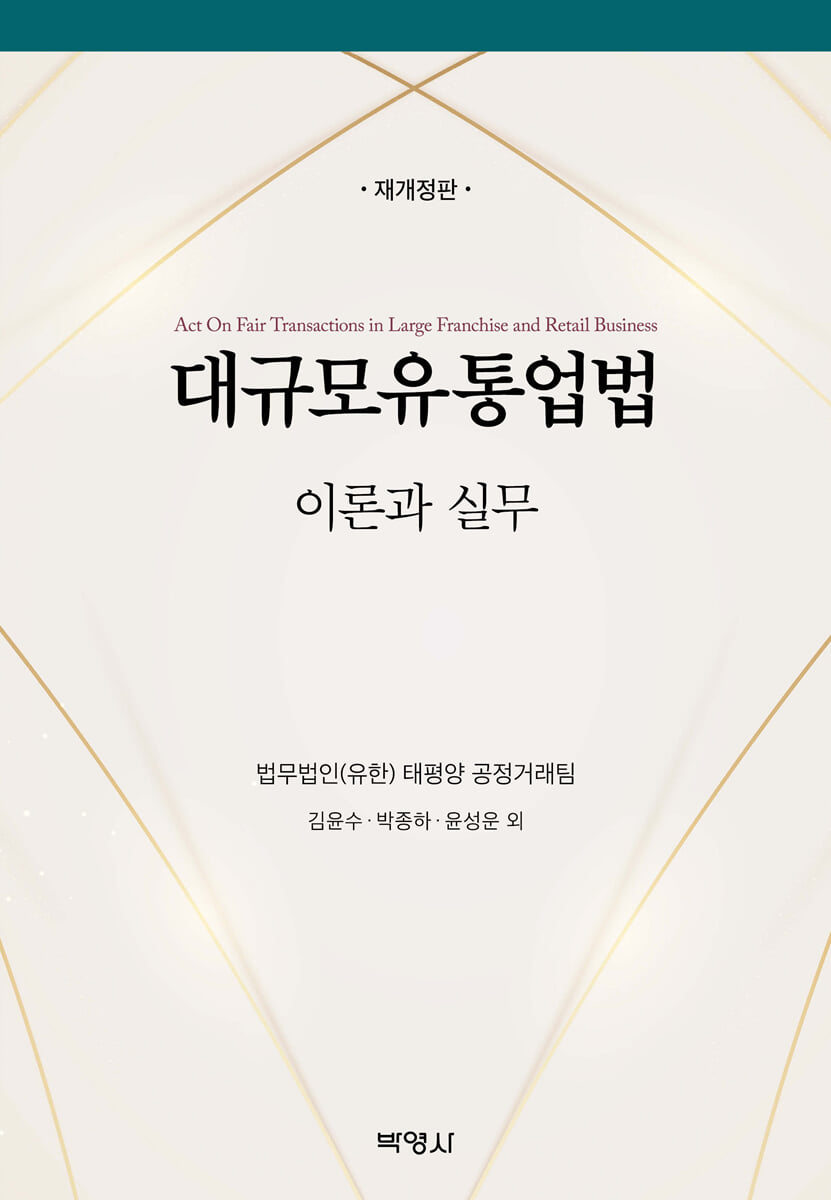
Large-Scale Distribution Business Act
 |
Description
index
Part 1 General
Chapter 1: Background and Circumstances of the Enactment of the Large-Scale Distribution Business Act 3
Chapter 2: Significance of the Enactment of the Large-Scale Distribution Business Act 7
Chapter 3: Status and Structure of the Large-Scale Distribution Business Act in the Legal System 12
1.
Introduction 12
2.
Relationship with the Constitution 12
3.
Relationship with the Fair Trade Act 13
4.
Relationship with General Civil Law 14
5.
Composition of the Large-Scale Distribution Business Act 15
Part 2: Theory and Cases of Large-Scale Distribution Business Act
Part 1 General Theory
Chapter 1 General Provisions 20
1.
Purpose of the Large-Scale Distribution Business Act 20
2.
Definition of Terms 21
go.
Large-scale distributor 21
me.
Supplier 25
all.
Direct Purchase Transaction 27
la.
Special Purchase Transaction 33
mind.
Above? Trust Transaction 43
bar.
Store Tenant 48
buy.
Return 51
ah.
Sales Promotion Event 52
ruler.
Sales incentive 55
car.
Fresh agricultural, fishery, and livestock products 64
Chapter 2 Scope of Application of the Large-Scale Distribution Business Act 66
1.
Exclusion from the Large-Scale Distribution Business Act 66
go.
Overview 66
me.
Fair Trade Commission and Court Positions on Exemptions from the Application of the Law 67
all.
Legislative Theory: The Need for Amendment to Article 3 of the Act 70
2.
Relationship between the Large-Scale Distribution Business Act and Other Laws 73
Part 2: Fair Transaction System in Large-Scale Distribution
Chapter 1: Principle of Good Faith 78
Chapter 2 Obligation to Issue Written Documents and Preserve Documents 80
1.
Introduction 80
go.
Overview 80
me.
The purpose of the system 81
2.
Obligation to provide written notice immediately upon conclusion of contract 85
go.
Overview 85
me.
Requirements for Written Delivery Obligation 85
all.
Related Issues - 93 in case of contract changes, renewals, etc.
la.
99 Format requirements for documents to be issued
mind.
Written information 102
bar.
Legal Effects of Non-delivery of Written Documents Immediately Upon Conclusion of Contract 123
buy.
Related Case 124
3.
Prohibition on requiring suppliers to prepare before issuing written documents 126
go.
Overview 126
me.
Contents of the system 127
all.
Exception 130 to the prohibition on requiring suppliers to prepare prior to delivery of written documents
4.
System 131 for requesting confirmation of contract details from suppliers, etc.
go.
Overview 131
me.
Timing of request for confirmation of contract contents 132
all.
Verification Request Target 134
la.
Effect of Confirmation Request 134
mind.
Method of Notification and Response 136
5.
Obligation to preserve documents 137
go.
Overview 137
me.
Subject and period of document preservation obligation 138
all.
Documents subject to preservation obligation 139
la.
Methods of Preserving Documents 148
6.
Recommendations for drafting and using a standard transaction contract 150
7.
Effects of Violation of Obligation to Deliver Documents and Preserve Documents 150
go.
Legal Effect 150
me.
Administrative sanctions 151
Chapter 3 Prohibition of Reduction in Product Price 153
1.
Introduction 153
2.
Prohibition of reduction in price for delivered goods 154
go.
Overview 154
me.
154 'delivered' goods
all.
Product 'price' 155
la.
Reduction of the deposit 156
3.
Reasons for Allowing Exceptional Payment Reduction 158
go.
Overview 158
me.
Content requirements 159
all.
Periodic requirement 162
4.
Scope of reduction 164
5.
Obligation to preserve related documents 164
6.
Effects of Violating the Prohibition on Reducing Product Prices 165
go.
Legal Effect 165
me.
Administrative sanctions 165
7.
Related Case 167
Chapter 4 Obligation to Comply with Payment Deadlines for Product Sales 170
1.
Introduction 170
2.
Statutory payment date for product sales, etc. 171
go.
Overview 171
me.
Transaction Type 172
all.
Statutory payment due date for product sales, etc. 174
la.
Related Issue 178
3.
Payment method for product sales, etc. 181
go.
Principle of Payment 181
me.
Permission for Set-off 183
all.
183 Permission to pay for product sales by promissory note
la.
Application to payment for direct purchase transactions 185
4.
Interest Payment Obligation of Large-Scale Retailers 185
5.
Obligation to preserve related documents 186
6.
Effects of Violation of Obligation to Comply with Payment Deadlines for Product Sales, etc. 186
go.
Legal Effect 186
me.
Administrative sanctions 187
7.
Related Case 189
Chapter 5: Refusal to Accept Goods? Prohibition of Delay 193
1.
Introduction 193
2.
Systemic Problems with This Provision 194
3.
Refusal of Receipt? Principle Prohibition of Delay 195
go.
Overview 195
me.
Refusal or delay in receipt 195
all.
Refusal to Accept? Prerequisite for Delay 196
4.
Refusal of Receipt? Exception to Prohibition of Delay 198
go.
If the delivered product is damaged due to a cause attributable to the supplier (No. 1) 199
me.
If the delivered product is defective (No. 2) 199
all.
If the delivered product is different from the product ordered by the large-scale distributor (No. 3) 199
la.
If a product is sold intensively for a certain period of time and delivered after that period (No. 4) 200
mind.
In addition, if there is a legitimate reason for a large-scale distributor to delay or refuse to receive the product for reasons similar to those in Articles 1 through 4 (Article 5) 200
5.
Duty to preserve related documents 201
6.
Refusal to Accept Goods? Consequences of Violating the Prohibition of Delay Regulations 201
go.
Legal Effect 201
me.
Administrative Sanctions 202
Chapter 6 Prohibition on Return of Goods 204
1.
Introduction 204
2.
206 Prohibition on return of delivered goods
go.
Overview 206
me.
Received goods 206
all.
Return of all or part 207
3.
Exceptional Return Allowance Reasons 208
go.
Overview 208
me.
The Meaning of 'Just Cause' and the Presumption of Just Cause 208
all.
Content requirements 209
la.
Time Requirement - Returns must be made within a time period deemed reasonable in the relevant trade area. 229
4.
Obligation to prepare and preserve related documents 234
5.
Effects of Violating the Prohibition on Return of Goods 234
go.
Legal Effect 234
me.
Administrative Sanctions 235
6.
Related Case 236
Chapter 7 Prohibition on Passing on Sales Promotion Costs 241
1.
Introduction 241
2.
Sharing of sales promotion costs 243
go.
Overview 243
me.
Scope 243
all.
Sales promotion expenses - costs incurred for sales promotion events 245
la.
Agreement on the Burden of Sales Promotion Costs 252
mind.
Legal Restrictions on Sales Promotion Cost Sharing Agreements 261
bar.
Prior written agreement and delivery 266
3.
Exception to the Principle of Sharing Sales Promotion Costs 267
go.
Overview 267
me.
Requirements for Recognition of Exceptions to the Principle of Sharing Sales Promotion Costs 267
all.
Legislative Theory: The Need to Relax Discrimination and Voluntariness Requirements 276
4.
Obligation to preserve related documents 279
5.
Effects of Violating the Prohibition on Shifting the Burden of Sales Promotion Costs 279
go.
Legal Effect 279
me.
Administrative sanctions 279
7.
Related Case 282
Chapter 8 Prohibition on Employment of Employees by Suppliers and Transfer of Labor Costs 287
1.
Introduction 287
2.
289 In principle, prohibition on the use of employees of suppliers, etc.
go.
Overview 289
me.
The meaning of 'employees, etc.' 290
all.
291. The principle prohibition of working at large-scale retail establishments.
3.
Exception 292 to the prohibition on the use of employees of suppliers, etc.
go.
Overview 292
me.
Reasons for Permitting the Dispatch of Employees, etc. (Article 12, Paragraph 1 of the Act) 292
all.
298 Prior agreement regarding dispatch of employees, etc.
la.
Formal requirements for dispatching employees, etc. 303
mind.
Limits to the scope of work of dispatched employees, etc. 304
bar.
Issues regarding the application of the law to sales promotion events using dispatched employees, etc. (whether Articles 11 and 12 of the Act apply concurrently) 308
309. Whether Article 12 of the Large-Scale Distribution Business Act applies to the appearance of supporting actors hired by suppliers in TV home shopping broadcasts.
4.
311 Prohibition on Large-Scale Retailers from Passing on Labor Costs to Employees Directly Hired
go.
Overview 311
me.
Legislative Theory Problem 311
5.
Obligation to preserve related documents 312
6.
Effects of Violation of the Prohibition on Employment of Employees by Suppliers, etc. 312
go.
Legal Effect 312
me.
Administrative Sanctions 313
7.
Related Case 315
8.
Related Matters - Issues under Labor-Related Laws Regarding the Dispatch of Employees, etc. 318
Chapter 9 Prohibition of Forced Exclusive Transactions 323
1.
Introduction 323
2.
Prohibition of forced exclusive transactions, etc. 324
go.
Scope 324
me.
Prohibition of Acts That 'Encourage Exclusive Transactions' 324
all.
Prohibition of acts that 'interfere with transactions with other businesses' 326
la.
The Existence of 'Unfairness' 327
3.
Effects of Violation of Prohibition of Exclusive Transaction Force, etc. 330
go.
Legal Effect 330
me.
Sanctions for Violations 330
4.
Related Case 332
Chapter 10: Prohibition on Requests for Management Information and Prohibition on Management Interference 336
1.
Introduction 336
2.
Prohibition of Unfair Requests for Management Information 341
go.
Overview 341
me.
Prohibition on 'requests' for management information provision 342
all.
The 'counterparty' in the request for management information 344
la.
Information 344 prohibited from being provided
mind.
Criteria for Determining the Unreasonableness of a Request for Information 348
bar.
Obligation to request prior written information 354
3.
Prohibition of Interference in Business Activities 357
go.
Overview 357
me.
Prohibition of acts of interfering with business activities directly or through affiliates or other business operators by unfairly abusing one's trading position 358
all.
Types or criteria for interference with business activities 362
4.
Sanctions for Violating the Prohibition on Requests for Management Information and the Prohibition on Management Interference 372
go.
Burden of Proof 372
me.
Corrective Action 373
all.
and fine 374
la.
Criminal Punishment 375
5.
Related Case 376
Chapter 11 Prohibition on Demanding Economic Benefits 387
1.
Introduction 387
2.
The principle of prohibition of demanding economic benefits 389
3.
Exception to the Prohibition on Demanding Economic Benefits: Existence of Justifiable Reasons 392
4.
Sales incentive 393
go.
Overview 393
me.
Interpretation of the application system of related provisions 394
all.
Legal requirements for receiving sales incentives under Article 15, Paragraph 2 of the Act 396
5.
Sanctions for Violating the Prohibition on Demanding Economic Benefits 407
go.
Burden of Proof 407
me.
Corrective Action 407
all.
and fine 408
6.
Related Case 409
Chapter 12 Obligation to Compensate for Store Equipment Costs 419
1.
Introduction 419
2.
Comparison with the previous system 420
3.
Obligation of Large-Scale Retailers to Compensate for Existing Store Equipment Costs 421
go.
Requirements for the occurrence of compensation obligations 421
me.
Compensation for Large-Scale Distributors 434
4.
Boron: The Problem of Double Compensation Due to Sharing of New Equipment Costs 434
5.
Effects of Breach of Obligation to Compensate for Store Equipment Costs 438
go.
Legal Effect 438
me.
Administrative Sanctions 439
Chapter 13 Prohibition of Unfair Restrictions on Business Hours 441
1.
Introduction 441
2.
Establishment Requirement 443
go.
Overview 443
me.
443 Store tenants and those who have received sales consignments from store tenants
all.
Unfairly restricting business hours by refusing to shorten business hours to the minimum extent necessary due to the onset of illness and treatment of the store tenant. 446
3.
Effects of Violating the Prohibition on Unfair Business Hours 448
go.
Legal Effect 448
me.
Administrative Sanctions 449
Chapter 14 Prohibition of Acts Providing Disadvantages 452
1.
Introduction 452
2.
Prohibition of Acts of Providing Disadvantages 452
go.
Overview 452
me.
Disadvantage provision 453
all.
Just cause 454
la.
Relationship with Article 15 of the Large-Scale Distribution Business Act 454
3.
Type 455 of Prohibited Acts
go.
Act of purchasing gift certificates or goods (No. 1) 455
me.
Act of supplying goods at a price significantly lower than the normal market price (No. 2) 462
all.
Act of delivering a quantity significantly greater than the normal delivery quantity in order to conduct a sales promotion event (No. 3) 466
la.
Act of forcing suppliers, etc. to participate in sales promotion events against their will (No. 4) 469
mind.
An act of not restoring the agreed upon temporary reduction in the delivery price to the regular price or delaying the restoration even after the deadline has passed (No. 5) 473
bar.
Act of advertising the products of a supplier, etc. against the will of the supplier, etc. (No. 6) 476
buy.
Acts of preventing vendors from leaving a certain store or forcing vendors to enter another store against their will (No. 7) 479
ah.
Act of changing the location, area, or facilities of a supplier's store during the contract period (No. 8) 482
ruler.
Act of changing contract terms and conditions, such as the ratio of sales incentives during the contract period, as prescribed by Presidential Decree (No. 9) 490
car.
Any other act that causes disadvantages or provides benefits to suppliers, etc. (No. 10) 496
4.
Effects of Violation of Prohibition of Providing Disadvantages 504
go.
Legal Effect 504
me.
Administrative Sanctions 504
Chapter 15 Prohibition of Retaliatory Measures 507
1.
Book 507
2.
Prohibition of retaliatory measures 508
go.
Existence of Fair Trade Commission reports, etc. 508
me.
509 Reasons for reporting to the Fair Trade Commission, etc.
3.
Effects of Violating the Prohibition of Retaliation Regulation 511
go.
Legal Effect 511
me.
Sanctions 511
Chapter 16: Agreement System between Large-Scale Distributors and Suppliers 514
1.
Book 514
2.
Convention Recommendation System 515
go.
Overview 515
me.
Purpose of the Agreement Evaluation Criteria and the Nature of the Agreement 515
all.
Parties to the Agreement 516
la.
Contents of the Agreement 516
mind.
Agreement Period and Procedures 519
3.
Fair Trade Commission's Support and Implementation Evaluation 520
go.
Fair Trade Commission Support General 520
me.
Performance Evaluation and Incentives 521
4.
Other Matters 526
go.
Protection of Trade Secrets 526
me.
Special Provisions on Unfair Trade Practices 526
all.
Measures against submission of false information, etc. 527
Part 3 Enforcement of the Large-Scale Distribution Business Act and Regulation of Violations of the Act
Chapter 1: Dispute Resolution 531
1.
Introduction 531
2.
531 Subjects of Mediation by the Dispute Mediation Council
3.
532. Composition of the Dispute Resolution Council
go.
Composition, Qualifications, and Appointment of Dispute Mediation Council Members 532
me.
Disqualification, avoidance, and evasion of committee members 533
all.
Dispute Resolution Council Meeting 533
4.
Adjustment Procedure 534
go.
Beginning of the Adjustment 534
me.
Dismissal of the application for adjustment 536
all.
Progress of the adjustment procedure 536
la.
Conclusion of the conciliation process 537
mind.
Actions after the conclusion of the mediation process 538
Chapter 2 Investigation and Disposition of Violations of the Law 540
1.
Investigation of Violations of the Law 540
go.
Incident awareness 540
me.
Notification of Investigation Results 541
all.
Written Survey 541
2.
Disposition of Businesses Violating the Law 541
go.
541. Point of Judgment for Violation of Law
me.
Administrative Sanctions 542
all.
Motion No. 553
la.
Criminal Sanctions 556
mind.
Fine 558
3.
Other 560
go.
Cooperation of heads of relevant organizations 560
me.
Application of the Fair Trade Act 560
all.
Report Reward System 560
Chapter 3 Compensation Procedures 563
1.
Introduction 563
2.
Procedure for claiming damages 563
go.
Party 563
me.
Jurisdiction Court 564
all.
Special Rules on Evidence Investigation Methods 564
3.
Requirements for Establishing a Claim for Damages 564
go.
Existence of Violations of the Law 564
me.
Occurrence of damage and amount of damage 565
all.
The Existence of Causality 568
la.
Intentional? Negligence 568
mind.
Statute of limitations 568
Appendix
1.
Act on Fair Transactions in Large-Scale Distribution Industry Article 575
2.
Enforcement Decree of the Act on Fair Transactions in Large-Scale Distribution Industry Article 594
3. Guidelines for Examining the Illegality of Certain Unfair Trade Practices by TV Home Shopping Businesses 604
4.
Guideline 612 on the Dispatch and Use of Employees by Suppliers, etc. in the Large-Scale Distribution Industry
5.
Guideline 620 on the Examination of Unfairness of Sales Promotion Funds in the Large-Scale Distribution Industry
6.
Guidelines for Examining the Unfairness of Special Purchase Transactions in Large-Scale Distribution Industries 627
7.
Guidelines for Examining the Illegality of Returns by Large-Scale Retailers 638
8.
Guidelines for Reviewing Unfair Trade Practices of Online Shopping Mall Operators 648
9.
Notice No. 671 on the Standards for Imposing Fines on Businesses Violating the Large-Scale Distribution Business Act
Reference 683
Index 687
Chapter 1: Background and Circumstances of the Enactment of the Large-Scale Distribution Business Act 3
Chapter 2: Significance of the Enactment of the Large-Scale Distribution Business Act 7
Chapter 3: Status and Structure of the Large-Scale Distribution Business Act in the Legal System 12
1.
Introduction 12
2.
Relationship with the Constitution 12
3.
Relationship with the Fair Trade Act 13
4.
Relationship with General Civil Law 14
5.
Composition of the Large-Scale Distribution Business Act 15
Part 2: Theory and Cases of Large-Scale Distribution Business Act
Part 1 General Theory
Chapter 1 General Provisions 20
1.
Purpose of the Large-Scale Distribution Business Act 20
2.
Definition of Terms 21
go.
Large-scale distributor 21
me.
Supplier 25
all.
Direct Purchase Transaction 27
la.
Special Purchase Transaction 33
mind.
Above? Trust Transaction 43
bar.
Store Tenant 48
buy.
Return 51
ah.
Sales Promotion Event 52
ruler.
Sales incentive 55
car.
Fresh agricultural, fishery, and livestock products 64
Chapter 2 Scope of Application of the Large-Scale Distribution Business Act 66
1.
Exclusion from the Large-Scale Distribution Business Act 66
go.
Overview 66
me.
Fair Trade Commission and Court Positions on Exemptions from the Application of the Law 67
all.
Legislative Theory: The Need for Amendment to Article 3 of the Act 70
2.
Relationship between the Large-Scale Distribution Business Act and Other Laws 73
Part 2: Fair Transaction System in Large-Scale Distribution
Chapter 1: Principle of Good Faith 78
Chapter 2 Obligation to Issue Written Documents and Preserve Documents 80
1.
Introduction 80
go.
Overview 80
me.
The purpose of the system 81
2.
Obligation to provide written notice immediately upon conclusion of contract 85
go.
Overview 85
me.
Requirements for Written Delivery Obligation 85
all.
Related Issues - 93 in case of contract changes, renewals, etc.
la.
99 Format requirements for documents to be issued
mind.
Written information 102
bar.
Legal Effects of Non-delivery of Written Documents Immediately Upon Conclusion of Contract 123
buy.
Related Case 124
3.
Prohibition on requiring suppliers to prepare before issuing written documents 126
go.
Overview 126
me.
Contents of the system 127
all.
Exception 130 to the prohibition on requiring suppliers to prepare prior to delivery of written documents
4.
System 131 for requesting confirmation of contract details from suppliers, etc.
go.
Overview 131
me.
Timing of request for confirmation of contract contents 132
all.
Verification Request Target 134
la.
Effect of Confirmation Request 134
mind.
Method of Notification and Response 136
5.
Obligation to preserve documents 137
go.
Overview 137
me.
Subject and period of document preservation obligation 138
all.
Documents subject to preservation obligation 139
la.
Methods of Preserving Documents 148
6.
Recommendations for drafting and using a standard transaction contract 150
7.
Effects of Violation of Obligation to Deliver Documents and Preserve Documents 150
go.
Legal Effect 150
me.
Administrative sanctions 151
Chapter 3 Prohibition of Reduction in Product Price 153
1.
Introduction 153
2.
Prohibition of reduction in price for delivered goods 154
go.
Overview 154
me.
154 'delivered' goods
all.
Product 'price' 155
la.
Reduction of the deposit 156
3.
Reasons for Allowing Exceptional Payment Reduction 158
go.
Overview 158
me.
Content requirements 159
all.
Periodic requirement 162
4.
Scope of reduction 164
5.
Obligation to preserve related documents 164
6.
Effects of Violating the Prohibition on Reducing Product Prices 165
go.
Legal Effect 165
me.
Administrative sanctions 165
7.
Related Case 167
Chapter 4 Obligation to Comply with Payment Deadlines for Product Sales 170
1.
Introduction 170
2.
Statutory payment date for product sales, etc. 171
go.
Overview 171
me.
Transaction Type 172
all.
Statutory payment due date for product sales, etc. 174
la.
Related Issue 178
3.
Payment method for product sales, etc. 181
go.
Principle of Payment 181
me.
Permission for Set-off 183
all.
183 Permission to pay for product sales by promissory note
la.
Application to payment for direct purchase transactions 185
4.
Interest Payment Obligation of Large-Scale Retailers 185
5.
Obligation to preserve related documents 186
6.
Effects of Violation of Obligation to Comply with Payment Deadlines for Product Sales, etc. 186
go.
Legal Effect 186
me.
Administrative sanctions 187
7.
Related Case 189
Chapter 5: Refusal to Accept Goods? Prohibition of Delay 193
1.
Introduction 193
2.
Systemic Problems with This Provision 194
3.
Refusal of Receipt? Principle Prohibition of Delay 195
go.
Overview 195
me.
Refusal or delay in receipt 195
all.
Refusal to Accept? Prerequisite for Delay 196
4.
Refusal of Receipt? Exception to Prohibition of Delay 198
go.
If the delivered product is damaged due to a cause attributable to the supplier (No. 1) 199
me.
If the delivered product is defective (No. 2) 199
all.
If the delivered product is different from the product ordered by the large-scale distributor (No. 3) 199
la.
If a product is sold intensively for a certain period of time and delivered after that period (No. 4) 200
mind.
In addition, if there is a legitimate reason for a large-scale distributor to delay or refuse to receive the product for reasons similar to those in Articles 1 through 4 (Article 5) 200
5.
Duty to preserve related documents 201
6.
Refusal to Accept Goods? Consequences of Violating the Prohibition of Delay Regulations 201
go.
Legal Effect 201
me.
Administrative Sanctions 202
Chapter 6 Prohibition on Return of Goods 204
1.
Introduction 204
2.
206 Prohibition on return of delivered goods
go.
Overview 206
me.
Received goods 206
all.
Return of all or part 207
3.
Exceptional Return Allowance Reasons 208
go.
Overview 208
me.
The Meaning of 'Just Cause' and the Presumption of Just Cause 208
all.
Content requirements 209
la.
Time Requirement - Returns must be made within a time period deemed reasonable in the relevant trade area. 229
4.
Obligation to prepare and preserve related documents 234
5.
Effects of Violating the Prohibition on Return of Goods 234
go.
Legal Effect 234
me.
Administrative Sanctions 235
6.
Related Case 236
Chapter 7 Prohibition on Passing on Sales Promotion Costs 241
1.
Introduction 241
2.
Sharing of sales promotion costs 243
go.
Overview 243
me.
Scope 243
all.
Sales promotion expenses - costs incurred for sales promotion events 245
la.
Agreement on the Burden of Sales Promotion Costs 252
mind.
Legal Restrictions on Sales Promotion Cost Sharing Agreements 261
bar.
Prior written agreement and delivery 266
3.
Exception to the Principle of Sharing Sales Promotion Costs 267
go.
Overview 267
me.
Requirements for Recognition of Exceptions to the Principle of Sharing Sales Promotion Costs 267
all.
Legislative Theory: The Need to Relax Discrimination and Voluntariness Requirements 276
4.
Obligation to preserve related documents 279
5.
Effects of Violating the Prohibition on Shifting the Burden of Sales Promotion Costs 279
go.
Legal Effect 279
me.
Administrative sanctions 279
7.
Related Case 282
Chapter 8 Prohibition on Employment of Employees by Suppliers and Transfer of Labor Costs 287
1.
Introduction 287
2.
289 In principle, prohibition on the use of employees of suppliers, etc.
go.
Overview 289
me.
The meaning of 'employees, etc.' 290
all.
291. The principle prohibition of working at large-scale retail establishments.
3.
Exception 292 to the prohibition on the use of employees of suppliers, etc.
go.
Overview 292
me.
Reasons for Permitting the Dispatch of Employees, etc. (Article 12, Paragraph 1 of the Act) 292
all.
298 Prior agreement regarding dispatch of employees, etc.
la.
Formal requirements for dispatching employees, etc. 303
mind.
Limits to the scope of work of dispatched employees, etc. 304
bar.
Issues regarding the application of the law to sales promotion events using dispatched employees, etc. (whether Articles 11 and 12 of the Act apply concurrently) 308
309. Whether Article 12 of the Large-Scale Distribution Business Act applies to the appearance of supporting actors hired by suppliers in TV home shopping broadcasts.
4.
311 Prohibition on Large-Scale Retailers from Passing on Labor Costs to Employees Directly Hired
go.
Overview 311
me.
Legislative Theory Problem 311
5.
Obligation to preserve related documents 312
6.
Effects of Violation of the Prohibition on Employment of Employees by Suppliers, etc. 312
go.
Legal Effect 312
me.
Administrative Sanctions 313
7.
Related Case 315
8.
Related Matters - Issues under Labor-Related Laws Regarding the Dispatch of Employees, etc. 318
Chapter 9 Prohibition of Forced Exclusive Transactions 323
1.
Introduction 323
2.
Prohibition of forced exclusive transactions, etc. 324
go.
Scope 324
me.
Prohibition of Acts That 'Encourage Exclusive Transactions' 324
all.
Prohibition of acts that 'interfere with transactions with other businesses' 326
la.
The Existence of 'Unfairness' 327
3.
Effects of Violation of Prohibition of Exclusive Transaction Force, etc. 330
go.
Legal Effect 330
me.
Sanctions for Violations 330
4.
Related Case 332
Chapter 10: Prohibition on Requests for Management Information and Prohibition on Management Interference 336
1.
Introduction 336
2.
Prohibition of Unfair Requests for Management Information 341
go.
Overview 341
me.
Prohibition on 'requests' for management information provision 342
all.
The 'counterparty' in the request for management information 344
la.
Information 344 prohibited from being provided
mind.
Criteria for Determining the Unreasonableness of a Request for Information 348
bar.
Obligation to request prior written information 354
3.
Prohibition of Interference in Business Activities 357
go.
Overview 357
me.
Prohibition of acts of interfering with business activities directly or through affiliates or other business operators by unfairly abusing one's trading position 358
all.
Types or criteria for interference with business activities 362
4.
Sanctions for Violating the Prohibition on Requests for Management Information and the Prohibition on Management Interference 372
go.
Burden of Proof 372
me.
Corrective Action 373
all.
and fine 374
la.
Criminal Punishment 375
5.
Related Case 376
Chapter 11 Prohibition on Demanding Economic Benefits 387
1.
Introduction 387
2.
The principle of prohibition of demanding economic benefits 389
3.
Exception to the Prohibition on Demanding Economic Benefits: Existence of Justifiable Reasons 392
4.
Sales incentive 393
go.
Overview 393
me.
Interpretation of the application system of related provisions 394
all.
Legal requirements for receiving sales incentives under Article 15, Paragraph 2 of the Act 396
5.
Sanctions for Violating the Prohibition on Demanding Economic Benefits 407
go.
Burden of Proof 407
me.
Corrective Action 407
all.
and fine 408
6.
Related Case 409
Chapter 12 Obligation to Compensate for Store Equipment Costs 419
1.
Introduction 419
2.
Comparison with the previous system 420
3.
Obligation of Large-Scale Retailers to Compensate for Existing Store Equipment Costs 421
go.
Requirements for the occurrence of compensation obligations 421
me.
Compensation for Large-Scale Distributors 434
4.
Boron: The Problem of Double Compensation Due to Sharing of New Equipment Costs 434
5.
Effects of Breach of Obligation to Compensate for Store Equipment Costs 438
go.
Legal Effect 438
me.
Administrative Sanctions 439
Chapter 13 Prohibition of Unfair Restrictions on Business Hours 441
1.
Introduction 441
2.
Establishment Requirement 443
go.
Overview 443
me.
443 Store tenants and those who have received sales consignments from store tenants
all.
Unfairly restricting business hours by refusing to shorten business hours to the minimum extent necessary due to the onset of illness and treatment of the store tenant. 446
3.
Effects of Violating the Prohibition on Unfair Business Hours 448
go.
Legal Effect 448
me.
Administrative Sanctions 449
Chapter 14 Prohibition of Acts Providing Disadvantages 452
1.
Introduction 452
2.
Prohibition of Acts of Providing Disadvantages 452
go.
Overview 452
me.
Disadvantage provision 453
all.
Just cause 454
la.
Relationship with Article 15 of the Large-Scale Distribution Business Act 454
3.
Type 455 of Prohibited Acts
go.
Act of purchasing gift certificates or goods (No. 1) 455
me.
Act of supplying goods at a price significantly lower than the normal market price (No. 2) 462
all.
Act of delivering a quantity significantly greater than the normal delivery quantity in order to conduct a sales promotion event (No. 3) 466
la.
Act of forcing suppliers, etc. to participate in sales promotion events against their will (No. 4) 469
mind.
An act of not restoring the agreed upon temporary reduction in the delivery price to the regular price or delaying the restoration even after the deadline has passed (No. 5) 473
bar.
Act of advertising the products of a supplier, etc. against the will of the supplier, etc. (No. 6) 476
buy.
Acts of preventing vendors from leaving a certain store or forcing vendors to enter another store against their will (No. 7) 479
ah.
Act of changing the location, area, or facilities of a supplier's store during the contract period (No. 8) 482
ruler.
Act of changing contract terms and conditions, such as the ratio of sales incentives during the contract period, as prescribed by Presidential Decree (No. 9) 490
car.
Any other act that causes disadvantages or provides benefits to suppliers, etc. (No. 10) 496
4.
Effects of Violation of Prohibition of Providing Disadvantages 504
go.
Legal Effect 504
me.
Administrative Sanctions 504
Chapter 15 Prohibition of Retaliatory Measures 507
1.
Book 507
2.
Prohibition of retaliatory measures 508
go.
Existence of Fair Trade Commission reports, etc. 508
me.
509 Reasons for reporting to the Fair Trade Commission, etc.
3.
Effects of Violating the Prohibition of Retaliation Regulation 511
go.
Legal Effect 511
me.
Sanctions 511
Chapter 16: Agreement System between Large-Scale Distributors and Suppliers 514
1.
Book 514
2.
Convention Recommendation System 515
go.
Overview 515
me.
Purpose of the Agreement Evaluation Criteria and the Nature of the Agreement 515
all.
Parties to the Agreement 516
la.
Contents of the Agreement 516
mind.
Agreement Period and Procedures 519
3.
Fair Trade Commission's Support and Implementation Evaluation 520
go.
Fair Trade Commission Support General 520
me.
Performance Evaluation and Incentives 521
4.
Other Matters 526
go.
Protection of Trade Secrets 526
me.
Special Provisions on Unfair Trade Practices 526
all.
Measures against submission of false information, etc. 527
Part 3 Enforcement of the Large-Scale Distribution Business Act and Regulation of Violations of the Act
Chapter 1: Dispute Resolution 531
1.
Introduction 531
2.
531 Subjects of Mediation by the Dispute Mediation Council
3.
532. Composition of the Dispute Resolution Council
go.
Composition, Qualifications, and Appointment of Dispute Mediation Council Members 532
me.
Disqualification, avoidance, and evasion of committee members 533
all.
Dispute Resolution Council Meeting 533
4.
Adjustment Procedure 534
go.
Beginning of the Adjustment 534
me.
Dismissal of the application for adjustment 536
all.
Progress of the adjustment procedure 536
la.
Conclusion of the conciliation process 537
mind.
Actions after the conclusion of the mediation process 538
Chapter 2 Investigation and Disposition of Violations of the Law 540
1.
Investigation of Violations of the Law 540
go.
Incident awareness 540
me.
Notification of Investigation Results 541
all.
Written Survey 541
2.
Disposition of Businesses Violating the Law 541
go.
541. Point of Judgment for Violation of Law
me.
Administrative Sanctions 542
all.
Motion No. 553
la.
Criminal Sanctions 556
mind.
Fine 558
3.
Other 560
go.
Cooperation of heads of relevant organizations 560
me.
Application of the Fair Trade Act 560
all.
Report Reward System 560
Chapter 3 Compensation Procedures 563
1.
Introduction 563
2.
Procedure for claiming damages 563
go.
Party 563
me.
Jurisdiction Court 564
all.
Special Rules on Evidence Investigation Methods 564
3.
Requirements for Establishing a Claim for Damages 564
go.
Existence of Violations of the Law 564
me.
Occurrence of damage and amount of damage 565
all.
The Existence of Causality 568
la.
Intentional? Negligence 568
mind.
Statute of limitations 568
Appendix
1.
Act on Fair Transactions in Large-Scale Distribution Industry Article 575
2.
Enforcement Decree of the Act on Fair Transactions in Large-Scale Distribution Industry Article 594
3. Guidelines for Examining the Illegality of Certain Unfair Trade Practices by TV Home Shopping Businesses 604
4.
Guideline 612 on the Dispatch and Use of Employees by Suppliers, etc. in the Large-Scale Distribution Industry
5.
Guideline 620 on the Examination of Unfairness of Sales Promotion Funds in the Large-Scale Distribution Industry
6.
Guidelines for Examining the Unfairness of Special Purchase Transactions in Large-Scale Distribution Industries 627
7.
Guidelines for Examining the Illegality of Returns by Large-Scale Retailers 638
8.
Guidelines for Reviewing Unfair Trade Practices of Online Shopping Mall Operators 648
9.
Notice No. 671 on the Standards for Imposing Fines on Businesses Violating the Large-Scale Distribution Business Act
Reference 683
Index 687
Publisher's Review
Preface to the revised edition
For ordinary books, once you write them, that's enough.
However, for legal textbooks like this one that cover specific laws, a continuous upgrading process is essential.
Because revised laws are continuously promulgated and new case law continues to emerge, it is inevitable that the version will become outdated after a short period of time.
Moreover, the large-scale distribution industry, which this book focuses on, is one in which market changes are more severe than any other field, and the nature of competition is also constantly changing.
Naturally, the legal issues involved are also becoming more diverse and complex.
Therefore, it is the authors' natural duty and responsibility to the readers to incorporate these changes into their textbooks.
However, due to the laziness of the authors, including myself, this revised edition has only been published now, more than seven years after the last revised edition was published.
First of all, I would like to apologize to the readers who have been waiting for the new textbook.
Not only was the start late, but it took more than a year for this book to be published after the revision work began.
To make a brief excuse, it took a considerable amount of time for the various lawyers in the Pacific Fair Trade Group of the law firm to rewrite their respective parts, engage in heated discussions to determine the direction for some areas where opinions differed, and coordinate each part as a whole.
Of course, during the period of textbook preparation, notices and guidelines were revised, and new precedents were introduced, so work to reflect these changes continued.
I hope that the result will be of a higher level of completion as it took time.
This revised edition faithfully reflects the contents of the revised laws and significant precedents and rulings, while actively incorporating the legal interpretation and legislative theories that the authors have pondered while handling cases of violations of the Large-Scale Distribution Business Act.
First, the contents of the new regulations added through the revision of the law were explained in detail.
We have compiled in detail the interpretation of regulations on payment deadlines for direct purchase transactions, prohibition of interference with business activities, and prohibition of unreasonable restrictions on business hours, along with issues that may arise in law enforcement practice.
The guidelines, which included the voluntary/discriminatory mitigation of the sharing of promotional costs between large-scale distributors and suppliers, which the authors emphasized in previous textbooks, were newly reflected in the relevant guidelines, and this part was also explained in detail.
In addition, we have faithfully reviewed new issues that have emerged during the Fair Trade Commission's law enforcement and ruling processes.
In addition to a thorough analysis of the Fair Trade Commission's precedents and major court decisions related to the dominant position in transactions under Article 3 of the Large-Scale Distribution Business Act, the authors also present their own perspectives on desirable legislative theories.
The issue was raised from various angles, focusing on the issues related to the applicable laws (Subcontracting Act or Large-Scale Distribution Act) for PB (Private Brand; distributor brand) products, which are unique to large-scale distribution.
Regarding the obligation to provide written information, the problems of the current regulations that do not match the reality of the distribution industry were pointed out, and various issues related to the use of employees by suppliers were analyzed in depth, and a desirable interpretation theory was presented.
In particular, just before starting the writing of this textbook, the Seoul High Court ruled that the Fair Trade Commission's previous ruling that the absence of an annual basic transaction contract is illegal in itself was unfair in relation to sales incentives, which had been a subject of much controversy in the Large-Scale Distribution Business Act. I have described this ruling in more detail, giving it more meaning.
This is because it appears that the arguments the authors have been making in this book have been accepted through court rulings.
I think this is a small reward that only authors of law textbooks can have.
While working on the revised edition of this book, a new concern came to mind.
When I first published this book, I was concerned about "overregulation," and even 14 years after the law was enacted and implemented, those concerns remain.
More specifically, the concern is whether the Large-Scale Distribution Business Act is being implemented in a way that sufficiently achieves the legislative purpose of establishing a fair trading order in the large-scale distribution industry and enabling large-scale distributors and suppliers to develop mutually complementary businesses on an equal footing.
Meanwhile, the Large-Scale Distribution Business Act has continued to create new regulations under the pretext of protecting suppliers, while also continuously expanding the scope of regulation.
As regulations from similar laws that deal with the so-called 'gap-eul' issue, such as the Franchise Business Act, the Agency Act, and the Subcontracting Act, are being used together, the differences between each law are gradually becoming less clear.
Most regulators are always on the lookout for new regulated entities, but I think it's time to take a step back.
It is time to seriously consider whether the scope of regulation has expanded too much, whether the regulations established so far are functioning meaningfully in the market, whether they are functioning merely as regulations for the sake of regulation, and whether such regulations are sufficiently useful in achieving their original legislative purpose.
As this is the most realistic law, the regulatory authorities need to put more thought into it and actively communicate with the industry to ensure reasonable enforcement that fits the reality.
In that respect, I believe that the specific reflection in the guidelines of mitigating the voluntariness and differentiation that are exceptions to the sharing of promotional costs is a good example of the regulatory authorities proactively changing the direction of law enforcement.
Lawyers at large law firms are much busier and more involved than most people realize.
Nevertheless, I would like to express my gratitude to the co-authors of Pacific Fair Trade Group, who undertook the tedious and arduous task of revising this textbook.
It would be difficult to list them all, but I believe you will fully appreciate my gratitude.
However, we cannot help but mention the name of attorney Park Jong-ha, who took on the difficult task of writing the textbooks himself, organizing the direction of textbook revisions, and contacting the writers of each section individually to urge them to complete the work, and at times, even took responsibility for the delays in the textbook work.
I would like to say that you have had a really hard time.
Every time I read the manuscript, I found things I regretted and things I needed to fix, and I wondered if it was okay to publish it like this.
However, I believe that delaying it any further would be disrespectful to the readers, so I would like to finish writing the manuscript, even though it is still incomplete.
I would like to leave any shortcomings to the responsibility of all co-authors involved in writing this book, including myself.
Nevertheless, I hope that this book will be of some help to those working in the distribution industry and those involved in the interpretation and enforcement of the Large-Scale Distribution Business Act.
Furthermore, I have a humble hope that it will contribute to the development of our country's distribution industry.
July 2025
On behalf of several authors
Kim Yun-su, a certified public accountant and former head of the Fair Trade Commission
For ordinary books, once you write them, that's enough.
However, for legal textbooks like this one that cover specific laws, a continuous upgrading process is essential.
Because revised laws are continuously promulgated and new case law continues to emerge, it is inevitable that the version will become outdated after a short period of time.
Moreover, the large-scale distribution industry, which this book focuses on, is one in which market changes are more severe than any other field, and the nature of competition is also constantly changing.
Naturally, the legal issues involved are also becoming more diverse and complex.
Therefore, it is the authors' natural duty and responsibility to the readers to incorporate these changes into their textbooks.
However, due to the laziness of the authors, including myself, this revised edition has only been published now, more than seven years after the last revised edition was published.
First of all, I would like to apologize to the readers who have been waiting for the new textbook.
Not only was the start late, but it took more than a year for this book to be published after the revision work began.
To make a brief excuse, it took a considerable amount of time for the various lawyers in the Pacific Fair Trade Group of the law firm to rewrite their respective parts, engage in heated discussions to determine the direction for some areas where opinions differed, and coordinate each part as a whole.
Of course, during the period of textbook preparation, notices and guidelines were revised, and new precedents were introduced, so work to reflect these changes continued.
I hope that the result will be of a higher level of completion as it took time.
This revised edition faithfully reflects the contents of the revised laws and significant precedents and rulings, while actively incorporating the legal interpretation and legislative theories that the authors have pondered while handling cases of violations of the Large-Scale Distribution Business Act.
First, the contents of the new regulations added through the revision of the law were explained in detail.
We have compiled in detail the interpretation of regulations on payment deadlines for direct purchase transactions, prohibition of interference with business activities, and prohibition of unreasonable restrictions on business hours, along with issues that may arise in law enforcement practice.
The guidelines, which included the voluntary/discriminatory mitigation of the sharing of promotional costs between large-scale distributors and suppliers, which the authors emphasized in previous textbooks, were newly reflected in the relevant guidelines, and this part was also explained in detail.
In addition, we have faithfully reviewed new issues that have emerged during the Fair Trade Commission's law enforcement and ruling processes.
In addition to a thorough analysis of the Fair Trade Commission's precedents and major court decisions related to the dominant position in transactions under Article 3 of the Large-Scale Distribution Business Act, the authors also present their own perspectives on desirable legislative theories.
The issue was raised from various angles, focusing on the issues related to the applicable laws (Subcontracting Act or Large-Scale Distribution Act) for PB (Private Brand; distributor brand) products, which are unique to large-scale distribution.
Regarding the obligation to provide written information, the problems of the current regulations that do not match the reality of the distribution industry were pointed out, and various issues related to the use of employees by suppliers were analyzed in depth, and a desirable interpretation theory was presented.
In particular, just before starting the writing of this textbook, the Seoul High Court ruled that the Fair Trade Commission's previous ruling that the absence of an annual basic transaction contract is illegal in itself was unfair in relation to sales incentives, which had been a subject of much controversy in the Large-Scale Distribution Business Act. I have described this ruling in more detail, giving it more meaning.
This is because it appears that the arguments the authors have been making in this book have been accepted through court rulings.
I think this is a small reward that only authors of law textbooks can have.
While working on the revised edition of this book, a new concern came to mind.
When I first published this book, I was concerned about "overregulation," and even 14 years after the law was enacted and implemented, those concerns remain.
More specifically, the concern is whether the Large-Scale Distribution Business Act is being implemented in a way that sufficiently achieves the legislative purpose of establishing a fair trading order in the large-scale distribution industry and enabling large-scale distributors and suppliers to develop mutually complementary businesses on an equal footing.
Meanwhile, the Large-Scale Distribution Business Act has continued to create new regulations under the pretext of protecting suppliers, while also continuously expanding the scope of regulation.
As regulations from similar laws that deal with the so-called 'gap-eul' issue, such as the Franchise Business Act, the Agency Act, and the Subcontracting Act, are being used together, the differences between each law are gradually becoming less clear.
Most regulators are always on the lookout for new regulated entities, but I think it's time to take a step back.
It is time to seriously consider whether the scope of regulation has expanded too much, whether the regulations established so far are functioning meaningfully in the market, whether they are functioning merely as regulations for the sake of regulation, and whether such regulations are sufficiently useful in achieving their original legislative purpose.
As this is the most realistic law, the regulatory authorities need to put more thought into it and actively communicate with the industry to ensure reasonable enforcement that fits the reality.
In that respect, I believe that the specific reflection in the guidelines of mitigating the voluntariness and differentiation that are exceptions to the sharing of promotional costs is a good example of the regulatory authorities proactively changing the direction of law enforcement.
Lawyers at large law firms are much busier and more involved than most people realize.
Nevertheless, I would like to express my gratitude to the co-authors of Pacific Fair Trade Group, who undertook the tedious and arduous task of revising this textbook.
It would be difficult to list them all, but I believe you will fully appreciate my gratitude.
However, we cannot help but mention the name of attorney Park Jong-ha, who took on the difficult task of writing the textbooks himself, organizing the direction of textbook revisions, and contacting the writers of each section individually to urge them to complete the work, and at times, even took responsibility for the delays in the textbook work.
I would like to say that you have had a really hard time.
Every time I read the manuscript, I found things I regretted and things I needed to fix, and I wondered if it was okay to publish it like this.
However, I believe that delaying it any further would be disrespectful to the readers, so I would like to finish writing the manuscript, even though it is still incomplete.
I would like to leave any shortcomings to the responsibility of all co-authors involved in writing this book, including myself.
Nevertheless, I hope that this book will be of some help to those working in the distribution industry and those involved in the interpretation and enforcement of the Large-Scale Distribution Business Act.
Furthermore, I have a humble hope that it will contribute to the development of our country's distribution industry.
July 2025
On behalf of several authors
Kim Yun-su, a certified public accountant and former head of the Fair Trade Commission
GOODS SPECIFICS
- Date of issue: August 30, 2025
- Format: Hardcover book binding method guide
- Page count, weight, size: 732 pages | 176*248*40mm
- ISBN13: 9791130349961
- ISBN10: 1130349969
You may also like
카테고리
korean


korean

![ELLE 엘르 스페셜 에디션 A형 : 12월 [2025]](http://librairie.coreenne.fr/cdn/shop/files/b8e27a3de6c9538896439686c6b0e8fb.jpg?v=1766436872&width=3840)


