

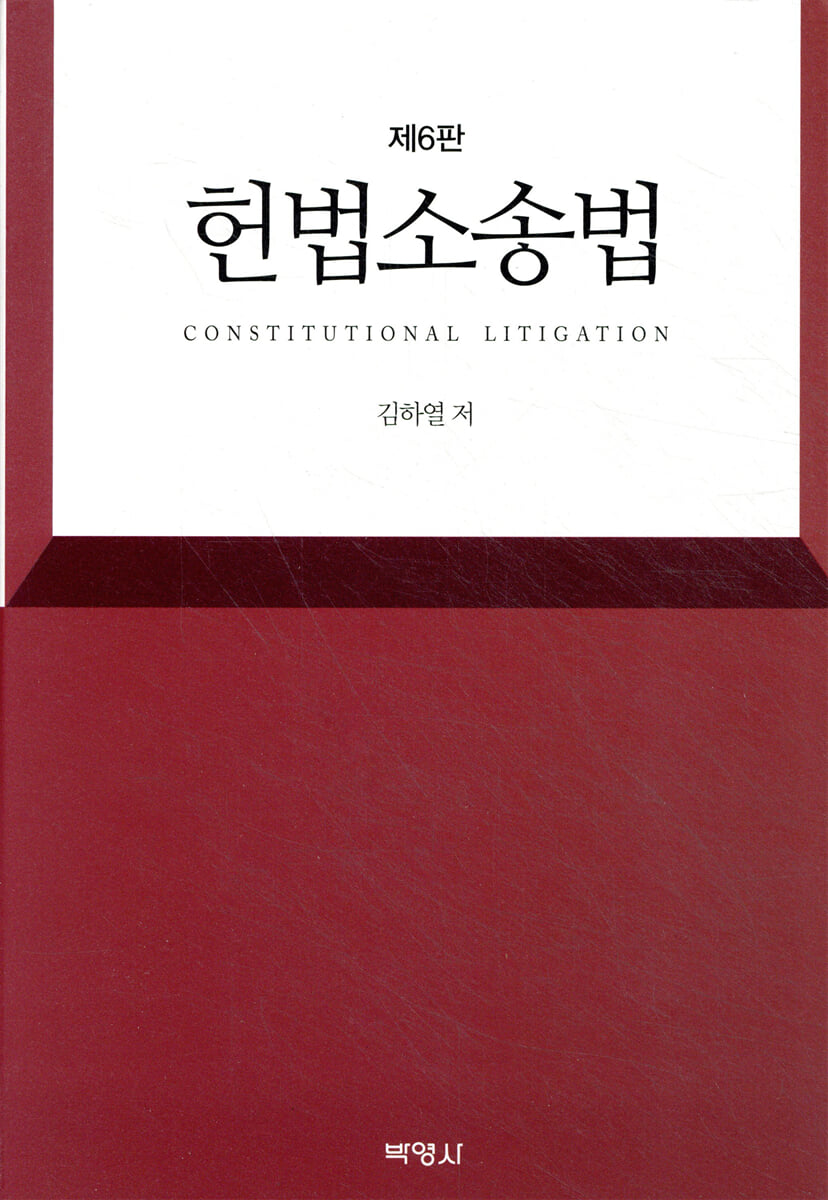
Constitutional Litigation Act
 |
Description
Book Introduction
The declaration of unconstitutional martial law led to a crisis of democracy and chaos in the constitutional order. The political conflict and chaos gave rise to numerous constitutional disputes, including the impeachment trial of the President and the Acting President and the dispute over the authority of the Acting President. In the process, constitutional litigation issues also arose.
A series of Constitutional Court decisions on this matter are introduced, their meaning is examined, and the author's position is also stated.
We have summarized and explained recent case law and updated some of the references.
A series of Constitutional Court decisions on this matter are introduced, their meaning is examined, and the author's position is also stated.
We have summarized and explained recent case law and updated some of the references.
index
Part 1
General Provisions of the Constitutional Court
Chapter 1: Concept and Types of Constitutional Court
Section 1: Concept of Constitutional Court 3
1.
Attempt to Unify the Concept 3
2.
Simple set concept· 4
3.
Summary 6
Section 2 Types and Development of Constitutional Court 9
1.
Decentralized Type 9
[Supplementary Material] Federalist Paper no. 78 9
2.
Focus Type 10
[Supplementary Material] Why Independent Constitutional Courts Came to Become a System in Europe: Cappelletti's Explanation 10
3.
Universalization of Constitutional Court 11
Chapter 2: The Nature and Function of the Constitutional Court
Section 1: The Legal Nature of the Constitutional Court 12
1.
Political Action Theory 12
2.
Legislative Action Theory 13
3.
Judicial Action Theory 13
4.
The Fourth State Function Theory 14
5.
Summary 15
go.
Review of Constitutional Court Cases by Type 15
me.
16 Irrelevant to the constitutional system of chapters
all.
Political Judicial Action· 16
Section 2: Functions of the Constitutional Court 17
1.
Guaranteeing the Normative Power of the Constitution 18
2.
Protection of Fundamental Rights 19
3.
Power Control 20
4.
Guarantee of political peace 20
5.
Constitutional Protection 21
Chapter 3 Legitimacy of the Constitutional Court
Section 1: Democracy and Constitutionalism 22
1.
The Conflict Between Democracy and Constitutionalism 22
2.
Attempts to Resolve the Conflict Between Democracy and Constitutionalism (Constitutional Court) 24
go.
Theoretical Exploration to Overcome the Semimajority of the Constitutional Court 24
me.
Improvement of the Constitutional Court's Composition 25
3.
Functional Limitations of the Constitutional Court 25
go.
Theory of Governmental Acts 26
[Supplementary Material] Political Question 26
me.
National Assembly Autonomy 26
Case Law: Respect for the Autonomy of the National Assembly 27
Case Law: The Speaker's Decision on the Proceedings of the National Assembly 27
Case Law: Method of Finding Facts Regarding National Assembly Procedures, Part 27
all.
Respect for the right to legislate 28
Section 2 Politics and the Judiciary: The Judicialization of Politics, the Politicization of the Judiciary 29
1.
The Judicialization of Politics 29
2.
Politicization of the Judiciary 31
Chapter 4: Relationship between Constitutional Court and General Court
Section 1 General Provisions 32
1.
Overview of the Distribution of Powers under Positive Law 32
go.
Distribution of Powers in the Constitution 32
me.
Distribution of Powers under the Law 34
2.
Controversy over the distribution of judicial power 34
go.
35. Attribution of the right to review the constitutionality of orders and regulations
me.
Limited Decision of Unconstitutionality and Authority to Interpret Law 36
all.
Transitional Rules for Decisions of Unconstitutionality 37
Section 2: General Criteria and Model for Distribution 38
1.
Distribution based on principles 39
go.
Distinction between Constitutional and Legal Issues 39
me.
The Conflict Between Democracy and Constitutionalism 40
all.
Power Control 41
2.
Policy-Based Distribution 42
go.
Organization and Personnel 42
me.
Level 43
all.
Competition and Cooperation 43
3.
Distribution Model 43
Section 3: Distribution of Normative Control 44
1.
Specific normative control over the law 44
go.
The working structure of specific normative control 44
me.
The court's authority to control norms 45
all.
The Constitutional Court's authority to control norms 50
la.
The Constitutional Court's concentration of normative control and the control it requires 50
2.
Normative Control over Commands and Rules 53
go.
Total 53
me.
Distribution and Problems of Current Law 55
Section 4 Distribution of Administrative Control 58
1.
Overview 58
2.
Distribution Criteria 58
3.
Problems with the Current System 59
go.
Combination of the prohibition of appeals and supplementarity 59
me.
Problems with the residual justice model 60
Part 2
Constitutional Court
Chapter 1: History of the Constitutional Court of Korea
Article 1, Section 65 of the Constitution
1.
Constitutional Court Review of Unconstitutionality 65
2.
Dualization of Specific Normative Control 66
3.
Impeachment Court 66
4.
The Reality of the Constitutional Court 66
"Case Law" Decision on Unconstitutionality of the Agricultural Land Reform Act (1952.9.9.
Decision 4285 Constitution 1) 66
「Case Law」Decision on the Constitutionality of Article 13 of the Martial Law (October 8, 1953)
Decision 4286 Constitution 2) 67
Section 2, Article 67 of the 1960 Constitution
1.
Establishment of the Constitutional Court 67
2.
Constitutional Court's Authority 68
3.
The Reality of the Constitutional Court 69
Section 3, Article 69 of the 1962 Constitution
1.
Adoption of decentralized judicial review 69
2.
Dissolution of political parties and impeachment 69
3.
The Reality of the Constitutional Court 69
Supreme Court's Unconstitutional Decision on the State Compensation Act, No. 70
Section 4 1972 Constitution (Yushin Constitution) and 1980 Constitution 72
1.
Reintroduction of the Constitutional Committee 72
2.
The Reality of the Constitutional Court 72
Case Law: Martial Law Declaration and Judicial Review 72
Section 5 Current Constitution (1987 Constitution) 73
1.
Launch of the Constitutional Court 73
2.
30 Years of the Constitutional Court: Restoring the Constitution's Normative Power 74
Chapter 2 Composition, Organization, and Powers of the Constitutional Court
Section 1 Composition of the Constitutional Court 75
1.
Composition 75
Case Law: The Meaning of the Right to Elect the National Assembly and the President's Duty to Appoint Officials 75
2.
Procedure for Appointing Judges 76
3.
Judges' Qualifications and Status 77
go.
Qualifications of a Judge 77
me.
Term of office and retirement age of judges 77
all.
Judges' Status Guaranteed and Prohibited from Political Involvement 78
4.
Problems with the Constitutional Court's Composition 78
[Supplementary Material] Structure of Constitutional Courts in Major Foreign Countries 80
Section 2 Organization of the Constitutional Court 81
1.
Chief Justice of the Constitutional Court 81
2.
Judges' Conference 81
3.
82 Constitutional Research Officers, etc.
4.
Office 82
5.
Constitutional Court Research Institute 83
Section 3: Powers of the Constitutional Court 83
1.
Constitutional Court's Jurisdiction 83
2.
Rulemaking Power 83
Part 3
General Judgment Procedure
Chapter 1 General Introduction
Section 1 Functions of the Constitutional Litigation Act 87
1.
Realization of the Substantive Constitution 87
[Supplementary Material] Case 88: Obstacles to the Implementation of the Substantive Constitution
2.
Appropriate Establishment of the Status and Functions of the Constitutional Court 88
3.
Ensuring the smooth functioning of the Constitutional Court 89
4.
Harmony of Three Functions 89
Section 2: Sources of the Constitutional Litigation Act 90
1.
Constitution, Constitutional Court Act, Constitutional Court Rules 90
2.
Application of other laws 91
go.
The necessity and form of application 91
me.
Meaning of Junyong 91
all.
Relationship between applicable laws 92
Case Law: Application of other laws (claim period) 93
3.
Supplementation of the law by the Constitutional Court 94
"Case Law" Filling Legal Gaps by the Constitutional Court 95
Section 3 Procedural Principles of Constitutional Litigation 95
1.
Dispositionalism and Offizialmaxime (Dispositions- und Offizialmaxime) 95
2.
97 Ex officio Detectionism and Argumentism
Chapter 2 The Court and the Parties
Section 1 Trial Division 99
1.
Tribunal and Designated Tribunal 99
2.
100 Recusal, Challenge, and Avoidance of Judges
go.
100 of of of
me.
100 Characteristics of the Constitutional Court
all.
My Chuck 101
la.
Avoidance 107
mind.
Avoidance 110
bar.
112 Rejection, avoidance, and evasion of emotional experts, Constitutional Court officials, and constitutional research officers
"Case Law" Whether Constitutional Court officials, etc. are subject to recusal 113
Section 2 Parties 113
1.
Constitutional Court and the Parties 113
2.
114 Parties by Judgment Type
go.
Constitutional Court Decision No. 114
me.
Impeachment Trial 115
all.
Political Party Dissolution Trial 116
la.
Authority Dispute Tribunal 116
mind.
Constitutional Appeal No. 116
3.
Status and Rights of the Parties 117
go.
The Meaning of Protecting the Procedural Rights of the Parties 117
me.
Specific procedural rights 118
4.
Parties' identification and coordination 118
go.
Arbitrary Change of Parties 118
Case Law 119: Prohibition of Exchange of Parties
Case Law: Prohibition of Additional Change of Parties 120
me.
Defendant's Correction 120
Case 121: Approval of the Respondent's Request for Correction
all.
121 Change of the defendant's authority
Case Law: Change of the Respondent's Authority 121
Case 121: Ex officio change of the defendant from the Minister of Construction and Transportation to the Korea Land Corporation
Case 122: Ex officio change of the defendant from the Commissioner General of the National Police Agency to the Chief of Yeongdeungpo Police Station
la.
Correction of party indication 122
Case 122 Recognizing Correction of Party Names in "Case Law"
Section 3 Participants and Interested Parties 123
1.
Participation number 123
Case 124: Deeming Application for Joint Trial Participation Unlawful
Case 125: Recognizing an Unlawful Application for Joint Trial Participation as an Application for Auxiliary Participation
Case 125 Recognizing Third-Party Participation in Trial Pursuant to Article 16 of the Administrative Litigation Act
Case 126: Third-party participation in a trial deemed unlawful under Article 16 of the Administrative Litigation Act
In a constitutional petition against a "case law," whether a third party with the same legal status as the plaintiff may participate under Article 16 of the Administrative Litigation Act. 127
Case 127: Recognizing an Additional Claimant's Application as a Joint Trial Participation Application
2.
Stakeholder 128
go.
128 of the of
me.
Scope of Stakeholders 128
all.
Stakeholder Status 129
Section 4 Representatives and Agents 130
1.
Representative 130
2.
Agent 132
go.
132 If a national agency or local government is a party
me.
132 If a private person is a party
Case Law: Effect of Previous Litigation Actions by a Resigned Agent 135
"Case Law" Effect of the Plaintiff's Act without the Agent's Approval 135
Chapter 3 Claim for Judgment
Section 1. Application and Request for Trial 136
1.
The significance of application principle 136
2.
Method of requesting a judgment 136
go.
Written Notice 136
me.
Reason for writing 137
all.
Reach 138
la.
Claim by electronic document 138
3.
Procedure after filing a request for arbitration 138
go.
Reception and Distribution 138
me.
Song Dal 139
all.
Correction 140
la.
Submission of Response 142
4.
The legal effects of a request for judgment 142
go.
Prohibition of Continuation of Litigation and Multiple Filings 142
Case 143: Not considered to be a case of duplicate filing
Case 144 deemed to be a case of duplicate filing
me.
Specific 144 of the subject of the judgment
5.
Change of the request for judgment 144
Changes to the Claim and Claim Period in the "Case Law" 146
Section 2: Subject of Judgment 146
1.
The legal significance of the subject of the judgment 146
2.
Principles and Exceptions to the Dispositionalism 147
Emphasis on the principle of ex officio in specifying the subject of judgment in "Case Law" 147
3.
Limitation of the subject of judgment 148
Case 148: Limiting the Subject of Judgment Ex officio
4.
Expansion of the Judgment Object 148
Case 149: Expanding the scope of review due to application of the same review standard in "Case Law"
Case 149: Expanding the scope of judgment based on close systematic relevance
Case 150: Cases in which only the "Case Law" was requested, but the scope of review was expanded to include lower-level laws.
Case 150: Cases in which only lower-level laws were requested, but the scope of review was expanded to include authorizing laws.
Case 151: Expanding the scope of review to include new laws with identical content
5.
Change of subject of judgment 151
Case 152: Change in the Subject of Precedent Judgment
Section 3 Withdrawal of Claim 153
1.
Overview 153
2.
Permission and Effect of Withdrawal of Claim by Type of Judgment 153
go.
Constitutional Court Decision No. 153
me.
Constitutional Appeal No. 154
"Case Law" Application of the Principle of Withdrawal of Petitions in Constitutional Petitions 155
Dissenting opinion 156 that the effect of withdrawal of a claim under "precedent" may be excluded
all.
Authority Dispute Tribunal 156
Case Law: Application of the Principle of Withdrawal of a Case in a Dispute over Authority 157
la.
Impeachment Trial 158
mind.
Political Party Dissolution Trial 158
3.
Methods, requirements, and procedures for withdrawal of claims 159
go.
Method and timing of withdrawal of claim 159
me.
Withdrawal of claim as a litigation action 159
all.
160. Request for consent from the other party, etc.
4.
Effect of Withdrawal of Claim 161
Section 4: Conducting Adjudication Procedures Through Electronic Information Processing Systems (Electronic Constitutional Court) 162
1.
Introduction of Electronic Constitutional Court 162
2.
The Significance and Utility of Electronic Constitutional Court 163
go.
The Significance of Electronic Constitutional Court 163
me.
The Benefits of Electronic Constitutional Court 163
all.
Application of Civil Procedure Laws 164
Chapter 4 Provisional Disposition
Section 1 General Provisions 165
1.
The meaning, function, and properties of provisional dispositions 165
go.
The significance and function of provisional dispositions 165
me.
Provisional Disposition as a Supplementary Procedure 166
2.
Grounds for injunction 166
go.
Constitutional Foundation 166
me.
Legal Basis 166
Case Law: Basis for Injunction 168
Supplementation through the application of "Case Law" 169
all.
Legislative Theory 169
Section 2 Legal Requirements for Provisional Dispositions 171
1.
Relationship with the main case 172
go.
Matters under the jurisdiction of the Constitutional Court 172
me.
Whether to continue the main trial 172
all.
The main trial will not be clearly unlawful 174
2.
Party 174
3.
Protection of Rights and Interests 175
Section 3 Grounds for Provisional Disposition 176
1.
Prevention of Significant (Significant) Damage 177
2.
Urgent 178
3.
There will be no concern that it will have a significant impact on public welfare 178
4.
Profitability 179
go.
Official 179
me.
Relationship with the main case 180
all.
The Need for Strict Review 181
Case Law: Specific Cases on the Amount of Provisional Disposition Benefits 181
Section 4 Procedure for Provisional Disposition 183
1.
Application for provisional disposition and withdrawal 184
2.
Psychology 184
3.
Cancellation of provisional disposition 184
4.
Objection to the injunction 185
5.
Delivery of Decision 186
Section 5 Decision on Provisional Disposition 186
1.
Decision-making subject 186
2.
Types and Contents of Decisions on Injunctions 187
go.
Decision of Dismissal and Rejection 187
me.
Injunction Decision 187
all.
Provisional Disposition of the Norm Control Procedure 188
Case Law 189: Injunction Decision Suspending the Effect of Legal Provisions
la.
Scope of provisional disposition application and decision 191
mind.
Reason 191
3.
Effect of provisional disposition decision 192
go.
Effective Date 192
me.
Board power, speed 192
all.
Enforcement of provisional disposition 193
Chapter 5 Psychology
Section 1 Written Examination and Oral Argument 194
1.
Overview 194
2.
Written Examination 195
3.
Oral Arguments and Examination 195
4.
Argument 196
go.
Judgment Preparation Procedure 196
me.
Procedure and Method of Argument 197
Section 2: Examination of Evidence 199
1.
Constitutional Court and Evidence Investigation 199
2.
Procedures and Methods of Evidence Investigation 200
go.
Investigation of evidence ex officio or upon request of a party 200
me.
Conducting Evidence Investigation 201
Section 3: Fact-finding, request for submission of records, and request for submission of materials 209
1.
209 of the of the of
2.
Limit 209
3.
Subject of the submission request 210
Section 4 Burden of Proof 211
1.
The Concept of Burden of Proof 211
2.
Distribution of the Burden of Proof 211
go.
Legal Requirements Classification Theory 212
me.
Normative Control and Burden of Proof 213
Section 5: Review 214
1.
The meaning and procedure of deliberation 214
2.
Verdict Method 215
Adoption of the "Case Law" Order-by-Order Verdict Method 216
[Supplementary Material] German Verdict Method 217
3.
Secrets of Deliberation and Publication of Minority Opinions 217
go.
The Significance and Limitations of the Secret of Deliberation 217
me.
Publication of Minority Opinion 218
Section 6 Quorum 219
1.
Overview 219
[Supplementary Material] Quorum Requirement for Cases Where the Constitutionality of a Law is a Precedent: 220
2.
Constitutional Policy Problems with the Six-Member Quorum 221
3.
Problems with the quorum for case law changes 222
4.
Quorum for the Authority Dispute Tribunal: 223
5.
Quorum for the designated court: 223
[Supplementary Material] Foreign Quorum Legislation Examples 224
6.
Order Decisions When Quorum Is Not Reached 224
go.
225 In case of differences of opinion only on the main issue
me.
In case of a split opinion on the main issue and a rejection opinion 226
all.
Jeong Lee 228
Section 7 Publication of Judgment, Judgment Direction, Judgment Costs, etc. 229
1.
Place of Judgment 229
2.
Public Judgment 229
go.
Publicity and Exceptions to Arguments and Sentencing 229
me.
230 Nondisclosure of Written Examination and Deliberations
3.
Judgement Command 230
4.
Terminology of the Court's Police Power and Judicial Justice 232
go.
Legal Police Powers 232
me.
Terminology of the Judgment 232
5.
Prohibition of recording, filming, broadcasting, etc. 233
6.
Judgment fee 235
go.
National Burden of Judgment Costs 235
me.
Reimbursement of arbitration fees 236
all.
Deposit 237
7.
Judgment period 238
The nature of the trial period in "Case Law" 239
8.
Penalty 240
Chapter 6 Final Decision
Section 1 General Provisions 241
1.
The Meaning and Types of Final Decisions 241
2.
Procedure for Final Decision 242
go.
Drafting of the Decision 242
me.
Pronouncement of the decision and delivery of the decision 243
all.
Publication of Decision 244
3.
Inspection and copying of judgment (final) records 244
go.
Types and Significance of Case Record Inspection and Copying 244
me.
244 Permission for parties or interested parties to inspect or copy
all.
Public viewing and copying 245
Section 2 Effect of Final Decision 248
1.
Overview 248
2.
The Meaning of Double Judgment in Constitutional Court 249
The Meaning of the Absence of Double Judgment in Case Law 250
3.
Self-binding, formal definitive power 250
go.
Self-restraint 250
me.
Formal definitiveness 251
252. Denial of Appeal in the Form of a Retrial
4.
Base plate power 252
go.
The Meaning and Basis of the Power of Responsibility 252
Case Law: The Scope of the Res judicata of Dismissal Decisions 253
me.
Normative Control Decisions and Res judicata 254
Case Law: The Res judicata of Normative Control Decisions 255
all.
Objective scope of the board of directors 256
la.
Subjective scope of the board of directors 256
mind.
Temporal scope of the substrate force 258
5.
Retrial 259
go.
Whether or not to allow retrial and reasons 259
Case Law: Permission for Retrial 261
Case Law: Recognition of Reasons for Retrial for Deviation of Judgment 261
me.
Request for Retrial 262
all.
Retrial Procedure 263
6.
Air speed 263
go.
The Meaning and Basis of Binding Force 263
Case Law: The Basis of Binding Force 264
me.
Decisions not recognized as binding 264
all.
Objective range of force 265
la.
Subjective range of force 267
mind.
The Problem of Repeated Legislation 267
Case Law: The Scope of Binding Force and the Permissibility of Repeated Legislation 271
bar.
Contents of the binding force 271
Case Law: Prohibition of Follow-up Dispositions That Create or Expand Unconstitutional Legal Relationships 273
Part 4
Constitutional review
Chapter 1 General Introduction
Section 1: Concept and Types of Normative Control 277
1.
The Concept of Normative Control 277
2.
Types of Normative Control and Litigation 278
go.
Concrete and Abstract Normative Control 278
me.
Incidental and Primary Normative Control 279
all.
Preemptive and Ex post Norm Control 280
la.
Litigation Types of Normative Control 281
Section 2: The Significance and Structure of the Constitutional Review System 281
1.
The Significance of Constitutional Review 281
2.
Structure of Constitutional Review 282
go.
Dualization of Normative Control Authority 282
me.
Function of the Dual Structure 283
Chapter 2 Subjects of Constitutional Review
Section 1. Formal Law 284
1.
Korean Law 284
2.
National Assembly Act 284
3.
Article 285 of the Constitution
"Case Law" 286. Whether or not to review the constitutionality of constitutional provisions
4.
Legal norms with the same effect as laws 287
go.
Treaties, generally accepted rules of international law 287
Constitutional Court Decision on Treaty 288
me.
Emergency Financial and Economic Orders and Emergency Order 290
Case Law: Attribution of the Constitutional Review Authority for Emergency Measures 291
5.
Customary Law 292
Constitutional Review Body for Customary Laws, Case Law 293
6.
Legislative Inaction 294
Section 2: Whether the law is subject to changes over time 294
1.
Old law, unconstitutional law 294
2.
Law 295 before promulgation or enforcement
3.
Law 296 under the old Constitution
4.
Pre-Constitutional Law 296
Constitutional Review of Pre-Constitutional Laws 297
Chapter 3 Request for Constitutional Review
Section 1 Subject of the Proposal 299
1.
Meaning of the Court 299
2.
Scope of the Referring Court 301
Section 2 Procedures Related to Submissions 301
1.
Application for Proposal 301
Case Law: Approval of Constitutional Review Petition by Assistant Participant 302
2.
My petition 302
go.
Legal Information 302
me.
Additional information according to the referee rules 303
3.
Suspension of Trial 303
go.
Meaning and Scope of Suspension of Trial 303
me.
Exception to stay of trial 304
all.
Suspension of trial period 305
4.
Decision on whether to submit a request and subsequent procedures 305
go.
Types of decisions and decision periods 305
me.
Delivery of decision on whether to submit a request 305
all.
Prohibition of Disobedience 306
la.
306 via Supreme Court
5.
Withdrawal of the Proposal 307
6.
Submission of Opinion 308
go.
308 Submission of opinions from the parties to the case and the Minister of Justice
me.
Expansion of Opinion Submission Opinions under the Judgment Rules 309
Chapter 4 Presumption of Justice
Section 1: The Meaning of “Trial” 310
Section 2: The “Presumption” of Judgment 310
1.
Specific cases will remain pending in court 311
2.
The law whose constitutionality is at issue will be applicable to the trial of the case in question. 312
go.
General Theory 312
Precedent Requirements for a Retrial Case 313
me.
Indirectly Applicable Law 314
Case 315: Recognizing the Presumption of Judgment Regarding Legal Provisions with Indirect Application (Conscientious Objection Case)
3.
In cases where the court in charge of the case will make a different judgment depending on whether the law violates the Constitution or not, 316
go.
General Theory 316
[Supplementary Material] Cases in which the Reasons for a Trial Are Different and the Prerequisites for a Trial 316
me.
Damages lawsuit and the prerequisites of trial 317
Case Law: Damages Litigation and the Presumption of Trial 318
all.
319 Prerequisite for a trial in cases where the legal basis for an administrative disposition is disputed after the period for litigation has expired
"Case Law": The Constitutionality of Administrative Dispositions and the Presumption of Judgment After the Period of Dispute 321
la.
323 Prerequisites for a trial when the constitutionality of the law underlying a prior disposition becomes incontestable in the proceedings challenging a subsequent disposition
Case 324: Denying the Presumption of Justice on the Basis of Non-Inheritance of Defects Between Prior and Subsequent Dispositions
mind.
The power of res judicata and the presumption of justice 324
bar.
Violation of the Principle of Equality and the Presumption of Justice 325
Section 3: The Elimination of the Presumption of Judgment and Its Effects 325
1.
The Abolition of the Premise of the Trial and the Withdrawal of the Petition 325
"Case Law": The Elimination of the Prerequisite for a Trial Due to Withdrawal of a Case 325
2.
The Need for Exceptional Constitutional Clarification 326
Chapter 5 Judgment
Section 1 Evaluation Criteria 327
1.
Constitution 327
go.
The Constitution as a whole 327
me.
Article 328 of the current Constitution
2.
Customary Constitution 329
3.
International Law 330
Case Law Denies the Standard for Constitutional Review of International Law 331
Section 2 Scope of Judgment and Decision of Unconstitutionality 331
1.
Overview 331
2.
Scope of Judgment and Unconstitutionality Decision 332
go.
Principle Scope 332
me.
Adjustment of the subject of judgment by authority 332
all.
Expansion of Unconstitutional Decisions 333
"Case Law" Expansion of Unconstitutionality Decisions 1 (Extension to the Entire Law) 335
"Case Law" Extension of Unconstitutionality Decision 2 (Extension to Other Systemically Relevant Provisions) 335
Chapter 6 Final Decision
Section 1 Types of Final Decisions 337
Section 2 Temporal Effect of Unconstitutional Decisions 337
1.
Two possible positions 337
go.
Retroactive Invalidity Theory (Non-Existential Invalidity Theory) 338
me.
Future Hyoseol 338
"Case Law": Direction of Legislative Policy Regarding the Temporal Effect of Unconstitutional Decisions 339
2.
Principle of future effect 340
go.
Adoption of the principle of future effect 340
"Case Law" Constitutionality of the Principle of Prospective Effect 340
me.
Starting point of future filial piety 341
3.
Exceptional retroactive effect 342
go.
The Need for Partial Retroactive Effect 342
me.
Scope of retroactive effect recognized by the Constitutional Court 343
all.
Scope of retroactive effect recognized by the court 343
Case Law: Scope of Retroactive Effect Recognized by the Court 344
Retroactive Effect of Administrative Dispositions and Unconstitutional Decisions That Have Gained Finality in Precedent 345
la.
Decision of unconstitutionality and retroactive effect under Article 68, Paragraph 1 of the Act 345
Case Law: Decision of Unconstitutionality and Retroactive Effect under Article 68, Paragraph 1 of the Act 1 (Case of Denial) 347
Case Law: Decision of Unconstitutionality and Retroactive Effect under Article 68, Paragraph 1 of the Act 2 (Recognized Cases) 347
4.
Retroactive Effect and Limitations of Unconstitutional Decisions on Penal Provisions 349
go.
Principle of retroactive effect 349
me.
Limitation of retroactive effect 351
all.
Possibility of Limiting Retroactive Effect through Decision of Unconstitutionality 357
la.
Retroactive effect of limited unconstitutionality decisions 357
Section 3: Binding Force of Unconstitutional Decisions 358
1.
Scope of Judicial Procedures Recognized as Binding 358
2.
Contents of the binding force 359
3.
Order form of unconstitutional decision recognized as binding 359
Section 4 Loss of Effect of Laws Decided Unconstitutional (General Effect) 359
1.
Concept and Essence 359
Legal Effect of Unconstitutional Decisions on "Case Law" 362
2.
Target Determination and Scope 362
go.
Target Decision 362
me.
Range 363
3.
Content 364
go.
Overview 364
me.
Decision No. 364 on Limited Unconstitutionality and Limited Constitutionality
all.
Decision of Unconstitutionality 366
4.
Public notice 366
Section 5 Determination of Transformation 367
1.
The significance and basis of the decision to transform 367
2.
Decision No. 369 on Limited Unconstitutionality and Limited Constitutionality
go.
The significance of the decisions of limited unconstitutionality and limited constitutionality 369
The Meaning, Basis, and Effect of Limited Unconstitutionality and Limited Constitutionality Decisions in "Case Law" 370
me.
Constitutional interpretation of law as the basis for decisions of limited unconstitutionality and limited constitutionality 372
all.
The Structural Relationship Between Limited Unconstitutionality and Limited Constitutionality 373
la.
Binding Force of Limited Unconstitutionality and Limited Constitutionality Decisions 374
Binding Power of Limited Unconstitutionality and Limited Constitutionality Decisions in "Case Law" 376
3.
Decision of Unconstitutionality 378
go.
The Concept of Decision of Unconstitutionality 378
me.
Characteristics of the Decision of Unconstitutionality 378
all.
Reasons for Decision of Unconstitutionality 379
Decision 383 on the Unconstitutionality of the Basic Provisions of the Precedent System
la.
Whether or not unconstitutional laws apply 385
Reasons for the decision of unconstitutionality based on continued application of "precedent" 387
Separation of the application of the decision of unconstitutionality of continued application by the court in "Case Law" 390
[Supplementary Material] Supreme Court of Canada's Unconstitutionality Decision 392
mind.
Retroactive Effect of Decisions of Unconstitutionality: Scope of Application of Reformative Legislation 394
"Case Law" Retroactive Effect of Decisions of Unconstitutionality on the Current Case and Concurrent Cases 395
Retroactive effect of the part of the decision of unconstitutionality included in the continued application of the "precedent" to the current case and concurrent cases 400
Retroactive effect on the transitional events of the part of the decision of unconstitutionality included in the continued application of the "Case Law" 401
[Supplementary Material] Retroactive Effect of Decisions of Unconstitutionality: Scope of Application of Reformative Legislation 402
bar.
Binding Force of Decision of Unconstitutionality 402
Whether the "Case Law" revision legislation conflicts with the binding force of a decision of unconstitutionality 408
buy.
Decision 408 on Unconstitutionality of Penal Provisions
411. Court Handling of Cases When a Penalty Clause in a Case is Deemed Unconstitutional
Chapter 7 Constitutional Petitions under Article 68, Paragraph 2 of the Constitutional Court Act
Section 1: Significance and Character 413
1.
413 of the of
[Supplementary Material] Austrian Model for Constitutional Complaints under Article 68, Paragraph 2 of the Act 414
2.
Legal personality 415
Legal Nature and Legal Requirements of a Constitutional Petition under Article 68, Paragraph 2 of the "Case Law" Act 415
Section 2 Procedures and Requirements 416
1.
Target Standard 416
2.
Application for Request and Dismissal Decision 416
go.
Application for Proposal 416
me.
Restrictions on Application for Proposal 417
all.
Dismissal Decision 418
3.
Claim for Judgment 419
4.
Limited Unconstitutionality Claim 420
go.
Problem material 420
me.
Permissible 421
Case Law: The Principle of Permissibility of Limited Unconstitutionality Claims 422
Case Law 423: Judgment on Limited Unconstitutionality Claims
Case 425: Limited Unconstitutionality Claims Deemed Illegal
5.
The Injustice of the Trial 426
6.
Presumption of Justice 426
7.
Mandatory Attorney Representation, Public Defender 428
8.
Preliminary Examination 429
9.
Stakeholder Opinion Submission 429
10.
Judging Criteria 429
11.
Billing period 429
Section 3 Form and Effect of Decisions 430
1.
Decision Format 430
2.
Effect of Decision 430
go.
General Effect 430
me.
Request for retrial and its scope for the case in question 431
Part 5
Constitutional appeal
Chapter 1 General Introduction
Section 1: The Concept and Essence of Constitutional Appeals 435
1.
Germany 435
2.
Other countries 436
go.
Austria 436
me.
Switzerland 437
all.
Spain 437
la.
Latin America 437
mind.
US 438
3.
Essential Elements of a Constitutional Petition 438
Section 2 Functions of Constitutional Appeals 439
1.
Fundamental Rights Relief 439
2.
Guaranteeing an objective constitutional order 440
Case Law Scope of Review for Violation of Fundamental Rights 441
"Case Law": The Objective Function of Constitutional Petitions and the Benefits of Judgment 441
3.
Power Control 441
Section 3: Overview of the Korean Constitutional Appeal System 442
1.
History and Basis 442
2.
Types of Constitutional Petitions 442
3.
Institutional Limitations of Constitutional Appeals: The Relationship Between Constitutional Appeals and Administrative Litigation 443
go.
Current Status 443
me.
Problem 443
4.
The Meaning and System of the Legal Requirements for Constitutional Petitions 444
go.
Meaning of legal requirements 444
me.
System of Legal Requirements 445
[Supplementary Material] Example 446 of Intersectionality in Classifying Legal Requirements
Chapter 2 Claimant Capacity
Section 1 Concept 448
Section 2: Nature 449
1.
National 449
Case Law Denies the Fundamental Rights of Embryos 449
Case Law No. 450: Constitutional Petition by a Spouse Who Ascended the Status of a Deceased Plaintiff
Case 450: Failure to Accept Application for Succession from Non-Heir
2.
Foreigner 451
Case Law: Subjectivity of Foreigners' Fundamental Rights 452
Section 3 Legal Persons 453
1.
Overview 453
2.
Public Corporations and Public Institutions 453
Case Law: The Subjectivity of Fundamental Rights of Corporations 454
Case Law: The Subjectivity of Fundamental Rights at National Universities 455
Case Law: The Subjectivity of Fundamental Rights in Public-Private Hybrid Enterprises 456
Case Law: The President's Subjectivity of Fundamental Rights 456
Chapter 3 Exercise or Non-Exercise of Public Power
Section 1 Introduction 458
1.
Acts of Public Entities 458
Case Law: Denial of the Exercise of Public Power in Relations Between Private Universities and Students, 458
Case Law: The Authority of Public Broadcasters and the Presidential Election Debate Committee 459
Case Law: Denial of the Public Power of Party Primary Elections 459
2.
Powerful Action 460
Case Law: Denial of the Exercise of Public Power in Acts of a Judicial Character by Public Entities, 462
Case Law Denies the Exercise of Public Power in Internal Supervision 463
Case Law: Denial of the Public Power of Private Wanted Orders 463
Case Law 463 Denial of the exercise of public power in simple notifications that do not affect legal status
Case Law: Judgment Methods for Legal Provisions That Do Not Affect Legal Status 464
3.
Comprehensiveness of the target 464
Section 2 Legislative Action 465
1.
Law 465
go.
Law 465 in the formal sense
466. Permission to file a constitutional complaint against a law under "Case Law"
me.
Significance as a normative control procedure 466
all.
The Need for Legislative Supplementation 467
2.
Treaties, generally accepted rules of international law 467
go.
Article 467
me.
Generally accepted international law 468
Case Law: The Exercise of Public Power in Treaties 468
3.
Emergency Financial and Economic Orders and Emergency Order 469
4.
Constitutional Article 469
5.
Legislative Inaction 469
go.
The Significance of Constitutional Petitions Against Legislative Inaction 469
me.
Genuine Legislative Omission and Insincere Legislative Omission 470
"Case Law" 471: How to Filing a Constitutional Appeal Against Legislative Inaction
Case Law: The Boundary Between Genuine Legislative Omission and Ungenuine Legislative Omission 471
all.
Requirements for Legislative Inaction 472
la.
Judgment on the merits of legislative inaction 473
"Case Law" Decision on the Merit of the Constitutional Petition for Legislative Inaction, No. 473
6.
Constitutional Petition No. 474 on the grounds of legislative procedural defects
Case Law: Defects in Legislative Procedure and the Possibility of a Constitutional Appeal 475
7.
Other Exercises of Public Power by the National Assembly 475
Section 3 Administrative Actions 476
1.
Overview 476
2.
Act of Government 476
Case Law: The President's Exercise of National Emergency Powers and the Constitutional Court's Review 477
Case Law: Deployment of Troops to Iraq and the Constitutional Court's Refrain from Judicial Review 478
Case Law: Denial of the President's Decision to Conduct ROK-US Joint Military Exercises as an Act of Government 478
Case Law: Court Review of Emergency Measures under the Yushin Constitution 478
3.
Administrative Legislation 479
go.
Recognition of jurisdiction over constitutional appeals 479
me.
Significance as a normative control procedure 480
all.
Range 480
Constitutional Complaint Subject to Supreme Court Rules, Case Law 481
Constitutional appealability of "Case Law" ordinance 481
la.
Administrative Rule 481
Precedent 482: The Principle Denial of the Subjectivity of Constitutional Complaints in Administrative Rules
"Case Law" 482: Subjectivity of Constitutional Appeals to Supplementary Administrative Rules
Case Law: Recognition of the exercise of public power in administrative rules according to the doctrine of self-restraint 483
Branching of Judicial Powers According to the Nature of the "Case Law" Notice 484
4.
Administrative Legislative Omission 484
Case Law Requirements for Administrative Legislative Inaction 486
Case Law Ordinance on Inaction 487
5.
Administrative Dispositions and Refusals 487
go.
Administrative Disposition 487
me.
Refusal 488
Case Law: Refusal and Supplementaryness 489
6.
Original Administrative Disposition 490
Precedent 492: Exclusion of Constitutional Appeals Against Original Administrative Dispositions
"Case Law" Original Administrative Disposition and Constitutional Petition Dismissed 493
Constitutional Petition No. 495 on the Non-Prosecution Decision after Request for Review of Precedent
7.
Executive Order 495
go.
Overview 495
Precedent 496: Requirements for a Constitutional Petition Against Administrative Actions
me.
Relationship with the Confirmation of Illegal Inaction Lawsuit 496
8.
Administrative Plan, Administrative Guidance, Public Notice 497
go.
Administrative Plan 497
me.
Administrative Map 498
all.
Announcement 500
9.
Powerful Fact Act 500
10.
Decisions of various committees 503
11.
Inspector's Disposition 503
go.
504 of the of
me.
Scope of Constitutional Petitions Against Non-Prosecution Dispositions 504
The Invalidity of a Constitutional Appeal Against a Non-Prosecution Decision Without a Request for Precedent Review 505
Section 4 Judicial Action 507
1.
Court Trial 507
go.
Exclusion of Constitutional Appeals Against Trials 507
me.
Scope of the exclusion of the tribunal member 509
all.
Exceptional Permission for Constitutional Appeals Against Trials 511
[Supplementary Material] Cancellation of Trial 512
la.
Problems with the exclusion of the tribunal 513
2.
Constitutional Court Decision 516
Chapter 4 Violation of Fundamental Rights
Section 1. Relevance to Fundamental Rights and Violation 517
1.
Fundamental Rights Relevance 517
Case Law: Invalidity of Constitutional Petitions Alleging Violation of Legal Rights 519
2.
Infringement Relevance 519
go.
The significance and scope of the infringement 519
me.
Infringement Relevance as a Possibility of Infringement 520
The Meaning of Infringement Relevance in Case Law 521
Case Law: Denial of the Relevance of Infringement to Reflective Disadvantage 522
all.
Claim of infringement liability 522
Section 2: Self-Relevance, Presentness, and Immediacy 523
1.
Self-relevance 523
go.
The Significance of Self-Relevance 523
me.
Criteria for Judging Self-Relevance 523
all.
Calling on Self-Relevance 528
2.
Current status 528
go.
The significance and recognition criteria of presentness 528
Case Law: Recognition of Currentness Considering the Periodic Characteristics of Elections 530
me.
The Relationship Between Present Status and Rights Protection Interests 530
The Relationship Between Current Case Law and Rights Protection Interests 532
[Supplementary Material] The U.S. Supreme Court's Ripeness Doctrine and Mootness Doctrine 532
all.
Current performance and billing period 533
3.
Direct Sex 533
go.
The Meaning of Directness and Its Relationship to Complementarity 533
Case Law: The Basis, Meaning, and Relationship with Directness
me.
The Scope of Directness: Constitutional Petition No. 535
all.
Type 536 of enforcement actions
Case Law, Discretionary Acts and Directness 538
Case Law: Tax Law and Directness of the Reporting and Payment Method 538
Case Law: Sanctions and Directness 540
[Supplementary Material] Judging Directness and Complementarity According to the Subject of Judgment 540
Enforcement and Directness of Subordinate Rules of Case Law 1 (Principled Case) 541
Enforcement and Directness of Subordinate Rules of "Case Law" 2 (When Directness of Delegated Law is Recognized) 542
"Case Law" Acts and Directness of Signs 543
"Case Law" Judicial Norms and Directness 544
la.
Whether or not there is an enforcement action and whether directness is recognized 545
Presence or absence of enforcement action and determination of directness 547
mind.
Directness and its Relationship to Other Legal Requirements 548
"Case Law" Definition and Directness 549
Case Law: Organizational and Professional Standards and Directness 549
Section 3 Claim Responsibility 550
Chapter 5 Other Legal Requirements
(Supplementaryity, claim period, rights protection interest)
Section 1 Supplementary Nature 552
1.
The significance of supplementarity 552
2.
Function of supplementarity 552
[Supplementary Material] The Litigational Functions and Limitations of Subsidiarity in a Broad Sense 553
3.
Meaning and Standards for Completing Relief Procedures 554
go.
Meaning and Types of Relief Procedures 554
Constitutional Petitions and Non-Application of Subsidiarity to "Case Law" 557
Method of Judging the Supplementaryness of Case Law Notices 557
Case Law 559: Request for Reconsideration as a Remedy Procedure
Case Law: Fair Trade Commission's Not-Guilty Decision and Complementarity 559
me.
Demand for legality of relief procedures and remedy of defects 560
4.
Exception to the principle of subsidiarity 560
Case 562 where the exception to supplementary nature was recognized in the "Case Law"
Section 2 Claim Period 562
1.
The significance of the billing period system 562
2.
Legal nature of the billing period 563
3.
Calculating the Billing Period 564
4.
Application area of the billing period 565
go.
Non-exercise of public power 565
me.
Constitutional Petition No. 565 on the Act
all.
Current performance and billing period 566
5.
Calculation of the billing period 566
go.
566 in case of relief procedures
me.
567 If no relief procedures are followed
Case Law: Starting date for cases where violation of fundamental rights continues or is repeated: 1 (first date) 570
Case Law: Starting Date 2 (Claim Period Not Applicable) in Cases of Persistent or Repeated Violations of Fundamental Rights 571
Case Law: Grace Period for Enforcement of Laws and Claim Period 572
all.
Fundamental Problems with the Billing Period Starting Point 573
6.
Just cause 575
Section 3: Rights Protection Interests 576
1.
The significance of rights protection interests 576
The significance and basis of the protection of rights in "Case Law" 577
2.
Defects and Extinction of Rights and Interests 578
go.
Defects in the request for judgment 578
me.
Subsequent extinction after filing for judgment 579
3.
Benefits of Judgment 580
Chapter 6 Claims for Judgment and Hearing
Section 1: Request for Judgment 582
1.
Submission of Claim 582
2.
Invoice details 582
go.
Legal Information 582
me.
Additional information according to the referee rules 584
all.
Attachment 585 of the agent-related documents
la.
Scope of Required Information 585
mind.
Effects of Omission of Information 585
bar.
Incorrect descriptions and their corrections 586
Section 2: Public Defender System 587
1.
587 of the of
2.
Reasons for Appointing a Public Defender 587
go.
No Magnetic Force 587
me.
Public Interest Required 588
all.
Passive Reasoning 588
3.
589 Application and appointment procedures, etc.
Section 3 Preliminary Examination 590
1.
The significance of the pre-screening system 590
The Significance of the Preliminary Examination System in Case Law 591
2.
Composition and Trial Procedure of the Designated Tribunal 592
go.
Composition of the designated tribunal 592
me.
Psychological Procedure 592
3.
Decisions and Effects of the Designated Tribunal 592
go.
Decision 592
me.
Decision to Refer to Tribunal and Consideration of Referral to Tribunal 594
4.
Notice of the Decision of the Designated Tribunal 594
go.
Notice to Parties 594
me.
Notice to the Minister of Justice, etc. 594
5.
Provisional Disposition 595
[Supplementary Material] Legislative Theory for Strengthening the Authority of the Designated Tribunal 596
Section 4 Psychology 597
1.
Application of General Judgment Procedures 597
2.
Submission of opinions from interested parties, etc. 598
go.
598 of the of
me.
Scope of Stakeholders 598
all.
Status of Stakeholders 599
la.
Expansion of Opinion Submission Opportunities under the Judgment Rules 599
Section 5. Standards for Review in the Decision on the Merits of Constitutional Complaints: The Correlation Between Fundamental Rights Norms and Objective Constitutional Principles 599
Chapter 7 Final Decision
Section 1 Types of Final Decisions 602
1.
Overview 602
2.
Declaration of the end of the trial process 602
Section 2: Citation Decision 603
1.
Types and Effects of Citation Decisions 603
go.
Constitutional Petition 604 on Individual and Specific Exercise or Non-Exercise of Public Power
me.
Constitutional Petition No. 606 on the Act
2.
609. Description of the fundamental rights violated and the order of the exercise of public power that caused the violation.
Reasons for Not Indicating the Infringed Fundamental Rights in a Constitutional Petition on a Case Law 612
3.
Incidental Declaration of Unconstitutionality 612
go.
612 of the of
me.
Procedure 613
all.
Effectiveness 614
Part 6
Authority dispute arbitration
Chapter 1 General Introduction
Section 1: Concept, Characteristics, and Functions of Authority Dispute Judgment 617
1.
The Concept of Authority Dispute Judgment 617
2.
Characteristics of Authority Dispute Tribunals 617
go.
Complexity of Personality and Function 617
me.
The Constitutional Court's Principled and Comprehensive Jurisdiction 618
all.
Strengthening subjective dispute resolution 620
3.
Function of the Authority Dispute Tribunal 621
go.
621 features common to each type
me.
Disputes over authority between government agencies 621
all.
Dispute over authority between national agencies and local governments 622
la.
Disputes over authority between local governments 622
Section 2 Development of the Authority Dispute Tribunal 623
1.
Partisan and State Disputes Surrounding the National Assembly 623
go.
623 Disputes within the National Assembly over the legitimacy of its proceedings
me.
Dispute 624 concerning the President's infringement of the National Assembly's authority
2.
Defense of Local Autonomy Against Central Government Interference 625
go.
Passive Authority Dispute 625
me.
Dispute over authority over specific actions of the central government 625
all.
Normative Authority Dispute 626
3.
Jurisdiction disputes between local governments 627
Case Law: Existence of Autonomy and Boundary Demarcation Standards for Public Waters and Their Reclaimed Lands, Article 628
Section 3: The Relationship Between Authority Dispute Adjudication and Administrative Litigation 629
1.
Distribution of Jurisdiction Regarding Disputes over Authority under Public Law 629
2.
Dispute Resolution and Institutional Litigation 631
go.
The Broadness of Concepts 631
me.
Disagreement between the parties 632
all.
Reason for Authority Dispute 634
3.
Dispute Resolution and Appeals 634
4.
Dispute Resolution and Party Litigation 635
5.
635. Solution to the Problem of Jurisdiction Conflict Between Dispute Resolution and Administrative Litigation
6.
Dispute Resolution and Litigation under Article 188 of the Local Autonomy Act 636
Chapter 2 Legal Requirements for Dispute Resolution
Section 1 Capacity of Parties 638
1.
National Agency 638
go.
Standards for Recognition of National Agencies 638
Case Law: Standards for Recognition of National Agencies 640
Case Law: National Human Rights Commission Denies Party Capacity 641
me.
Scope of party recognition 643
Case Law: Election Commission's Capacity as a Party 647
all.
Scope of State Agencies in Dispute Resolutions Against Local Governments 648
Government as an Example of Case Law 650
2.
Local government 650
go.
Local government agency capacity 650
Case Law: Denial of Jurisdiction in Dispute over Authority Between Local Council Members and Local Council Speakers 652
me.
Special Provisions on Local Government Affairs Concerning Education and Arts 652
Section 2 Disposition or Inaction 653
1.
Overview 653
Case Law: Permission of Disputes over Authority through Normative Control 654
The Meaning of Omission in Case Law 655
Case Law: 656 Cases Recognizing the Legal Duty to Take Action
2.
Future Disposition Theory 656
3.
The Problem of Norm-Controlling Authority Disputes 657
go.
Problem material 657
me.
The Need for Recognition of Normative Authority Disputes 657
all.
Issue 659: Defendant and Subject of Trial
[Supplementary Material] Germany's Norm-Controlling Authority Dispute 660
Section 3 Infringement of Authority 661
1.
Relationship between Article 61, Paragraphs 1 and 2 of the Act 661
2.
“Dispute over the existence or scope of authority” 662
3.
Claimant Eligibility 663
go.
Authority Relevance 664
Case Law: Denial of Local Governments' Eligibility to File Claims Regarding Delegated Affairs 665
Case 665 Denying the Possibility of Infringement of Authority Regarding State Affairs
me.
Passive Authority Dispute 666
Case Law: Permissibility of Passive Authority Disputes 667
all.
Third-Party Litigation Officer 669
Case Law: Permission for Third-Party Litigation 670
[Supplementary Material] Third-Party Litigation in Germany 671
la.
Potential for infringement of rights 671
Case 673: The Possibility of Infringement of Authority Denied
"Case Law": Revision of the law partially restricting prosecutors' investigative and prosecutorial powers and the possibility of infringement on prosecutors' authority 674
4.
Defendant Eligibility 675
Case 675: Lack of Eligibility as Defendant
Section 4 Other Requirements 676
1.
Benefits of Judgment 676
Case 677 Recognizing the Benefits of Precedent Judgment
Case 678 Denying the Benefits of Precedent Judgment
2.
Billing period 679
Chapter 3 Claims for Judgment and Examination
Section 1. Request for Judgment 681
1.
Submission of claim 681
2.
Invoice details 681
3.
Notice of Petition for Arbitration 682
4.
Provisional Disposition 682
go.
Legal basis 682
me.
Requirements and Contents 683
Section 2 Psychology 684
1.
Application of general arbitration procedures 684
2.
Number of members: 684
go.
General case 684
me.
In the case of a normative authority dispute, 684
Chapter 4 Final Decision
Section 1 Types of Final Decisions 686
1.
Overview 686
2.
Declaration of the end of the trial process 686
Section 2 Contents of the Main Decision 687
1.
Checking the presence or scope of authority 687
go.
Decision 687 confirming the attribution of authority
me.
Decision 688 confirming infringement of authority
all.
Standards of Review and Substantive Functions of the Judgment on the Main Case 688
la.
Legal personality 689
2.
Cancellation or Invalidation Confirmation 689
go.
Discretionary, Additional Judgment 689
The significance of Article 66, Paragraph 2 of the "Case Law" Act 690
me.
Retroactive effect of cancellation decision 691
all.
Issue 691 of the decision to confirm invalidity
Section 3 Effect of Decision 693
1.
Speed 693
go.
Binding force of dismissal decision 693
me.
Binding force of citation decision 694
Case Law: Scope of Binding Force of Decisions Confirming Infringement of Authority 694
2.
Limitation of the effect of cancellation decision 695
3.
Effect of citation decisions on legislative dispositions 696
go.
Effect of citation decisions on dispositions related to legislative procedures 696
Requirements for Confirming Invalidity Due to Defects in Legislative Procedures in "Case Law" 700
me.
The Effect of a Decision on a Norm-Controlling Authority Dispute 701
Part 7
impeachment trial
Chapter 1 General Introduction
Section 1: Impeachment System and Constitutional Order 705
1.
Impeachment System and Constitutional Principles 705
go.
Impeachment System and Democratic Principles 705
me.
Impeachment System and the Rule of Law Principle 706
all.
Impeachment and Judicial Independence 706
2.
Type 707 of the Impeachment System
go.
Distinction between Political and Judicial Impeachment Systems 707
me.
Political Impeachment System 708
all.
Judicial impeachment system 711
la.
South Korea: A Strong Judicial Impeachment System 711
Impeachment as a Normative Judicial Procedure (Case Law) 712
Section 2: The Significance and Function of Impeachment Trials 713
1.
The Significance of the Impeachment Trial 713
"Case Law" Purpose of Impeachment Trial Procedure 713
2.
The Legal Function of Impeachment Trials 714
go.
Power Control 714
me.
Constitutional Protection 714
all.
Checks and balances on judicial power 715
3.
The Usefulness of the Impeachment System 715
4.
The Political Function of the Impeachment System 716
go.
Touchstone of Democracy 716
me.
Impeachment and Divided Government 717
all.
The Difficulty of Resolving Political and Social Conflicts 718
Chapter 2. Subjects and Grounds for Impeachment
Section 1. Subjects of Impeachment 720
1.
720 people subject to impeachment under the Constitution
go.
President 720
me.
Prime Minister, State Council members, and heads of administrative ministries 721
all.
Judge 721
la.
Constitutional Court Justice 722
2.
722 persons subject to impeachment under the law
[Supplementary Material] Impeachment Case Statistics 723
3.
Impeachment of the Acting President 723
go.
724 If the acting president is subject to impeachment
"Case Law": 726 votes required to impeach the Prime Minister, who is also the Acting President.
me.
727 If the acting president is not a subject of impeachment
Section 2 Grounds for Impeachment 727
1.
Violation of the Constitution or Law 727
go.
Exclusion of Political Reasons 727
Case Law: Exclusion of Non-Legal Reasons from Impeachment Grounds 727
me.
Scope of the Constitution and Laws that are the Standards of Review 728
all.
729 Whether the grounds for impeachment are limited
Case Law Limitations on Grounds for Dismissal 732
2.
Acts in the Execution of Official Duties 733
go.
General meaning 733
The Meaning of Job-Relevance in Case Law 733
me.
Temporal scope of job performance 734
3.
Intentional or Negligence 736
Chapter 3 Impeachment
Section 1. Initiation of Impeachment 737
1.
Bill 737
2.
Post-Proposal Procedure 738
Section 2: Resolution on Impeachment 738
1.
Resolution 738
2.
Method of voting 740
3.
Effect of Resolution 740
go.
Suspension 740
me.
Prohibition on Accepting Resignations and Dismissals of Employees 741
Chapter 4 Claims for Judgment and Hearing
Section 1. Request for Judgment 742
1.
Submission of a copy of the impeachment resolution 742
2.
743 parties to the impeachment trial
Section 2: Impeachment Trial Deliberations 744
1.
The nature and application of the impeachment trial process, Article 744
2.
Impeachment Procedures and Civil and Criminal Trial Procedures 745
3.
746 Additional Subjects of Impeachment Trial (Claims) and Grounds for Prosecution
4.
Oral Argument 747
5.
748. Impeachment trial review, including resignation of the accused, retirement upon expiration of term, etc.
go.
Problem material 748
me.
A Step-by-Step Review of the Impeachment Process 749
Case Law: Retirement of Impeached Judges Upon Expiration of Their Term and the Deliberation of Impeachment Trials 750
all.
Legislative Theory 751
6.
Withdrawal of the petition for arbitration 752
go.
Significance and Necessity 752
me.
Requirements for Withdrawal of a Petition for Arbitration 753
all.
Whether a decision on the merits can be made exceptionally despite withdrawal 754
Chapter 5 Final Decision
Section 1 Types of Final Decisions 756
Section 2 Effect of Decision 757
1.
General Effect of Decision 757
2.
Binding force of decision 757
3.
Your Excellency, Dismissal Decision 758
4.
Dismissal Decision 758
go.
Effective date of dismissal 758
me.
Scope of loss of public office due to dismissal 759
all.
Civil and criminal liability of dismissed persons 759
la.
Dismissal and Restrictions on Qualifications for Public Office, etc. 759
mind.
Dismissal and Pardon 760
bar.
Dismissal and Treatment of Former Presidents 761
5.
Retrial of the Dismissal Decision 761
Section 3 Publication of Minority Opinions 762
Part 8
Political party dissolution trial
Chapter 1 General Introduction
Section 1: Significance of the Political Party Dissolution Tribunal 767
Section 2 Functions of Political Party Dissolution Tribunals 769
"Case Law" The Nature of the Political Party Dissolution System under Our Constitution 770
[Supplementary Material] Cases and Operations of the German Political Party Dissolution Tribunal 771
Chapter 2 Requirements for Dissolution of a Political Party
Section 1. Target political parties 772
Section 2 Reasons for Dissolution of a Political Party 773
1.
The purpose or activities of political parties 773
"Case Law" 774 Purpose or Activities of Political Parties
2.
Violation of the Basic Democratic Order 776
Chapter 3 Claims for Judgment and Examination
Section 1. Request for Judgment 780
1.
Claimant 780
2.
780 Discretion in billing
3.
Representative, Agent 782
4.
Procedure for filing a claim for judgment 782
5.
Voluntary dissolution after filing for arbitration, Bundang and Hapdang 783
6.
Withdrawal of the petition for arbitration 784
go.
Possibility and Reasons for Cancellation 784
me.
Cancellation Procedure 784
all.
Whether a decision on the merits can be made exceptionally despite withdrawal 785
7.
Provisional Disposition 785
go.
The significance and legal basis of provisional dispositions 785
Case Law: The Constitutionality of the Grounds for Injunctions Against Political Activities 786
me.
Requirements and Contents 786
all.
Procedure 788
Section 2 Psychology 788
Chapter 4 Final Decision
Section 1 Types and Delivery of Final Decisions 789
Section 2 General Effect of Decisions 790
Section 3 Effect of the Dissolution Decision 791
1.
Dissolution of the political party 791
2.
792. Return of residual assets to the national treasury
3.
Ban on alternative political parties 792
4.
Status of Members of the National Assembly 793
Case Law: Loss of National Assembly Members of Unconstitutional Parties' Seats 794
5.
Enforcement of the Dissolution Decision 795
Constitutional Court Act 797
Constitutional Court Rule 815
Item Index 827
General Provisions of the Constitutional Court
Chapter 1: Concept and Types of Constitutional Court
Section 1: Concept of Constitutional Court 3
1.
Attempt to Unify the Concept 3
2.
Simple set concept· 4
3.
Summary 6
Section 2 Types and Development of Constitutional Court 9
1.
Decentralized Type 9
[Supplementary Material] Federalist Paper no. 78 9
2.
Focus Type 10
[Supplementary Material] Why Independent Constitutional Courts Came to Become a System in Europe: Cappelletti's Explanation 10
3.
Universalization of Constitutional Court 11
Chapter 2: The Nature and Function of the Constitutional Court
Section 1: The Legal Nature of the Constitutional Court 12
1.
Political Action Theory 12
2.
Legislative Action Theory 13
3.
Judicial Action Theory 13
4.
The Fourth State Function Theory 14
5.
Summary 15
go.
Review of Constitutional Court Cases by Type 15
me.
16 Irrelevant to the constitutional system of chapters
all.
Political Judicial Action· 16
Section 2: Functions of the Constitutional Court 17
1.
Guaranteeing the Normative Power of the Constitution 18
2.
Protection of Fundamental Rights 19
3.
Power Control 20
4.
Guarantee of political peace 20
5.
Constitutional Protection 21
Chapter 3 Legitimacy of the Constitutional Court
Section 1: Democracy and Constitutionalism 22
1.
The Conflict Between Democracy and Constitutionalism 22
2.
Attempts to Resolve the Conflict Between Democracy and Constitutionalism (Constitutional Court) 24
go.
Theoretical Exploration to Overcome the Semimajority of the Constitutional Court 24
me.
Improvement of the Constitutional Court's Composition 25
3.
Functional Limitations of the Constitutional Court 25
go.
Theory of Governmental Acts 26
[Supplementary Material] Political Question 26
me.
National Assembly Autonomy 26
Case Law: Respect for the Autonomy of the National Assembly 27
Case Law: The Speaker's Decision on the Proceedings of the National Assembly 27
Case Law: Method of Finding Facts Regarding National Assembly Procedures, Part 27
all.
Respect for the right to legislate 28
Section 2 Politics and the Judiciary: The Judicialization of Politics, the Politicization of the Judiciary 29
1.
The Judicialization of Politics 29
2.
Politicization of the Judiciary 31
Chapter 4: Relationship between Constitutional Court and General Court
Section 1 General Provisions 32
1.
Overview of the Distribution of Powers under Positive Law 32
go.
Distribution of Powers in the Constitution 32
me.
Distribution of Powers under the Law 34
2.
Controversy over the distribution of judicial power 34
go.
35. Attribution of the right to review the constitutionality of orders and regulations
me.
Limited Decision of Unconstitutionality and Authority to Interpret Law 36
all.
Transitional Rules for Decisions of Unconstitutionality 37
Section 2: General Criteria and Model for Distribution 38
1.
Distribution based on principles 39
go.
Distinction between Constitutional and Legal Issues 39
me.
The Conflict Between Democracy and Constitutionalism 40
all.
Power Control 41
2.
Policy-Based Distribution 42
go.
Organization and Personnel 42
me.
Level 43
all.
Competition and Cooperation 43
3.
Distribution Model 43
Section 3: Distribution of Normative Control 44
1.
Specific normative control over the law 44
go.
The working structure of specific normative control 44
me.
The court's authority to control norms 45
all.
The Constitutional Court's authority to control norms 50
la.
The Constitutional Court's concentration of normative control and the control it requires 50
2.
Normative Control over Commands and Rules 53
go.
Total 53
me.
Distribution and Problems of Current Law 55
Section 4 Distribution of Administrative Control 58
1.
Overview 58
2.
Distribution Criteria 58
3.
Problems with the Current System 59
go.
Combination of the prohibition of appeals and supplementarity 59
me.
Problems with the residual justice model 60
Part 2
Constitutional Court
Chapter 1: History of the Constitutional Court of Korea
Article 1, Section 65 of the Constitution
1.
Constitutional Court Review of Unconstitutionality 65
2.
Dualization of Specific Normative Control 66
3.
Impeachment Court 66
4.
The Reality of the Constitutional Court 66
"Case Law" Decision on Unconstitutionality of the Agricultural Land Reform Act (1952.9.9.
Decision 4285 Constitution 1) 66
「Case Law」Decision on the Constitutionality of Article 13 of the Martial Law (October 8, 1953)
Decision 4286 Constitution 2) 67
Section 2, Article 67 of the 1960 Constitution
1.
Establishment of the Constitutional Court 67
2.
Constitutional Court's Authority 68
3.
The Reality of the Constitutional Court 69
Section 3, Article 69 of the 1962 Constitution
1.
Adoption of decentralized judicial review 69
2.
Dissolution of political parties and impeachment 69
3.
The Reality of the Constitutional Court 69
Supreme Court's Unconstitutional Decision on the State Compensation Act, No. 70
Section 4 1972 Constitution (Yushin Constitution) and 1980 Constitution 72
1.
Reintroduction of the Constitutional Committee 72
2.
The Reality of the Constitutional Court 72
Case Law: Martial Law Declaration and Judicial Review 72
Section 5 Current Constitution (1987 Constitution) 73
1.
Launch of the Constitutional Court 73
2.
30 Years of the Constitutional Court: Restoring the Constitution's Normative Power 74
Chapter 2 Composition, Organization, and Powers of the Constitutional Court
Section 1 Composition of the Constitutional Court 75
1.
Composition 75
Case Law: The Meaning of the Right to Elect the National Assembly and the President's Duty to Appoint Officials 75
2.
Procedure for Appointing Judges 76
3.
Judges' Qualifications and Status 77
go.
Qualifications of a Judge 77
me.
Term of office and retirement age of judges 77
all.
Judges' Status Guaranteed and Prohibited from Political Involvement 78
4.
Problems with the Constitutional Court's Composition 78
[Supplementary Material] Structure of Constitutional Courts in Major Foreign Countries 80
Section 2 Organization of the Constitutional Court 81
1.
Chief Justice of the Constitutional Court 81
2.
Judges' Conference 81
3.
82 Constitutional Research Officers, etc.
4.
Office 82
5.
Constitutional Court Research Institute 83
Section 3: Powers of the Constitutional Court 83
1.
Constitutional Court's Jurisdiction 83
2.
Rulemaking Power 83
Part 3
General Judgment Procedure
Chapter 1 General Introduction
Section 1 Functions of the Constitutional Litigation Act 87
1.
Realization of the Substantive Constitution 87
[Supplementary Material] Case 88: Obstacles to the Implementation of the Substantive Constitution
2.
Appropriate Establishment of the Status and Functions of the Constitutional Court 88
3.
Ensuring the smooth functioning of the Constitutional Court 89
4.
Harmony of Three Functions 89
Section 2: Sources of the Constitutional Litigation Act 90
1.
Constitution, Constitutional Court Act, Constitutional Court Rules 90
2.
Application of other laws 91
go.
The necessity and form of application 91
me.
Meaning of Junyong 91
all.
Relationship between applicable laws 92
Case Law: Application of other laws (claim period) 93
3.
Supplementation of the law by the Constitutional Court 94
"Case Law" Filling Legal Gaps by the Constitutional Court 95
Section 3 Procedural Principles of Constitutional Litigation 95
1.
Dispositionalism and Offizialmaxime (Dispositions- und Offizialmaxime) 95
2.
97 Ex officio Detectionism and Argumentism
Chapter 2 The Court and the Parties
Section 1 Trial Division 99
1.
Tribunal and Designated Tribunal 99
2.
100 Recusal, Challenge, and Avoidance of Judges
go.
100 of of of
me.
100 Characteristics of the Constitutional Court
all.
My Chuck 101
la.
Avoidance 107
mind.
Avoidance 110
bar.
112 Rejection, avoidance, and evasion of emotional experts, Constitutional Court officials, and constitutional research officers
"Case Law" Whether Constitutional Court officials, etc. are subject to recusal 113
Section 2 Parties 113
1.
Constitutional Court and the Parties 113
2.
114 Parties by Judgment Type
go.
Constitutional Court Decision No. 114
me.
Impeachment Trial 115
all.
Political Party Dissolution Trial 116
la.
Authority Dispute Tribunal 116
mind.
Constitutional Appeal No. 116
3.
Status and Rights of the Parties 117
go.
The Meaning of Protecting the Procedural Rights of the Parties 117
me.
Specific procedural rights 118
4.
Parties' identification and coordination 118
go.
Arbitrary Change of Parties 118
Case Law 119: Prohibition of Exchange of Parties
Case Law: Prohibition of Additional Change of Parties 120
me.
Defendant's Correction 120
Case 121: Approval of the Respondent's Request for Correction
all.
121 Change of the defendant's authority
Case Law: Change of the Respondent's Authority 121
Case 121: Ex officio change of the defendant from the Minister of Construction and Transportation to the Korea Land Corporation
Case 122: Ex officio change of the defendant from the Commissioner General of the National Police Agency to the Chief of Yeongdeungpo Police Station
la.
Correction of party indication 122
Case 122 Recognizing Correction of Party Names in "Case Law"
Section 3 Participants and Interested Parties 123
1.
Participation number 123
Case 124: Deeming Application for Joint Trial Participation Unlawful
Case 125: Recognizing an Unlawful Application for Joint Trial Participation as an Application for Auxiliary Participation
Case 125 Recognizing Third-Party Participation in Trial Pursuant to Article 16 of the Administrative Litigation Act
Case 126: Third-party participation in a trial deemed unlawful under Article 16 of the Administrative Litigation Act
In a constitutional petition against a "case law," whether a third party with the same legal status as the plaintiff may participate under Article 16 of the Administrative Litigation Act. 127
Case 127: Recognizing an Additional Claimant's Application as a Joint Trial Participation Application
2.
Stakeholder 128
go.
128 of the of
me.
Scope of Stakeholders 128
all.
Stakeholder Status 129
Section 4 Representatives and Agents 130
1.
Representative 130
2.
Agent 132
go.
132 If a national agency or local government is a party
me.
132 If a private person is a party
Case Law: Effect of Previous Litigation Actions by a Resigned Agent 135
"Case Law" Effect of the Plaintiff's Act without the Agent's Approval 135
Chapter 3 Claim for Judgment
Section 1. Application and Request for Trial 136
1.
The significance of application principle 136
2.
Method of requesting a judgment 136
go.
Written Notice 136
me.
Reason for writing 137
all.
Reach 138
la.
Claim by electronic document 138
3.
Procedure after filing a request for arbitration 138
go.
Reception and Distribution 138
me.
Song Dal 139
all.
Correction 140
la.
Submission of Response 142
4.
The legal effects of a request for judgment 142
go.
Prohibition of Continuation of Litigation and Multiple Filings 142
Case 143: Not considered to be a case of duplicate filing
Case 144 deemed to be a case of duplicate filing
me.
Specific 144 of the subject of the judgment
5.
Change of the request for judgment 144
Changes to the Claim and Claim Period in the "Case Law" 146
Section 2: Subject of Judgment 146
1.
The legal significance of the subject of the judgment 146
2.
Principles and Exceptions to the Dispositionalism 147
Emphasis on the principle of ex officio in specifying the subject of judgment in "Case Law" 147
3.
Limitation of the subject of judgment 148
Case 148: Limiting the Subject of Judgment Ex officio
4.
Expansion of the Judgment Object 148
Case 149: Expanding the scope of review due to application of the same review standard in "Case Law"
Case 149: Expanding the scope of judgment based on close systematic relevance
Case 150: Cases in which only the "Case Law" was requested, but the scope of review was expanded to include lower-level laws.
Case 150: Cases in which only lower-level laws were requested, but the scope of review was expanded to include authorizing laws.
Case 151: Expanding the scope of review to include new laws with identical content
5.
Change of subject of judgment 151
Case 152: Change in the Subject of Precedent Judgment
Section 3 Withdrawal of Claim 153
1.
Overview 153
2.
Permission and Effect of Withdrawal of Claim by Type of Judgment 153
go.
Constitutional Court Decision No. 153
me.
Constitutional Appeal No. 154
"Case Law" Application of the Principle of Withdrawal of Petitions in Constitutional Petitions 155
Dissenting opinion 156 that the effect of withdrawal of a claim under "precedent" may be excluded
all.
Authority Dispute Tribunal 156
Case Law: Application of the Principle of Withdrawal of a Case in a Dispute over Authority 157
la.
Impeachment Trial 158
mind.
Political Party Dissolution Trial 158
3.
Methods, requirements, and procedures for withdrawal of claims 159
go.
Method and timing of withdrawal of claim 159
me.
Withdrawal of claim as a litigation action 159
all.
160. Request for consent from the other party, etc.
4.
Effect of Withdrawal of Claim 161
Section 4: Conducting Adjudication Procedures Through Electronic Information Processing Systems (Electronic Constitutional Court) 162
1.
Introduction of Electronic Constitutional Court 162
2.
The Significance and Utility of Electronic Constitutional Court 163
go.
The Significance of Electronic Constitutional Court 163
me.
The Benefits of Electronic Constitutional Court 163
all.
Application of Civil Procedure Laws 164
Chapter 4 Provisional Disposition
Section 1 General Provisions 165
1.
The meaning, function, and properties of provisional dispositions 165
go.
The significance and function of provisional dispositions 165
me.
Provisional Disposition as a Supplementary Procedure 166
2.
Grounds for injunction 166
go.
Constitutional Foundation 166
me.
Legal Basis 166
Case Law: Basis for Injunction 168
Supplementation through the application of "Case Law" 169
all.
Legislative Theory 169
Section 2 Legal Requirements for Provisional Dispositions 171
1.
Relationship with the main case 172
go.
Matters under the jurisdiction of the Constitutional Court 172
me.
Whether to continue the main trial 172
all.
The main trial will not be clearly unlawful 174
2.
Party 174
3.
Protection of Rights and Interests 175
Section 3 Grounds for Provisional Disposition 176
1.
Prevention of Significant (Significant) Damage 177
2.
Urgent 178
3.
There will be no concern that it will have a significant impact on public welfare 178
4.
Profitability 179
go.
Official 179
me.
Relationship with the main case 180
all.
The Need for Strict Review 181
Case Law: Specific Cases on the Amount of Provisional Disposition Benefits 181
Section 4 Procedure for Provisional Disposition 183
1.
Application for provisional disposition and withdrawal 184
2.
Psychology 184
3.
Cancellation of provisional disposition 184
4.
Objection to the injunction 185
5.
Delivery of Decision 186
Section 5 Decision on Provisional Disposition 186
1.
Decision-making subject 186
2.
Types and Contents of Decisions on Injunctions 187
go.
Decision of Dismissal and Rejection 187
me.
Injunction Decision 187
all.
Provisional Disposition of the Norm Control Procedure 188
Case Law 189: Injunction Decision Suspending the Effect of Legal Provisions
la.
Scope of provisional disposition application and decision 191
mind.
Reason 191
3.
Effect of provisional disposition decision 192
go.
Effective Date 192
me.
Board power, speed 192
all.
Enforcement of provisional disposition 193
Chapter 5 Psychology
Section 1 Written Examination and Oral Argument 194
1.
Overview 194
2.
Written Examination 195
3.
Oral Arguments and Examination 195
4.
Argument 196
go.
Judgment Preparation Procedure 196
me.
Procedure and Method of Argument 197
Section 2: Examination of Evidence 199
1.
Constitutional Court and Evidence Investigation 199
2.
Procedures and Methods of Evidence Investigation 200
go.
Investigation of evidence ex officio or upon request of a party 200
me.
Conducting Evidence Investigation 201
Section 3: Fact-finding, request for submission of records, and request for submission of materials 209
1.
209 of the of the of
2.
Limit 209
3.
Subject of the submission request 210
Section 4 Burden of Proof 211
1.
The Concept of Burden of Proof 211
2.
Distribution of the Burden of Proof 211
go.
Legal Requirements Classification Theory 212
me.
Normative Control and Burden of Proof 213
Section 5: Review 214
1.
The meaning and procedure of deliberation 214
2.
Verdict Method 215
Adoption of the "Case Law" Order-by-Order Verdict Method 216
[Supplementary Material] German Verdict Method 217
3.
Secrets of Deliberation and Publication of Minority Opinions 217
go.
The Significance and Limitations of the Secret of Deliberation 217
me.
Publication of Minority Opinion 218
Section 6 Quorum 219
1.
Overview 219
[Supplementary Material] Quorum Requirement for Cases Where the Constitutionality of a Law is a Precedent: 220
2.
Constitutional Policy Problems with the Six-Member Quorum 221
3.
Problems with the quorum for case law changes 222
4.
Quorum for the Authority Dispute Tribunal: 223
5.
Quorum for the designated court: 223
[Supplementary Material] Foreign Quorum Legislation Examples 224
6.
Order Decisions When Quorum Is Not Reached 224
go.
225 In case of differences of opinion only on the main issue
me.
In case of a split opinion on the main issue and a rejection opinion 226
all.
Jeong Lee 228
Section 7 Publication of Judgment, Judgment Direction, Judgment Costs, etc. 229
1.
Place of Judgment 229
2.
Public Judgment 229
go.
Publicity and Exceptions to Arguments and Sentencing 229
me.
230 Nondisclosure of Written Examination and Deliberations
3.
Judgement Command 230
4.
Terminology of the Court's Police Power and Judicial Justice 232
go.
Legal Police Powers 232
me.
Terminology of the Judgment 232
5.
Prohibition of recording, filming, broadcasting, etc. 233
6.
Judgment fee 235
go.
National Burden of Judgment Costs 235
me.
Reimbursement of arbitration fees 236
all.
Deposit 237
7.
Judgment period 238
The nature of the trial period in "Case Law" 239
8.
Penalty 240
Chapter 6 Final Decision
Section 1 General Provisions 241
1.
The Meaning and Types of Final Decisions 241
2.
Procedure for Final Decision 242
go.
Drafting of the Decision 242
me.
Pronouncement of the decision and delivery of the decision 243
all.
Publication of Decision 244
3.
Inspection and copying of judgment (final) records 244
go.
Types and Significance of Case Record Inspection and Copying 244
me.
244 Permission for parties or interested parties to inspect or copy
all.
Public viewing and copying 245
Section 2 Effect of Final Decision 248
1.
Overview 248
2.
The Meaning of Double Judgment in Constitutional Court 249
The Meaning of the Absence of Double Judgment in Case Law 250
3.
Self-binding, formal definitive power 250
go.
Self-restraint 250
me.
Formal definitiveness 251
252. Denial of Appeal in the Form of a Retrial
4.
Base plate power 252
go.
The Meaning and Basis of the Power of Responsibility 252
Case Law: The Scope of the Res judicata of Dismissal Decisions 253
me.
Normative Control Decisions and Res judicata 254
Case Law: The Res judicata of Normative Control Decisions 255
all.
Objective scope of the board of directors 256
la.
Subjective scope of the board of directors 256
mind.
Temporal scope of the substrate force 258
5.
Retrial 259
go.
Whether or not to allow retrial and reasons 259
Case Law: Permission for Retrial 261
Case Law: Recognition of Reasons for Retrial for Deviation of Judgment 261
me.
Request for Retrial 262
all.
Retrial Procedure 263
6.
Air speed 263
go.
The Meaning and Basis of Binding Force 263
Case Law: The Basis of Binding Force 264
me.
Decisions not recognized as binding 264
all.
Objective range of force 265
la.
Subjective range of force 267
mind.
The Problem of Repeated Legislation 267
Case Law: The Scope of Binding Force and the Permissibility of Repeated Legislation 271
bar.
Contents of the binding force 271
Case Law: Prohibition of Follow-up Dispositions That Create or Expand Unconstitutional Legal Relationships 273
Part 4
Constitutional review
Chapter 1 General Introduction
Section 1: Concept and Types of Normative Control 277
1.
The Concept of Normative Control 277
2.
Types of Normative Control and Litigation 278
go.
Concrete and Abstract Normative Control 278
me.
Incidental and Primary Normative Control 279
all.
Preemptive and Ex post Norm Control 280
la.
Litigation Types of Normative Control 281
Section 2: The Significance and Structure of the Constitutional Review System 281
1.
The Significance of Constitutional Review 281
2.
Structure of Constitutional Review 282
go.
Dualization of Normative Control Authority 282
me.
Function of the Dual Structure 283
Chapter 2 Subjects of Constitutional Review
Section 1. Formal Law 284
1.
Korean Law 284
2.
National Assembly Act 284
3.
Article 285 of the Constitution
"Case Law" 286. Whether or not to review the constitutionality of constitutional provisions
4.
Legal norms with the same effect as laws 287
go.
Treaties, generally accepted rules of international law 287
Constitutional Court Decision on Treaty 288
me.
Emergency Financial and Economic Orders and Emergency Order 290
Case Law: Attribution of the Constitutional Review Authority for Emergency Measures 291
5.
Customary Law 292
Constitutional Review Body for Customary Laws, Case Law 293
6.
Legislative Inaction 294
Section 2: Whether the law is subject to changes over time 294
1.
Old law, unconstitutional law 294
2.
Law 295 before promulgation or enforcement
3.
Law 296 under the old Constitution
4.
Pre-Constitutional Law 296
Constitutional Review of Pre-Constitutional Laws 297
Chapter 3 Request for Constitutional Review
Section 1 Subject of the Proposal 299
1.
Meaning of the Court 299
2.
Scope of the Referring Court 301
Section 2 Procedures Related to Submissions 301
1.
Application for Proposal 301
Case Law: Approval of Constitutional Review Petition by Assistant Participant 302
2.
My petition 302
go.
Legal Information 302
me.
Additional information according to the referee rules 303
3.
Suspension of Trial 303
go.
Meaning and Scope of Suspension of Trial 303
me.
Exception to stay of trial 304
all.
Suspension of trial period 305
4.
Decision on whether to submit a request and subsequent procedures 305
go.
Types of decisions and decision periods 305
me.
Delivery of decision on whether to submit a request 305
all.
Prohibition of Disobedience 306
la.
306 via Supreme Court
5.
Withdrawal of the Proposal 307
6.
Submission of Opinion 308
go.
308 Submission of opinions from the parties to the case and the Minister of Justice
me.
Expansion of Opinion Submission Opinions under the Judgment Rules 309
Chapter 4 Presumption of Justice
Section 1: The Meaning of “Trial” 310
Section 2: The “Presumption” of Judgment 310
1.
Specific cases will remain pending in court 311
2.
The law whose constitutionality is at issue will be applicable to the trial of the case in question. 312
go.
General Theory 312
Precedent Requirements for a Retrial Case 313
me.
Indirectly Applicable Law 314
Case 315: Recognizing the Presumption of Judgment Regarding Legal Provisions with Indirect Application (Conscientious Objection Case)
3.
In cases where the court in charge of the case will make a different judgment depending on whether the law violates the Constitution or not, 316
go.
General Theory 316
[Supplementary Material] Cases in which the Reasons for a Trial Are Different and the Prerequisites for a Trial 316
me.
Damages lawsuit and the prerequisites of trial 317
Case Law: Damages Litigation and the Presumption of Trial 318
all.
319 Prerequisite for a trial in cases where the legal basis for an administrative disposition is disputed after the period for litigation has expired
"Case Law": The Constitutionality of Administrative Dispositions and the Presumption of Judgment After the Period of Dispute 321
la.
323 Prerequisites for a trial when the constitutionality of the law underlying a prior disposition becomes incontestable in the proceedings challenging a subsequent disposition
Case 324: Denying the Presumption of Justice on the Basis of Non-Inheritance of Defects Between Prior and Subsequent Dispositions
mind.
The power of res judicata and the presumption of justice 324
bar.
Violation of the Principle of Equality and the Presumption of Justice 325
Section 3: The Elimination of the Presumption of Judgment and Its Effects 325
1.
The Abolition of the Premise of the Trial and the Withdrawal of the Petition 325
"Case Law": The Elimination of the Prerequisite for a Trial Due to Withdrawal of a Case 325
2.
The Need for Exceptional Constitutional Clarification 326
Chapter 5 Judgment
Section 1 Evaluation Criteria 327
1.
Constitution 327
go.
The Constitution as a whole 327
me.
Article 328 of the current Constitution
2.
Customary Constitution 329
3.
International Law 330
Case Law Denies the Standard for Constitutional Review of International Law 331
Section 2 Scope of Judgment and Decision of Unconstitutionality 331
1.
Overview 331
2.
Scope of Judgment and Unconstitutionality Decision 332
go.
Principle Scope 332
me.
Adjustment of the subject of judgment by authority 332
all.
Expansion of Unconstitutional Decisions 333
"Case Law" Expansion of Unconstitutionality Decisions 1 (Extension to the Entire Law) 335
"Case Law" Extension of Unconstitutionality Decision 2 (Extension to Other Systemically Relevant Provisions) 335
Chapter 6 Final Decision
Section 1 Types of Final Decisions 337
Section 2 Temporal Effect of Unconstitutional Decisions 337
1.
Two possible positions 337
go.
Retroactive Invalidity Theory (Non-Existential Invalidity Theory) 338
me.
Future Hyoseol 338
"Case Law": Direction of Legislative Policy Regarding the Temporal Effect of Unconstitutional Decisions 339
2.
Principle of future effect 340
go.
Adoption of the principle of future effect 340
"Case Law" Constitutionality of the Principle of Prospective Effect 340
me.
Starting point of future filial piety 341
3.
Exceptional retroactive effect 342
go.
The Need for Partial Retroactive Effect 342
me.
Scope of retroactive effect recognized by the Constitutional Court 343
all.
Scope of retroactive effect recognized by the court 343
Case Law: Scope of Retroactive Effect Recognized by the Court 344
Retroactive Effect of Administrative Dispositions and Unconstitutional Decisions That Have Gained Finality in Precedent 345
la.
Decision of unconstitutionality and retroactive effect under Article 68, Paragraph 1 of the Act 345
Case Law: Decision of Unconstitutionality and Retroactive Effect under Article 68, Paragraph 1 of the Act 1 (Case of Denial) 347
Case Law: Decision of Unconstitutionality and Retroactive Effect under Article 68, Paragraph 1 of the Act 2 (Recognized Cases) 347
4.
Retroactive Effect and Limitations of Unconstitutional Decisions on Penal Provisions 349
go.
Principle of retroactive effect 349
me.
Limitation of retroactive effect 351
all.
Possibility of Limiting Retroactive Effect through Decision of Unconstitutionality 357
la.
Retroactive effect of limited unconstitutionality decisions 357
Section 3: Binding Force of Unconstitutional Decisions 358
1.
Scope of Judicial Procedures Recognized as Binding 358
2.
Contents of the binding force 359
3.
Order form of unconstitutional decision recognized as binding 359
Section 4 Loss of Effect of Laws Decided Unconstitutional (General Effect) 359
1.
Concept and Essence 359
Legal Effect of Unconstitutional Decisions on "Case Law" 362
2.
Target Determination and Scope 362
go.
Target Decision 362
me.
Range 363
3.
Content 364
go.
Overview 364
me.
Decision No. 364 on Limited Unconstitutionality and Limited Constitutionality
all.
Decision of Unconstitutionality 366
4.
Public notice 366
Section 5 Determination of Transformation 367
1.
The significance and basis of the decision to transform 367
2.
Decision No. 369 on Limited Unconstitutionality and Limited Constitutionality
go.
The significance of the decisions of limited unconstitutionality and limited constitutionality 369
The Meaning, Basis, and Effect of Limited Unconstitutionality and Limited Constitutionality Decisions in "Case Law" 370
me.
Constitutional interpretation of law as the basis for decisions of limited unconstitutionality and limited constitutionality 372
all.
The Structural Relationship Between Limited Unconstitutionality and Limited Constitutionality 373
la.
Binding Force of Limited Unconstitutionality and Limited Constitutionality Decisions 374
Binding Power of Limited Unconstitutionality and Limited Constitutionality Decisions in "Case Law" 376
3.
Decision of Unconstitutionality 378
go.
The Concept of Decision of Unconstitutionality 378
me.
Characteristics of the Decision of Unconstitutionality 378
all.
Reasons for Decision of Unconstitutionality 379
Decision 383 on the Unconstitutionality of the Basic Provisions of the Precedent System
la.
Whether or not unconstitutional laws apply 385
Reasons for the decision of unconstitutionality based on continued application of "precedent" 387
Separation of the application of the decision of unconstitutionality of continued application by the court in "Case Law" 390
[Supplementary Material] Supreme Court of Canada's Unconstitutionality Decision 392
mind.
Retroactive Effect of Decisions of Unconstitutionality: Scope of Application of Reformative Legislation 394
"Case Law" Retroactive Effect of Decisions of Unconstitutionality on the Current Case and Concurrent Cases 395
Retroactive effect of the part of the decision of unconstitutionality included in the continued application of the "precedent" to the current case and concurrent cases 400
Retroactive effect on the transitional events of the part of the decision of unconstitutionality included in the continued application of the "Case Law" 401
[Supplementary Material] Retroactive Effect of Decisions of Unconstitutionality: Scope of Application of Reformative Legislation 402
bar.
Binding Force of Decision of Unconstitutionality 402
Whether the "Case Law" revision legislation conflicts with the binding force of a decision of unconstitutionality 408
buy.
Decision 408 on Unconstitutionality of Penal Provisions
411. Court Handling of Cases When a Penalty Clause in a Case is Deemed Unconstitutional
Chapter 7 Constitutional Petitions under Article 68, Paragraph 2 of the Constitutional Court Act
Section 1: Significance and Character 413
1.
413 of the of
[Supplementary Material] Austrian Model for Constitutional Complaints under Article 68, Paragraph 2 of the Act 414
2.
Legal personality 415
Legal Nature and Legal Requirements of a Constitutional Petition under Article 68, Paragraph 2 of the "Case Law" Act 415
Section 2 Procedures and Requirements 416
1.
Target Standard 416
2.
Application for Request and Dismissal Decision 416
go.
Application for Proposal 416
me.
Restrictions on Application for Proposal 417
all.
Dismissal Decision 418
3.
Claim for Judgment 419
4.
Limited Unconstitutionality Claim 420
go.
Problem material 420
me.
Permissible 421
Case Law: The Principle of Permissibility of Limited Unconstitutionality Claims 422
Case Law 423: Judgment on Limited Unconstitutionality Claims
Case 425: Limited Unconstitutionality Claims Deemed Illegal
5.
The Injustice of the Trial 426
6.
Presumption of Justice 426
7.
Mandatory Attorney Representation, Public Defender 428
8.
Preliminary Examination 429
9.
Stakeholder Opinion Submission 429
10.
Judging Criteria 429
11.
Billing period 429
Section 3 Form and Effect of Decisions 430
1.
Decision Format 430
2.
Effect of Decision 430
go.
General Effect 430
me.
Request for retrial and its scope for the case in question 431
Part 5
Constitutional appeal
Chapter 1 General Introduction
Section 1: The Concept and Essence of Constitutional Appeals 435
1.
Germany 435
2.
Other countries 436
go.
Austria 436
me.
Switzerland 437
all.
Spain 437
la.
Latin America 437
mind.
US 438
3.
Essential Elements of a Constitutional Petition 438
Section 2 Functions of Constitutional Appeals 439
1.
Fundamental Rights Relief 439
2.
Guaranteeing an objective constitutional order 440
Case Law Scope of Review for Violation of Fundamental Rights 441
"Case Law": The Objective Function of Constitutional Petitions and the Benefits of Judgment 441
3.
Power Control 441
Section 3: Overview of the Korean Constitutional Appeal System 442
1.
History and Basis 442
2.
Types of Constitutional Petitions 442
3.
Institutional Limitations of Constitutional Appeals: The Relationship Between Constitutional Appeals and Administrative Litigation 443
go.
Current Status 443
me.
Problem 443
4.
The Meaning and System of the Legal Requirements for Constitutional Petitions 444
go.
Meaning of legal requirements 444
me.
System of Legal Requirements 445
[Supplementary Material] Example 446 of Intersectionality in Classifying Legal Requirements
Chapter 2 Claimant Capacity
Section 1 Concept 448
Section 2: Nature 449
1.
National 449
Case Law Denies the Fundamental Rights of Embryos 449
Case Law No. 450: Constitutional Petition by a Spouse Who Ascended the Status of a Deceased Plaintiff
Case 450: Failure to Accept Application for Succession from Non-Heir
2.
Foreigner 451
Case Law: Subjectivity of Foreigners' Fundamental Rights 452
Section 3 Legal Persons 453
1.
Overview 453
2.
Public Corporations and Public Institutions 453
Case Law: The Subjectivity of Fundamental Rights of Corporations 454
Case Law: The Subjectivity of Fundamental Rights at National Universities 455
Case Law: The Subjectivity of Fundamental Rights in Public-Private Hybrid Enterprises 456
Case Law: The President's Subjectivity of Fundamental Rights 456
Chapter 3 Exercise or Non-Exercise of Public Power
Section 1 Introduction 458
1.
Acts of Public Entities 458
Case Law: Denial of the Exercise of Public Power in Relations Between Private Universities and Students, 458
Case Law: The Authority of Public Broadcasters and the Presidential Election Debate Committee 459
Case Law: Denial of the Public Power of Party Primary Elections 459
2.
Powerful Action 460
Case Law: Denial of the Exercise of Public Power in Acts of a Judicial Character by Public Entities, 462
Case Law Denies the Exercise of Public Power in Internal Supervision 463
Case Law: Denial of the Public Power of Private Wanted Orders 463
Case Law 463 Denial of the exercise of public power in simple notifications that do not affect legal status
Case Law: Judgment Methods for Legal Provisions That Do Not Affect Legal Status 464
3.
Comprehensiveness of the target 464
Section 2 Legislative Action 465
1.
Law 465
go.
Law 465 in the formal sense
466. Permission to file a constitutional complaint against a law under "Case Law"
me.
Significance as a normative control procedure 466
all.
The Need for Legislative Supplementation 467
2.
Treaties, generally accepted rules of international law 467
go.
Article 467
me.
Generally accepted international law 468
Case Law: The Exercise of Public Power in Treaties 468
3.
Emergency Financial and Economic Orders and Emergency Order 469
4.
Constitutional Article 469
5.
Legislative Inaction 469
go.
The Significance of Constitutional Petitions Against Legislative Inaction 469
me.
Genuine Legislative Omission and Insincere Legislative Omission 470
"Case Law" 471: How to Filing a Constitutional Appeal Against Legislative Inaction
Case Law: The Boundary Between Genuine Legislative Omission and Ungenuine Legislative Omission 471
all.
Requirements for Legislative Inaction 472
la.
Judgment on the merits of legislative inaction 473
"Case Law" Decision on the Merit of the Constitutional Petition for Legislative Inaction, No. 473
6.
Constitutional Petition No. 474 on the grounds of legislative procedural defects
Case Law: Defects in Legislative Procedure and the Possibility of a Constitutional Appeal 475
7.
Other Exercises of Public Power by the National Assembly 475
Section 3 Administrative Actions 476
1.
Overview 476
2.
Act of Government 476
Case Law: The President's Exercise of National Emergency Powers and the Constitutional Court's Review 477
Case Law: Deployment of Troops to Iraq and the Constitutional Court's Refrain from Judicial Review 478
Case Law: Denial of the President's Decision to Conduct ROK-US Joint Military Exercises as an Act of Government 478
Case Law: Court Review of Emergency Measures under the Yushin Constitution 478
3.
Administrative Legislation 479
go.
Recognition of jurisdiction over constitutional appeals 479
me.
Significance as a normative control procedure 480
all.
Range 480
Constitutional Complaint Subject to Supreme Court Rules, Case Law 481
Constitutional appealability of "Case Law" ordinance 481
la.
Administrative Rule 481
Precedent 482: The Principle Denial of the Subjectivity of Constitutional Complaints in Administrative Rules
"Case Law" 482: Subjectivity of Constitutional Appeals to Supplementary Administrative Rules
Case Law: Recognition of the exercise of public power in administrative rules according to the doctrine of self-restraint 483
Branching of Judicial Powers According to the Nature of the "Case Law" Notice 484
4.
Administrative Legislative Omission 484
Case Law Requirements for Administrative Legislative Inaction 486
Case Law Ordinance on Inaction 487
5.
Administrative Dispositions and Refusals 487
go.
Administrative Disposition 487
me.
Refusal 488
Case Law: Refusal and Supplementaryness 489
6.
Original Administrative Disposition 490
Precedent 492: Exclusion of Constitutional Appeals Against Original Administrative Dispositions
"Case Law" Original Administrative Disposition and Constitutional Petition Dismissed 493
Constitutional Petition No. 495 on the Non-Prosecution Decision after Request for Review of Precedent
7.
Executive Order 495
go.
Overview 495
Precedent 496: Requirements for a Constitutional Petition Against Administrative Actions
me.
Relationship with the Confirmation of Illegal Inaction Lawsuit 496
8.
Administrative Plan, Administrative Guidance, Public Notice 497
go.
Administrative Plan 497
me.
Administrative Map 498
all.
Announcement 500
9.
Powerful Fact Act 500
10.
Decisions of various committees 503
11.
Inspector's Disposition 503
go.
504 of the of
me.
Scope of Constitutional Petitions Against Non-Prosecution Dispositions 504
The Invalidity of a Constitutional Appeal Against a Non-Prosecution Decision Without a Request for Precedent Review 505
Section 4 Judicial Action 507
1.
Court Trial 507
go.
Exclusion of Constitutional Appeals Against Trials 507
me.
Scope of the exclusion of the tribunal member 509
all.
Exceptional Permission for Constitutional Appeals Against Trials 511
[Supplementary Material] Cancellation of Trial 512
la.
Problems with the exclusion of the tribunal 513
2.
Constitutional Court Decision 516
Chapter 4 Violation of Fundamental Rights
Section 1. Relevance to Fundamental Rights and Violation 517
1.
Fundamental Rights Relevance 517
Case Law: Invalidity of Constitutional Petitions Alleging Violation of Legal Rights 519
2.
Infringement Relevance 519
go.
The significance and scope of the infringement 519
me.
Infringement Relevance as a Possibility of Infringement 520
The Meaning of Infringement Relevance in Case Law 521
Case Law: Denial of the Relevance of Infringement to Reflective Disadvantage 522
all.
Claim of infringement liability 522
Section 2: Self-Relevance, Presentness, and Immediacy 523
1.
Self-relevance 523
go.
The Significance of Self-Relevance 523
me.
Criteria for Judging Self-Relevance 523
all.
Calling on Self-Relevance 528
2.
Current status 528
go.
The significance and recognition criteria of presentness 528
Case Law: Recognition of Currentness Considering the Periodic Characteristics of Elections 530
me.
The Relationship Between Present Status and Rights Protection Interests 530
The Relationship Between Current Case Law and Rights Protection Interests 532
[Supplementary Material] The U.S. Supreme Court's Ripeness Doctrine and Mootness Doctrine 532
all.
Current performance and billing period 533
3.
Direct Sex 533
go.
The Meaning of Directness and Its Relationship to Complementarity 533
Case Law: The Basis, Meaning, and Relationship with Directness
me.
The Scope of Directness: Constitutional Petition No. 535
all.
Type 536 of enforcement actions
Case Law, Discretionary Acts and Directness 538
Case Law: Tax Law and Directness of the Reporting and Payment Method 538
Case Law: Sanctions and Directness 540
[Supplementary Material] Judging Directness and Complementarity According to the Subject of Judgment 540
Enforcement and Directness of Subordinate Rules of Case Law 1 (Principled Case) 541
Enforcement and Directness of Subordinate Rules of "Case Law" 2 (When Directness of Delegated Law is Recognized) 542
"Case Law" Acts and Directness of Signs 543
"Case Law" Judicial Norms and Directness 544
la.
Whether or not there is an enforcement action and whether directness is recognized 545
Presence or absence of enforcement action and determination of directness 547
mind.
Directness and its Relationship to Other Legal Requirements 548
"Case Law" Definition and Directness 549
Case Law: Organizational and Professional Standards and Directness 549
Section 3 Claim Responsibility 550
Chapter 5 Other Legal Requirements
(Supplementaryity, claim period, rights protection interest)
Section 1 Supplementary Nature 552
1.
The significance of supplementarity 552
2.
Function of supplementarity 552
[Supplementary Material] The Litigational Functions and Limitations of Subsidiarity in a Broad Sense 553
3.
Meaning and Standards for Completing Relief Procedures 554
go.
Meaning and Types of Relief Procedures 554
Constitutional Petitions and Non-Application of Subsidiarity to "Case Law" 557
Method of Judging the Supplementaryness of Case Law Notices 557
Case Law 559: Request for Reconsideration as a Remedy Procedure
Case Law: Fair Trade Commission's Not-Guilty Decision and Complementarity 559
me.
Demand for legality of relief procedures and remedy of defects 560
4.
Exception to the principle of subsidiarity 560
Case 562 where the exception to supplementary nature was recognized in the "Case Law"
Section 2 Claim Period 562
1.
The significance of the billing period system 562
2.
Legal nature of the billing period 563
3.
Calculating the Billing Period 564
4.
Application area of the billing period 565
go.
Non-exercise of public power 565
me.
Constitutional Petition No. 565 on the Act
all.
Current performance and billing period 566
5.
Calculation of the billing period 566
go.
566 in case of relief procedures
me.
567 If no relief procedures are followed
Case Law: Starting date for cases where violation of fundamental rights continues or is repeated: 1 (first date) 570
Case Law: Starting Date 2 (Claim Period Not Applicable) in Cases of Persistent or Repeated Violations of Fundamental Rights 571
Case Law: Grace Period for Enforcement of Laws and Claim Period 572
all.
Fundamental Problems with the Billing Period Starting Point 573
6.
Just cause 575
Section 3: Rights Protection Interests 576
1.
The significance of rights protection interests 576
The significance and basis of the protection of rights in "Case Law" 577
2.
Defects and Extinction of Rights and Interests 578
go.
Defects in the request for judgment 578
me.
Subsequent extinction after filing for judgment 579
3.
Benefits of Judgment 580
Chapter 6 Claims for Judgment and Hearing
Section 1: Request for Judgment 582
1.
Submission of Claim 582
2.
Invoice details 582
go.
Legal Information 582
me.
Additional information according to the referee rules 584
all.
Attachment 585 of the agent-related documents
la.
Scope of Required Information 585
mind.
Effects of Omission of Information 585
bar.
Incorrect descriptions and their corrections 586
Section 2: Public Defender System 587
1.
587 of the of
2.
Reasons for Appointing a Public Defender 587
go.
No Magnetic Force 587
me.
Public Interest Required 588
all.
Passive Reasoning 588
3.
589 Application and appointment procedures, etc.
Section 3 Preliminary Examination 590
1.
The significance of the pre-screening system 590
The Significance of the Preliminary Examination System in Case Law 591
2.
Composition and Trial Procedure of the Designated Tribunal 592
go.
Composition of the designated tribunal 592
me.
Psychological Procedure 592
3.
Decisions and Effects of the Designated Tribunal 592
go.
Decision 592
me.
Decision to Refer to Tribunal and Consideration of Referral to Tribunal 594
4.
Notice of the Decision of the Designated Tribunal 594
go.
Notice to Parties 594
me.
Notice to the Minister of Justice, etc. 594
5.
Provisional Disposition 595
[Supplementary Material] Legislative Theory for Strengthening the Authority of the Designated Tribunal 596
Section 4 Psychology 597
1.
Application of General Judgment Procedures 597
2.
Submission of opinions from interested parties, etc. 598
go.
598 of the of
me.
Scope of Stakeholders 598
all.
Status of Stakeholders 599
la.
Expansion of Opinion Submission Opportunities under the Judgment Rules 599
Section 5. Standards for Review in the Decision on the Merits of Constitutional Complaints: The Correlation Between Fundamental Rights Norms and Objective Constitutional Principles 599
Chapter 7 Final Decision
Section 1 Types of Final Decisions 602
1.
Overview 602
2.
Declaration of the end of the trial process 602
Section 2: Citation Decision 603
1.
Types and Effects of Citation Decisions 603
go.
Constitutional Petition 604 on Individual and Specific Exercise or Non-Exercise of Public Power
me.
Constitutional Petition No. 606 on the Act
2.
609. Description of the fundamental rights violated and the order of the exercise of public power that caused the violation.
Reasons for Not Indicating the Infringed Fundamental Rights in a Constitutional Petition on a Case Law 612
3.
Incidental Declaration of Unconstitutionality 612
go.
612 of the of
me.
Procedure 613
all.
Effectiveness 614
Part 6
Authority dispute arbitration
Chapter 1 General Introduction
Section 1: Concept, Characteristics, and Functions of Authority Dispute Judgment 617
1.
The Concept of Authority Dispute Judgment 617
2.
Characteristics of Authority Dispute Tribunals 617
go.
Complexity of Personality and Function 617
me.
The Constitutional Court's Principled and Comprehensive Jurisdiction 618
all.
Strengthening subjective dispute resolution 620
3.
Function of the Authority Dispute Tribunal 621
go.
621 features common to each type
me.
Disputes over authority between government agencies 621
all.
Dispute over authority between national agencies and local governments 622
la.
Disputes over authority between local governments 622
Section 2 Development of the Authority Dispute Tribunal 623
1.
Partisan and State Disputes Surrounding the National Assembly 623
go.
623 Disputes within the National Assembly over the legitimacy of its proceedings
me.
Dispute 624 concerning the President's infringement of the National Assembly's authority
2.
Defense of Local Autonomy Against Central Government Interference 625
go.
Passive Authority Dispute 625
me.
Dispute over authority over specific actions of the central government 625
all.
Normative Authority Dispute 626
3.
Jurisdiction disputes between local governments 627
Case Law: Existence of Autonomy and Boundary Demarcation Standards for Public Waters and Their Reclaimed Lands, Article 628
Section 3: The Relationship Between Authority Dispute Adjudication and Administrative Litigation 629
1.
Distribution of Jurisdiction Regarding Disputes over Authority under Public Law 629
2.
Dispute Resolution and Institutional Litigation 631
go.
The Broadness of Concepts 631
me.
Disagreement between the parties 632
all.
Reason for Authority Dispute 634
3.
Dispute Resolution and Appeals 634
4.
Dispute Resolution and Party Litigation 635
5.
635. Solution to the Problem of Jurisdiction Conflict Between Dispute Resolution and Administrative Litigation
6.
Dispute Resolution and Litigation under Article 188 of the Local Autonomy Act 636
Chapter 2 Legal Requirements for Dispute Resolution
Section 1 Capacity of Parties 638
1.
National Agency 638
go.
Standards for Recognition of National Agencies 638
Case Law: Standards for Recognition of National Agencies 640
Case Law: National Human Rights Commission Denies Party Capacity 641
me.
Scope of party recognition 643
Case Law: Election Commission's Capacity as a Party 647
all.
Scope of State Agencies in Dispute Resolutions Against Local Governments 648
Government as an Example of Case Law 650
2.
Local government 650
go.
Local government agency capacity 650
Case Law: Denial of Jurisdiction in Dispute over Authority Between Local Council Members and Local Council Speakers 652
me.
Special Provisions on Local Government Affairs Concerning Education and Arts 652
Section 2 Disposition or Inaction 653
1.
Overview 653
Case Law: Permission of Disputes over Authority through Normative Control 654
The Meaning of Omission in Case Law 655
Case Law: 656 Cases Recognizing the Legal Duty to Take Action
2.
Future Disposition Theory 656
3.
The Problem of Norm-Controlling Authority Disputes 657
go.
Problem material 657
me.
The Need for Recognition of Normative Authority Disputes 657
all.
Issue 659: Defendant and Subject of Trial
[Supplementary Material] Germany's Norm-Controlling Authority Dispute 660
Section 3 Infringement of Authority 661
1.
Relationship between Article 61, Paragraphs 1 and 2 of the Act 661
2.
“Dispute over the existence or scope of authority” 662
3.
Claimant Eligibility 663
go.
Authority Relevance 664
Case Law: Denial of Local Governments' Eligibility to File Claims Regarding Delegated Affairs 665
Case 665 Denying the Possibility of Infringement of Authority Regarding State Affairs
me.
Passive Authority Dispute 666
Case Law: Permissibility of Passive Authority Disputes 667
all.
Third-Party Litigation Officer 669
Case Law: Permission for Third-Party Litigation 670
[Supplementary Material] Third-Party Litigation in Germany 671
la.
Potential for infringement of rights 671
Case 673: The Possibility of Infringement of Authority Denied
"Case Law": Revision of the law partially restricting prosecutors' investigative and prosecutorial powers and the possibility of infringement on prosecutors' authority 674
4.
Defendant Eligibility 675
Case 675: Lack of Eligibility as Defendant
Section 4 Other Requirements 676
1.
Benefits of Judgment 676
Case 677 Recognizing the Benefits of Precedent Judgment
Case 678 Denying the Benefits of Precedent Judgment
2.
Billing period 679
Chapter 3 Claims for Judgment and Examination
Section 1. Request for Judgment 681
1.
Submission of claim 681
2.
Invoice details 681
3.
Notice of Petition for Arbitration 682
4.
Provisional Disposition 682
go.
Legal basis 682
me.
Requirements and Contents 683
Section 2 Psychology 684
1.
Application of general arbitration procedures 684
2.
Number of members: 684
go.
General case 684
me.
In the case of a normative authority dispute, 684
Chapter 4 Final Decision
Section 1 Types of Final Decisions 686
1.
Overview 686
2.
Declaration of the end of the trial process 686
Section 2 Contents of the Main Decision 687
1.
Checking the presence or scope of authority 687
go.
Decision 687 confirming the attribution of authority
me.
Decision 688 confirming infringement of authority
all.
Standards of Review and Substantive Functions of the Judgment on the Main Case 688
la.
Legal personality 689
2.
Cancellation or Invalidation Confirmation 689
go.
Discretionary, Additional Judgment 689
The significance of Article 66, Paragraph 2 of the "Case Law" Act 690
me.
Retroactive effect of cancellation decision 691
all.
Issue 691 of the decision to confirm invalidity
Section 3 Effect of Decision 693
1.
Speed 693
go.
Binding force of dismissal decision 693
me.
Binding force of citation decision 694
Case Law: Scope of Binding Force of Decisions Confirming Infringement of Authority 694
2.
Limitation of the effect of cancellation decision 695
3.
Effect of citation decisions on legislative dispositions 696
go.
Effect of citation decisions on dispositions related to legislative procedures 696
Requirements for Confirming Invalidity Due to Defects in Legislative Procedures in "Case Law" 700
me.
The Effect of a Decision on a Norm-Controlling Authority Dispute 701
Part 7
impeachment trial
Chapter 1 General Introduction
Section 1: Impeachment System and Constitutional Order 705
1.
Impeachment System and Constitutional Principles 705
go.
Impeachment System and Democratic Principles 705
me.
Impeachment System and the Rule of Law Principle 706
all.
Impeachment and Judicial Independence 706
2.
Type 707 of the Impeachment System
go.
Distinction between Political and Judicial Impeachment Systems 707
me.
Political Impeachment System 708
all.
Judicial impeachment system 711
la.
South Korea: A Strong Judicial Impeachment System 711
Impeachment as a Normative Judicial Procedure (Case Law) 712
Section 2: The Significance and Function of Impeachment Trials 713
1.
The Significance of the Impeachment Trial 713
"Case Law" Purpose of Impeachment Trial Procedure 713
2.
The Legal Function of Impeachment Trials 714
go.
Power Control 714
me.
Constitutional Protection 714
all.
Checks and balances on judicial power 715
3.
The Usefulness of the Impeachment System 715
4.
The Political Function of the Impeachment System 716
go.
Touchstone of Democracy 716
me.
Impeachment and Divided Government 717
all.
The Difficulty of Resolving Political and Social Conflicts 718
Chapter 2. Subjects and Grounds for Impeachment
Section 1. Subjects of Impeachment 720
1.
720 people subject to impeachment under the Constitution
go.
President 720
me.
Prime Minister, State Council members, and heads of administrative ministries 721
all.
Judge 721
la.
Constitutional Court Justice 722
2.
722 persons subject to impeachment under the law
[Supplementary Material] Impeachment Case Statistics 723
3.
Impeachment of the Acting President 723
go.
724 If the acting president is subject to impeachment
"Case Law": 726 votes required to impeach the Prime Minister, who is also the Acting President.
me.
727 If the acting president is not a subject of impeachment
Section 2 Grounds for Impeachment 727
1.
Violation of the Constitution or Law 727
go.
Exclusion of Political Reasons 727
Case Law: Exclusion of Non-Legal Reasons from Impeachment Grounds 727
me.
Scope of the Constitution and Laws that are the Standards of Review 728
all.
729 Whether the grounds for impeachment are limited
Case Law Limitations on Grounds for Dismissal 732
2.
Acts in the Execution of Official Duties 733
go.
General meaning 733
The Meaning of Job-Relevance in Case Law 733
me.
Temporal scope of job performance 734
3.
Intentional or Negligence 736
Chapter 3 Impeachment
Section 1. Initiation of Impeachment 737
1.
Bill 737
2.
Post-Proposal Procedure 738
Section 2: Resolution on Impeachment 738
1.
Resolution 738
2.
Method of voting 740
3.
Effect of Resolution 740
go.
Suspension 740
me.
Prohibition on Accepting Resignations and Dismissals of Employees 741
Chapter 4 Claims for Judgment and Hearing
Section 1. Request for Judgment 742
1.
Submission of a copy of the impeachment resolution 742
2.
743 parties to the impeachment trial
Section 2: Impeachment Trial Deliberations 744
1.
The nature and application of the impeachment trial process, Article 744
2.
Impeachment Procedures and Civil and Criminal Trial Procedures 745
3.
746 Additional Subjects of Impeachment Trial (Claims) and Grounds for Prosecution
4.
Oral Argument 747
5.
748. Impeachment trial review, including resignation of the accused, retirement upon expiration of term, etc.
go.
Problem material 748
me.
A Step-by-Step Review of the Impeachment Process 749
Case Law: Retirement of Impeached Judges Upon Expiration of Their Term and the Deliberation of Impeachment Trials 750
all.
Legislative Theory 751
6.
Withdrawal of the petition for arbitration 752
go.
Significance and Necessity 752
me.
Requirements for Withdrawal of a Petition for Arbitration 753
all.
Whether a decision on the merits can be made exceptionally despite withdrawal 754
Chapter 5 Final Decision
Section 1 Types of Final Decisions 756
Section 2 Effect of Decision 757
1.
General Effect of Decision 757
2.
Binding force of decision 757
3.
Your Excellency, Dismissal Decision 758
4.
Dismissal Decision 758
go.
Effective date of dismissal 758
me.
Scope of loss of public office due to dismissal 759
all.
Civil and criminal liability of dismissed persons 759
la.
Dismissal and Restrictions on Qualifications for Public Office, etc. 759
mind.
Dismissal and Pardon 760
bar.
Dismissal and Treatment of Former Presidents 761
5.
Retrial of the Dismissal Decision 761
Section 3 Publication of Minority Opinions 762
Part 8
Political party dissolution trial
Chapter 1 General Introduction
Section 1: Significance of the Political Party Dissolution Tribunal 767
Section 2 Functions of Political Party Dissolution Tribunals 769
"Case Law" The Nature of the Political Party Dissolution System under Our Constitution 770
[Supplementary Material] Cases and Operations of the German Political Party Dissolution Tribunal 771
Chapter 2 Requirements for Dissolution of a Political Party
Section 1. Target political parties 772
Section 2 Reasons for Dissolution of a Political Party 773
1.
The purpose or activities of political parties 773
"Case Law" 774 Purpose or Activities of Political Parties
2.
Violation of the Basic Democratic Order 776
Chapter 3 Claims for Judgment and Examination
Section 1. Request for Judgment 780
1.
Claimant 780
2.
780 Discretion in billing
3.
Representative, Agent 782
4.
Procedure for filing a claim for judgment 782
5.
Voluntary dissolution after filing for arbitration, Bundang and Hapdang 783
6.
Withdrawal of the petition for arbitration 784
go.
Possibility and Reasons for Cancellation 784
me.
Cancellation Procedure 784
all.
Whether a decision on the merits can be made exceptionally despite withdrawal 785
7.
Provisional Disposition 785
go.
The significance and legal basis of provisional dispositions 785
Case Law: The Constitutionality of the Grounds for Injunctions Against Political Activities 786
me.
Requirements and Contents 786
all.
Procedure 788
Section 2 Psychology 788
Chapter 4 Final Decision
Section 1 Types and Delivery of Final Decisions 789
Section 2 General Effect of Decisions 790
Section 3 Effect of the Dissolution Decision 791
1.
Dissolution of the political party 791
2.
792. Return of residual assets to the national treasury
3.
Ban on alternative political parties 792
4.
Status of Members of the National Assembly 793
Case Law: Loss of National Assembly Members of Unconstitutional Parties' Seats 794
5.
Enforcement of the Dissolution Decision 795
Constitutional Court Act 797
Constitutional Court Rule 815
Item Index 827
Publisher's Review
Preface to the 6th Edition
The declaration of unconstitutional martial law led to a crisis of democracy and chaos in the constitutional order. The political conflict and chaos gave rise to numerous constitutional disputes, including the impeachment trial of the President and the Acting President and the dispute over the authority of the Acting President. In the process, constitutional litigation issues also arose.
A series of Constitutional Court decisions on this matter are introduced, their meaning is examined, and the author's position is also stated.
We have summarized and explained recent case law and updated some of the references.
I would like to thank the staff at Park Young-sa for creating this excellent book once again.
Kim Ha-yeol
The declaration of unconstitutional martial law led to a crisis of democracy and chaos in the constitutional order. The political conflict and chaos gave rise to numerous constitutional disputes, including the impeachment trial of the President and the Acting President and the dispute over the authority of the Acting President. In the process, constitutional litigation issues also arose.
A series of Constitutional Court decisions on this matter are introduced, their meaning is examined, and the author's position is also stated.
We have summarized and explained recent case law and updated some of the references.
I would like to thank the staff at Park Young-sa for creating this excellent book once again.
Kim Ha-yeol
GOODS SPECIFICS
- Date of issue: August 20, 2025
- Format: Hardcover book binding method guide
- Page count, weight, size: 884 pages | 176*248*40mm
- ISBN13: 9791130324210
- ISBN10: 1130324214
You may also like
카테고리
korean


korean

![ELLE 엘르 스페셜 에디션 A형 : 12월 [2025]](http://librairie.coreenne.fr/cdn/shop/files/b8e27a3de6c9538896439686c6b0e8fb.jpg?v=1766436872&width=3840)


