

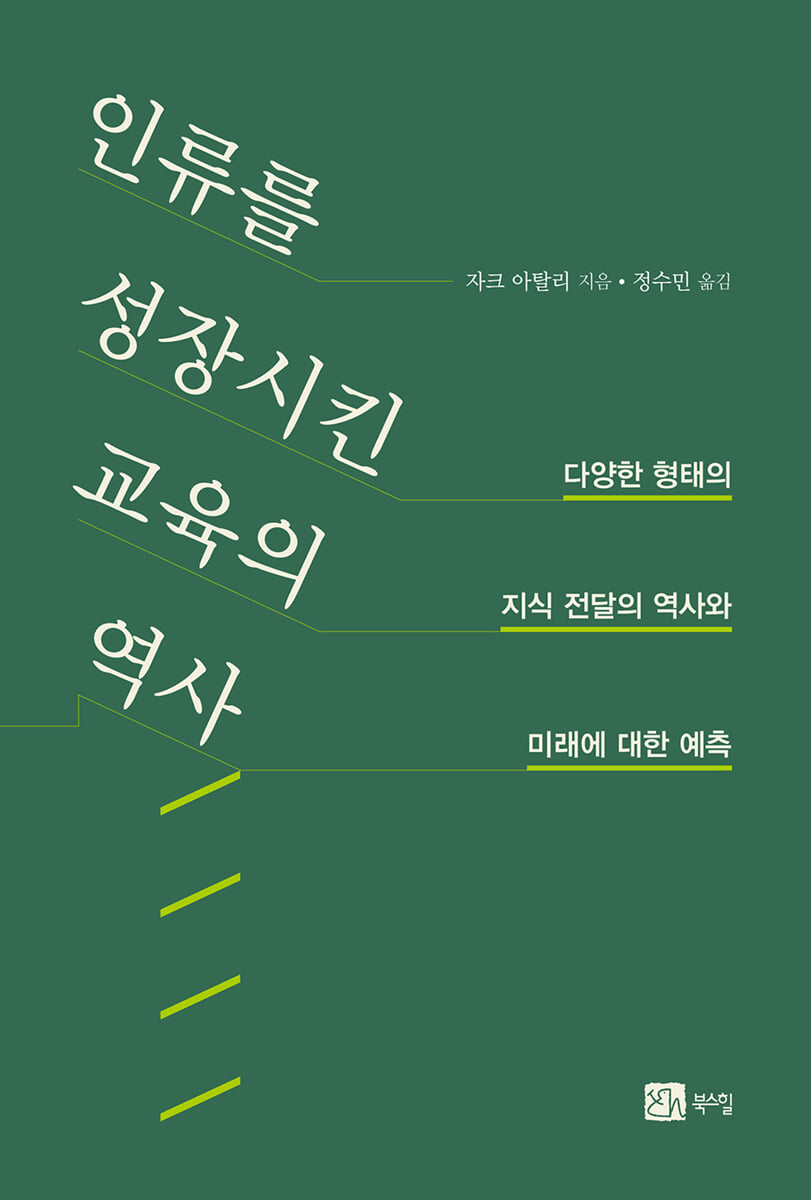
The history of education that fostered human development
 |
Description
Book Introduction
Europe's greatest scholar
Jacques Attali reports
The Grand History of World Education
What would humanity be like without those who accumulated, protected, and shared knowledge for millennia? What would become of us if the numbers and letters that fueled civilization, the books of Plato and Aristotle, and the music of Bach and Mozart disappeared? And what would happen to the future?
Jacques Attali, who has covered the history and future of diverse topics in numerous books, has now compiled the vast history of global education into a single book.
This book tells the story of the history of various forms of knowledge transmission and the future of education.
This book calmly retraces the grand history of education around the world, from ancient times to the present day, and encompasses the educational realities of many countries around the world.
In this book, Jacques Attali does not simply examine the history of education, but also provides insight into the future of education.
Let's embark on a journey with this book to the site of education that has continued for thousands of years.
Jacques Attali reports
The Grand History of World Education
What would humanity be like without those who accumulated, protected, and shared knowledge for millennia? What would become of us if the numbers and letters that fueled civilization, the books of Plato and Aristotle, and the music of Bach and Mozart disappeared? And what would happen to the future?
Jacques Attali, who has covered the history and future of diverse topics in numerous books, has now compiled the vast history of global education into a single book.
This book tells the story of the history of various forms of knowledge transmission and the future of education.
This book calmly retraces the grand history of education around the world, from ancient times to the present day, and encompasses the educational realities of many countries around the world.
In this book, Jacques Attali does not simply examine the history of education, but also provides insight into the future of education.
Let's embark on a journey with this book to the site of education that has continued for thousands of years.
- You can preview some of the book's contents.
Preview
index
introduction
Chapter 1: Transmission in the same way
Scribes and judges
The Scribe and the House of Life
Pariah and Brahmin
Brush and School
Transmission of the Law
School and educator
Scholars and pedants
Druid and Bard
Chapter 2 When Monotheism Completely Controlled Education
Rabbis and the Talmud
Educated in the Empire, Fighting the Empire
In China, where atheistic education was practiced to serve the emperor
Persia, where the tradition of Gatas was being passed down
Europe: The Church Takes Control of Education
Charlemagne, the Court School, and the "Double School"
The Eastern Roman Empire: The First University in Christendom
The Islamic World: Dual Knowledge
Flanders and Veneto: Citizen Schools Against Monastic Schools
Other European regions until the 14th century: parochial and episcopal schools still used in cities.
Western Europe's first college and university
Family and occupational transmission in Europe
Bishop's School Open to Students Other Than Future Clergy
Meanwhile, education for the emperor was carried out in China.
Chapter 3: Printing, Reformation, and Ambition
china
Printing, the Reformation, and the Transmission of Knowledge
In Germany, Luther, who made people read the Bible, destroyed the church.
From the Netherlands to the Dutch Republic: The First Literacy for the Masses
Sweden: The second country to achieve universal literacy, whether voluntarily or involuntarily.
Saxe-Gotha, the first absolutely compulsory education plan
Britain: From Erasmus to Locke: A Careful and Practical Education
Venice in Decline, Bologna in Resistance
Jesuit Education: Excellence in Faith
France, from Rabelais to Montaigne: Schools Fail to Escape Church Control
Adeok School: Educating Poor Students a Little Better
Some unique educational examples
America: Evangelism and Colonization
Islamic Regions: Rejecting Printing and Knowledge
Chapter 4: The Ideal of Education Against the Obligation to Transmit
China and Islam: A Rigid Universe
The Netherlands: A country that achieved remarkable economic success without universal education.
UK: Schools that don't exist except for the purpose of transferring power
Prussia: Schools used for the state, such as the army and the church.
Russia: The important thing is that no one educates
France: Religious education has declined somewhat, but religion still controls education.
Horizontal Changes: Books and Newspapers
British Colonies: From the American Revolution to India
France, the first utopia: schools for citizens
Chapter 5: Transmitting the Demands of Capital
UK: Educate poor students, but don't overeducate them.
America: A School for Building a Nation
Prussia: A School of Violent Obedience
France: A Long Struggle to Eliminate Church Influence in Schools
Algeria and other French colonies: enslavement without education
Russia: Deliberate Backwardness
Other European countries: Developing in a similar direction
The Ottoman Empire and the Islamic World: The Delay Repeats
India: Everything was prepared for imperial rule, but nothing was left for the Indians.
Mexico: The first secular education system in the Americas
Brazil: Baby Steps
Argentina: The Italy of the Americas
China: A 2,000-Year-Old System Faces Death
Japan: Totalitarian Westernization
Chapter 6: The Beginning of Education for All, the Best and the Worst
America: Mass production education, excluding education for the rich
UK: Education for all, but to each at home
France, the endless war of separation of church and state
Germany: A Tragic Story of Recovery
Switzerland: A multilingual country with many of the world's best universities.
Spain: Caught up at lightning speed, but with poor results
Italy: A much-overdue reform
Finland: A World-Leading Education System Built on Collaboration
Sweden: How They Ruined Their Education System in 20 Years
Canada: One of the world's best education systems, fully decentralized.
Estonia: The country where parents' social status has the least impact on their children's academic performance.
The European Union: Several Attempts at Harmonization
Singapore: One of the world's most competitive and best education systems
Korea: A ruthless competition that produces both excellent results and many tragedies.
Japan: The most competitive system in a country where children will soon disappear
China: Everything for the Empire and the Emperor
Israel: A Complex System
Russia, Soviet Union, Russia: From one disaster to another
India: An absolute disaster
Pakistan: Abysmal Secular Education
Brazil: Poor Education, Politically Cracked
Mexico: The Fall of a Potentially Successful Nation
Chile: Full privatization
Argentina: The most advanced country in Latin America overall.
Sub-Saharan Africa: An Educational Disaster
Nigeria: The World's Worst Education System
Democratic Republic of the Congo: A Tragedy in a French-Speaking Country
Ethiopia: A Successful African Nation Threatened by Civil War
Saudi Arabia: Recent Developments
Morocco: Excellent, but too far behind to catch up
Algeria: A school system handicapped by its past
Tunisia: A Case Study in a Deteriorating Education System
international organizations
Private Schools: For Profit or for the Poor?
Religious education, especially in Islam
Family inheritance and homeschooling are clearly proven successes.
Education through labor, with its pros and cons
Unabated educational violence
Horizontal Change: The Digital Tsunami
COVID-19: The Disaster of Schoolless Education Nearly Everywhere
A Few Things Neuroscience Teaches Us
The World Now: Some Major Types of Teaching Methods
The overall picture in 2022: A still elitist system that has failed almost everyone.
Chapter 7 The Future: Homo Barbaricus or Homo Hyper Sapiens
Lessons learned from the past
Questions for the future
Transmitting and educating 9 billion people
Scenario One: The Barbarism of Ignorance
Second Scenario: The Savagery of Artifacts
Wishing for the demise of schools
Transmission through digital artifacts
Transmission using neuroprosthetic technology
Transmission through genetic manipulation
Third Scenario: Towards Homo Hyper Sapiens and a Supercollective Consciousness
Learn at every age in life
Weaknesses to eliminate, qualities to encourage
Knowledge to be passed on: New 4
Jobs to prepare for
Pedagogy of the Future
Lifelong education and career guidance that will continue even after economic activity
Bringing New Value to the Classroom: Hybrid Classrooms
Education of Tomorrow
Knowledge transfer as part of the bioeconomy
From Homo hyper sapiens to hyper collective consciousness
conclusion
References
Author's book
Acknowledgements
Search
Chapter 1: Transmission in the same way
Scribes and judges
The Scribe and the House of Life
Pariah and Brahmin
Brush and School
Transmission of the Law
School and educator
Scholars and pedants
Druid and Bard
Chapter 2 When Monotheism Completely Controlled Education
Rabbis and the Talmud
Educated in the Empire, Fighting the Empire
In China, where atheistic education was practiced to serve the emperor
Persia, where the tradition of Gatas was being passed down
Europe: The Church Takes Control of Education
Charlemagne, the Court School, and the "Double School"
The Eastern Roman Empire: The First University in Christendom
The Islamic World: Dual Knowledge
Flanders and Veneto: Citizen Schools Against Monastic Schools
Other European regions until the 14th century: parochial and episcopal schools still used in cities.
Western Europe's first college and university
Family and occupational transmission in Europe
Bishop's School Open to Students Other Than Future Clergy
Meanwhile, education for the emperor was carried out in China.
Chapter 3: Printing, Reformation, and Ambition
china
Printing, the Reformation, and the Transmission of Knowledge
In Germany, Luther, who made people read the Bible, destroyed the church.
From the Netherlands to the Dutch Republic: The First Literacy for the Masses
Sweden: The second country to achieve universal literacy, whether voluntarily or involuntarily.
Saxe-Gotha, the first absolutely compulsory education plan
Britain: From Erasmus to Locke: A Careful and Practical Education
Venice in Decline, Bologna in Resistance
Jesuit Education: Excellence in Faith
France, from Rabelais to Montaigne: Schools Fail to Escape Church Control
Adeok School: Educating Poor Students a Little Better
Some unique educational examples
America: Evangelism and Colonization
Islamic Regions: Rejecting Printing and Knowledge
Chapter 4: The Ideal of Education Against the Obligation to Transmit
China and Islam: A Rigid Universe
The Netherlands: A country that achieved remarkable economic success without universal education.
UK: Schools that don't exist except for the purpose of transferring power
Prussia: Schools used for the state, such as the army and the church.
Russia: The important thing is that no one educates
France: Religious education has declined somewhat, but religion still controls education.
Horizontal Changes: Books and Newspapers
British Colonies: From the American Revolution to India
France, the first utopia: schools for citizens
Chapter 5: Transmitting the Demands of Capital
UK: Educate poor students, but don't overeducate them.
America: A School for Building a Nation
Prussia: A School of Violent Obedience
France: A Long Struggle to Eliminate Church Influence in Schools
Algeria and other French colonies: enslavement without education
Russia: Deliberate Backwardness
Other European countries: Developing in a similar direction
The Ottoman Empire and the Islamic World: The Delay Repeats
India: Everything was prepared for imperial rule, but nothing was left for the Indians.
Mexico: The first secular education system in the Americas
Brazil: Baby Steps
Argentina: The Italy of the Americas
China: A 2,000-Year-Old System Faces Death
Japan: Totalitarian Westernization
Chapter 6: The Beginning of Education for All, the Best and the Worst
America: Mass production education, excluding education for the rich
UK: Education for all, but to each at home
France, the endless war of separation of church and state
Germany: A Tragic Story of Recovery
Switzerland: A multilingual country with many of the world's best universities.
Spain: Caught up at lightning speed, but with poor results
Italy: A much-overdue reform
Finland: A World-Leading Education System Built on Collaboration
Sweden: How They Ruined Their Education System in 20 Years
Canada: One of the world's best education systems, fully decentralized.
Estonia: The country where parents' social status has the least impact on their children's academic performance.
The European Union: Several Attempts at Harmonization
Singapore: One of the world's most competitive and best education systems
Korea: A ruthless competition that produces both excellent results and many tragedies.
Japan: The most competitive system in a country where children will soon disappear
China: Everything for the Empire and the Emperor
Israel: A Complex System
Russia, Soviet Union, Russia: From one disaster to another
India: An absolute disaster
Pakistan: Abysmal Secular Education
Brazil: Poor Education, Politically Cracked
Mexico: The Fall of a Potentially Successful Nation
Chile: Full privatization
Argentina: The most advanced country in Latin America overall.
Sub-Saharan Africa: An Educational Disaster
Nigeria: The World's Worst Education System
Democratic Republic of the Congo: A Tragedy in a French-Speaking Country
Ethiopia: A Successful African Nation Threatened by Civil War
Saudi Arabia: Recent Developments
Morocco: Excellent, but too far behind to catch up
Algeria: A school system handicapped by its past
Tunisia: A Case Study in a Deteriorating Education System
international organizations
Private Schools: For Profit or for the Poor?
Religious education, especially in Islam
Family inheritance and homeschooling are clearly proven successes.
Education through labor, with its pros and cons
Unabated educational violence
Horizontal Change: The Digital Tsunami
COVID-19: The Disaster of Schoolless Education Nearly Everywhere
A Few Things Neuroscience Teaches Us
The World Now: Some Major Types of Teaching Methods
The overall picture in 2022: A still elitist system that has failed almost everyone.
Chapter 7 The Future: Homo Barbaricus or Homo Hyper Sapiens
Lessons learned from the past
Questions for the future
Transmitting and educating 9 billion people
Scenario One: The Barbarism of Ignorance
Second Scenario: The Savagery of Artifacts
Wishing for the demise of schools
Transmission through digital artifacts
Transmission using neuroprosthetic technology
Transmission through genetic manipulation
Third Scenario: Towards Homo Hyper Sapiens and a Supercollective Consciousness
Learn at every age in life
Weaknesses to eliminate, qualities to encourage
Knowledge to be passed on: New 4
Jobs to prepare for
Pedagogy of the Future
Lifelong education and career guidance that will continue even after economic activity
Bringing New Value to the Classroom: Hybrid Classrooms
Education of Tomorrow
Knowledge transfer as part of the bioeconomy
From Homo hyper sapiens to hyper collective consciousness
conclusion
References
Author's book
Acknowledgements
Search
Detailed image
.jpg)
Into the book
Around 3400 BC, the relationship between knowledge and tradition changed completely.
What appears to be the first writing system of mankind emerged in Uruk, the capital of one of the first empires built along the Euphrates, one of Mesopotamia's great rivers.
It is called 'cuneiform' because it is a wedge-shaped pictogram carved with the end of a reed on a clay tablet.
Cuneiform was used to write Sumerian and Akkadian.
Writing has a huge impact on the brain, transmission, power, and economic transformation.
---From "Transmission in the Same Way"
In 70 AD, the Romans destroyed the Second Temple in Jerusalem, but the rabbis did not give up.
They gathered around one of them, Yohanan ben Zakkai, and with the consent of the Romans, they established a school in Yavneh.
There, dozens of rabbis gathered their commentaries, which later formed the content of the Talmud.
They reminded us that the transmission of language, faith, and knowledge was more important than ever for the survival of a people beginning to disperse.
To a child, a teacher was more important than a father, and living in a village without a school was a sin.
---From "When Monotheism Completely Controlled Education"
A major technological innovation called printing changed everything.
Printing was used primarily to improve the transmission of knowledge by making it accessible at a lower cost.
Next, Christians protesting against the corruption of the Roman Church in some northern European regions revived the old 20th-century Jewish demand that all children be able to read and write so that they could study the Torah themselves.
For 150 years, the few schools established for this purpose also taught knowledge of reason.
In the growing cities, countless children roaming the streets were locked up under the vain pretext of education.
---From "Printing, Reformation, and Ambition"
Around the same time, in 1787, Andrew Bell, a British clergyman and educator, left for another colony, India.
Arriving in Madras, he became chaplain to several British regiments.
In 1789, he was appointed superintendent of an asylum for orphans and illegitimate children of military officers.
He saw Christian children in Malabar teaching the alphabet to other children by drawing in the sand, and the idea of assigning excellent students the task of helping their friends came to him.
(…) This method reduced the need for teachers and led to the examination of mass education as an alternative to the level-based classes already used in almost all of Europe.
Moreover, this system foreshadowed the education that would reappear much later under the name of teacher-less peer learning.
---From "The Ideal of Education Against the Duty of Transmission"
In cities, reading skills have become increasingly important for understanding the messages conveyed in newspapers, books, and posters, and writing skills have also become crucial for filling out administrative forms and communicating with others through correspondence.
With the ever-increasing commercial and artisan lifestyles, now even industrial, it became necessary to know how to calculate in order to carry out activities in these fields.
If for thousands of years accounting justified teaching arithmetic to a few people, and architecture required teaching geometry to some, now, alongside these knowledge, new professions such as steam engine or loom makers, mechanics, foremen, and agricultural and industrial engineers increasingly required additional knowledge.
---From "Transmitting the Demands of Capital"
In many parts of the world, religious values are taught through families and schools, without contrasting them with the values of reason.
All over the world, through the Internet, families, churches, and schools, an increasingly ideological, conspiratorial, and totalitarian education is spreading rather than a scientific one.
Moreover, what reason recommends and what propagandists put out are treated as of equal value.
775 million people are virtually illiterate, two-thirds of whom are women.
According to data from the UNESCO Institute for Statistics, in 2018, 258 million children and adolescents were not in primary school, and 500 million had difficulty getting to school.
Rural African youth have fewer opportunities for education than their urban counterparts.
---From "The Beginning of Education for All, the Best and Worst Education"
Technology will also contribute to distrust in schools.
Despite significant efforts over at least 200 years in many countries to develop less authoritarian and more engaging teaching methods, the educational methods used today in many countries are still largely based on punishment, fear of failure, discipline, obedience to authority, repetition, and memorization.
All of this is a stark contrast to what teenagers experience when they spend more time digitally than they do in school.
They value gratification over punishment, games over effort, narcissism over curiosity, freedom over constraint, and moments over long periods of time.
The hierarchical and centralized nature of teachers is slowing down the development and introduction of innovation in teachers.
What appears to be the first writing system of mankind emerged in Uruk, the capital of one of the first empires built along the Euphrates, one of Mesopotamia's great rivers.
It is called 'cuneiform' because it is a wedge-shaped pictogram carved with the end of a reed on a clay tablet.
Cuneiform was used to write Sumerian and Akkadian.
Writing has a huge impact on the brain, transmission, power, and economic transformation.
---From "Transmission in the Same Way"
In 70 AD, the Romans destroyed the Second Temple in Jerusalem, but the rabbis did not give up.
They gathered around one of them, Yohanan ben Zakkai, and with the consent of the Romans, they established a school in Yavneh.
There, dozens of rabbis gathered their commentaries, which later formed the content of the Talmud.
They reminded us that the transmission of language, faith, and knowledge was more important than ever for the survival of a people beginning to disperse.
To a child, a teacher was more important than a father, and living in a village without a school was a sin.
---From "When Monotheism Completely Controlled Education"
A major technological innovation called printing changed everything.
Printing was used primarily to improve the transmission of knowledge by making it accessible at a lower cost.
Next, Christians protesting against the corruption of the Roman Church in some northern European regions revived the old 20th-century Jewish demand that all children be able to read and write so that they could study the Torah themselves.
For 150 years, the few schools established for this purpose also taught knowledge of reason.
In the growing cities, countless children roaming the streets were locked up under the vain pretext of education.
---From "Printing, Reformation, and Ambition"
Around the same time, in 1787, Andrew Bell, a British clergyman and educator, left for another colony, India.
Arriving in Madras, he became chaplain to several British regiments.
In 1789, he was appointed superintendent of an asylum for orphans and illegitimate children of military officers.
He saw Christian children in Malabar teaching the alphabet to other children by drawing in the sand, and the idea of assigning excellent students the task of helping their friends came to him.
(…) This method reduced the need for teachers and led to the examination of mass education as an alternative to the level-based classes already used in almost all of Europe.
Moreover, this system foreshadowed the education that would reappear much later under the name of teacher-less peer learning.
---From "The Ideal of Education Against the Duty of Transmission"
In cities, reading skills have become increasingly important for understanding the messages conveyed in newspapers, books, and posters, and writing skills have also become crucial for filling out administrative forms and communicating with others through correspondence.
With the ever-increasing commercial and artisan lifestyles, now even industrial, it became necessary to know how to calculate in order to carry out activities in these fields.
If for thousands of years accounting justified teaching arithmetic to a few people, and architecture required teaching geometry to some, now, alongside these knowledge, new professions such as steam engine or loom makers, mechanics, foremen, and agricultural and industrial engineers increasingly required additional knowledge.
---From "Transmitting the Demands of Capital"
In many parts of the world, religious values are taught through families and schools, without contrasting them with the values of reason.
All over the world, through the Internet, families, churches, and schools, an increasingly ideological, conspiratorial, and totalitarian education is spreading rather than a scientific one.
Moreover, what reason recommends and what propagandists put out are treated as of equal value.
775 million people are virtually illiterate, two-thirds of whom are women.
According to data from the UNESCO Institute for Statistics, in 2018, 258 million children and adolescents were not in primary school, and 500 million had difficulty getting to school.
Rural African youth have fewer opportunities for education than their urban counterparts.
---From "The Beginning of Education for All, the Best and Worst Education"
Technology will also contribute to distrust in schools.
Despite significant efforts over at least 200 years in many countries to develop less authoritarian and more engaging teaching methods, the educational methods used today in many countries are still largely based on punishment, fear of failure, discipline, obedience to authority, repetition, and memorization.
All of this is a stark contrast to what teenagers experience when they spend more time digitally than they do in school.
They value gratification over punishment, games over effort, narcissism over curiosity, freedom over constraint, and moments over long periods of time.
The hierarchical and centralized nature of teachers is slowing down the development and introduction of innovation in teachers.
---From "The Future: Homo Barbaricus or Homo Hyper Sapiens"
Publisher's Review
From ancient times to the present day,
The evolution of education over thousands of years
The transmission of knowledge took place long before the emergence of language.
Our ancestors wanted to pass on to their descendants the knowledge necessary for survival.
The skills of making tools and other things were passed down through examples and imitation, and later, with the emergence of language, stories and knowledge were conveyed through songs.
As settled life began, the first villages arose, and accumulation became possible, accounting became necessary.
For this purpose, counting emerged, and experts in this field trained successors for generations.
After writing was invented in the first empires of Mesopotamia, knowledge was transmitted through clay tablets or papyrus.
Work became more specialized, sons usually took over their fathers' jobs, and daughters' education fell to mothers.
4,000 years ago, the first educational institutions, the ancestors of today's universities, appeared.
It began in Mesopotamia and later appeared in India, Egypt, and China, and developed knowledge such as mathematics, medicine, and philosophy that we know today.
Later, in Greece and Rome, educational institutions were built exclusively for the children of the ruling classes, and philosophy was taught there.
During the first millennium AD, most knowledge was transmitted everywhere through mothers, and even very young children had to be taught work-related knowledge.
In Europe, the teaching methods, philosophies, and scientific disciplines inherited from ancient Greece and Rome began to increasingly conflict with Christian and Islamic doctrines.
As religion took the lead in education, education was only permitted to the clergy.
Because religious leaders had to seize power by enforcing their own defined ethics and by confining the transmission of knowledge to their own priests.
Beginning in the 14th century, schools and universities in Flanders and Venice, which had escaped the control of the Catholic Church, and later in Germany, where printing and the Reformation had arrived, began to teach not only future clergy but also others the knowledge needed to break free from the constraints of the Church.
In the 17th century, a theoretically compulsory system of primary education emerged in the Protestant Netherlands and Sweden.
In the 18th century, as Europe began to gain influence in the world economy and politics, it became necessary to educate more people for activities essential to the functioning of society, and technological advances gave rise to more friendly methods of education and new means of cultural transmission.
The desire for freedom, which emerged with the Reformation, nationalism, and the works of daring writers, created a desire to know more than just the demands of one's profession.
Following this trend, in the late 18th century, Europe and North America gradually realized the utopia of liberating and equal schools for all.
In the 19th century, with its explosive technological advancements, the need to impart new knowledge to young people grew, giving Europe and the United States more incentive to send more children to school.
Although the number of primary schools in Europe was increasing, secondary and tertiary institutions remained primarily for privileged urban youth.
Entering the 20th century, many countries felt the need to establish mass education as a driving force for growth, and various forms of education were initiated.
The past and present of education,
Insights into the future of education
In this way, the transmission of knowledge has continued for a very long time all over the world.
The way knowledge is transmitted has played a crucial role in the development of culture, power relations, ideology, and religion, and those in power in the past have sought to deprive the majority of their citizens of knowledge that threatens their privileges.
The education system sought fairness but was clumsy, and it promoted equity but was not fair.
The situation is getting worse.
Schools have only recently established themselves as centers of knowledge transmission, but today's traditional schools are on the verge of collapse due to population problems and the digital age.
From this future, Atali envisages two scenarios.
The first scenario is that the education system collapses due to funding shortages caused by a rapidly growing population, while the second scenario is that most knowledge is transmitted digitally and then in person.
This second scenario also includes the possibility of directly linking brains and machines, filling them with knowledge and even turning humans into artifacts themselves.
In either of these scenarios, or more likely a combination of the two, schools will soon disappear.
And perhaps, as in the distant past, only the very wealthy will have the right to access quality knowledge.
If we overlook this in the coming future, humanity will struggle to escape the new barbarism created by ignorance and unskilled technology.
However, we are exploring ways to provide educational opportunities to many people for a world in harmony with nature.
If all humans are not educated to build and protect the future, can we truly dream of freedom? Can we preserve nature? Through this book, we will retrace the long history of education, assess the present, and prepare for the future.
The evolution of education over thousands of years
The transmission of knowledge took place long before the emergence of language.
Our ancestors wanted to pass on to their descendants the knowledge necessary for survival.
The skills of making tools and other things were passed down through examples and imitation, and later, with the emergence of language, stories and knowledge were conveyed through songs.
As settled life began, the first villages arose, and accumulation became possible, accounting became necessary.
For this purpose, counting emerged, and experts in this field trained successors for generations.
After writing was invented in the first empires of Mesopotamia, knowledge was transmitted through clay tablets or papyrus.
Work became more specialized, sons usually took over their fathers' jobs, and daughters' education fell to mothers.
4,000 years ago, the first educational institutions, the ancestors of today's universities, appeared.
It began in Mesopotamia and later appeared in India, Egypt, and China, and developed knowledge such as mathematics, medicine, and philosophy that we know today.
Later, in Greece and Rome, educational institutions were built exclusively for the children of the ruling classes, and philosophy was taught there.
During the first millennium AD, most knowledge was transmitted everywhere through mothers, and even very young children had to be taught work-related knowledge.
In Europe, the teaching methods, philosophies, and scientific disciplines inherited from ancient Greece and Rome began to increasingly conflict with Christian and Islamic doctrines.
As religion took the lead in education, education was only permitted to the clergy.
Because religious leaders had to seize power by enforcing their own defined ethics and by confining the transmission of knowledge to their own priests.
Beginning in the 14th century, schools and universities in Flanders and Venice, which had escaped the control of the Catholic Church, and later in Germany, where printing and the Reformation had arrived, began to teach not only future clergy but also others the knowledge needed to break free from the constraints of the Church.
In the 17th century, a theoretically compulsory system of primary education emerged in the Protestant Netherlands and Sweden.
In the 18th century, as Europe began to gain influence in the world economy and politics, it became necessary to educate more people for activities essential to the functioning of society, and technological advances gave rise to more friendly methods of education and new means of cultural transmission.
The desire for freedom, which emerged with the Reformation, nationalism, and the works of daring writers, created a desire to know more than just the demands of one's profession.
Following this trend, in the late 18th century, Europe and North America gradually realized the utopia of liberating and equal schools for all.
In the 19th century, with its explosive technological advancements, the need to impart new knowledge to young people grew, giving Europe and the United States more incentive to send more children to school.
Although the number of primary schools in Europe was increasing, secondary and tertiary institutions remained primarily for privileged urban youth.
Entering the 20th century, many countries felt the need to establish mass education as a driving force for growth, and various forms of education were initiated.
The past and present of education,
Insights into the future of education
In this way, the transmission of knowledge has continued for a very long time all over the world.
The way knowledge is transmitted has played a crucial role in the development of culture, power relations, ideology, and religion, and those in power in the past have sought to deprive the majority of their citizens of knowledge that threatens their privileges.
The education system sought fairness but was clumsy, and it promoted equity but was not fair.
The situation is getting worse.
Schools have only recently established themselves as centers of knowledge transmission, but today's traditional schools are on the verge of collapse due to population problems and the digital age.
From this future, Atali envisages two scenarios.
The first scenario is that the education system collapses due to funding shortages caused by a rapidly growing population, while the second scenario is that most knowledge is transmitted digitally and then in person.
This second scenario also includes the possibility of directly linking brains and machines, filling them with knowledge and even turning humans into artifacts themselves.
In either of these scenarios, or more likely a combination of the two, schools will soon disappear.
And perhaps, as in the distant past, only the very wealthy will have the right to access quality knowledge.
If we overlook this in the coming future, humanity will struggle to escape the new barbarism created by ignorance and unskilled technology.
However, we are exploring ways to provide educational opportunities to many people for a world in harmony with nature.
If all humans are not educated to build and protect the future, can we truly dream of freedom? Can we preserve nature? Through this book, we will retrace the long history of education, assess the present, and prepare for the future.
GOODS SPECIFICS
- Date of issue: August 15, 2025
- Format: Paperback book binding method guide
- Page count, weight, size: 504 pages | 152*225*26mm
- ISBN13: 9791159716867
- ISBN10: 1159716862
You may also like
카테고리
korean


korean

![ELLE 엘르 스페셜 에디션 A형 : 12월 [2025]](http://librairie.coreenne.fr/cdn/shop/files/b8e27a3de6c9538896439686c6b0e8fb.jpg?v=1766436872&width=3840)


