

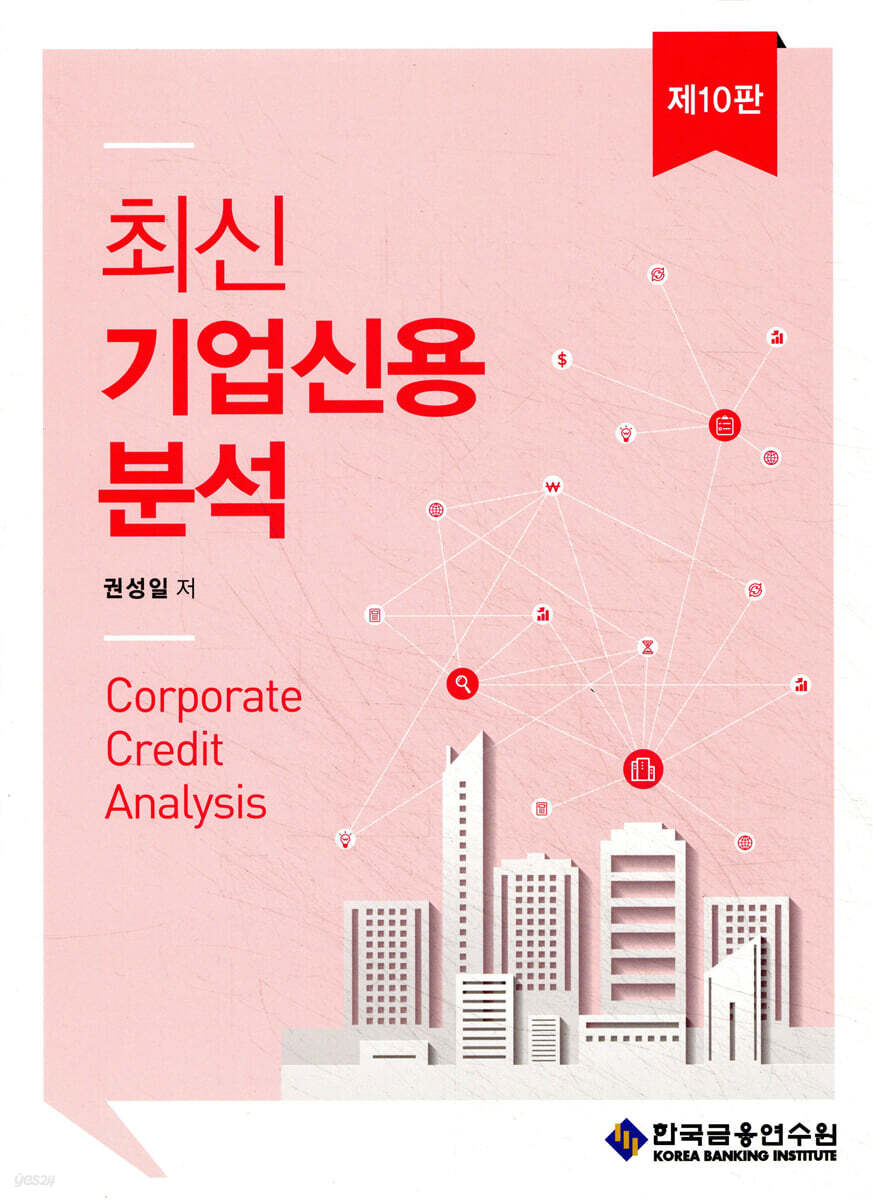
Latest Corporate Credit Analysis
 |
Description
Book Introduction
This book, which explains a new, advanced technique for corporate credit analysis that focuses on analyzing a company's short-term and long-term solvency and future cash generation and repayment capacity (FLC), consists of 13 chapters in 3 parts and an appendix.
Part 1 covers the basics of credit analysis, including cash flow analysis, balance sheet analysis, and income statement analysis.
In Part 2, for a full-scale corporate credit status analysis, various risk factors of a company, such as industrial risk, operating risk, and financial risk, are analyzed using the FLC method, and methods for evaluating sales and profitability analysis, short-term/long-term solvency analysis, and asset value are analyzed, along with an analysis of the process of corporate insolvency and its causes, explained in detail and in an easy-to-understand manner through case studies.
In Part 3, in order to develop a thorough understanding of corporate credit analysis and the ability to apply it to actual work, 45 recently bankrupt or insolvent companies were analyzed as the subjects of analysis. Through an analysis of the cash flow status for four years from three years before bankruptcy to the current year, the ability to identify the signs and characteristics of each of the six stages of corporate insolvency was developed and the KSI model, a technique for analyzing insolvent companies, was introduced.
This book was written by an author who has been in charge of corporate credit analysis at a foreign financial institution for a long time. It focuses on the actual application techniques of advanced financial institutions, which are different from the conventional credit analysis methods seen so far. I am confident that this book will provide an opportunity for both beginners in credit analysis work and experienced readers in this field to learn new, cutting-edge corporate credit analysis techniques.
Part 1 covers the basics of credit analysis, including cash flow analysis, balance sheet analysis, and income statement analysis.
In Part 2, for a full-scale corporate credit status analysis, various risk factors of a company, such as industrial risk, operating risk, and financial risk, are analyzed using the FLC method, and methods for evaluating sales and profitability analysis, short-term/long-term solvency analysis, and asset value are analyzed, along with an analysis of the process of corporate insolvency and its causes, explained in detail and in an easy-to-understand manner through case studies.
In Part 3, in order to develop a thorough understanding of corporate credit analysis and the ability to apply it to actual work, 45 recently bankrupt or insolvent companies were analyzed as the subjects of analysis. Through an analysis of the cash flow status for four years from three years before bankruptcy to the current year, the ability to identify the signs and characteristics of each of the six stages of corporate insolvency was developed and the KSI model, a technique for analyzing insolvent companies, was introduced.
This book was written by an author who has been in charge of corporate credit analysis at a foreign financial institution for a long time. It focuses on the actual application techniques of advanced financial institutions, which are different from the conventional credit analysis methods seen so far. I am confident that this book will provide an opportunity for both beginners in credit analysis work and experienced readers in this field to learn new, cutting-edge corporate credit analysis techniques.
index
Part 1: Essentials of Credit Analysis
Chapter 1 Credit Rating
Chapter 2 Credit Analysis
Chapter 3 Financial Statement Analysis
Chapter 4: Income Statement Analysis
Chapter 5 Cash Flow Analysis
Part 2: Practice and Application
Chapter 6 Industrial Risk
Chapter 7 Management and Operational Risks
Chapter 8: Short-Term Solvency Analysis
Chapter 9: Long-Term Solvency Analysis
Chapter 10: Signs of Corporate Insolvency and Bankruptcy
Chapter 11: Accounting Fraud and Predicting Corporate Insolvency
Part 3: K-IFRS Financial Statement Analysis and Corporate Insolvency Prediction Model
Chapter 12 K-IFRS Financial Statement Analysis
Chapter 13: A Corporate Insolvency Prediction Model Using Cash Flow Analysis
Chapter 1 Credit Rating
Chapter 2 Credit Analysis
Chapter 3 Financial Statement Analysis
Chapter 4: Income Statement Analysis
Chapter 5 Cash Flow Analysis
Part 2: Practice and Application
Chapter 6 Industrial Risk
Chapter 7 Management and Operational Risks
Chapter 8: Short-Term Solvency Analysis
Chapter 9: Long-Term Solvency Analysis
Chapter 10: Signs of Corporate Insolvency and Bankruptcy
Chapter 11: Accounting Fraud and Predicting Corporate Insolvency
Part 3: K-IFRS Financial Statement Analysis and Corporate Insolvency Prediction Model
Chapter 12 K-IFRS Financial Statement Analysis
Chapter 13: A Corporate Insolvency Prediction Model Using Cash Flow Analysis
GOODS SPECIFICS
- Date of issue: August 4, 2025
- Page count, weight, size: 493 pages | 188*257*30mm
- ISBN13: 9788928782734
- ISBN10: 8928782732
You may also like
카테고리
korean


korean

![ELLE 엘르 스페셜 에디션 A형 : 12월 [2025]](http://librairie.coreenne.fr/cdn/shop/files/b8e27a3de6c9538896439686c6b0e8fb.jpg?v=1766436872&width=3840)


