

Probability and Statistics for AI with Python
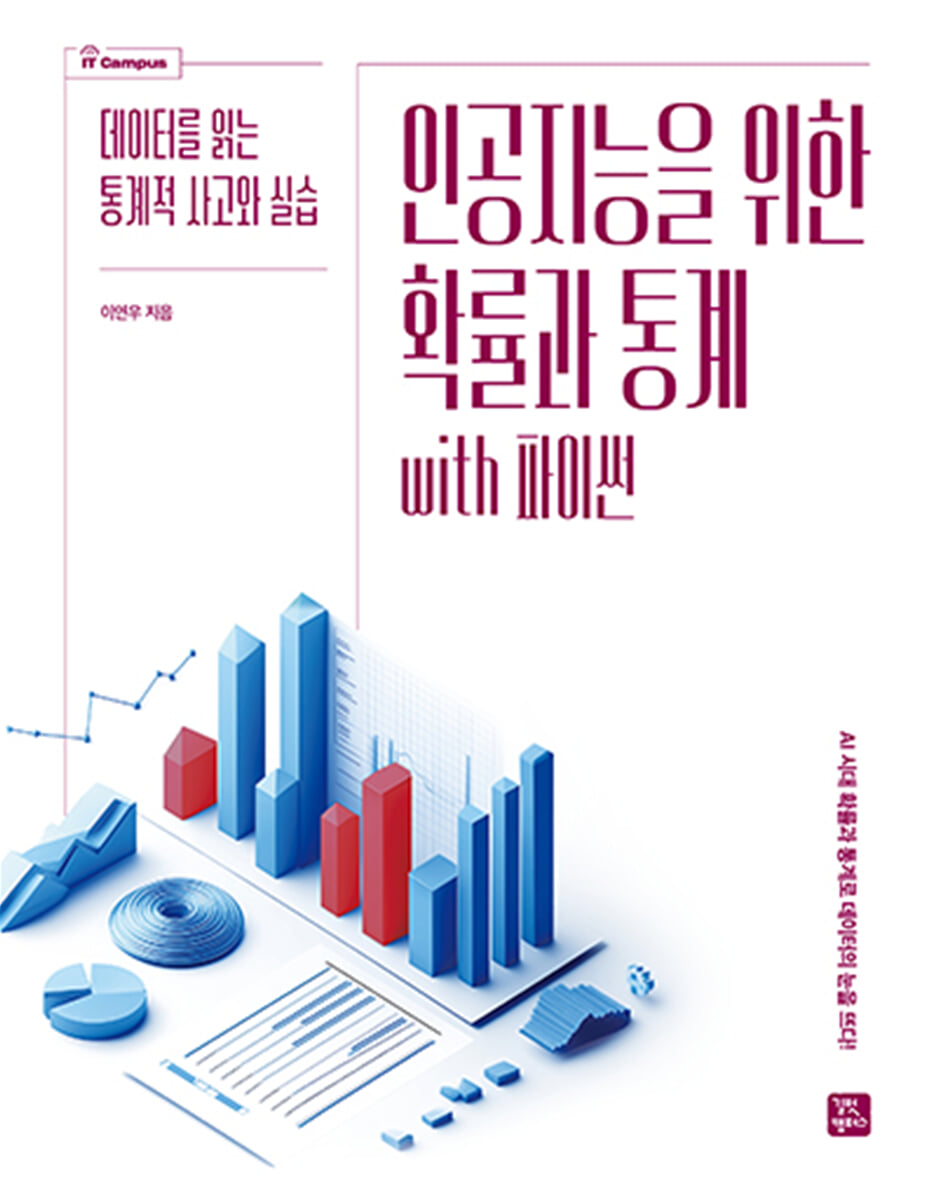 |
Description
Book Introduction
Learning AI Probability and Statistics with Python
Open your eyes to data with probability and statistics in the AI era!
Insight in the AI era begins with "statistical thinking." This is an era where AI solves mathematical problems, analyzes data, and even automatically performs programming.
"Probability and Statistics for AI with Python" is a book that started with the question, "Do we really need to learn probability and statistics in this 'AI revolution era?'"
No matter how advanced AI becomes, asking meaningful questions and interpreting the results remains a human task, and statistical thinking is essential for gaining meaningful insights from the abundance of data.
"Probability and Statistics for AI with Python" might conjure up a math book full of formulas just by its title, but it teaches us about statistics in everyday life in a way that's easy to understand. It covers a variety of step-by-step processes for statistical estimation, from regression analysis models for diabetes to models for diabetes.
Starting from the nature of data and the role of statistics, it moves on to probability concepts, inferential statistics, Bayesian models, regression analysis, and machine learning practice, with real-world examples and Python practice code. It is structured so that anyone interested in probability, statistics, and statistical machine learning, as well as readers who plan to major in data science or artificial intelligence, can follow along on their own.
This book will help you get a little closer to probability and statistics, which have often felt difficult and distant, and will help you understand and utilize data science and AI.
In particular, through hands-on experience using Python, you will be able to interpret data, understand statistical meaning, and apply the theory to AI models.
Open your eyes to data with probability and statistics in the AI era!
Insight in the AI era begins with "statistical thinking." This is an era where AI solves mathematical problems, analyzes data, and even automatically performs programming.
"Probability and Statistics for AI with Python" is a book that started with the question, "Do we really need to learn probability and statistics in this 'AI revolution era?'"
No matter how advanced AI becomes, asking meaningful questions and interpreting the results remains a human task, and statistical thinking is essential for gaining meaningful insights from the abundance of data.
"Probability and Statistics for AI with Python" might conjure up a math book full of formulas just by its title, but it teaches us about statistics in everyday life in a way that's easy to understand. It covers a variety of step-by-step processes for statistical estimation, from regression analysis models for diabetes to models for diabetes.
Starting from the nature of data and the role of statistics, it moves on to probability concepts, inferential statistics, Bayesian models, regression analysis, and machine learning practice, with real-world examples and Python practice code. It is structured so that anyone interested in probability, statistics, and statistical machine learning, as well as readers who plan to major in data science or artificial intelligence, can follow along on their own.
This book will help you get a little closer to probability and statistics, which have often felt difficult and distant, and will help you understand and utilize data science and AI.
In particular, through hands-on experience using Python, you will be able to interpret data, understand statistical meaning, and apply the theory to AI models.
- You can preview some of the book's contents.
Preview
index
Chapter 1: Probability and Statistics
1.1 Data Science and Statistics
1.2 What is Statistics?
1.3 Statistical Model
1.4 Practice Problems
Chapter 2: Fundamentals of Descriptive Statistics
2.1 Types and organization of data
2.2 Descriptive statistics
2.3 Data Visualization
2.4 Practice Problems
Chapter 3: Basic Concepts of Probability
3.1 Basics of Probability
3.2 Rolling Dice with Python
3.3 Probability in Artificial Intelligence
3.4 Practice Problems
Chapter 4 Conditional Probability
4.1 Number of cases
4.2 Types of cases
4.3 Conditional probability
4.4 Conditional probability in artificial intelligence
4.5 Practice Problems
Chapter 5 Bayes' Theorem
5.1 Understanding Bayes' Theorem
5.2 Repeated Bayes' theorem
5.3 Extension of Bayes' theorem
5.4 Bayes' Theorem in Artificial Intelligence
5.5 Practice Problems
Chapter 6: Real-Life Probability Models
6.1 Unarmed Probabilistic Models: Random Walk and Brownian Motion
6.2 Predictive Probability Model: Markov Model
6.3 Repeated Probabilistic Models: Monte Carlo Simulation
6.4 Practice Problems
Chapter 7: Random Variables and Probability Distributions
7.1 Random variables
7.2 Expected value and variance
7.3 Discrete random variable distributions
7.4 Continuous Random Variable Distributions
7.5 Practice Problems
Chapter 8 Statistical Estimation
8.1 Population and Sample Distribution
8.2 Point Estimation
8.3 Interval estimation
8.4 Practice Problems
Chapter 9 Statistical Hypothesis Testing
9.1 Principles of Hypothesis Testing
9.2 Single-Sample Hypothesis Testing
9.3 Two-Sample Hypothesis Testing
9.4 Practice Problems
Chapter 10: Regression Analysis and Prediction
10.1 Regression Analysis
10.2 Least Squares Regression for Estimation and Prediction
10.3 Python Statistical Analysis Techniques
10.4 Practice Problems
Chapter 11: Testing Correlation and Regression Models
11.1 Relationship between Correlation Coefficient and Regression Analysis
11.2 Statistical significance test of regression coefficients
11.3 Variance and coefficient of determination of regression analysis model
11.4 Testing the Fit of the Regression Analysis Model
11.5 Practice Problems
Chapter 12: Machine Learning Regression Analysis
12.1 Interpreting Regression Analysis with Machine Learning
12.2 Gradient Descent
12.3 Stochastic Gradient Descent
12.4 Creating an Advanced Regression Analysis Model
12.5 Practice Problems
Chapter 13: Logistic Regression and Classification
13.1 Understanding Logistic Regression
13.2 Understanding the Logistic Function
13.3 Logistic Regression Analysis Using Python
13.4 Practice Problems
1.1 Data Science and Statistics
1.2 What is Statistics?
1.3 Statistical Model
1.4 Practice Problems
Chapter 2: Fundamentals of Descriptive Statistics
2.1 Types and organization of data
2.2 Descriptive statistics
2.3 Data Visualization
2.4 Practice Problems
Chapter 3: Basic Concepts of Probability
3.1 Basics of Probability
3.2 Rolling Dice with Python
3.3 Probability in Artificial Intelligence
3.4 Practice Problems
Chapter 4 Conditional Probability
4.1 Number of cases
4.2 Types of cases
4.3 Conditional probability
4.4 Conditional probability in artificial intelligence
4.5 Practice Problems
Chapter 5 Bayes' Theorem
5.1 Understanding Bayes' Theorem
5.2 Repeated Bayes' theorem
5.3 Extension of Bayes' theorem
5.4 Bayes' Theorem in Artificial Intelligence
5.5 Practice Problems
Chapter 6: Real-Life Probability Models
6.1 Unarmed Probabilistic Models: Random Walk and Brownian Motion
6.2 Predictive Probability Model: Markov Model
6.3 Repeated Probabilistic Models: Monte Carlo Simulation
6.4 Practice Problems
Chapter 7: Random Variables and Probability Distributions
7.1 Random variables
7.2 Expected value and variance
7.3 Discrete random variable distributions
7.4 Continuous Random Variable Distributions
7.5 Practice Problems
Chapter 8 Statistical Estimation
8.1 Population and Sample Distribution
8.2 Point Estimation
8.3 Interval estimation
8.4 Practice Problems
Chapter 9 Statistical Hypothesis Testing
9.1 Principles of Hypothesis Testing
9.2 Single-Sample Hypothesis Testing
9.3 Two-Sample Hypothesis Testing
9.4 Practice Problems
Chapter 10: Regression Analysis and Prediction
10.1 Regression Analysis
10.2 Least Squares Regression for Estimation and Prediction
10.3 Python Statistical Analysis Techniques
10.4 Practice Problems
Chapter 11: Testing Correlation and Regression Models
11.1 Relationship between Correlation Coefficient and Regression Analysis
11.2 Statistical significance test of regression coefficients
11.3 Variance and coefficient of determination of regression analysis model
11.4 Testing the Fit of the Regression Analysis Model
11.5 Practice Problems
Chapter 12: Machine Learning Regression Analysis
12.1 Interpreting Regression Analysis with Machine Learning
12.2 Gradient Descent
12.3 Stochastic Gradient Descent
12.4 Creating an Advanced Regression Analysis Model
12.5 Practice Problems
Chapter 13: Logistic Regression and Classification
13.1 Understanding Logistic Regression
13.2 Understanding the Logistic Function
13.3 Logistic Regression Analysis Using Python
13.4 Practice Problems
Detailed image

Publisher's Review
Learn probability and statistics through hands-on practice with Python.
From concepts to inference, machine learning regression analysis,
An Introduction to Data Analysis Even Non-Majors Can Understand
Now is the era where AI solves math problems and automates programming.
Yet, ‘probability and statistics’ remain the key to deciphering the data age.
This book is not just a simple math textbook.
Through real-world examples and Python exercises, you'll gain firsthand experience with probability and statistics concepts, even implementing machine learning regression models, and cultivate the ability to connect theory and practice.
A step-by-step explanation and hands-on training structure that anyone can follow, from non-statisticians unfamiliar with statistics to beginners learning AI and data science.
From statistical stories in everyday life to a data analysis journey toward artificial intelligence, your statistics are now in motion.
STEP 1: Understanding the basic concepts of statistics through systematic theory and statistical discussions.
STEP2 Mathematical meaning and examples of probability and statistics
STEP 3: Implementing Artificial Intelligence Principles in Python
STEP 4 Apply and organize what you've learned with various examples and practice problems for each chapter.
From concepts to inference, machine learning regression analysis,
An Introduction to Data Analysis Even Non-Majors Can Understand
Now is the era where AI solves math problems and automates programming.
Yet, ‘probability and statistics’ remain the key to deciphering the data age.
This book is not just a simple math textbook.
Through real-world examples and Python exercises, you'll gain firsthand experience with probability and statistics concepts, even implementing machine learning regression models, and cultivate the ability to connect theory and practice.
A step-by-step explanation and hands-on training structure that anyone can follow, from non-statisticians unfamiliar with statistics to beginners learning AI and data science.
From statistical stories in everyday life to a data analysis journey toward artificial intelligence, your statistics are now in motion.
STEP 1: Understanding the basic concepts of statistics through systematic theory and statistical discussions.
STEP2 Mathematical meaning and examples of probability and statistics
STEP 3: Implementing Artificial Intelligence Principles in Python
STEP 4 Apply and organize what you've learned with various examples and practice problems for each chapter.
GOODS SPECIFICS
- Date of issue: July 31, 2025
- Page count, weight, size: 632 pages | 183*235*26mm
- ISBN13: 9791140714889
- ISBN10: 1140714880
You may also like
카테고리
korean


korean

![GQ KOREA Mark (Monthly): December [2025]](http://librairie.coreenne.fr/cdn/shop/files/8ef265dbbfbf186523ed75ba7319009d.jpg?v=1765340328&width=3840)


