

Walk
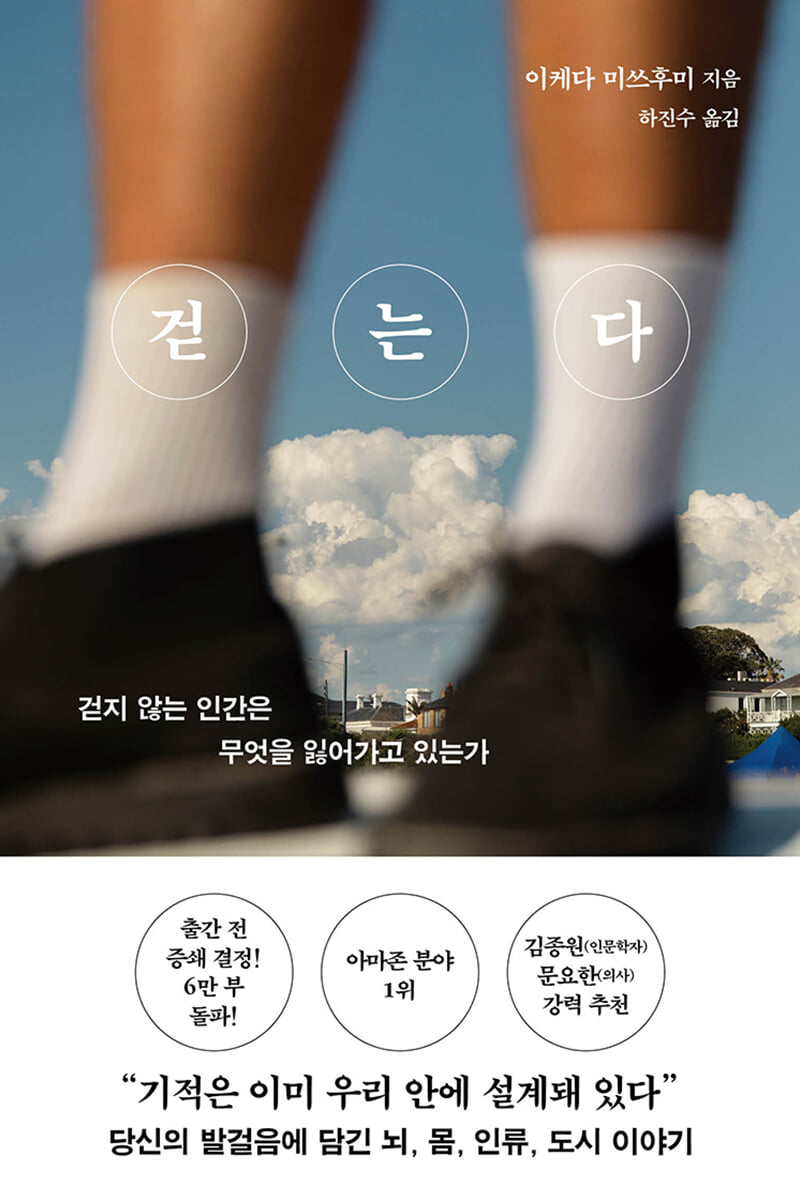 |
Description
Book Introduction
#1 on Amazon, sales exceed 60,000 copies!
From human evolution to street design
The first non-fiction book to delve into "walking" from 360 degrees.
"A day without walking doesn't add up to life!" (Humanist Kim Jong-won)
“A book that makes you want to go for a walk as soon as you start reading it!
The senses and the mind awaken.
“It’s more fun than anything else” (psychiatrist Moon Yo-han)
In your footsteps
A story about the brain, the body, humanity, and the city
'Was walking ever this enjoyable?'
The trigger was a pair of shoes.
After about two years of wearing open-toed shoes, I couldn't wear any other shoes.
Because both my body and my head were surprisingly light.
―From the preface of the book
It's been a long time since humans stopped walking.
What differentiates humans from chimpanzees, who do not even walk 3 kilometers a day, is the act of walking long distances on two feet, which is none other than upright bipedalism.
However, modern people, who spend more than 60% of their waking hours sitting in a chair, live a life that is very different from their original design as ‘walking beings.’
"Walking" is a nonfiction book that explores, based on cutting-edge research and vivid experience, how the simple act of walking connects to all aspects of human life.
The author is an economic journalist who has written articles on the front lines of industry and finance, but one day, an encounter with comfortable shoes opened his eyes to the world of 'walking.'
The column he serialized in the economic media NewsPicks received a warm response from readers, leading to the publication of this book.
The author unfolds a remarkable trajectory of inquiry, traversing neuroscience, anthropology, urban studies, and medical research, extending from the physiology of walking to work, sleep, diet, human relationships, cities, management, and the very structure of happiness.
This book was flooded with requests for reprints even before it was released in Japan, and it became a huge hit, selling over 60,000 copies immediately after its release.
Few people are conscious of their own movements when walking.
Lift your legs, lean your body forward, and look forward.
What the author, who took a fresh look at this movement that he had taken for granted, encountered was the 'wonder of the foot' that even the genius Leonardo da Vinci noticed, and the 'truth' about how modern civilization, which has confined the foot to shoes and replaced it with a car, has taken us farther away from this innate miracle.
In this way, the author dissects walking with six keywords: 'brain-body-city-feet-shoes-nature', searching for a clue to recovering the most natural and therefore happiest sense of human beings.
In 'Brain,' we highlight world leaders who have used walking as a management tool and explore the process by which walking stimulates creativity. In 'Body,' we use the new term "sitting humanity" to point out the pathological problems caused by prolonged sitting.
In 'City', we compare the walking environments of New York, Tokyo, Hong Kong, and Indonesia, and in 'Feet' and 'Shoes', we follow the development stories of leading brands such as Nike to see how technology has transformed our bodies.
In the final chapter, the forgotten meaning of walking in ‘nature’ is unraveled through the experience of trekking in Iceland.
The history of people's poor condition is the history of them becoming sedentary.
"Walking" asks why, in an age of explosive growth in convenience, including AI, we are increasingly losing vitality.
And then we turn our gaze back to the 'toes'.
As one Amazon reader commented, “You can no longer look at walking the same way again,” the book explores the history and daily life surrounding walking from a new perspective, like an exciting mystery novel, centered on sociological, epidemiological, and statistical data.
Walking is more than just a simple movement; it is a persuasive revival of one of the abilities that humans have lost in the fleeting moments of modern times.
By the time you close the last chapter of this book, you too will have come to the same realization.
Walking is a noble thing.
And when you walk, everything changes.
From human evolution to street design
The first non-fiction book to delve into "walking" from 360 degrees.
"A day without walking doesn't add up to life!" (Humanist Kim Jong-won)
“A book that makes you want to go for a walk as soon as you start reading it!
The senses and the mind awaken.
“It’s more fun than anything else” (psychiatrist Moon Yo-han)
In your footsteps
A story about the brain, the body, humanity, and the city
'Was walking ever this enjoyable?'
The trigger was a pair of shoes.
After about two years of wearing open-toed shoes, I couldn't wear any other shoes.
Because both my body and my head were surprisingly light.
―From the preface of the book
It's been a long time since humans stopped walking.
What differentiates humans from chimpanzees, who do not even walk 3 kilometers a day, is the act of walking long distances on two feet, which is none other than upright bipedalism.
However, modern people, who spend more than 60% of their waking hours sitting in a chair, live a life that is very different from their original design as ‘walking beings.’
"Walking" is a nonfiction book that explores, based on cutting-edge research and vivid experience, how the simple act of walking connects to all aspects of human life.
The author is an economic journalist who has written articles on the front lines of industry and finance, but one day, an encounter with comfortable shoes opened his eyes to the world of 'walking.'
The column he serialized in the economic media NewsPicks received a warm response from readers, leading to the publication of this book.
The author unfolds a remarkable trajectory of inquiry, traversing neuroscience, anthropology, urban studies, and medical research, extending from the physiology of walking to work, sleep, diet, human relationships, cities, management, and the very structure of happiness.
This book was flooded with requests for reprints even before it was released in Japan, and it became a huge hit, selling over 60,000 copies immediately after its release.
Few people are conscious of their own movements when walking.
Lift your legs, lean your body forward, and look forward.
What the author, who took a fresh look at this movement that he had taken for granted, encountered was the 'wonder of the foot' that even the genius Leonardo da Vinci noticed, and the 'truth' about how modern civilization, which has confined the foot to shoes and replaced it with a car, has taken us farther away from this innate miracle.
In this way, the author dissects walking with six keywords: 'brain-body-city-feet-shoes-nature', searching for a clue to recovering the most natural and therefore happiest sense of human beings.
In 'Brain,' we highlight world leaders who have used walking as a management tool and explore the process by which walking stimulates creativity. In 'Body,' we use the new term "sitting humanity" to point out the pathological problems caused by prolonged sitting.
In 'City', we compare the walking environments of New York, Tokyo, Hong Kong, and Indonesia, and in 'Feet' and 'Shoes', we follow the development stories of leading brands such as Nike to see how technology has transformed our bodies.
In the final chapter, the forgotten meaning of walking in ‘nature’ is unraveled through the experience of trekking in Iceland.
The history of people's poor condition is the history of them becoming sedentary.
"Walking" asks why, in an age of explosive growth in convenience, including AI, we are increasingly losing vitality.
And then we turn our gaze back to the 'toes'.
As one Amazon reader commented, “You can no longer look at walking the same way again,” the book explores the history and daily life surrounding walking from a new perspective, like an exciting mystery novel, centered on sociological, epidemiological, and statistical data.
Walking is more than just a simple movement; it is a persuasive revival of one of the abilities that humans have lost in the fleeting moments of modern times.
By the time you close the last chapter of this book, you too will have come to the same realization.
Walking is a noble thing.
And when you walk, everything changes.
- You can preview some of the book's contents.
Preview
index
Introduction: Why do humans walk?
Step 1: Brain: Walking Makes Ideas Flow
Even Jobs and Zuckerberg walk recklessly | Great minds noticed | Walking makes your brain younger?! | Stanford's 'walking experiment' | The link between walking and creativity | The walking meeting method | Beethoven, giving the brain a rest
[Column: Habits That Boost Creativity]
Step 2 Body: Homo sedentarius - Sitting Hominids
Five Benefits of Walking | Highlighted on the Apple Watch | Sitting Time Is More Than Sleep | Homo sedentarius
[Column: Habits for Maintaining Health]
Step 3: The City: A Human Experiment on Urbanization
Step Count Rankings Around the World | The New Concept of the "Activity Gap" | The World's Most Walkable Cities | The Current State of the Walking Nation | The US: A Non-Walking Country | The Rising Value of Walkable Streets | Cars vs. Pedestrians | Metro Sapiens
Step 4: The Miracle of Walking on Two Feet
The Mechanism of Walking | Losing Weight by Walking Is Difficult | A Day in the Hunter-Gatherer Era | Feet as Precision Instruments | People with "Modern Footbinding" | Free Your Feet | Our Feet Are Broken
[Column: Changing Shoes Makes You Want to Walk]
Step 5: Shoes: Technology as a Wearable
Another 'Running Lab' | A Harvard Professor's Torch | The Birth of Zero Drop | The Epicness of a Shoe Brand's Creation | Placing the Body in Its 'Natural Position' | Altra's Hypothesis | Why Did the Barefoot Shoe Craze End? | The Meaning of Cushioning | Shoe Rankings for Long-Distance Hikers | The 'Next Wave' in the Footwear Industry | BORN TO WALK
Step 6 Nature: What We Lost with Civilization
The Island of Fire and Ice | Carrying Myself | Seeing the 'Real Reality' | Withdrawal | Learning Through the Body | Theory of Happiness
Step 1: Brain: Walking Makes Ideas Flow
Even Jobs and Zuckerberg walk recklessly | Great minds noticed | Walking makes your brain younger?! | Stanford's 'walking experiment' | The link between walking and creativity | The walking meeting method | Beethoven, giving the brain a rest
[Column: Habits That Boost Creativity]
Step 2 Body: Homo sedentarius - Sitting Hominids
Five Benefits of Walking | Highlighted on the Apple Watch | Sitting Time Is More Than Sleep | Homo sedentarius
[Column: Habits for Maintaining Health]
Step 3: The City: A Human Experiment on Urbanization
Step Count Rankings Around the World | The New Concept of the "Activity Gap" | The World's Most Walkable Cities | The Current State of the Walking Nation | The US: A Non-Walking Country | The Rising Value of Walkable Streets | Cars vs. Pedestrians | Metro Sapiens
Step 4: The Miracle of Walking on Two Feet
The Mechanism of Walking | Losing Weight by Walking Is Difficult | A Day in the Hunter-Gatherer Era | Feet as Precision Instruments | People with "Modern Footbinding" | Free Your Feet | Our Feet Are Broken
[Column: Changing Shoes Makes You Want to Walk]
Step 5: Shoes: Technology as a Wearable
Another 'Running Lab' | A Harvard Professor's Torch | The Birth of Zero Drop | The Epicness of a Shoe Brand's Creation | Placing the Body in Its 'Natural Position' | Altra's Hypothesis | Why Did the Barefoot Shoe Craze End? | The Meaning of Cushioning | Shoe Rankings for Long-Distance Hikers | The 'Next Wave' in the Footwear Industry | BORN TO WALK
Step 6 Nature: What We Lost with Civilization
The Island of Fire and Ice | Carrying Myself | Seeing the 'Real Reality' | Withdrawal | Learning Through the Body | Theory of Happiness
Detailed image

Into the book
As I read through each paper, what I felt was perhaps the opposite of 'people become healthy by walking'.
It was more noticeable that 'the problem arose because people stopped walking.'
In other words, walking is not a 'plus' thing.
Rather, it is closer to returning the minus of disharmony in the human body to ‘zero.’
--- p.84
It is said that two people walking together naturally match each other's walking speed without saying a word.
This stems from the tendency to want to make a good impression on the person walking with you.
It seems like a strange contradiction that Steve Jobs, who may or may not have known about these effects of working meetings and made them a habit, was the one who invented the smartphone, a device that disrupts the focus of conversation and changed our lifestyle overnight.
--- p.88
For Americans and Mexicans, the average activity level, measured by steps taken by smartphones, was the same.
However, Americans have a wider distribution of activity levels than Mexicans.
That is, there is a large gap between people who walk frequently and those who sit frequently, and this is also related to the high prevalence of obesity in the United States as a whole.
What we need to pay attention to here is the reason why there is an activity gap.
Surprisingly, in countries with a large activity gap, women's activity levels were found to be significantly lower than men's.
For example, in Saudi Arabia and the United States, women's activity levels were significantly lower than men's, and this 'gender gap' accounted for 43% of the activity gap.
Why don't women walk?
--- p.109
Wolverine Worldwide, headquartered in suburban West Michigan, was struggling with a staff exodus.
The cause was the lack of ‘street life’.
This means that the families of newly appointed employees have not found any connection with the local community.
Ironically, West Michigan residents are known for their openness and welcoming nature to outsiders.
However, the reason we ended up in this situation is because the exchange center had a fatal flaw: it could only be accessed by vehicle.
Then there is no room to delve into the circle of interaction unless invited.
--- p.125
“Only modern people are obsessed with destinations.”
Narita explained calmly.
“Just walking, having something to eat, and being able to spend time leisurely, that’s enough for me.”
Moreover, the fact that one must choose where to step each time was different from modern walking.
Normally, I walked without paying much attention to whether it was asphalt or stairs, but I realized that it was the city that made me forget about my 'footing'.
--- p.157
“So, to put it another way, are you saying that we are walking around without using our original bodily functions?”
“Yes.”
The most surprising moment was when I saw Director Hideyuki Komine's bare feet.
I don't know if it would be right to say that it is completely different from that of modern people.
The traces of training were evident, and even one of the accompanying cameramen held his breath.
He later whispered, “I’ve never seen feet like those before.”
This does not mean that the shoe size is too big.
I got the impression that the entire foot was three-dimensionally large and that the muscles that gripped the ground were strong.
--- p.165
The more pointed it was, the more I could show off that I was 'at the cutting edge of fashion' and the higher my status was.
There is even an anecdote that because of these shoes, the French army had to cut off the toes of their shoes in order to retreat quickly during the Battle of Nicopolis in 1396, which ended in a landslide victory for the Ottoman Empire.
He even went out to the battlefield wearing full-length boots.
--- p.174
Just the ups and downs leading to the horizon and the sky stretching out above it.
I don't remember ever seeing a 'just blue sky' with absolutely nothing in it.
On the second morning, after walking the long road on foot and overcoming the cold and fatigue, I was overcome by a sense of certainty.
'I walked for this.'
There was no particular scenery that was the goal.
In the city, you can buy comfort with money, but here you can only get it with your own feet and will.
Unlike man-made money or nations, the natural earth is both kind and strict to everyone.
That is, all humans are equal.
It was more noticeable that 'the problem arose because people stopped walking.'
In other words, walking is not a 'plus' thing.
Rather, it is closer to returning the minus of disharmony in the human body to ‘zero.’
--- p.84
It is said that two people walking together naturally match each other's walking speed without saying a word.
This stems from the tendency to want to make a good impression on the person walking with you.
It seems like a strange contradiction that Steve Jobs, who may or may not have known about these effects of working meetings and made them a habit, was the one who invented the smartphone, a device that disrupts the focus of conversation and changed our lifestyle overnight.
--- p.88
For Americans and Mexicans, the average activity level, measured by steps taken by smartphones, was the same.
However, Americans have a wider distribution of activity levels than Mexicans.
That is, there is a large gap between people who walk frequently and those who sit frequently, and this is also related to the high prevalence of obesity in the United States as a whole.
What we need to pay attention to here is the reason why there is an activity gap.
Surprisingly, in countries with a large activity gap, women's activity levels were found to be significantly lower than men's.
For example, in Saudi Arabia and the United States, women's activity levels were significantly lower than men's, and this 'gender gap' accounted for 43% of the activity gap.
Why don't women walk?
--- p.109
Wolverine Worldwide, headquartered in suburban West Michigan, was struggling with a staff exodus.
The cause was the lack of ‘street life’.
This means that the families of newly appointed employees have not found any connection with the local community.
Ironically, West Michigan residents are known for their openness and welcoming nature to outsiders.
However, the reason we ended up in this situation is because the exchange center had a fatal flaw: it could only be accessed by vehicle.
Then there is no room to delve into the circle of interaction unless invited.
--- p.125
“Only modern people are obsessed with destinations.”
Narita explained calmly.
“Just walking, having something to eat, and being able to spend time leisurely, that’s enough for me.”
Moreover, the fact that one must choose where to step each time was different from modern walking.
Normally, I walked without paying much attention to whether it was asphalt or stairs, but I realized that it was the city that made me forget about my 'footing'.
--- p.157
“So, to put it another way, are you saying that we are walking around without using our original bodily functions?”
“Yes.”
The most surprising moment was when I saw Director Hideyuki Komine's bare feet.
I don't know if it would be right to say that it is completely different from that of modern people.
The traces of training were evident, and even one of the accompanying cameramen held his breath.
He later whispered, “I’ve never seen feet like those before.”
This does not mean that the shoe size is too big.
I got the impression that the entire foot was three-dimensionally large and that the muscles that gripped the ground were strong.
--- p.165
The more pointed it was, the more I could show off that I was 'at the cutting edge of fashion' and the higher my status was.
There is even an anecdote that because of these shoes, the French army had to cut off the toes of their shoes in order to retreat quickly during the Battle of Nicopolis in 1396, which ended in a landslide victory for the Ottoman Empire.
He even went out to the battlefield wearing full-length boots.
--- p.174
Just the ups and downs leading to the horizon and the sky stretching out above it.
I don't remember ever seeing a 'just blue sky' with absolutely nothing in it.
On the second morning, after walking the long road on foot and overcoming the cold and fatigue, I was overcome by a sense of certainty.
'I walked for this.'
There was no particular scenery that was the goal.
In the city, you can buy comfort with money, but here you can only get it with your own feet and will.
Unlike man-made money or nations, the natural earth is both kind and strict to everyone.
That is, all humans are equal.
--- p.298
GOODS SPECIFICS
- Date of issue: October 29, 2025
- Page count, weight, size: 316 pages | 130*195*30mm
- ISBN13: 9791140716289
- ISBN10: 114071628X
You may also like
카테고리
korean


korean

![ELLE 엘르 스페셜 에디션 A형 : 12월 [2025]](http://librairie.coreenne.fr/cdn/shop/files/b8e27a3de6c9538896439686c6b0e8fb.jpg?v=1766436872&width=3840)


