

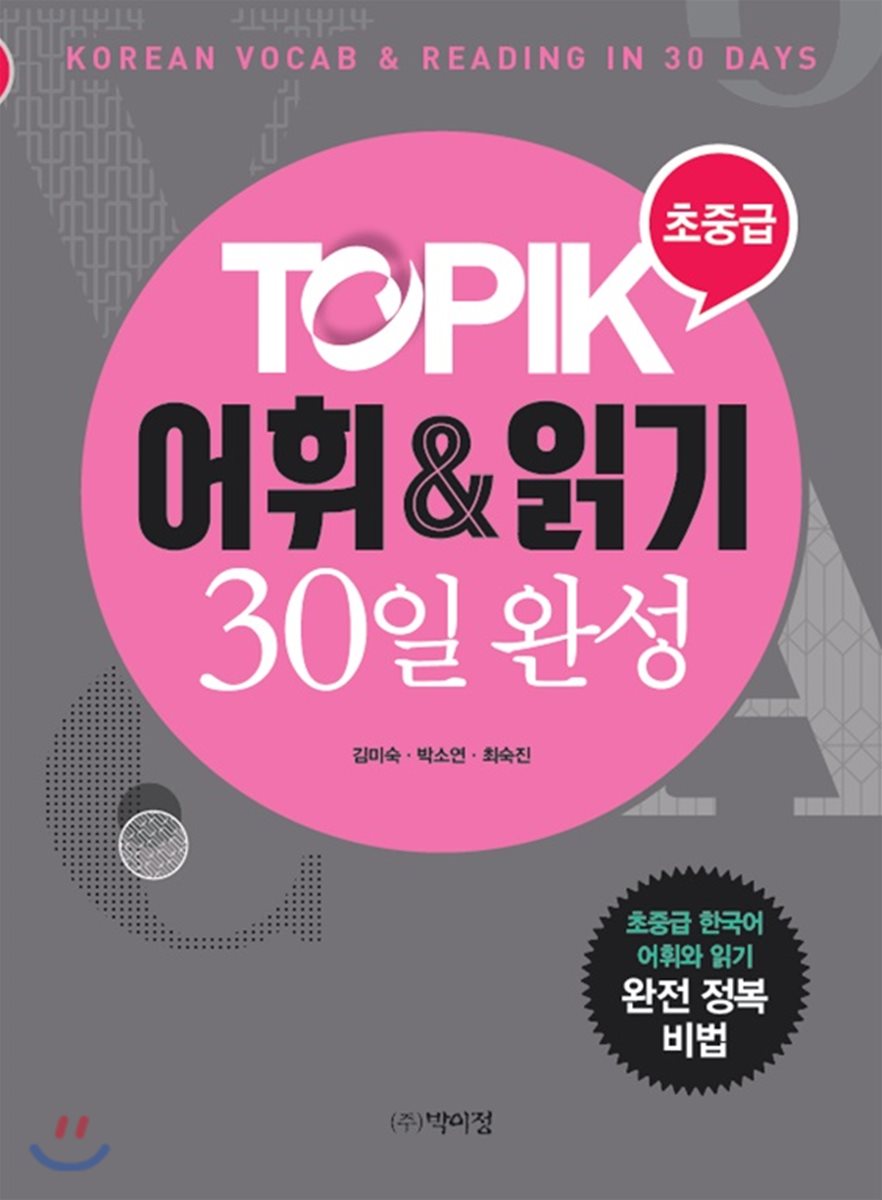
TOPIK Vocabulary & Reading in 30 Days
 |
Description
Book Introduction
Korean language learners often say that the biggest reason they have difficulty communicating is a lack of vocabulary.
Even if you have a little bit of grammar knowledge, having a rich vocabulary is much more advantageous for communication than the opposite case.
In the Test of Proficiency in Korean (TOPIK), a person with a rich vocabulary often receives a high score.
This book was published to improve learners' vocabulary and enhance their proficiency in Korean.
This book is divided into two parts.
[Checking Basic Vocabulary] contains 300 beginner level vocabulary words divided into 15 topics.
We have provided basic vocabulary that must be known by topic and vocabulary that is used together so that you can check your beginner vocabulary.
[TOPIK Test Preparation] presents 600 beginner and intermediate vocabulary, idioms, and proverbs with example sentences.
The content you understand can be used to confirm its use once more through confirmation questions.
We also included reading passages on various topics to help you prepare for the reading section of the Test of Proficiency in Korean (TOPIK).
The vocabulary in this book was selected by analyzing elementary and intermediate textbooks from six Korean language education institutions and past questions from the Test of Proficiency in Korean (TOPIK).
Even if you have a little bit of grammar knowledge, having a rich vocabulary is much more advantageous for communication than the opposite case.
In the Test of Proficiency in Korean (TOPIK), a person with a rich vocabulary often receives a high score.
This book was published to improve learners' vocabulary and enhance their proficiency in Korean.
This book is divided into two parts.
[Checking Basic Vocabulary] contains 300 beginner level vocabulary words divided into 15 topics.
We have provided basic vocabulary that must be known by topic and vocabulary that is used together so that you can check your beginner vocabulary.
[TOPIK Test Preparation] presents 600 beginner and intermediate vocabulary, idioms, and proverbs with example sentences.
The content you understand can be used to confirm its use once more through confirmation questions.
We also included reading passages on various topics to help you prepare for the reading section of the Test of Proficiency in Korean (TOPIK).
The vocabulary in this book was selected by analyzing elementary and intermediate textbooks from six Korean language education institutions and past questions from the Test of Proficiency in Korean (TOPIK).
index
PART 01
Check basic vocabulary
01 Day & Time 09 Hobbies & Exercise
02 Place 10 Food & Taste
03 Appearance 11 Education (Classroom, Lessons)
04 Travel 12 Occupation
05 Seasons and Weather 13 Friends
06 Transportation 14 Shopping
07 House 15 Culture
08 Health
PART 02
Preparing for the TOPIK exam
DAY 01 DAY 13 DAY 25
DAY 02 DAY 14 DAY 26
DAY 03 DAY 15 DAY 27
Reading 01 Reading 05 Reading 09
DAY 04 DAY 16 DAY 28
DAY 05 DAY 17 DAY 29
DAY 06 DAY 18 DAY 30
Reading 02 Reading 06 Reading 10
DAY 07 DAY 19
DAY 08 DAY 20 ?Appendix
DAY 09 DAY 21 Let's check_Answer
Reading 03 Reading 07 Reading_Answer
DAY 10 DAY 22 Vocabulary Index
DAY 11 DAY 23
DAY 12 DAY 24
Reading 04 Reading 08
Check basic vocabulary
01 Day & Time 09 Hobbies & Exercise
02 Place 10 Food & Taste
03 Appearance 11 Education (Classroom, Lessons)
04 Travel 12 Occupation
05 Seasons and Weather 13 Friends
06 Transportation 14 Shopping
07 House 15 Culture
08 Health
PART 02
Preparing for the TOPIK exam
DAY 01 DAY 13 DAY 25
DAY 02 DAY 14 DAY 26
DAY 03 DAY 15 DAY 27
Reading 01 Reading 05 Reading 09
DAY 04 DAY 16 DAY 28
DAY 05 DAY 17 DAY 29
DAY 06 DAY 18 DAY 30
Reading 02 Reading 06 Reading 10
DAY 07 DAY 19
DAY 08 DAY 20 ?Appendix
DAY 09 DAY 21 Let's check_Answer
Reading 03 Reading 07 Reading_Answer
DAY 10 DAY 22 Vocabulary Index
DAY 11 DAY 23
DAY 12 DAY 24
Reading 04 Reading 08
Publisher's Review
Preparation for the TOPIK exam, which ends in 30 days
You can prepare for not only the TOPIK I exam but also the TOPIK II exam by studying the basic vocabulary required for the TOPIK exam for 30 days.
Vocabulary you can study on your own
You can study 20 vocabulary words that frequently appear on the TOPIK test every day and check what you have studied by solving review problems.
You can also study proverbs one by one.
Reading on various topics
You can improve your reading skills by studying the origins of proverbs, and you can also improve your reading skills by solving the latest TOPIK reading problems.
Part 01 [Checking Basic Vocabulary]
We've divided 300 essential vocabulary words for beginners into 15 topics and included translations.
For each topic, we have provided basic vocabulary and vocabulary that is used together with the basic vocabulary.
We recommend that you check your beginner vocabulary through [Check Basic Vocabulary] and study [Prepare for the TOPIK Test].
To check your topic-specific vocabulary learning, we have presented a simple problem.
There are problems where you have to look at the translation and write Korean vocabulary and complete the sentence by inserting the appropriate vocabulary.
Another good way to study is to create sentences using the given vocabulary after solving the problem.
Part 02 [Preparing for the TOPIK Test]
It is designed to allow you to learn 20 Korean vocabulary words per day.
If you study consistently every day, your vocabulary will improve significantly.
It was written so that the meaning of vocabulary can be inferred through examples.
So, if you learn by looking at examples, you will be able to infer the meaning.
We've also organized the vocabulary and most frequently used expressions together to make it easier to learn.
Synonyms and antonyms are provided, and verb and adjective forms are provided for each word.
In 'Catching Korean Idioms', we present proverbs and idiomatic expressions that you need to know at the beginner and intermediate levels.
It was written to help you understand the meaning through examples.
We have included problems that will help you check what you have studied each day.
The vocabulary presented in the example was also selected from the vocabulary learned previously.
Reading problems were presented every three days.
It is designed to allow learners to access a variety of topics, and questions are presented in the format of the actual Test of Proficiency in Korean (TOPIK) to help with test preparation.
Contains the origins of proverbs and idioms that you need to know in beginner and intermediate courses.
We have made it possible to understand the meaning of expressions through stories, and have also provided example dialogues to aid understanding.
You can prepare for not only the TOPIK I exam but also the TOPIK II exam by studying the basic vocabulary required for the TOPIK exam for 30 days.
Vocabulary you can study on your own
You can study 20 vocabulary words that frequently appear on the TOPIK test every day and check what you have studied by solving review problems.
You can also study proverbs one by one.
Reading on various topics
You can improve your reading skills by studying the origins of proverbs, and you can also improve your reading skills by solving the latest TOPIK reading problems.
Part 01 [Checking Basic Vocabulary]
We've divided 300 essential vocabulary words for beginners into 15 topics and included translations.
For each topic, we have provided basic vocabulary and vocabulary that is used together with the basic vocabulary.
We recommend that you check your beginner vocabulary through [Check Basic Vocabulary] and study [Prepare for the TOPIK Test].
To check your topic-specific vocabulary learning, we have presented a simple problem.
There are problems where you have to look at the translation and write Korean vocabulary and complete the sentence by inserting the appropriate vocabulary.
Another good way to study is to create sentences using the given vocabulary after solving the problem.
Part 02 [Preparing for the TOPIK Test]
It is designed to allow you to learn 20 Korean vocabulary words per day.
If you study consistently every day, your vocabulary will improve significantly.
It was written so that the meaning of vocabulary can be inferred through examples.
So, if you learn by looking at examples, you will be able to infer the meaning.
We've also organized the vocabulary and most frequently used expressions together to make it easier to learn.
Synonyms and antonyms are provided, and verb and adjective forms are provided for each word.
In 'Catching Korean Idioms', we present proverbs and idiomatic expressions that you need to know at the beginner and intermediate levels.
It was written to help you understand the meaning through examples.
We have included problems that will help you check what you have studied each day.
The vocabulary presented in the example was also selected from the vocabulary learned previously.
Reading problems were presented every three days.
It is designed to allow learners to access a variety of topics, and questions are presented in the format of the actual Test of Proficiency in Korean (TOPIK) to help with test preparation.
Contains the origins of proverbs and idioms that you need to know in beginner and intermediate courses.
We have made it possible to understand the meaning of expressions through stories, and have also provided example dialogues to aid understanding.
GOODS SPECIFICS
- Date of publication: December 12, 2017
- Page count, weight, size: 276 pages | 500g | 188*257*20mm
- ISBN13: 9791158483180
- ISBN10: 115848318X
You may also like
카테고리
korean


korean

![GQ KOREA Mark (Monthly): December [2025]](http://librairie.coreenne.fr/cdn/shop/files/8ef265dbbfbf186523ed75ba7319009d.jpg?v=1765340328&width=3840)


