

Hyukpenheim's Easy! Deep Learning
 |
Description
Book Introduction
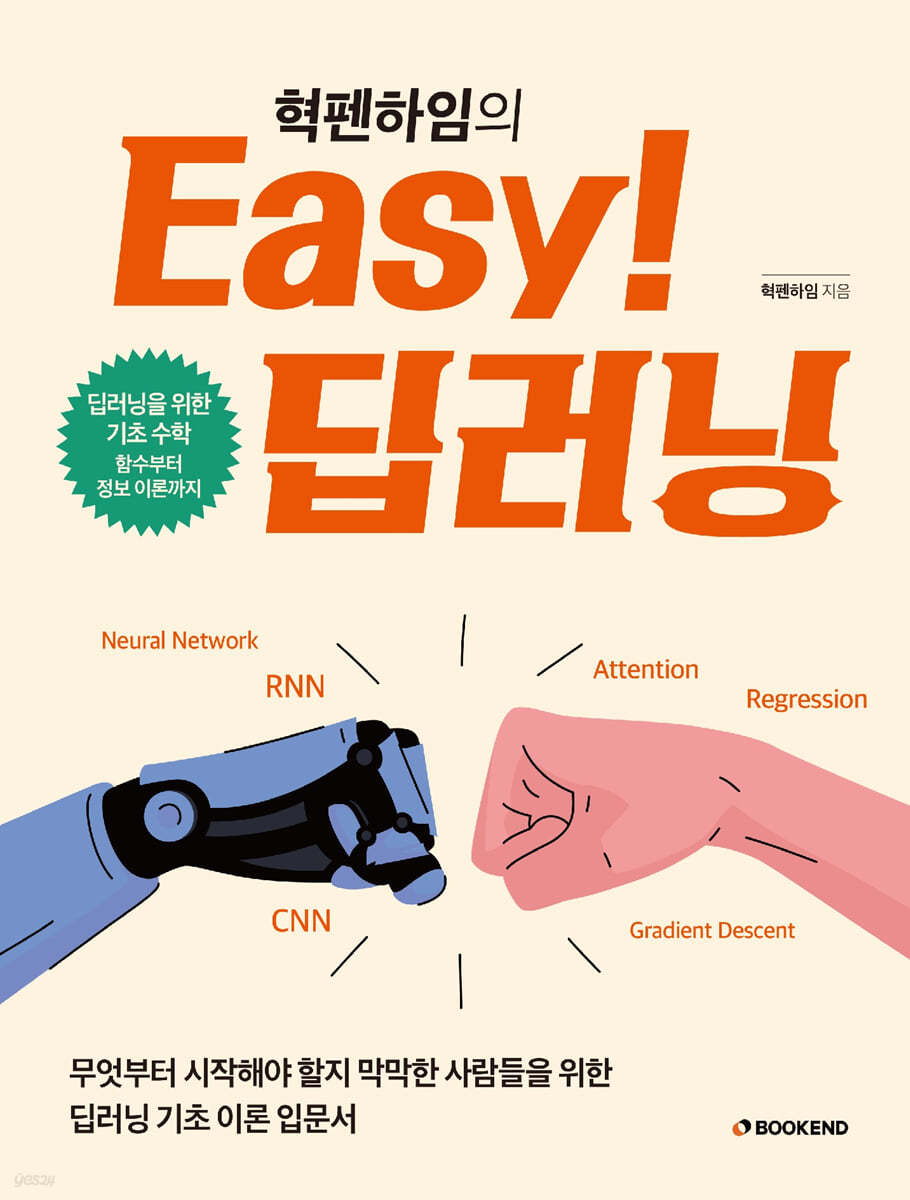
"Hyukpenheim's Easy! Deep Learning" is an essential guide for readers new to deep learning, covering everything from the fundamentals of artificial intelligence to key topics in deep learning, including CNNs and RNNs. Written by Hyukpenheim, a KAIST PhD holder and active YouTuber, this book is designed to systematically understand the principles of deep learning through intuitive analogies.
Even complex deep learning concepts can be easily followed by beginners thanks to the author's easy-to-follow explanations, and over 280 illustrations and video lectures aid the learning process.
Additionally, for readers who lack mathematical foundation, essential mathematical concepts such as functions and calculus are provided as appendices to ease the learning difficulty.
This book helps everyone, from beginners just starting out with deep learning to practitioners with some knowledge, gain the knowledge necessary to deeply understand deep learning.
"Hyukpenheim's Easy! Deep Learning" is the ultimate textbook for building a solid foundation in deep learning, combining clear, accessible explanations with hands-on practice.
- You can preview some of the book's contents.
Preview
index
Author's Note
How to view this book
Chapter 1 - Why is AI so hot right now?
- 1.1 AI (Artificial Intelligence) vs ML (Machine Learning) vs DL (Deep Learning)
- 1.2 Rule-Based vs. Data-Based
- 1.3 How does AI classify images?
- 1.4 How does AI translate?
- 1.5 Supervised Learning
- 1.6 Self-Supervised Learning
- 1.7 Unsupervised Learning
- 1.8 Reinforcement Learning
Chapter 2 - Artificial Neural Networks, Linear Regression, and Optimization Techniques
- 2.1 Artificial Neural Networks: Intuitive Understanding of Weight and Bias
- 2.2 Artificial Neural Networks and MLP (Multi-Layer Perceptron)
- 2.3 Artificial neural networks are functions!
- 2.4 Linear Regression, Step by Step from Concept to Algorithm
- 2.5 Gradient Descent
- 2.5.1 Two problems of gradient descent
- 2.6 Weight Initialization
- 2.7 Stochastic Gradient Descent
- 2.8 Mini-Batch Gradient Descent
- 2.8.1 Adjusting Batch Size and Learning Rate
- 2.9 Momentum
- 2.10 RMSProp(Root Mean Squared Propagation)
- 2.11 Adam (Adaptive Moment Estimation)
- 2.12 Validation Data
- 2.12.1 K-fold Cross Validation
Chapter 3 - Deep Learning, What I Want to Know
- 3.1 MLP, representing with matrices and vectors
- 3.2 The Importance of Non-Linear Activation
- 3.3 Backpropagation
- 3.3.1 Why Forward Propagation is Needed in the Learning Process
Chapter 4 - Binary Classification and Multiclass Classification
- 4.1 Binary classification using Unit Step Function
- 4.1.1 Two Problems with Unit Step Function and Sigmoid
- 4.2 Binary classification using sigmoid
- 4.2.1 BCE (Binary Cross-Entropy) Loss
- 4.2.2 Logistic Regression
- 4.3 MSE Loss vs. BCE Loss
- 4.4 Deep Learning and MLE (Maximum Likelihood Estimation)
- 4.4.1 Loss function and NLL (Negative Log-Likelihood)
- 4.5 Multi-classification
- 4.5.1 Softmax
- 4.5.2 Cross-Entropy Loss
- 4.5.3 Softmax Regression
Chapter 5 - Artificial Neural Networks: What Are Their Limits?
- 5.1 Universal Approximation Theorem
- 5.2 Proof of Universal Approximation Theorem
- 5.3 Universal Approximation Theorem Misconceptions and Truths
Chapter 6 - Chronic Problems and Solutions in Deep Neural Networks
- 6.1 Vanishing Gradient and Underfitting
- 6.1.1 ReLU(Rectified Linear Unit)
- 6.1.2 Analysis of Sigmoid vs. ReLU Experimental Results
- 6.1.3 ReLU After that...
- 6.1.4 Batch Normalization
- 6.1.5 Analysis of Batch Normalization Experiment Results
- 6.1.6 Layer Normalization
- 6.2 Loss landscape problem and ResNet's Skip-Connection
- 6.3 Overfitting
- 6.3.1 Data Augmentation
- 6.3.2 Dropout
- 6.3.3 Applying Dropout to Autoencoders and Analyzing Experimental Results
- 6.3.4 Regularization
- 6.3.5 Regularization and MAP (Maximum A Posteriori)
- 6.3.6 Analysis of L2-Regularization vs. L1-Regularization Experiment Results
Chapter 7 - Why are CNNs widely used for image data?
- 7.1 How did CNN mimic human thinking?
- 7.2 Problems with FC layers in image recognition
- 7.3 How Convolution Works
- 7.3.1 How does convolution extract location-specific features?
- 7.3.2 Feature Map
- 7.3.3 AI figures out which features to extract!
- 7.4 Convolution for multi-channel input
- 7.5 Meaning of 1x1 convolution
- 7.6 Padding & Stride
- 7.7 Pooling layer
- 7.8 Overall structure of CNN: from feature extraction to classification
- Analysis of the experimental results of CNN feature maps
- 7.10 VGGNet Complete Anatomy
- 7.10.1 Receptive Field Concept and Why We Pass Through Convolutional Layers Multiple Times
- Additional thoughts on CNN on July 11
Chapter 8 - Why are transformers better than RNNs?
- 8.1 Continuous Data and Tokenizing
- 8.2 How RNN works
- 8.3 Next Token Prediction
- 8.4 Structural limitations of RNN
- 8.5 Different types of RNNs
- 8.6 Seq2seq Concepts and Issues
- 8.7 Attention: Using different context vectors at each point in time
- 8.7.1 Attention: Creating a Context Vector
- 8.7.2 Learning Principles and Interpretation of Attention
- 8.7.3 Two problems with RNN+Attention
- 8.8 Self-Attention of Transformer
- 8.9 In conclusion...
Appendix: Essential Fundamentals of Mathematics for Deep Learning
- Lesson 1-1.
function
- Lessons 1-2.
Logarithmic function
- Lesson 2-1.
Vectors and matrices
- 2-2 lecture.
Preposition and inner product
- Lesson 3-1.
Limits and the epsilon-delta argument
- 3-2nd class.
Differentiation and Derivatives
- 3-3 classes.
chain rule
- 3-4 strong.
Partial differentiation and gradient
- 4-1 class.
Random variables and probability distributions
- 4-2 strong.
Mean and variance
- 4-3 strong.
Uniform distribution and normal distribution
- Lesson 5-1. Maximum Likelihood Estimation (MLE)
- Lesson 5-2. Maximum A Posteriori (MAP)
- 6th lecture.
Information Theory Foundations
Detailed image

Into the book
The most notable feature of this book is that it explains complex concepts in an intuitive and metaphorical way, making them as easy to understand as possible.
For example, to understand the vanishing gradient problem, neural networks were likened to 'restaurants', batch normalization was explained as 'rearranging grains of sand', and dropout was likened to 'employee vacations'.
This approach helps you understand the essence and meaning of difficult concepts more deeply, rather than simply memorizing them.
--- p.2
Is there any field as hot as AI right now? Throughout human history, it's hard to find another field that has advanced so rapidly.
Large-scale language models like ChatGPT have surprised us by surpassing human language capabilities based on their vast knowledge base.
And as if to mock the idea that AI will never invade the realm of art, AI-created works are sweeping art competitions and composition contests.
--- p.12
The idea is simple.
In layers where the number of nodes decreases, the nonlinearity is somewhat sacrificed by not activating, thereby preventing information loss. Conversely, in layers where the number of nodes increases, the nonlinear activation is used to minimize information loss while ensuring sufficient nonlinearity.
--- p.88
MLE is a method that says, “Let’s select the parameters that maximize the probability of the observed Measurement occurring.”
Let's recall the example presented in the appendix.
When a black ball comes out, you choose the pocket that gives you the greatest chance of getting a black ball.
Similarly, if we interpret binary classification from an MLE perspective, when the dog label is given, it is equivalent to choosing the neural network w that maximizes the probability of the dog label being given.
--- p.113
To better understand this, let's think of artificial neural networks as restaurants.
In this restaurant, ingredients such as noodles and soybean paste come in as input, the first layer is responsible for preparing the ingredients, the second layer is responsible for cooking, and the third layer is responsible for plating.
Each node represents one employee.
The goal of this restaurant is to create two bowls of delicious Jjajangmyeon using two ingredients, three people preparing the ingredients, three people cooking, and two people plating.
--- p.141
If you are new to deep learning, it would be a good idea to read this appendix after reading Chapter 1 and before reading Chapter 2.
This will help you build a solid foundation in overall mathematics and make it easier to understand the content of the text.
The content of each chapter is structured to start with basic concepts and gradually become more in-depth.
--- p.293
A random variable is a function that maps a specific event to a real number.
For example, in a coin toss, the event “heads” can be represented as 1, and the event “tails” can be represented as 0.
In this way, random variables allow us to mathematically handle uncertain events.
--- p.322
Concepts from information theory are widely used in deep learning.
Cross-Entropy is widely used as a loss function for classification problems, and KL-Divergence plays a key role in image generation models.
These concepts are primarily used as mathematical tools for constructing loss functions and serve as criteria for quantitatively evaluating how well a model has learned the distribution of data.
--- p.344
Publisher's Review
For readers taking their first steps into the world of deep learning, "Easy! Deep Learning" is more than just a textbook; it's an essential guide. Written by "Hyukpenheim," a KAIST PhD and YouTuber with 100,000 subscribers, this book unravels complex and complex deep learning concepts in a simple and accessible way, seamlessly blending theory and practice. It's a unique introductory book.
The perception that deep learning is difficult is now a thing of the past.
"Easy! Deep Learning" is meticulously designed for readers new to deep learning, and features approximately 280 illustrations to help readers intuitively understand abstract concepts.
Readers can learn more easily through video lectures provided by the author about the contents of the book.
This perfect combination of book and video lectures ensures readers gain a solid grasp of the core concepts of deep learning without missing a beat.
In particular, this book covers the mathematical foundations required for deep learning in the appendix.
Fundamental concepts such as functions, calculus, probability, and statistics support deep learning and help establish a solid theoretical foundation for deep learning.
Readers who have struggled to study deep learning due to a lack of mathematical background can also acquire the necessary mathematical foundations through this book.
Unlike many existing books on the market that assume an understanding of basic mathematics, this book was created with a beginner-friendly plan.
"Easy! Deep Learning," as its name suggests, takes an easy and accessible approach, yet is academically rigorous and in-depth.
Through this book, readers can learn step-by-step everything from the fundamental principles of deep learning to how to design actual models and process data. Rather than simply memorizing deep learning theory, they will understand its principles and learn how to apply them in the field.
Author Hyukpenheim, drawing on extensive research and teaching experience, presents a balanced approach that easily explains the core concepts of deep learning while maintaining depth.
He anticipates various questions and difficulties that may arise in deep learning and presents clear solutions to them.
In particular, his experience and know-how from communicating with numerous readers through lectures given at universities and on YouTube for many years are incorporated into the book, so readers will gain a vivid learning experience that feels like attending an actual lecture while reading the book.
"Easy! Deep Learning" is a complete guide covering everything beginners need to learn deep learning.
This book, which builds up from the basics of deep learning step by step and covers everything from theory and practice to mathematical foundations, will be of great help not only to readers new to deep learning but also to those already familiar with some aspects of it.
This book will help beginners overcome their fear of deep learning and continue learning with confidence. It will be the best choice for building a solid foundation.
With this book, deep learning will no longer feel difficult.
As the author says, "Deep learning is inherently easy," by following the expert explanations and detailed practical guidance in this book, readers will gain the confidence and skills to easily understand the complex concepts of deep learning and apply them in real-world situations.
GOODS SPECIFICS
- Date of issue: November 26, 2024
- Page count, weight, size: 352 pages | 183*235*30mm
- ISBN13: 9791197601347
- ISBN10: 1197601341
You may also like
카테고리
korean


korean


