

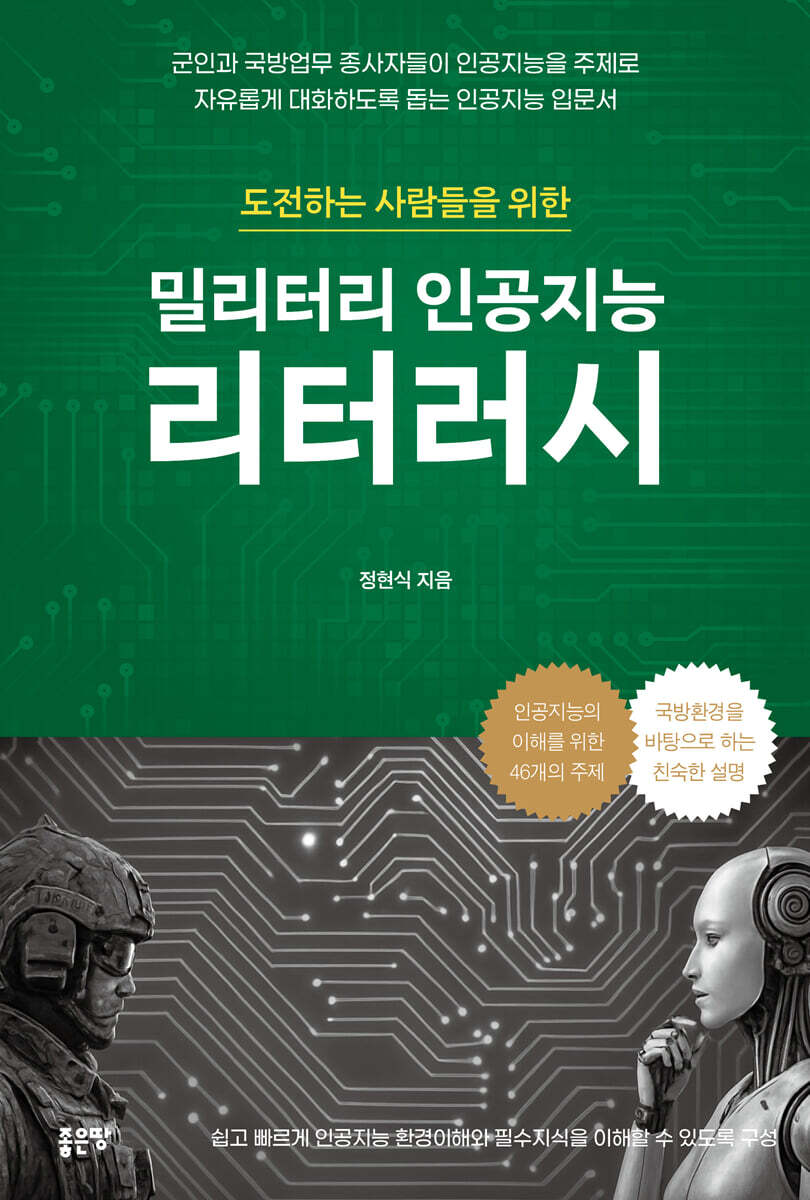
Military AI Literacy
 |
Description
Book Introduction
"Military Artificial Intelligence Literacy" is an introductory book that systematically and easily explains the concepts and principles of artificial intelligence based on the defense environment.
Author Jeong Hyeon-sik, drawing on his practical experience in smart defense work, helps military organizations and defense professionals gain a familiar understanding of artificial intelligence technology and apply it to their practice.
It guides you step-by-step from the basics of artificial intelligence to practical applications through 46 topics, including Python, open source, neural network learning, and large language models (LLM), and is rich in specific application examples in defense fields such as training, maintenance, and operations.
This book reminds us that the power to 'understand' technology is national defense power.
Author Jeong Hyeon-sik, drawing on his practical experience in smart defense work, helps military organizations and defense professionals gain a familiar understanding of artificial intelligence technology and apply it to their practice.
It guides you step-by-step from the basics of artificial intelligence to practical applications through 46 topics, including Python, open source, neural network learning, and large language models (LLM), and is rich in specific application examples in defense fields such as training, maintenance, and operations.
This book reminds us that the power to 'understand' technology is national defense power.
- You can preview some of the book's contents.
Preview
index
Recommendation
prolog
Part 1.
Understanding the environment
Chapter 1.
Artificial intelligence model development environment
1.1 Python! Learn to read and write for AI development.
1.2 Open Source! Paving the Way for AI through Sharing and Collaboration
1.3 Integrated Development Environment (IDE)! Creating a learning environment
1.4 Development Framework! Preparing the Tools for Learning
1.5 Dataset! Preparing Materials for Learning
Chapter 2.
Artificial intelligence infrastructure environment
2.1 Processor! The Heart of Your Computer
2.2 GPU! Making NVIDIA a Powerhouse in AI
2.3 CUDA! Controlling GPU Parallel Processing
2.4 NPU! Equipping Everything with AI
2.5 AI Platform! The Foundation for AI Services
2.6 Development Automation Tools! Increase Efficiency and Accuracy
Chapter 3.
Artificial intelligence applications
3.1 Data Science! Paving the Way for Artificial Intelligence
3.2 Prediction and Classification! AI is already a part of our daily lives.
3.3 Computer Vision! Understanding What AI Sees
3.4 Natural Language Processing! AI Conversates with People
3.5 Intelligent Robots! Artificial Intelligence Takes Action in the World
Part 2.
Technical elements and learning techniques
Chapter 4.
Artificial neural network technology elements
4.1 Artificial Neural Networks! Technology that mimics the human brain emerges.
4.2 Artificial Neural Networks! There are many different types of artificial brains.
4.3 Training an artificial neural network! The goal is to maximize probability.
4.4 Parameters! The Source of Intelligence
4.5 Hyperparameters! This is the curriculum for artificial neural network learning.
4.6 Activation Function! This is the scoring method for artificial neural networks.
4.7 Overfitting! Too much is always a problem.
Chapter 5.
Artificial neural network learning techniques
5.1 Machine Learning! Giving machines the ability to think.
5.2 Basic Learning! Unleash Your Machine's Reasoning Abilities
5.3 Transfer Learning! Transfer the completed model to a new job.
5.4 Self-Supervised Learning! Reduce the effort of processing training data.
5.5 Meta-Learning! Learn how to learn.
5.6 Ensemble Learning! AI Unleashes Collective Intelligence
5.7 n-shot learning! Learning even with insufficient datasets
5.8 Multimodal Learning! Learn with a variety of senses.
Part 3.
Approach for utilization
Chapter 6.
Object detection model
6.1 Efforts for object detection
6.2 Evolution of Object Detection Models
6.3 Information provided by the object detection model!
6.4 Performance Evaluation of Object Detection Model!
Chapter 7.
Large-Scale Language Models and Generative AI
The 7.1 LLM is here! Ushering in an era of collaboration between humans and AI.
7.2 Word Embeddings! How LLMs Build Knowledge
7.3 Hallucinations and Bias! The Fatal Weakness of a Great LLM
7.4 Fine Tuning and RAG! Bring Expertise and Modernity to LLM
7.5 sLLM! Need a lightweight, fast LLM?
7.6 Generative AI! Challenging Human Creativity
Chapter 8.
Defense Applications of Open Source AI Models
8.1 Application of Predictive Models to Defense Operations
8.2 Application of the classification model to national defense operations
8.3 Defense Applications of 3D Rendering Models
8.4 Defense Applications of Image Generation Models
8.5 Defense Applications of Audio Generation Models
Epilogue
supplement
References
prolog
Part 1.
Understanding the environment
Chapter 1.
Artificial intelligence model development environment
1.1 Python! Learn to read and write for AI development.
1.2 Open Source! Paving the Way for AI through Sharing and Collaboration
1.3 Integrated Development Environment (IDE)! Creating a learning environment
1.4 Development Framework! Preparing the Tools for Learning
1.5 Dataset! Preparing Materials for Learning
Chapter 2.
Artificial intelligence infrastructure environment
2.1 Processor! The Heart of Your Computer
2.2 GPU! Making NVIDIA a Powerhouse in AI
2.3 CUDA! Controlling GPU Parallel Processing
2.4 NPU! Equipping Everything with AI
2.5 AI Platform! The Foundation for AI Services
2.6 Development Automation Tools! Increase Efficiency and Accuracy
Chapter 3.
Artificial intelligence applications
3.1 Data Science! Paving the Way for Artificial Intelligence
3.2 Prediction and Classification! AI is already a part of our daily lives.
3.3 Computer Vision! Understanding What AI Sees
3.4 Natural Language Processing! AI Conversates with People
3.5 Intelligent Robots! Artificial Intelligence Takes Action in the World
Part 2.
Technical elements and learning techniques
Chapter 4.
Artificial neural network technology elements
4.1 Artificial Neural Networks! Technology that mimics the human brain emerges.
4.2 Artificial Neural Networks! There are many different types of artificial brains.
4.3 Training an artificial neural network! The goal is to maximize probability.
4.4 Parameters! The Source of Intelligence
4.5 Hyperparameters! This is the curriculum for artificial neural network learning.
4.6 Activation Function! This is the scoring method for artificial neural networks.
4.7 Overfitting! Too much is always a problem.
Chapter 5.
Artificial neural network learning techniques
5.1 Machine Learning! Giving machines the ability to think.
5.2 Basic Learning! Unleash Your Machine's Reasoning Abilities
5.3 Transfer Learning! Transfer the completed model to a new job.
5.4 Self-Supervised Learning! Reduce the effort of processing training data.
5.5 Meta-Learning! Learn how to learn.
5.6 Ensemble Learning! AI Unleashes Collective Intelligence
5.7 n-shot learning! Learning even with insufficient datasets
5.8 Multimodal Learning! Learn with a variety of senses.
Part 3.
Approach for utilization
Chapter 6.
Object detection model
6.1 Efforts for object detection
6.2 Evolution of Object Detection Models
6.3 Information provided by the object detection model!
6.4 Performance Evaluation of Object Detection Model!
Chapter 7.
Large-Scale Language Models and Generative AI
The 7.1 LLM is here! Ushering in an era of collaboration between humans and AI.
7.2 Word Embeddings! How LLMs Build Knowledge
7.3 Hallucinations and Bias! The Fatal Weakness of a Great LLM
7.4 Fine Tuning and RAG! Bring Expertise and Modernity to LLM
7.5 sLLM! Need a lightweight, fast LLM?
7.6 Generative AI! Challenging Human Creativity
Chapter 8.
Defense Applications of Open Source AI Models
8.1 Application of Predictive Models to Defense Operations
8.2 Application of the classification model to national defense operations
8.3 Defense Applications of 3D Rendering Models
8.4 Defense Applications of Image Generation Models
8.5 Defense Applications of Audio Generation Models
Epilogue
supplement
References
Publisher's Review
Jeong Hyeon-sik's "Military Artificial Intelligence Literacy" is a book that explains the concepts and principles of artificial intelligence in an easy-to-understand way, using the field of national defense as a backdrop.
It provides concrete examples of how artificial intelligence can be utilized within military organizations, and guides in practical terms how technology, people, and organizations should collaborate.
Drawing on his experience in the field of smart defense, the author focuses on translating complex technical terms into everyday language.
The book is organized around core topics such as Python, neural networks, and large language models (LLM).
But it doesn't stop at just a simple technical textbook.
Each chapter begins with the question, "Why do we need to understand AI?" and explores the digital transformation trends not only in the defense sector but also across organizations.
This allows readers to understand artificial intelligence not as a tool, but as a new paradigm for thinking and decision-making.
The author defines artificial intelligence as “a companion that assists the military in its practical work.”
While discussing the efficiency and innovation that artificial intelligence can create, it cautions against technological supremacy and emphasizes a human-centered approach.
In other words, it emphasizes that literacy in properly understanding and handling artificial intelligence must become the new foundation of national defense capabilities.
This perspective demonstrates the author's balanced approach to translating technology into human language.
"Military AI Literacy" is a useful introductory book not only for soldiers and defense professionals, but also for general readers new to AI.
The structure of the book, which explains complex principles in an easy-to-understand manner and provides concrete examples to aid understanding, enhances its quality as a textbook.
Above all, artificial intelligence has the power to make us imagine the 'future of national defense'.
This book goes beyond understanding technology and makes us reflect on how that technology changes humans.
It provides concrete examples of how artificial intelligence can be utilized within military organizations, and guides in practical terms how technology, people, and organizations should collaborate.
Drawing on his experience in the field of smart defense, the author focuses on translating complex technical terms into everyday language.
The book is organized around core topics such as Python, neural networks, and large language models (LLM).
But it doesn't stop at just a simple technical textbook.
Each chapter begins with the question, "Why do we need to understand AI?" and explores the digital transformation trends not only in the defense sector but also across organizations.
This allows readers to understand artificial intelligence not as a tool, but as a new paradigm for thinking and decision-making.
The author defines artificial intelligence as “a companion that assists the military in its practical work.”
While discussing the efficiency and innovation that artificial intelligence can create, it cautions against technological supremacy and emphasizes a human-centered approach.
In other words, it emphasizes that literacy in properly understanding and handling artificial intelligence must become the new foundation of national defense capabilities.
This perspective demonstrates the author's balanced approach to translating technology into human language.
"Military AI Literacy" is a useful introductory book not only for soldiers and defense professionals, but also for general readers new to AI.
The structure of the book, which explains complex principles in an easy-to-understand manner and provides concrete examples to aid understanding, enhances its quality as a textbook.
Above all, artificial intelligence has the power to make us imagine the 'future of national defense'.
This book goes beyond understanding technology and makes us reflect on how that technology changes humans.
GOODS SPECIFICS
- Date of issue: October 30, 2025
- Page count, weight, size: 300 pages | 152*225*20mm
- ISBN13: 9791138849005
- ISBN10: 1138849006
You may also like
카테고리
korean


korean

![GQ KOREA Mark (Monthly): December [2025]](http://librairie.coreenne.fr/cdn/shop/files/8ef265dbbfbf186523ed75ba7319009d.jpg?v=1765340328&width=3840)


