

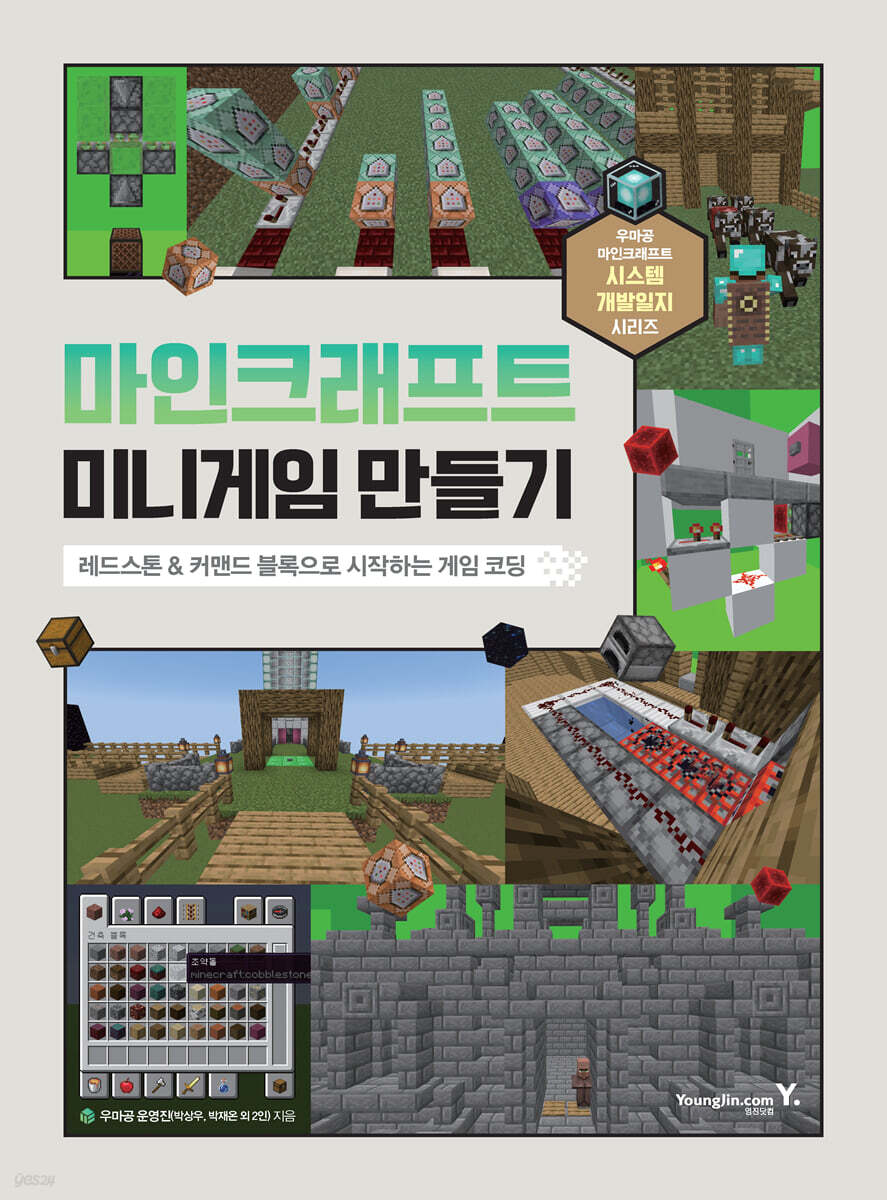
Making Minecraft Minigames
 |
Description
Book Introduction
The first book in the 'Umagong Minecraft System Development Diary' series!
Fun coding lessons starting with Minecraft Redstone and Command Blocks.
For those who love Minecraft but find redstone and command blocks challenging, the [Our Minecraft Space] management team has ambitiously prepared this book! Written by veteran gamers who handle circuits and maps, "Making Minecraft Minigames" is the first book to compile redstone design and command utilization know-how.
In this book, '[PART 1] Redstone', we will learn about the principles of various redstone devices, and '[PART 2] Command Block' will look at creative methods using commands.
In '[PART 3] Finale', we will design and create a mini-game based on what we have learned so far.
Break away from the simple rules of the game and enter a mysterious world of redstone that demands creative design and engineering prowess.
Let's develop your inner creativity and critical thinking skills by creating minigames using redstone and commands!
Fun coding lessons starting with Minecraft Redstone and Command Blocks.
For those who love Minecraft but find redstone and command blocks challenging, the [Our Minecraft Space] management team has ambitiously prepared this book! Written by veteran gamers who handle circuits and maps, "Making Minecraft Minigames" is the first book to compile redstone design and command utilization know-how.
In this book, '[PART 1] Redstone', we will learn about the principles of various redstone devices, and '[PART 2] Command Block' will look at creative methods using commands.
In '[PART 3] Finale', we will design and create a mini-game based on what we have learned so far.
Break away from the simple rules of the game and enter a mysterious world of redstone that demands creative design and engineering prowess.
Let's develop your inner creativity and critical thinking skills by creating minigames using redstone and commands!
- You can preview some of the book's contents.
Preview
index
preface
About the writers
Structure of this book
[Part 1] Redstone
Chapter 1: Redstone Overview
Getting started
Redstone signal
Redstone repeater
Conductors and insulators
Transmitter and actuator
〈Chapter 2〉 Ancient Jungle Temple
Learn - Piston
Learn - Wire Trap Hook
Make it - Temple Gate
Making a trap to protect the temple
Chapter 3: Building a Turtle Ship
Learn - Blocks, Objects
Learn - Explosion
Making it - Turtle Ship Appearance
Making it - Large Front Cannon
Making a Side Small Cannon
Chapter 4: Iron Block Observatory
Learn - Observatory
Learn - Piston (Advanced)
Making it - Building an Observatory
Making it - Elevator
Chapter 5: Building a Secret Base
Learn - T Flip-Flop
Learn - Fake Connectivity
Making a 1×1 Piston Trap Door
Making a Door Using a T Flip-Flop
Making it - Floating Button
[Part 2] Command Blocks
Chapter 6: Command Overview
Getting started
How to read command descriptions
selector
coordinate
Command Block
Chapter 7: The Witch's Secret Attic
Learn - Block ID, Item ID, Object ID, ?
Learn - setblock
Learn - Block States and Block Objects
Try Making It - Witch House Construction
Make it - Appearing and Disappearing Stairs
Chapter 8: Unmanned Stores
Learn - execute
Learn - give, clear
Learn More - NBT
How to make - 1 rotten flesh to 1 steak
Chapter 9: The Illagers' Secret Base
Learn - fill
Learn - summon
Make It - Secret Base
Make it - A Room with a Sink in the Floor
Making a Regenerating Floor
Let's make it - Ambush! The Marauders Appear!
Chapter 10: Catching the Escaped Cow
Learn - tellraw
Learn - title
Learn - playsound
Learn - scoreboard
Make it - Barn
Make It - Cow Catching Minigame
[Part 3] Finale
Chapter 11: Illager Defense
Learn - bossbar
Learn - effect
Let's Make It - Building a Minigame Arena
Creating a System - Setting Up the Basics of System Development
Make it - Defense Game
In conclusion
About the writers
Structure of this book
[Part 1] Redstone
Chapter 1: Redstone Overview
Getting started
Redstone signal
Redstone repeater
Conductors and insulators
Transmitter and actuator
〈Chapter 2〉 Ancient Jungle Temple
Learn - Piston
Learn - Wire Trap Hook
Make it - Temple Gate
Making a trap to protect the temple
Chapter 3: Building a Turtle Ship
Learn - Blocks, Objects
Learn - Explosion
Making it - Turtle Ship Appearance
Making it - Large Front Cannon
Making a Side Small Cannon
Chapter 4: Iron Block Observatory
Learn - Observatory
Learn - Piston (Advanced)
Making it - Building an Observatory
Making it - Elevator
Chapter 5: Building a Secret Base
Learn - T Flip-Flop
Learn - Fake Connectivity
Making a 1×1 Piston Trap Door
Making a Door Using a T Flip-Flop
Making it - Floating Button
[Part 2] Command Blocks
Chapter 6: Command Overview
Getting started
How to read command descriptions
selector
coordinate
Command Block
Chapter 7: The Witch's Secret Attic
Learn - Block ID, Item ID, Object ID, ?
Learn - setblock
Learn - Block States and Block Objects
Try Making It - Witch House Construction
Make it - Appearing and Disappearing Stairs
Chapter 8: Unmanned Stores
Learn - execute
Learn - give, clear
Learn More - NBT
How to make - 1 rotten flesh to 1 steak
Chapter 9: The Illagers' Secret Base
Learn - fill
Learn - summon
Make It - Secret Base
Make it - A Room with a Sink in the Floor
Making a Regenerating Floor
Let's make it - Ambush! The Marauders Appear!
Chapter 10: Catching the Escaped Cow
Learn - tellraw
Learn - title
Learn - playsound
Learn - scoreboard
Make it - Barn
Make It - Cow Catching Minigame
[Part 3] Finale
Chapter 11: Illager Defense
Learn - bossbar
Learn - effect
Let's Make It - Building a Minigame Arena
Creating a System - Setting Up the Basics of System Development
Make it - Defense Game
In conclusion
Detailed image

Publisher's Review
The cradle of domestic Minecraft gamers,
Fun game coding with "Our Minecraft Space"
'Umagong Minecraft System Development Diary', written by the management team of 'Our Minecraft Space', the largest Minecraft community in Korea, is a computational thinking learning series book for Minecraft users.
This series covers electronic circuits, commands, and programming, laying the foundation for game system development.
In the first book, "Make Minecraft Minigames," you'll learn the fundamental concepts of game coding using redstone and command blocks.
Rather than simply following along, you can create mini-games while learning the operating principles and structure of the device.
Take a look at the redstone design and command utilization know-how of veteran gamers who have played Minecraft for a long time and worked with circuits and maps.
It's time to explore the fundamentals of game coding and become a minigame creator through Minecraft, a game that anyone can easily enjoy!
Structure of this book
[PART 1] Redstone
Just as you use various electronic circuits and mechanical devices in real life, you can create redstone devices in Minecraft to automate many tasks.
In Part 1, we will study the principles of various redstone devices.
Learn redstone design, build your own circuits, and master the fundamental concepts of game coding.
[PART 2] Command Blocks
Using commands, or text that computers understand, you can control flexible and powerful functions in the Minecraft world.
In Part 2, we will learn how to create using commands.
Let's apply the concepts you learned in Part 1 to actual game coding using command blocks.
[PART 3] Finale
If you've learned redstone design and commands to create simple systems, it's time to build your own game based on what you've learned! Follow along as we consider what to consider when creating a fun minigame and how to break down complex systems into multiple parts.
〈Try this when you need help!〉
· What if there are too many commands to input when creating a minigame in Ch 10, 11?
Please download and use the practice files from ‘Youngjin.com website (www.youngjin.com) → Customer Center → Download Appendix CD’.
· What if I find it difficult to study alone or need more information?
Share your questions on the 'Questions' bulletin board of Naver Cafe 'Our Minecraft Space' and study with others!
Author's Note
There is learning in the game called Minecraft.
It's not the kind of soft, child-friendly learning that's often thought of, but a real study that delves deeper and brings you closer to real engineering principles and information technology.
Players come together to play Minecraft, connect with each other, and showcase their individual talents.
In fact, Minecraft is only a small part of the game's role as a driving force for play and growth.
There are so many good things in the world besides the game we love.
What we think is really cool is the whole community that these games create among young students.
I'm talking about communities that inevitably form because people in Korea enjoyed the same 'play' at the same time, rather than human relationships that are given in places like schools or academies.
I hope to see more of them creating their own culture, experiencing things they would never have experienced before, competing to stand out, and transforming through chemistry with one another.
I sincerely hope that parents reading this understand that their children's hobbies can serve as valuable assets for their children's growth over time, and that you will spare no effort in supporting them so that their interests can develop further and deeper.
I believe that is the easiest way to discover your child's talent.
We in the Minecraft community will always strive to help players grow.
Fun game coding with "Our Minecraft Space"
'Umagong Minecraft System Development Diary', written by the management team of 'Our Minecraft Space', the largest Minecraft community in Korea, is a computational thinking learning series book for Minecraft users.
This series covers electronic circuits, commands, and programming, laying the foundation for game system development.
In the first book, "Make Minecraft Minigames," you'll learn the fundamental concepts of game coding using redstone and command blocks.
Rather than simply following along, you can create mini-games while learning the operating principles and structure of the device.
Take a look at the redstone design and command utilization know-how of veteran gamers who have played Minecraft for a long time and worked with circuits and maps.
It's time to explore the fundamentals of game coding and become a minigame creator through Minecraft, a game that anyone can easily enjoy!
Structure of this book
[PART 1] Redstone
Just as you use various electronic circuits and mechanical devices in real life, you can create redstone devices in Minecraft to automate many tasks.
In Part 1, we will study the principles of various redstone devices.
Learn redstone design, build your own circuits, and master the fundamental concepts of game coding.
[PART 2] Command Blocks
Using commands, or text that computers understand, you can control flexible and powerful functions in the Minecraft world.
In Part 2, we will learn how to create using commands.
Let's apply the concepts you learned in Part 1 to actual game coding using command blocks.
[PART 3] Finale
If you've learned redstone design and commands to create simple systems, it's time to build your own game based on what you've learned! Follow along as we consider what to consider when creating a fun minigame and how to break down complex systems into multiple parts.
〈Try this when you need help!〉
· What if there are too many commands to input when creating a minigame in Ch 10, 11?
Please download and use the practice files from ‘Youngjin.com website (www.youngjin.com) → Customer Center → Download Appendix CD’.
· What if I find it difficult to study alone or need more information?
Share your questions on the 'Questions' bulletin board of Naver Cafe 'Our Minecraft Space' and study with others!
Author's Note
There is learning in the game called Minecraft.
It's not the kind of soft, child-friendly learning that's often thought of, but a real study that delves deeper and brings you closer to real engineering principles and information technology.
Players come together to play Minecraft, connect with each other, and showcase their individual talents.
In fact, Minecraft is only a small part of the game's role as a driving force for play and growth.
There are so many good things in the world besides the game we love.
What we think is really cool is the whole community that these games create among young students.
I'm talking about communities that inevitably form because people in Korea enjoyed the same 'play' at the same time, rather than human relationships that are given in places like schools or academies.
I hope to see more of them creating their own culture, experiencing things they would never have experienced before, competing to stand out, and transforming through chemistry with one another.
I sincerely hope that parents reading this understand that their children's hobbies can serve as valuable assets for their children's growth over time, and that you will spare no effort in supporting them so that their interests can develop further and deeper.
I believe that is the easiest way to discover your child's talent.
We in the Minecraft community will always strive to help players grow.
GOODS SPECIFICS
- Date of issue: February 26, 2024
- Page count, weight, size: 224 pages | 190*257*20mm
- ISBN13: 9788931474442
- ISBN10: 893147444X
You may also like
카테고리
korean


korean

![GQ KOREA Mark (Monthly): December [2025]](http://librairie.coreenne.fr/cdn/shop/files/8ef265dbbfbf186523ed75ba7319009d.jpg?v=1765340328&width=3840)


