

Minecraft RPG Maker
 |
Description
Book Introduction
The second book in the 'Umagong Minecraft System Development Diary' series!
Create your own RPG world in Minecraft with plugins
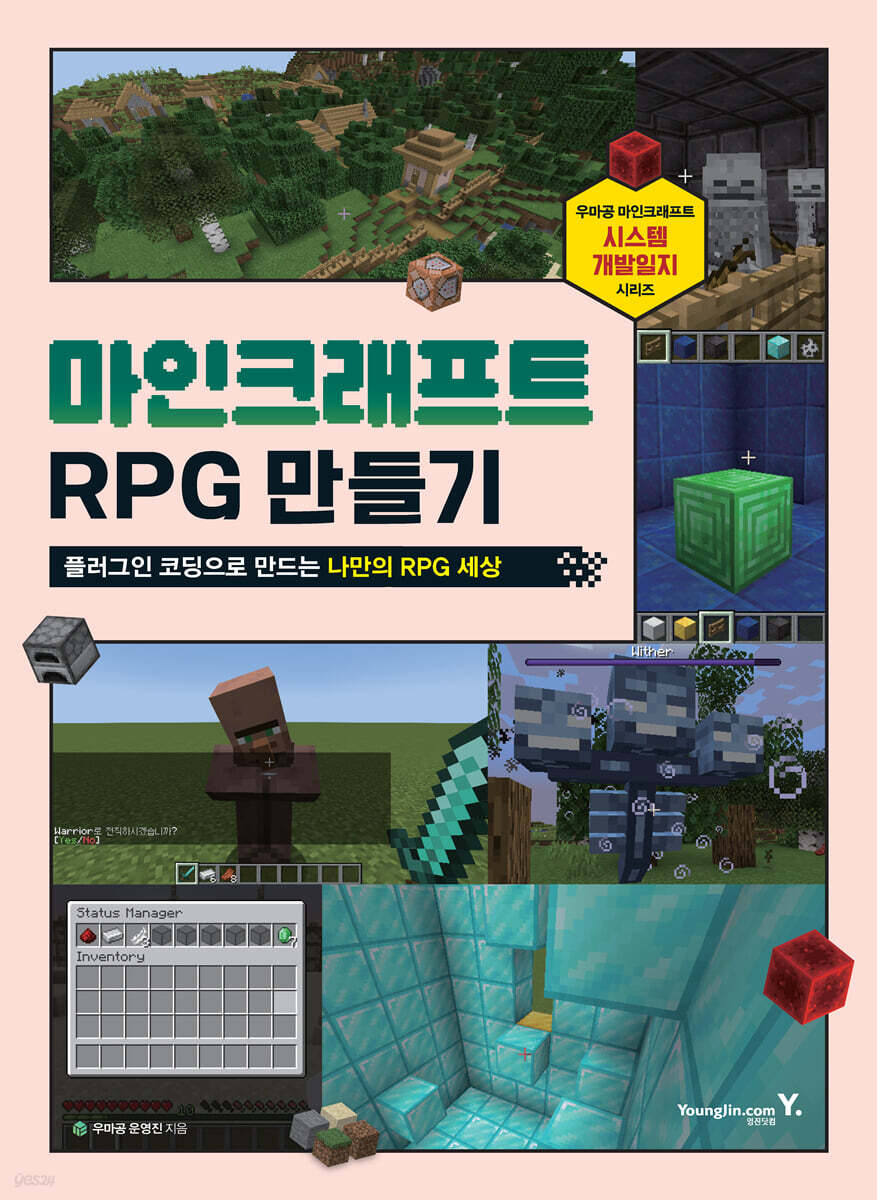
If you've become familiar with redstone and command blocks through the previous book, "Make Minecraft Minigames," it's time to hone your coding skills and create an actual RPG! "Make Minecraft RPGs," the second book by the Umagong team, teaches you how to create your own RPG world within the Minecraft world.
In '[PART 1] Plugin Basics' of this book, you will set up a basic development environment and learn how to use plugins that enable Java coding in Minecraft. Then, in '[PART 2] Plugin Applications', you will learn the full coding-related functions required for RPG project development.
In '[PART 3] Project Planning', we will organize the functions required before production into pseudocode, and in the final '[PART 4] Finale: Creating an RPG Game', we will create the functions that should actually be in an RPG game and implement an RPG game in the world of Minecraft.
Code freely using the plugin function that enables full-fledged Java coding in Minecraft and implement the RPG of your dreams directly in the Minecraft world!
Create your own RPG world in Minecraft with plugins
If you've become familiar with redstone and command blocks through the previous book, "Make Minecraft Minigames," it's time to hone your coding skills and create an actual RPG! "Make Minecraft RPGs," the second book by the Umagong team, teaches you how to create your own RPG world within the Minecraft world.
In '[PART 1] Plugin Basics' of this book, you will set up a basic development environment and learn how to use plugins that enable Java coding in Minecraft. Then, in '[PART 2] Plugin Applications', you will learn the full coding-related functions required for RPG project development.
In '[PART 3] Project Planning', we will organize the functions required before production into pseudocode, and in the final '[PART 4] Finale: Creating an RPG Game', we will create the functions that should actually be in an RPG game and implement an RPG game in the world of Minecraft.
Code freely using the plugin function that enables full-fledged Java coding in Minecraft and implement the RPG of your dreams directly in the Minecraft world!
index
preface
About the writers
[Part 1] Plugin Basics
〈Chapter 01〉 Setting up the development environment
Compiler and IDE
Bucket server settings
Create a project
〈Chapter 02〉 Message
Console messages
Player Messages
Kyori Adventure API
〈Chapter 03〉 Commands and Events
event
Command
〈Chapter 04〉 Variables and Lists
variable
List
[Part 2] Plugin Application
〈Chapter 05〉 Conditional statements, loops, and coordinates
Conditional statements
loop
coordinate
〈Chapter 06〉 Classes and Entities
object-oriented programming
entity
〈Chapter 07〉 Cooldown and Boss Bar
Scheduler
Boss Bar
〈Chapter 08〉 Custom Items
ItemStack and Inventory
PlayerInteractEvent
〈Chapter 09〉 Map
Map
HashMap
〈Bouns Chapter〉 Java docs
Bukkit Java docs
Programming with Java docs
〈Chapter 10〉 Custom Event
interface
Custom Event
[Part 3] Project Concept
〈Chapter 11〉 Content Concept: RPG Battle
Level and Status System
Experience system
Monster classes and battle system
Boss Monster
〈Chapter 12〉 Content Concept: RPG Space
local system
Job system
NPC
Store system
[Part 4] Finale: Creating an RPG Game
Chapter 13: Content Implementation: Battle System
Create a project
Level and experience system
Monster class
Battle system
Status GUI
Chapter 14: Content Implementation: Level System
local system
Boss Monster
Skill System
Chapter 15: Content Implementation: NPC Interaction System
NPC
Job system and career change
Store system
Level design
About the writers
[Part 1] Plugin Basics
〈Chapter 01〉 Setting up the development environment
Compiler and IDE
Bucket server settings
Create a project
〈Chapter 02〉 Message
Console messages
Player Messages
Kyori Adventure API
〈Chapter 03〉 Commands and Events
event
Command
〈Chapter 04〉 Variables and Lists
variable
List
[Part 2] Plugin Application
〈Chapter 05〉 Conditional statements, loops, and coordinates
Conditional statements
loop
coordinate
〈Chapter 06〉 Classes and Entities
object-oriented programming
entity
〈Chapter 07〉 Cooldown and Boss Bar
Scheduler
Boss Bar
〈Chapter 08〉 Custom Items
ItemStack and Inventory
PlayerInteractEvent
〈Chapter 09〉 Map
Map
HashMap
〈Bouns Chapter〉 Java docs
Bukkit Java docs
Programming with Java docs
〈Chapter 10〉 Custom Event
interface
Custom Event
[Part 3] Project Concept
〈Chapter 11〉 Content Concept: RPG Battle
Level and Status System
Experience system
Monster classes and battle system
Boss Monster
〈Chapter 12〉 Content Concept: RPG Space
local system
Job system
NPC
Store system
[Part 4] Finale: Creating an RPG Game
Chapter 13: Content Implementation: Battle System
Create a project
Level and experience system
Monster class
Battle system
Status GUI
Chapter 14: Content Implementation: Level System
local system
Boss Monster
Skill System
Chapter 15: Content Implementation: NPC Interaction System
NPC
Job system and career change
Store system
Level design
Detailed image
.jpg)
Publisher's Review
The cradle of domestic Minecraft gamers,
The second fun game coding with "Our Minecraft Space"
'Umagong Minecraft System Development Diary', written by the management team of 'Our Minecraft Space', the largest Minecraft community in Korea, is a computational thinking learning series book for Minecraft users.
This series covers electronic circuits, commands, and programming, laying the foundation for game system development.
In the second book, "Make Minecraft Minigames," you'll learn how to code directly into Minecraft using plugins, allowing you to create your own games within the Minecraft world.
This book is great to read as both a coding book and a game development book, as it not only teaches you the Java language knowledge necessary to handle plugins, but also provides systematic planning before implementing functions, just like actual game development.
Take a look at the plugin-making know-how of veteran gamers who have been playing and developing Minecraft for a long time.
It's time to learn real-world game coding and create your own RPG game through Minecraft, a game that anyone can easily enjoy!
Structure of this book
[PART 1] Plugin Basics
This part is a rehearsal for covering plugins that enable full-scale programming in Minecraft.
After completing the basic development environment preparation, we will study basic functions and simple Java grammar.
Build your own Minecraft features using Java programming and build a foundation for game coding.
[PART 2] Plugin Application
Let's learn a little more complex syntax to use plugins in earnest and implement the full functionality needed for the game.
Boss bars, items, inventories, events, and more are features that, when combined, can create a great game.
Use the features you've learned to start coding real games.
[PART 3] Project Concept
Before actually creating an RPG game, this is the part where you think about the features and content needed for an RPG game and draw a flowchart.
As complex coding is required, it is a task to prepare a blueprint before coding.
By studying this part, you'll gain design knowledge applicable not only to Minecraft but also to actual game development. Follow along as you consider what content you need to add to create an RPG and how to implement it by dividing it into various parts.
[PART 4] Finale: Creating an RPG Game
This is the part where we implement actual content based on the organized content to turn Minecraft into a full-fledged RPG game.
It implements content such as battles, levels, and NPC interactions, all of which are essential features for RPGs, but can also be used to create your own RPGs in the future.
〈Try this when you need help!〉
○ What if there are too many commands to input?
Please download and use the practice files from ‘Youngjin.com website (www.youngjin.com) → Customer Center → Download Appendix CD’.
○ What if I find it difficult to study alone or need more information?
Share your questions on the 'Questions' bulletin board of Naver Cafe 'Our Minecraft Space' and study with others!
■ Author's Note
I'm sure many of you who have opened this book, or perhaps your children, will also enjoy Minecraft.
Same goes for me.
But to say it's just fun would be to underestimate Minecraft's potential.
One day in 2011, I stumbled upon a game with rough, square graphics on Naver, and it came as a refreshing shock to me.
Compared to the games of the time that boasted flashy and impressive graphics, it looked really bad.
But the idea of being able to roam the vast world and create anything was somehow appealing to me, and I quickly became hooked on Minecraft. It was a much more exciting game than I'd imagined.
Simple graphics, in fact, served as a foundation for a rich imagination, and the blocks of the digital world unleashed boundless creativity that transcended real-world block play. If I didn't know something, I would search the internet, gather information, study, and share and exchange what I learned with others.
I was amazed by someone's amazing work, and I played unique content created by others. At this point, Minecraft was no longer just another game.
It was a 'tool' and a 'space' that allowed creators to create their own world.
We've drawn pictures made of pixels, built amazing structures by stacking blocks, set up servers to play with others, and even created games within games.
Among them, we called people who create new worlds by writing their own code developers.
This book is for those ‘creators’ and ‘developers’.
This doesn't mean that you, the readers of this book, have to have a job as a designer, architect, or programmer.
Of course, many people have chosen this career path because of Minecraft, but what's more important is experiencing creation and development firsthand.
Consider that we humans are originally interpreted as playful humans (Homo Ludens) and maker humans (Homo Faber).
The act of immersing ourselves in something and creating something ourselves is deeply human and essential.
Digging and creating in Minecraft isn't just fun; it's also an act of self-realization and humanity expansion. Everyone's reasons for opening this book will vary.
Because you like Minecraft, because you want to make your own game, because the developers seem cool, whatever.
As you open this book and wander through the digital world, you may one day encounter the complexities of the real world.
You might be wondering, "What if this isn't my path?" "Should I change my dreams?" "Will the experiences I've accumulated fade?"
It's okay to put those worries aside for a moment.
Anyone who has ever immersed themselves in something and seen it through to the end can use that experience as a stepping stone to shine and grow as a person, in any path.
Such a person is already a creator and a developer.
I hope this book will serve as a small stepping stone on your adventure.
I encourage you to become both a player and a creator through Minecraft and this book.
The second fun game coding with "Our Minecraft Space"
'Umagong Minecraft System Development Diary', written by the management team of 'Our Minecraft Space', the largest Minecraft community in Korea, is a computational thinking learning series book for Minecraft users.
This series covers electronic circuits, commands, and programming, laying the foundation for game system development.
In the second book, "Make Minecraft Minigames," you'll learn how to code directly into Minecraft using plugins, allowing you to create your own games within the Minecraft world.
This book is great to read as both a coding book and a game development book, as it not only teaches you the Java language knowledge necessary to handle plugins, but also provides systematic planning before implementing functions, just like actual game development.
Take a look at the plugin-making know-how of veteran gamers who have been playing and developing Minecraft for a long time.
It's time to learn real-world game coding and create your own RPG game through Minecraft, a game that anyone can easily enjoy!
Structure of this book
[PART 1] Plugin Basics
This part is a rehearsal for covering plugins that enable full-scale programming in Minecraft.
After completing the basic development environment preparation, we will study basic functions and simple Java grammar.
Build your own Minecraft features using Java programming and build a foundation for game coding.
[PART 2] Plugin Application
Let's learn a little more complex syntax to use plugins in earnest and implement the full functionality needed for the game.
Boss bars, items, inventories, events, and more are features that, when combined, can create a great game.
Use the features you've learned to start coding real games.
[PART 3] Project Concept
Before actually creating an RPG game, this is the part where you think about the features and content needed for an RPG game and draw a flowchart.
As complex coding is required, it is a task to prepare a blueprint before coding.
By studying this part, you'll gain design knowledge applicable not only to Minecraft but also to actual game development. Follow along as you consider what content you need to add to create an RPG and how to implement it by dividing it into various parts.
[PART 4] Finale: Creating an RPG Game
This is the part where we implement actual content based on the organized content to turn Minecraft into a full-fledged RPG game.
It implements content such as battles, levels, and NPC interactions, all of which are essential features for RPGs, but can also be used to create your own RPGs in the future.
〈Try this when you need help!〉
○ What if there are too many commands to input?
Please download and use the practice files from ‘Youngjin.com website (www.youngjin.com) → Customer Center → Download Appendix CD’.
○ What if I find it difficult to study alone or need more information?
Share your questions on the 'Questions' bulletin board of Naver Cafe 'Our Minecraft Space' and study with others!
■ Author's Note
I'm sure many of you who have opened this book, or perhaps your children, will also enjoy Minecraft.
Same goes for me.
But to say it's just fun would be to underestimate Minecraft's potential.
One day in 2011, I stumbled upon a game with rough, square graphics on Naver, and it came as a refreshing shock to me.
Compared to the games of the time that boasted flashy and impressive graphics, it looked really bad.
But the idea of being able to roam the vast world and create anything was somehow appealing to me, and I quickly became hooked on Minecraft. It was a much more exciting game than I'd imagined.
Simple graphics, in fact, served as a foundation for a rich imagination, and the blocks of the digital world unleashed boundless creativity that transcended real-world block play. If I didn't know something, I would search the internet, gather information, study, and share and exchange what I learned with others.
I was amazed by someone's amazing work, and I played unique content created by others. At this point, Minecraft was no longer just another game.
It was a 'tool' and a 'space' that allowed creators to create their own world.
We've drawn pictures made of pixels, built amazing structures by stacking blocks, set up servers to play with others, and even created games within games.
Among them, we called people who create new worlds by writing their own code developers.
This book is for those ‘creators’ and ‘developers’.
This doesn't mean that you, the readers of this book, have to have a job as a designer, architect, or programmer.
Of course, many people have chosen this career path because of Minecraft, but what's more important is experiencing creation and development firsthand.
Consider that we humans are originally interpreted as playful humans (Homo Ludens) and maker humans (Homo Faber).
The act of immersing ourselves in something and creating something ourselves is deeply human and essential.
Digging and creating in Minecraft isn't just fun; it's also an act of self-realization and humanity expansion. Everyone's reasons for opening this book will vary.
Because you like Minecraft, because you want to make your own game, because the developers seem cool, whatever.
As you open this book and wander through the digital world, you may one day encounter the complexities of the real world.
You might be wondering, "What if this isn't my path?" "Should I change my dreams?" "Will the experiences I've accumulated fade?"
It's okay to put those worries aside for a moment.
Anyone who has ever immersed themselves in something and seen it through to the end can use that experience as a stepping stone to shine and grow as a person, in any path.
Such a person is already a creator and a developer.
I hope this book will serve as a small stepping stone on your adventure.
I encourage you to become both a player and a creator through Minecraft and this book.
GOODS SPECIFICS
- Date of issue: September 25, 2025
- Page count, weight, size: 304 pages | 188*257*30mm
- ISBN13: 9788931480542
- ISBN10: 8931480547
You may also like
카테고리
korean


korean

![GQ KOREA Mark (Monthly): December [2025]](http://librairie.coreenne.fr/cdn/shop/files/8ef265dbbfbf186523ed75ba7319009d.jpg?v=1765340328&width=3840)


