

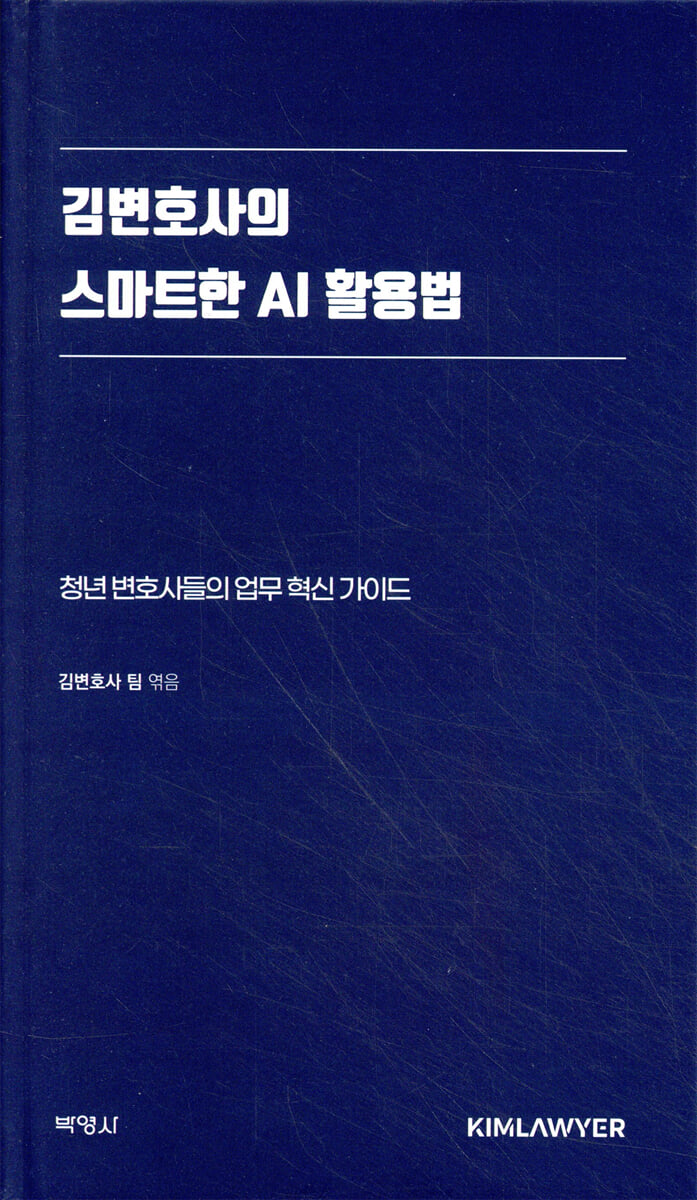
Attorney Kim's Smart Ways to Use AI
 |
Description
Book Introduction
"Attorney Kim's Smart AI Utilization" captures the essence of "lawyer work innovation in the AI era" based on "Attorney Kim's AI Study" conducted with over 60 lawyers.
Additionally, some of the lectures that received the highest reviews from the Korea University ESEL Data and AI Law Advanced Course are also included.
You'll also discover how generative AI can accelerate legal research and document creation, and how searchable AI can help you more efficiently find useful case law and regulations to solve problems.
Additionally, some of the lectures that received the highest reviews from the Korea University ESEL Data and AI Law Advanced Course are also included.
You'll also discover how generative AI can accelerate legal research and document creation, and how searchable AI can help you more efficiently find useful case law and regulations to solve problems.
- You can preview some of the book's contents.
Preview
index
Chapter 01.
ingress
· How should experts use generative AI? 4
Introduction to Legal AI 7
· How to Solve Problems with AI 16
· Clear questions create clear answers - Prompt Engineering Strategy 19
In the AI era, I protect my personal information. 24
· ChatGPT Pro and DeepSeek are out? 27
Chapter 02.
How to Use Search-Type AI
· Search-based AI: Is it really necessary? 34
· Introduction to Key Search-Type AI Tools 39
(SearchGPT, Liner, Perplexity, Genspark)
· Why Perplexity? 48
· Getting Started with Perplexity 52
· Perplexity Data Search Method - 57 Effective Prompt Writing Methods
· Utilizing Perplexity as Legal AI - Civil Case 61
· Utilizing Perplexity as Legal AI - Criminal Case 66
· Utilizing Perplexity Legal AI - Examining Special Laws 72
· Perplexity Data Search Method - Utilizing 'Space' 77
· 82 Tips for Using Perplexity Efficiently
Chapter 03. Contract Review Using AI
· Writing a Contract with Claude 88
· First-time Academy Lease Agreement 91
· Become a certified real estate agent in Daechi-dong with 30 years of experience and write a lease agreement. 94
· Twenty Questions for Contract Writing - Asking AI 97 Questions
· Twenty Questions for Contract Writing - Asking AI 102 Questions
· Resigning the contract 106
· Reviewing Contracts - Basic Prompts 109
Analyzing Key Contract Provisions with AI 112
· Reviewing Unfavorable Provisions 115
· Compare industry standard contracts and develop negotiation strategies 118
· Solve it all in one go with the Claude Project 121
Chapter 04.
My personal secretary, GPTs
· GPTs 130, a personalized assistant for busy lawyers
· Getting Started with GPTs 134
· Security Issues to Watch Out for When Using GPTs 143
· How to Write Prompts to Reduce Hallucinations 147
· What if you could anticipate your boss's rebuttal before reporting? 151
· Summary bot 158 for modern people who don't like reading long texts
· Let's create a bot for in-house lawyers' work 165
· Newsletterbot 175, providing easy access to legal trends
· Create your own industry newsletter in 5 seconds 181
· GPTs can be used like associative variables, but verification is essential. 185
Chapter 05.
How Attorney Song Mu Uses AI
· AI 190, a must-have for lawyers
· 194 Case Consultations Prepared with AI
· AI-generated litigation proposal 201
· Mastering the Verdict - From Client Communication to Marketing 209
· AI Prompt Strategy 216 to Automate Work
· Get legal drafting edited with AI 226
· Quickly and easily create anticipated questions for investigative agencies 230
· Prompt 236 for Writing a Sentencing Opinion
· Oral Argument Preparation with AI 241
· Lawyers' Use of AI: Precautions and Infinite Possibilities 247
ingress
· How should experts use generative AI? 4
Introduction to Legal AI 7
· How to Solve Problems with AI 16
· Clear questions create clear answers - Prompt Engineering Strategy 19
In the AI era, I protect my personal information. 24
· ChatGPT Pro and DeepSeek are out? 27
Chapter 02.
How to Use Search-Type AI
· Search-based AI: Is it really necessary? 34
· Introduction to Key Search-Type AI Tools 39
(SearchGPT, Liner, Perplexity, Genspark)
· Why Perplexity? 48
· Getting Started with Perplexity 52
· Perplexity Data Search Method - 57 Effective Prompt Writing Methods
· Utilizing Perplexity as Legal AI - Civil Case 61
· Utilizing Perplexity as Legal AI - Criminal Case 66
· Utilizing Perplexity Legal AI - Examining Special Laws 72
· Perplexity Data Search Method - Utilizing 'Space' 77
· 82 Tips for Using Perplexity Efficiently
Chapter 03. Contract Review Using AI
· Writing a Contract with Claude 88
· First-time Academy Lease Agreement 91
· Become a certified real estate agent in Daechi-dong with 30 years of experience and write a lease agreement. 94
· Twenty Questions for Contract Writing - Asking AI 97 Questions
· Twenty Questions for Contract Writing - Asking AI 102 Questions
· Resigning the contract 106
· Reviewing Contracts - Basic Prompts 109
Analyzing Key Contract Provisions with AI 112
· Reviewing Unfavorable Provisions 115
· Compare industry standard contracts and develop negotiation strategies 118
· Solve it all in one go with the Claude Project 121
Chapter 04.
My personal secretary, GPTs
· GPTs 130, a personalized assistant for busy lawyers
· Getting Started with GPTs 134
· Security Issues to Watch Out for When Using GPTs 143
· How to Write Prompts to Reduce Hallucinations 147
· What if you could anticipate your boss's rebuttal before reporting? 151
· Summary bot 158 for modern people who don't like reading long texts
· Let's create a bot for in-house lawyers' work 165
· Newsletterbot 175, providing easy access to legal trends
· Create your own industry newsletter in 5 seconds 181
· GPTs can be used like associative variables, but verification is essential. 185
Chapter 05.
How Attorney Song Mu Uses AI
· AI 190, a must-have for lawyers
· 194 Case Consultations Prepared with AI
· AI-generated litigation proposal 201
· Mastering the Verdict - From Client Communication to Marketing 209
· AI Prompt Strategy 216 to Automate Work
· Get legal drafting edited with AI 226
· Quickly and easily create anticipated questions for investigative agencies 230
· Prompt 236 for Writing a Sentencing Opinion
· Oral Argument Preparation with AI 241
· Lawyers' Use of AI: Precautions and Infinite Possibilities 247
Detailed image

Publisher's Review
prolog
Today, lawyers are feeling a strange sense of tension in the face of a new technological paradigm: artificial intelligence (AI).
On the one hand, there's intense curiosity about the innovative possibilities that were previously unimaginable, but on the other hand, there's also a growing fear that highly specialized expertise could be replaced by AI.
This emotional turmoil isn't limited to lawyers. When AI first emerged, there was a heated debate among developers about whether AI would replace developers.
But as time goes by, developers who are adept at leveraging AI are actually opening up a larger market.
In this flow, it becomes noticeable that the situations of lawyers and developers are very similar.
Although they may seem like completely different fields, both professions require expertise in 'deciphering and judging documents.'
No matter how sophisticated AI generates documents, only a lawyer can determine whether they are legally valid and strategically appropriate.
For this reason, we must study the technological changes wrought by AI "right now." While AI won't completely replace lawyers in areas like accountability and attending actual trials, lawyers who know how to utilize AI can replace those who don't.
As recently as 2023, I was working as an in-house lawyer for a major corporation.
It was a stable life with regular work hours, commuting to Yeouido and leaving at 6 p.m., not being overly busy, and a moderately warm back.
At a seminar I attended by chance, I was exposed to Copilot videos and various document automation AI tools, and my mind became dizzy.
A sense of crisis came over me, thinking, 'If this continues, I'll end up like a frog in warm water.'
From then on, I started going to every meeting where I could learn about AI.
That's how I participated in the 'AI Startup Competition', and in the process, the current 'Attorney Kim' MVP (Minimum Viable Product) was born.
The IT community I attended was filled with developers and entrepreneurs.
Those who were more technologically advanced than me often assumed that the legal market would be lucrative, yet they treated me with the unfounded conviction that AI could replace professional lawyers.
I could feel that while they wanted to use me for business purposes, they also looked down on me as someone who was technically backward.
In particular, some developers were quick to say that lawyers, whose high-level documentation skills are crucial, would be the first to be replaced when LLMs (Large-Scale Language Models) become widespread.
When we look at the services they have created—for example, a “legal service” that automatically creates certified mail—the technology is excellent, but the paradox is that the engineers who created the technology and the users have no understanding of the legal arguments in their own documents.
Non-lawyer planners and developers would often draft seemingly plausible documents and then ask, “Is that good?” without even understanding key legal issues like the release argument.
Without any understanding of what the writing meant.
Seeing that, I was convinced.
It's not AI that's pushing out lawyers, it's lawyers who know how to apply AI to their work.
Two years have passed since then.
Attorney Kim's service has grown to be used by over 60% of attorneys with 1-2 years of experience, and is visited by approximately 3,400 attorneys.
We conducted an AI study targeting junior lawyers with the greatest desire for growth and drive, and all cohorts sold out.
This book captures the essence of "Lawyer Work Innovation in the AI Era" based on the "Attorney Kim AI Study" conducted with over 60 lawyers.
Additionally, some of the lectures that received the highest reviews from Korea University's ESEL Data and AI Law Advanced Course are included.
You'll also discover how generative AI can accelerate legal research and document creation, and how searchable AI can help you more efficiently find useful case law and regulations to solve problems.
The advent of the AI era presents both a threat and an opportunity not only for lawyers, but for all professions.
This will create new occupations and redefine the roles of professionals across industries.
But for those of us who are prepared, the door of opportunity is clearly opening.
AI won't replace everything, but lawyers who are adept at using AI will outperform those who aren't.
Just as I have, and as the co-author of this book and numerous study participants have, Attorney Kim will now walk alongside you on the path of becoming a legal professional who leads a new era, fueled by anxiety and curiosity.
I am confident that this book will dramatically improve the work efficiency of lawyers.
2025.
2. 3
Attorney Kim
Today, lawyers are feeling a strange sense of tension in the face of a new technological paradigm: artificial intelligence (AI).
On the one hand, there's intense curiosity about the innovative possibilities that were previously unimaginable, but on the other hand, there's also a growing fear that highly specialized expertise could be replaced by AI.
This emotional turmoil isn't limited to lawyers. When AI first emerged, there was a heated debate among developers about whether AI would replace developers.
But as time goes by, developers who are adept at leveraging AI are actually opening up a larger market.
In this flow, it becomes noticeable that the situations of lawyers and developers are very similar.
Although they may seem like completely different fields, both professions require expertise in 'deciphering and judging documents.'
No matter how sophisticated AI generates documents, only a lawyer can determine whether they are legally valid and strategically appropriate.
For this reason, we must study the technological changes wrought by AI "right now." While AI won't completely replace lawyers in areas like accountability and attending actual trials, lawyers who know how to utilize AI can replace those who don't.
As recently as 2023, I was working as an in-house lawyer for a major corporation.
It was a stable life with regular work hours, commuting to Yeouido and leaving at 6 p.m., not being overly busy, and a moderately warm back.
At a seminar I attended by chance, I was exposed to Copilot videos and various document automation AI tools, and my mind became dizzy.
A sense of crisis came over me, thinking, 'If this continues, I'll end up like a frog in warm water.'
From then on, I started going to every meeting where I could learn about AI.
That's how I participated in the 'AI Startup Competition', and in the process, the current 'Attorney Kim' MVP (Minimum Viable Product) was born.
The IT community I attended was filled with developers and entrepreneurs.
Those who were more technologically advanced than me often assumed that the legal market would be lucrative, yet they treated me with the unfounded conviction that AI could replace professional lawyers.
I could feel that while they wanted to use me for business purposes, they also looked down on me as someone who was technically backward.
In particular, some developers were quick to say that lawyers, whose high-level documentation skills are crucial, would be the first to be replaced when LLMs (Large-Scale Language Models) become widespread.
When we look at the services they have created—for example, a “legal service” that automatically creates certified mail—the technology is excellent, but the paradox is that the engineers who created the technology and the users have no understanding of the legal arguments in their own documents.
Non-lawyer planners and developers would often draft seemingly plausible documents and then ask, “Is that good?” without even understanding key legal issues like the release argument.
Without any understanding of what the writing meant.
Seeing that, I was convinced.
It's not AI that's pushing out lawyers, it's lawyers who know how to apply AI to their work.
Two years have passed since then.
Attorney Kim's service has grown to be used by over 60% of attorneys with 1-2 years of experience, and is visited by approximately 3,400 attorneys.
We conducted an AI study targeting junior lawyers with the greatest desire for growth and drive, and all cohorts sold out.
This book captures the essence of "Lawyer Work Innovation in the AI Era" based on the "Attorney Kim AI Study" conducted with over 60 lawyers.
Additionally, some of the lectures that received the highest reviews from Korea University's ESEL Data and AI Law Advanced Course are included.
You'll also discover how generative AI can accelerate legal research and document creation, and how searchable AI can help you more efficiently find useful case law and regulations to solve problems.
The advent of the AI era presents both a threat and an opportunity not only for lawyers, but for all professions.
This will create new occupations and redefine the roles of professionals across industries.
But for those of us who are prepared, the door of opportunity is clearly opening.
AI won't replace everything, but lawyers who are adept at using AI will outperform those who aren't.
Just as I have, and as the co-author of this book and numerous study participants have, Attorney Kim will now walk alongside you on the path of becoming a legal professional who leads a new era, fueled by anxiety and curiosity.
I am confident that this book will dramatically improve the work efficiency of lawyers.
2025.
2. 3
Attorney Kim
GOODS SPECIFICS
- Date of issue: March 26, 2025
- Format: Hardcover book binding method guide
- Page count, weight, size: 264 pages | 153*224*20mm
- ISBN13: 9791130349473
- ISBN10: 1130349470
You may also like
카테고리
korean


korean

![GQ KOREA Mark (Monthly): December [2025]](http://librairie.coreenne.fr/cdn/shop/files/8ef265dbbfbf186523ed75ba7319009d.jpg?v=1765340328&width=3840)


