

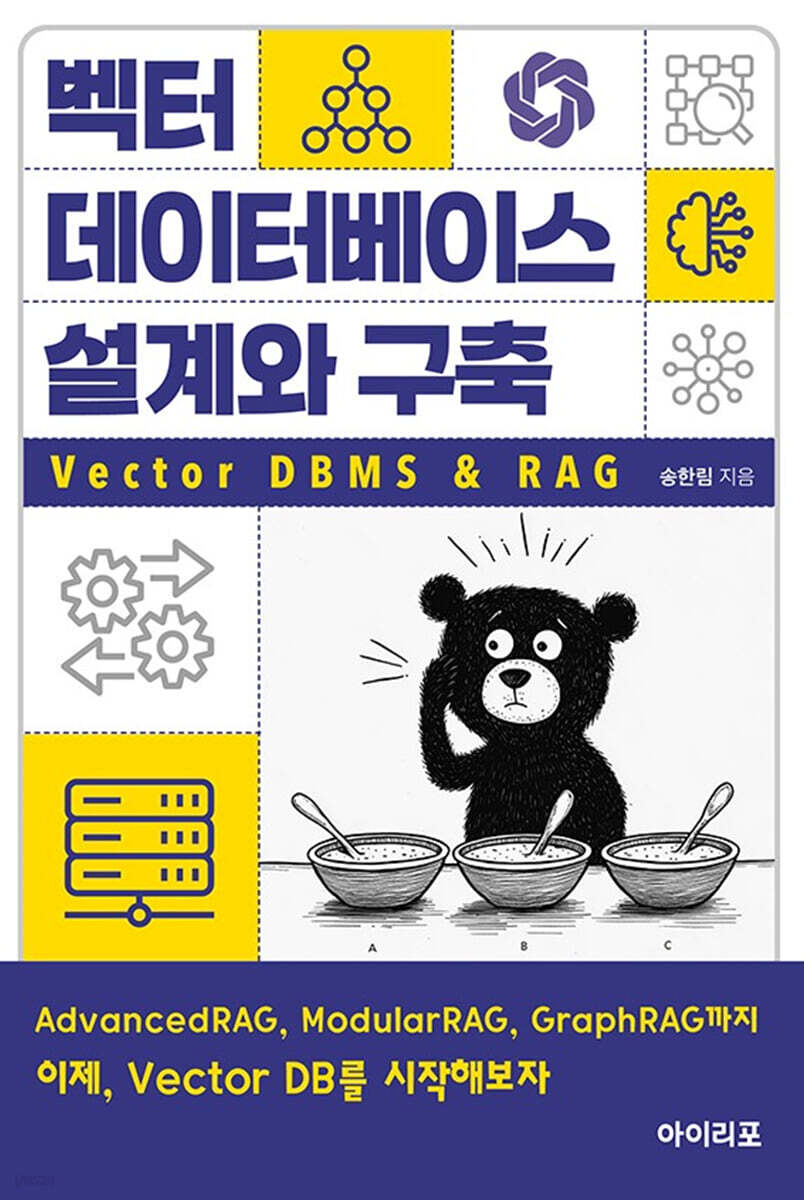
Vector Database Design and Construction
 |
Description
Book Introduction
Recently, AI software companies like Palantir have emerged as prominent players in the defense and healthcare sectors, and at their core are data-driven design and advanced analytics. To maximize the performance of AI systems, it's essential to structurally define and efficiently utilize unstructured data. Key technologies supporting this include Vector DB, knowledge graph modeling, and ontology.
In particular, Vector DB, which can quickly search for semantic similarity in unstructured data, and Graph DB, which can perform relationship-centered search, are essential elements for AI implementation.
For our country to compete with advanced AI countries, it is crucial to develop the ability to structure and analyze data beyond AI development capabilities. This book provides a core guide to data-centric AI design, from the concepts of Vector DB and Graph DB to practical application.
In particular, Vector DB, which can quickly search for semantic similarity in unstructured data, and Graph DB, which can perform relationship-centered search, are essential elements for AI implementation.
For our country to compete with advanced AI countries, it is crucial to develop the ability to structure and analyze data beyond AI development capabilities. This book provides a core guide to data-centric AI design, from the concepts of Vector DB and Graph DB to practical application.
- You can preview some of the book's contents.
Preview
index
Chapter 1.
Vector Database Overview
__1.1 The Rising Star of AI
__1.2 Understanding Vectors
Chapter 2.
Vector DBMS Types and Selection Criteria
__2.1 Vector DBMS Features
__2.2 Types of Vector DBMS and Considerations for Selection
__2.3 Comparison of Features by Vector DBMS Type
Chapter 3.
Generative AI Project Design Methodology
__3.1 Generative AI Project Execution Procedure
__3.2 Data Analysis Preparation and Design Procedure
Chapter 4.
Data Analysis and Preparation
__4.1 Data Range/Type Analysis
__4.2 Data Requirements Analysis
__4.3 Data Feature Analysis
__4.4 Obtaining the dataset
Chapter 5.
Vector DataBase Schema Design
__5.1 Vector DB Schema Design
__5.2 Collection Design
__5.3 Vector Design
__5.4 Meta Data Design
__5.5 Relationship Design
Chapter 6.
Data retrieval/response consistency verification
__6.1 Data Evaluation and Validation
Chapter 7. RAG Overview and Performance Improvements
__7.1 RAG Overview
__7.2 RAG Architecture
__7.3 RAG Limits
__7.4 RAG improvements (Advanced RAG, Modular RAG, Graph RAG)
Chapter 8.
Advanced RAG
__8.1 Advanced RAG Overview
__8.2 Cleaning the source data
__8.3 Adjusting the Retrieval Strategy
__8.4 Adjusting Search Strategy
__8.5 Collection separation/distribution
Chapter 9.
Modular RAG
__9.1 Modular RAG Overview
__9.2 Independent modularization
__9.3 Various FLOW patterns
__9.4 Reference - Modular RAG External Paper
Chapter 10.
Graph RAG - Knowledge-Based RAG
__10.1 Graph RAG Overview
__10.2 Graph DB Modeling - Basic Data Modeling Structure
__10.3 Graph DB Modeling - Data Divide Depth
__10.4 Graph DB Modeling - Data Modeling Procedure
__10.5 Graph DB Modeling - Data Retrieval
__10.6 Ontology
__10.7 Using Knowledge Graph in Graph RAG (Graph DB + Ontology)
__10.8 Business Application Cases of Graph RAG (Defense, Medical, Legal)
__10.9 Neo4j DB
Chapter 11.
Try the program
__11.1 Chroma DB - Vector DB
____11.1.1 Installing Chroma DB
____11.1.2 Program Walkthrough with Python - Saving Chroma Embedding Data
____11.1.3 Program Follow-up with Python - Generating Response Information with OpenAI
____11.1.4 Follow the Program with Python - Chunking
____11.1.5 Follow the Program with Python - Sample Program
__11.2 Neo4j DB - Graph DB
____11.2.1 Installing Neo4j DB
____11.2.2 Program Walkthrough with Python - Neo4j Embedding Data Storage
____11.2.3 Program Follow-up with Python - Haluciation Improvements with Neo4j
__11.3 Utilizing Neo4J DB algorithm (creating a community)
____11.3.1 Installing the Neo4J Plug-In
____11.3.2 Program Walkthrough with Python - Creating a Graph Model (Internet News Data)
____11.3.3 Program Follow-up with Algorithm - Community Creation (Internet News Data)
__11.4 FAISS - Library
____11.4.1 FAISS Installation
____11.4.2 Program Walkthrough with Python - FAISS Embedding Storage and Retrieval
__11.5 CHAT System - RAG Environment
____11.5.1 Streamlit
____11.5.2 Follow the program with Python - Simple CHAT program
Vector Database Overview
__1.1 The Rising Star of AI
__1.2 Understanding Vectors
Chapter 2.
Vector DBMS Types and Selection Criteria
__2.1 Vector DBMS Features
__2.2 Types of Vector DBMS and Considerations for Selection
__2.3 Comparison of Features by Vector DBMS Type
Chapter 3.
Generative AI Project Design Methodology
__3.1 Generative AI Project Execution Procedure
__3.2 Data Analysis Preparation and Design Procedure
Chapter 4.
Data Analysis and Preparation
__4.1 Data Range/Type Analysis
__4.2 Data Requirements Analysis
__4.3 Data Feature Analysis
__4.4 Obtaining the dataset
Chapter 5.
Vector DataBase Schema Design
__5.1 Vector DB Schema Design
__5.2 Collection Design
__5.3 Vector Design
__5.4 Meta Data Design
__5.5 Relationship Design
Chapter 6.
Data retrieval/response consistency verification
__6.1 Data Evaluation and Validation
Chapter 7. RAG Overview and Performance Improvements
__7.1 RAG Overview
__7.2 RAG Architecture
__7.3 RAG Limits
__7.4 RAG improvements (Advanced RAG, Modular RAG, Graph RAG)
Chapter 8.
Advanced RAG
__8.1 Advanced RAG Overview
__8.2 Cleaning the source data
__8.3 Adjusting the Retrieval Strategy
__8.4 Adjusting Search Strategy
__8.5 Collection separation/distribution
Chapter 9.
Modular RAG
__9.1 Modular RAG Overview
__9.2 Independent modularization
__9.3 Various FLOW patterns
__9.4 Reference - Modular RAG External Paper
Chapter 10.
Graph RAG - Knowledge-Based RAG
__10.1 Graph RAG Overview
__10.2 Graph DB Modeling - Basic Data Modeling Structure
__10.3 Graph DB Modeling - Data Divide Depth
__10.4 Graph DB Modeling - Data Modeling Procedure
__10.5 Graph DB Modeling - Data Retrieval
__10.6 Ontology
__10.7 Using Knowledge Graph in Graph RAG (Graph DB + Ontology)
__10.8 Business Application Cases of Graph RAG (Defense, Medical, Legal)
__10.9 Neo4j DB
Chapter 11.
Try the program
__11.1 Chroma DB - Vector DB
____11.1.1 Installing Chroma DB
____11.1.2 Program Walkthrough with Python - Saving Chroma Embedding Data
____11.1.3 Program Follow-up with Python - Generating Response Information with OpenAI
____11.1.4 Follow the Program with Python - Chunking
____11.1.5 Follow the Program with Python - Sample Program
__11.2 Neo4j DB - Graph DB
____11.2.1 Installing Neo4j DB
____11.2.2 Program Walkthrough with Python - Neo4j Embedding Data Storage
____11.2.3 Program Follow-up with Python - Haluciation Improvements with Neo4j
__11.3 Utilizing Neo4J DB algorithm (creating a community)
____11.3.1 Installing the Neo4J Plug-In
____11.3.2 Program Walkthrough with Python - Creating a Graph Model (Internet News Data)
____11.3.3 Program Follow-up with Algorithm - Community Creation (Internet News Data)
__11.4 FAISS - Library
____11.4.1 FAISS Installation
____11.4.2 Program Walkthrough with Python - FAISS Embedding Storage and Retrieval
__11.5 CHAT System - RAG Environment
____11.5.1 Streamlit
____11.5.2 Follow the program with Python - Simple CHAT program
Detailed image

Publisher's Review
It doesn't just stop at explaining the concept.
Beyond that, examples are included to help you get started with a real-world Vector DB.
* Chroma DB - Vector DB
* Neo4j DB - Graph DB
* Neo4j DB - Algorithm Utilization (Community Creation)
* FAISS - Library
* CHAT system - RAG environment
-------------------------------------------------------------------------------
* Vector DB is a database optimized for processing unstructured data, especially vector data.
Vector DB handles data in a vector space, and each data is expressed as a high-dimensional vector.
In other words, Vector DB models data in a multidimensional space of three or more dimensions through mathematical calculations.
* Graph DB can analyze data based on complex relationship information and provide more accurate information or inference results for problems.
In addition to simple data retrieval, in-depth analysis using the connections between data is possible.
* This book aims to provide step-by-step explanations of the concepts of Vector DB, and then move on to practical Vector DB and Graph DB in the last chapter.
What kind of readers is this book for?
- AI analysts/designers interested in the analysis/design of AI unstructured data and data utilization strategies.
-.
AI researchers and developers who want to explore data modeling, optimization, and application methods based on Vector DB.
-.
Readers interested in structuring knowledge graphs using Graph DB from a data analysis perspective
Beyond that, examples are included to help you get started with a real-world Vector DB.
* Chroma DB - Vector DB
* Neo4j DB - Graph DB
* Neo4j DB - Algorithm Utilization (Community Creation)
* FAISS - Library
* CHAT system - RAG environment
-------------------------------------------------------------------------------
* Vector DB is a database optimized for processing unstructured data, especially vector data.
Vector DB handles data in a vector space, and each data is expressed as a high-dimensional vector.
In other words, Vector DB models data in a multidimensional space of three or more dimensions through mathematical calculations.
* Graph DB can analyze data based on complex relationship information and provide more accurate information or inference results for problems.
In addition to simple data retrieval, in-depth analysis using the connections between data is possible.
* This book aims to provide step-by-step explanations of the concepts of Vector DB, and then move on to practical Vector DB and Graph DB in the last chapter.
What kind of readers is this book for?
- AI analysts/designers interested in the analysis/design of AI unstructured data and data utilization strategies.
-.
AI researchers and developers who want to explore data modeling, optimization, and application methods based on Vector DB.
-.
Readers interested in structuring knowledge graphs using Graph DB from a data analysis perspective
GOODS SPECIFICS
- Date of issue: March 1, 2025
- Page count, weight, size: 288 pages | 152*225*20mm
- ISBN13: 9791193747049
- ISBN10: 119374704X
You may also like
카테고리
korean


korean

![GQ KOREA Mark (Monthly): December [2025]](http://librairie.coreenne.fr/cdn/shop/files/8ef265dbbfbf186523ed75ba7319009d.jpg?v=1765340328&width=3840)


