

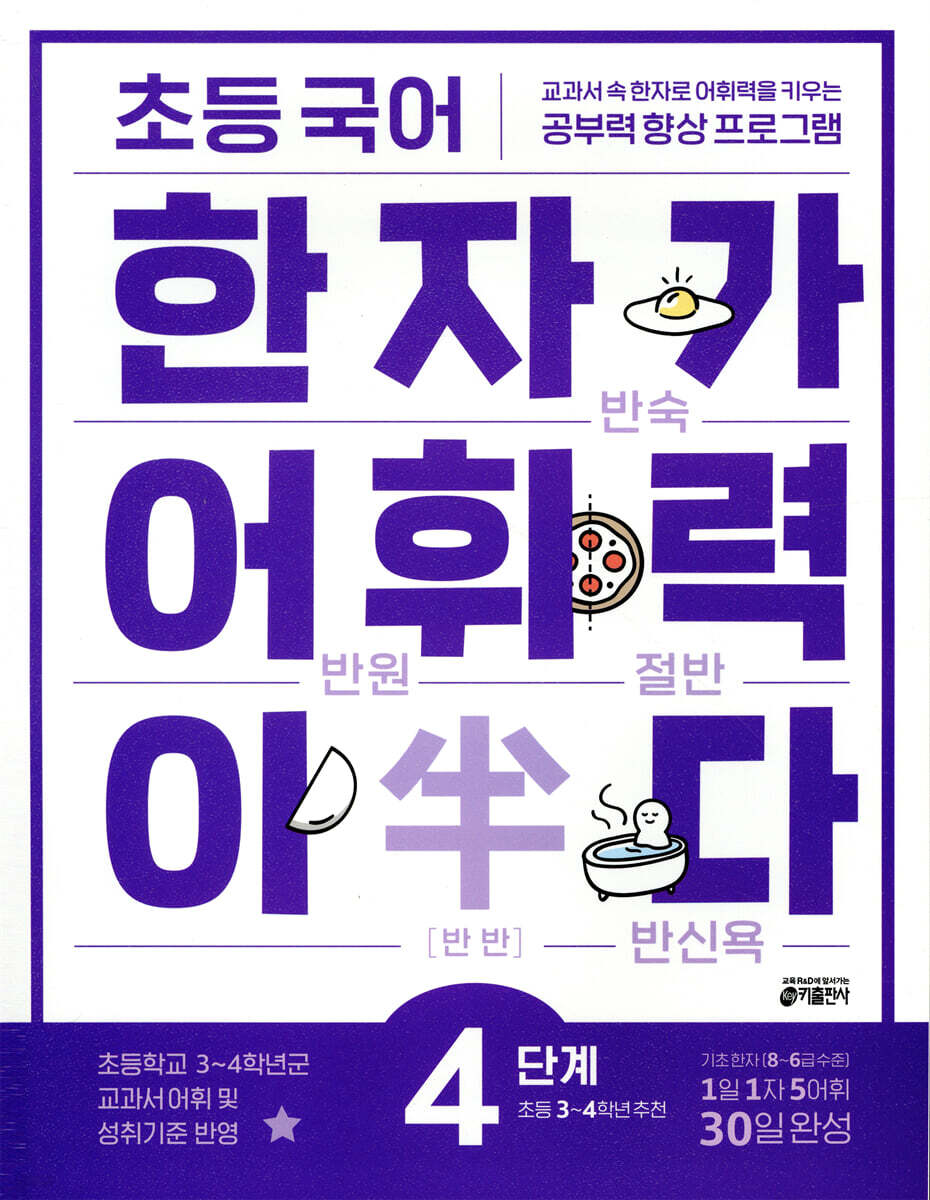
Elementary Korean Chinese Character Vocabulary Level 4: Recommended for 3rd and 4th graders
 |
Description
Book Introduction
Say goodbye to Hanja for Hanja's sake! "Elementary Korean: Hanja is Vocabulary" is here to help you improve your vocabulary and study skills. Knowing one will help you understand ten! If you've become familiar with Chinese characters in steps 1 and 2, let's get to know more advanced Chinese characters and vocabulary in steps 3 and 4! The vocabulary for textbooks for 3rd and 4th grade elementary school students was determined using basic Chinese characters (level 8-6). If you start with familiar words and follow them step by step, you will be able to guess the meaning of unfamiliar vocabulary on your own. In the process, your vocabulary and study skills will grow. |
- You can preview some of the book's contents.
Preview
index
* This book
Unit 1 School Life
Lesson 1 Name: Place name / Signature / Famous person / Designation
Lesson 2: Direction: Direction / Wind direction / South-facing house / Improvement
3. One thing: Tie / Simultaneously / Club / Cooperation
4. Combined: Choir / Ensemble / Integrated / Mixed
Lesson 5: Asking Questions: Problems / Questions / Surveys / Academics
Lesson 6: Beauty: Beautification / Art / Beauty Salon / All-rounder
Lesson 7: Longevity / Longevity / Growth / Advantages
Lesson 8 Body God: Body / Self / Accessories / Shame
Expand your vocabulary 1
Unit 2 Science
Lesson 1: Contents / Inside / Downtown / Introvert
2. Complete before: complete / preserved / whole / whole country
3 and a half: Half-circle / Half-boiled / Half-body / Half-body bath
Lesson 4 Bill Gong: Space / Aerial / Air / Aircraft
Lesson 5: Horn Angles: Sugar Cube / Angle / Right Angle / Triangle
Lesson 6: How many?: Various / Many readings / Affection / Excessive
Lesson 7 Cells: Calculations / Clocks / Schedules / Statistics
Expand your vocabulary 2
Unit 3 Art
Lesson 1: Being / Being present / Present / Absent
Between 2 and 3: Interval / Moment / Time / Human
3. Distinguishing words: division / section / section / compartment
Lesson 4: Shape: ?Shape/Form/Basic Form/Intangible Cultural Heritage
Lesson 5: Before: Morning / Pre-mortem / Past Life / First Half
Lesson 6 After: Dessert / Regret / Book Review / The End
Lesson 7 Left Left?: Back and forth, left and right / Left and right / Right and left / Left and right and left and right
Expand your vocabulary 3
Unit 4 Social Studies
Lesson 1: Reversible Class: Repetition / Reflection / Opposition / Foul Play
2. Ball with: Sharing/Commonality/Community/Public Space
Lesson 3: Fairness: Fairness / Parks / Public Interest / Public Telephones
Lesson 4: Legal Ceremony: Forms / Officials / Rituals / Weddings
Lesson 5: Flat: Horizontal / Average / Equal / Peaceful
Lesson 6: Happiness Row: Happiness / Luck / Unhappiness / Fortune
Lesson 7: Carts: Carriage / Train / Fire Truck / Parking Lot
Lesson 8 Military Military: Military / Soldier / General / Air Force
Expand your vocabulary 4
* Book in Book (answer sheet)
* Chinese character index
* View all Chinese characters
Unit 1 School Life
Lesson 1 Name: Place name / Signature / Famous person / Designation
Lesson 2: Direction: Direction / Wind direction / South-facing house / Improvement
3. One thing: Tie / Simultaneously / Club / Cooperation
4. Combined: Choir / Ensemble / Integrated / Mixed
Lesson 5: Asking Questions: Problems / Questions / Surveys / Academics
Lesson 6: Beauty: Beautification / Art / Beauty Salon / All-rounder
Lesson 7: Longevity / Longevity / Growth / Advantages
Lesson 8 Body God: Body / Self / Accessories / Shame
Expand your vocabulary 1
Unit 2 Science
Lesson 1: Contents / Inside / Downtown / Introvert
2. Complete before: complete / preserved / whole / whole country
3 and a half: Half-circle / Half-boiled / Half-body / Half-body bath
Lesson 4 Bill Gong: Space / Aerial / Air / Aircraft
Lesson 5: Horn Angles: Sugar Cube / Angle / Right Angle / Triangle
Lesson 6: How many?: Various / Many readings / Affection / Excessive
Lesson 7 Cells: Calculations / Clocks / Schedules / Statistics
Expand your vocabulary 2
Unit 3 Art
Lesson 1: Being / Being present / Present / Absent
Between 2 and 3: Interval / Moment / Time / Human
3. Distinguishing words: division / section / section / compartment
Lesson 4: Shape: ?Shape/Form/Basic Form/Intangible Cultural Heritage
Lesson 5: Before: Morning / Pre-mortem / Past Life / First Half
Lesson 6 After: Dessert / Regret / Book Review / The End
Lesson 7 Left Left?: Back and forth, left and right / Left and right / Right and left / Left and right and left and right
Expand your vocabulary 3
Unit 4 Social Studies
Lesson 1: Reversible Class: Repetition / Reflection / Opposition / Foul Play
2. Ball with: Sharing/Commonality/Community/Public Space
Lesson 3: Fairness: Fairness / Parks / Public Interest / Public Telephones
Lesson 4: Legal Ceremony: Forms / Officials / Rituals / Weddings
Lesson 5: Flat: Horizontal / Average / Equal / Peaceful
Lesson 6: Happiness Row: Happiness / Luck / Unhappiness / Fortune
Lesson 7: Carts: Carriage / Train / Fire Truck / Parking Lot
Lesson 8 Military Military: Military / Soldier / General / Air Force
Expand your vocabulary 4
* Book in Book (answer sheet)
* Chinese character index
* View all Chinese characters
Detailed image

Publisher's Review
Chinese characters: the key to vocabulary and study skills! How should you study them?
Say goodbye to Hanja for Hanja! "Elementary Korean: Hanja is Vocabulary" is here to help you improve your vocabulary and study skills. Knowing one will help you understand ten!
If you have become familiar with Chinese characters in steps 1 and 2, try learning more advanced Chinese characters and vocabulary in steps 3 and 4.
I have compiled vocabulary for elementary school 3rd and 4th graders using basic Chinese characters (level 8-6).
If you start with familiar words and follow them step by step, you will be able to guess the meaning of unfamiliar vocabulary on your own.
In the process, your vocabulary and study skills will grow.
① Easy and fun way to learn Chinese characters without overwhelming children! A textbook children love!
Start with familiar vocabulary that your child already knows.
First of all, this is not a Chinese character textbook that teaches you to write and memorize the suggested Chinese characters.
By realizing for yourself that the letters common to vocabulary are Chinese characters and knowing the meaning of those Chinese characters, you will develop the ability to infer the meaning of words you encounter in long texts.
② Closely linked to the textbook! Complete in 30 days with '1 letter, 4 vocabulary words per day'!
Learn one Chinese character a day and learn the four vocabulary words hidden in that character.
Finally, find the vocabulary you learned in the long text.
In long texts, one new vocabulary word is added with the Chinese character learned that day, and in [Expand Vocabulary], you check the specific meaning, so in fact, you learn a total of five vocabulary words for each Chinese character.
▶ Chinese characters: Classify basic Chinese characters of level 8-6 into an order that children can easily understand.
▶ Vocabulary: Textbook vocabulary for 3rd and 4th graders and everyday vocabulary familiar to children
▶ Long text: A text written on the topic of the achievement standards for the 3rd and 4th grade elementary school curriculum
It's longer than the long texts in steps 1 and 2, and it's more interesting because it's divided into new paragraphs.
③ Learning Korean etymology to develop your inferential skills!
Improve your vocabulary, which is the foundation for all school subjects, through Chinese characters.
If you know Chinese characters, the meaning of vocabulary you already know becomes clearer.
Children can guess the meaning of new vocabulary by inferring it on their own.
By starting the process of building vocabulary with Chinese characters, you will establish a more solid and solid foundation.
By learning Chinese characters, which are the origin of many Korean words, children develop a real vocabulary that allows them to infer meaning on their own, rather than just memorizing vocabulary.
▶ Learners who don't know how to start studying Chinese characters that are connected to vocabulary!
▶ Learners who find studying Chinese characters difficult and boring and feel burdened!
▶ Learners who want to study Chinese characters to improve their reading comprehension, not for the purpose of learning Chinese characters!
▶ Learners who want to learn vocabulary in conjunction with elementary school textbooks!
▶ Learners who have too many unfamiliar words
What Chinese characters do you learn?
Basic Chinese characters (levels 8-6) are classified according to specially designed selection criteria.
It is an order that is easy for children to accept, not a gradual order.
1.
Chinese characters learned in levels 1 and 2 of this textbook, or Chinese characters with few strokes and easy strokes
2.
Many Chinese characters in textbook vocabulary for 3rd and 4th grade elementary school students
3.
Chinese characters closely related to the daily lives of 3rd and 4th grade elementary school students
What vocabulary do you learn?
It starts with words that your child has likely heard at least once at home or school.
You will know that there are Chinese characters hidden in words you already know, and if you didn't know, you can guess the meaning through the Chinese characters.
1.
Textbook vocabulary for 3rd and 4th grade elementary school students
2.
Vocabulary closely related to the daily lives of 3rd and 4th grade elementary school students
Linking the curriculum to the achievement standards for 3rd and 4th grade elementary school students!
All fingerprints are designed to capture children's interest, and the content matches the '3rd and 4th grade achievement standards' that children learn in school.
In texts on familiar topics, recall the meaning of the Chinese characters hidden in the words.
Help your child learn to infer unfamiliar words without giving up.
It is structured so that you can follow along step by step and gain a sense of accomplishment!
If the child became interested in Chinese characters and became familiar with them in the 1st and 2nd level textbooks, then in the 3rd and 4th levels, information on 'radical' elements was added to the shape, meaning, and sound of the Chinese characters.
The principles of Chinese characters are also explained through interesting illustrations.
The National Institute of the Korean Language's [Standard Korean Dictionary] definitions have been edited to fit children's needs.
Say goodbye to Hanja for Hanja! "Elementary Korean: Hanja is Vocabulary" is here to help you improve your vocabulary and study skills. Knowing one will help you understand ten!
If you have become familiar with Chinese characters in steps 1 and 2, try learning more advanced Chinese characters and vocabulary in steps 3 and 4.
I have compiled vocabulary for elementary school 3rd and 4th graders using basic Chinese characters (level 8-6).
If you start with familiar words and follow them step by step, you will be able to guess the meaning of unfamiliar vocabulary on your own.
In the process, your vocabulary and study skills will grow.
① Easy and fun way to learn Chinese characters without overwhelming children! A textbook children love!
Start with familiar vocabulary that your child already knows.
First of all, this is not a Chinese character textbook that teaches you to write and memorize the suggested Chinese characters.
By realizing for yourself that the letters common to vocabulary are Chinese characters and knowing the meaning of those Chinese characters, you will develop the ability to infer the meaning of words you encounter in long texts.
② Closely linked to the textbook! Complete in 30 days with '1 letter, 4 vocabulary words per day'!
Learn one Chinese character a day and learn the four vocabulary words hidden in that character.
Finally, find the vocabulary you learned in the long text.
In long texts, one new vocabulary word is added with the Chinese character learned that day, and in [Expand Vocabulary], you check the specific meaning, so in fact, you learn a total of five vocabulary words for each Chinese character.
▶ Chinese characters: Classify basic Chinese characters of level 8-6 into an order that children can easily understand.
▶ Vocabulary: Textbook vocabulary for 3rd and 4th graders and everyday vocabulary familiar to children
▶ Long text: A text written on the topic of the achievement standards for the 3rd and 4th grade elementary school curriculum
It's longer than the long texts in steps 1 and 2, and it's more interesting because it's divided into new paragraphs.
③ Learning Korean etymology to develop your inferential skills!
Improve your vocabulary, which is the foundation for all school subjects, through Chinese characters.
If you know Chinese characters, the meaning of vocabulary you already know becomes clearer.
Children can guess the meaning of new vocabulary by inferring it on their own.
By starting the process of building vocabulary with Chinese characters, you will establish a more solid and solid foundation.
By learning Chinese characters, which are the origin of many Korean words, children develop a real vocabulary that allows them to infer meaning on their own, rather than just memorizing vocabulary.
▶ Learners who don't know how to start studying Chinese characters that are connected to vocabulary!
▶ Learners who find studying Chinese characters difficult and boring and feel burdened!
▶ Learners who want to study Chinese characters to improve their reading comprehension, not for the purpose of learning Chinese characters!
▶ Learners who want to learn vocabulary in conjunction with elementary school textbooks!
▶ Learners who have too many unfamiliar words
What Chinese characters do you learn?
Basic Chinese characters (levels 8-6) are classified according to specially designed selection criteria.
It is an order that is easy for children to accept, not a gradual order.
1.
Chinese characters learned in levels 1 and 2 of this textbook, or Chinese characters with few strokes and easy strokes
2.
Many Chinese characters in textbook vocabulary for 3rd and 4th grade elementary school students
3.
Chinese characters closely related to the daily lives of 3rd and 4th grade elementary school students
What vocabulary do you learn?
It starts with words that your child has likely heard at least once at home or school.
You will know that there are Chinese characters hidden in words you already know, and if you didn't know, you can guess the meaning through the Chinese characters.
1.
Textbook vocabulary for 3rd and 4th grade elementary school students
2.
Vocabulary closely related to the daily lives of 3rd and 4th grade elementary school students
Linking the curriculum to the achievement standards for 3rd and 4th grade elementary school students!
All fingerprints are designed to capture children's interest, and the content matches the '3rd and 4th grade achievement standards' that children learn in school.
In texts on familiar topics, recall the meaning of the Chinese characters hidden in the words.
Help your child learn to infer unfamiliar words without giving up.
It is structured so that you can follow along step by step and gain a sense of accomplishment!
If the child became interested in Chinese characters and became familiar with them in the 1st and 2nd level textbooks, then in the 3rd and 4th levels, information on 'radical' elements was added to the shape, meaning, and sound of the Chinese characters.
The principles of Chinese characters are also explained through interesting illustrations.
The National Institute of the Korean Language's [Standard Korean Dictionary] definitions have been edited to fit children's needs.
GOODS SPECIFICS
- Publication date: December 29, 2020
- Page count, weight, size: 176 pages | 334g | 210*270*11mm
- ISBN13: 9791165260668
- ISBN10: 1165260662
- Reference book grade: Elementary school common
- Reference book usage semester: Common semester
- Reference book difficulty level: Easy Reference book difficulty level guide
- KC Certification: Certification Type: Conformity Confirmation
You may also like
카테고리
korean


korean

![ELLE 엘르 스페셜 에디션 A형 : 12월 [2025]](http://librairie.coreenne.fr/cdn/shop/files/b8e27a3de6c9538896439686c6b0e8fb.jpg?v=1766436872&width=3840)


