

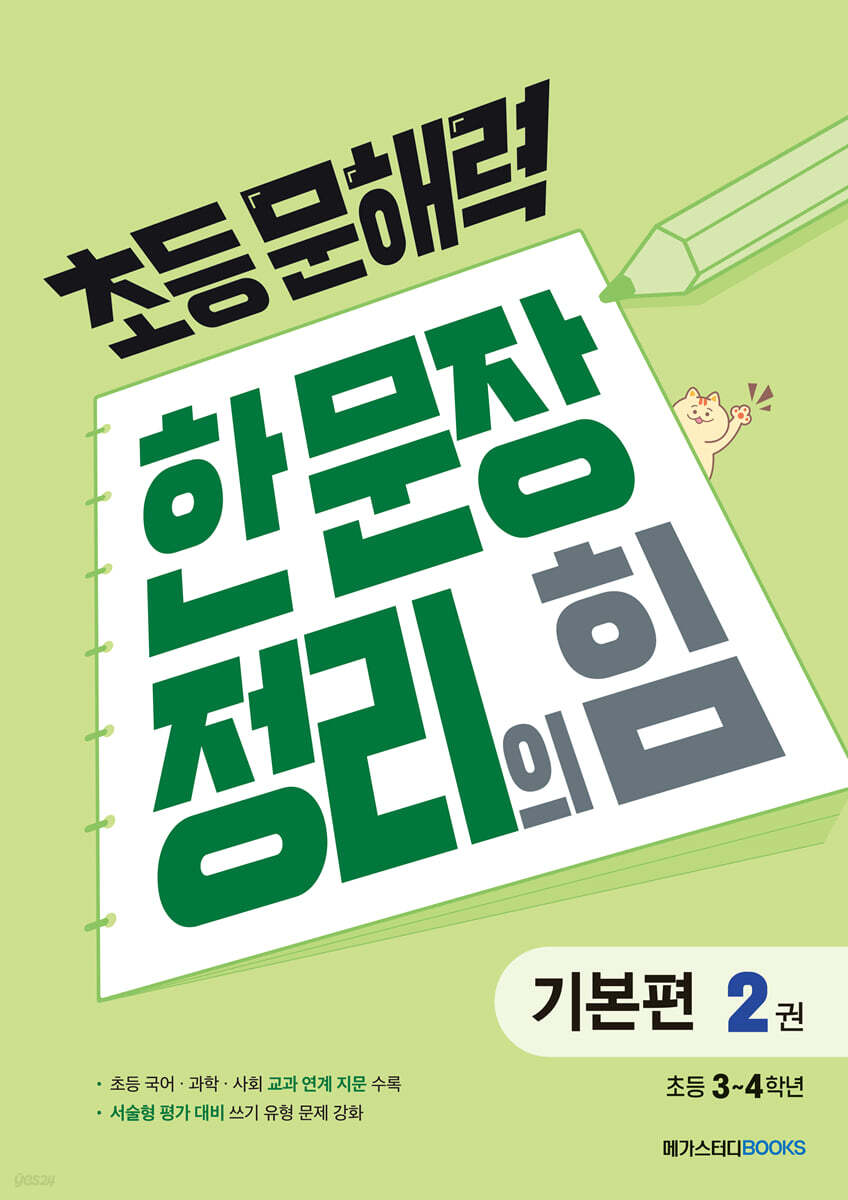
The Power of One-Sentence Summary: Elementary Literacy, Volume 2
 |
Description
Book Introduction
Elementary, now literacy! This book aims to develop literacy, which is the foundation of all learning. Rather than simply reading the text mechanically, it is designed to help children develop literacy skills by grasping the core of the text and organizing the key content into a single sentence. In particular, it was created to naturally help students acquire literacy skills and efficient study methods by incorporating the note-taking format used by the top 1% of students. The secret of the top 1% of children who achieve high grades despite studying the same amount of time, and children who are confident in descriptive and performance assessments. That's literacy. Elementary, Literacy Now! Develop your child's literacy now! |
- You can preview some of the book's contents.
Preview
index
[Basics: Finding the Central Word]
My dream is to be a veterinarian (Life Literature┃Korean Language 3-2)
Drones are now delivering books (Article ┃Society 3-1)
How do Arctic Terns Find Their Way? (Explanation┃Science 3-1)
In the old days, there was a poop general in the bathroom (Explanation┃Social Studies 3-2)
Gather words, gather hearts, gather words (Guide┃Korean 3-1)
Our Traditional Market, Oil Market (Explanation┃Social Studies 4-2)
[Basics: Finding the Central Sentence]
Farming in the City? (Explanation┃Social Studies 4-2)
Traditional Philippine Games (Introduction┃Social Studies 4-2)
Meet the Note-Taking Master (Dialogue┃Korean 3-1)
Save Water (Editorial┃Science 4-2)
Reading "Manbok's Rice Cake Shop" (Review┃Korean Language 3-2)
Everyday objects that utilize animal characteristics (Explanation┃Science 3-2)
[Basics: Summary]
Animals' Unique Bathing Methods (Explanation┃Science 3-2)
Does poop become fossils? (Dialogue┃Science 4-1)
Greetings vary from country to country (Explanation┃Korean 3-2)
Potatoes and Sweet Potatoes: Similar, But Different (Explanation┃Science 4-2)
Yi Bang-won and Jeong Mong-ju, a Battle of Sijo Poetry (Literature┃Korean Language 3-2)
What kind of soil do plants grow best in? (Observation Notes┃Science 3-2)
[Take a break] Find foreign words!
[practice]
Write a letter with all your heart (Explanation┃Korean 3-1)
Join the Camp! (Guide┃Korean 3-1)
Ghost-Exorcising Folktale (Explanation┃Social Studies 3-2)
Let's go to Ganghwa Island (Introduction┃Social Studies 4-1)
Surviving the Tidal Flats (Explanation┃Science 3-2)
The Salt Merchant and the Donkey (Literature┃Korean 4-2)
[Practice: Week 1]
Day 1: What's the Difference Between Trees and Grass? (Explanation ┃Science 4-2)
Day 2: Sundials of the World (Explanation┃Science 4-2)
Day 3: Korean Folk Songs (Explanation┃Social Studies 3-2)
Day 4: A Bustling and Diverse Family (Dialogue┃Society 3-2)
Day 5: Mysterious and Strange Mythical Creatures (Description┃Korean 4-2)
[Take a break] Look at the picture and find the proverb
[Practice: Week 2]
Day 1: Use Correct and Fair Language! (Discussion Paper┃Korean Language 3-1)
Day 2: Earthquakes: How to Prepare (Article ┃Science 4-2)
Day 3: How Did People Wash in the Joseon Dynasty? (Explanation┃Social Studies 3-2)
Day 4: Complete and Incomplete Metamorphosis (Explanation┃Science 3-1)
Day 5: Various Idioms (Explanation┃Korean 3-1)
[Break] What's for dinner tonight?
[Practice: Week 3]
Day 1: Establishing Sister City Relationships Between Regions (Explanation┃Social Studies 4-2)
Day 2: Ice and Dry Ice (Explanation┃Science 3-2)
Day 3: Visiting the Jeju Haenyeo Museum (Travelogue┃Social Studies 4-1)
Day 4: Jang Yeong-sil, Joseon's Greatest Inventor (Introduction┃Korean Language 4-2)
Day 5: Should Zoos Be Closed? (Discussion Paper ┃Korean 4-1)
[Break] Fun Korean
[Practice: Week 4]
Day 1: Things to Note When Visiting a Museum (Practical Text┃Korean 4-1)
Day 2: Pungmulnori and Samulnori (Explanation┃Social Studies 3-2)
Day 3: Platypus, an Egg-Laying Mammal (Explanation┃Science 3-1)
Day 4: It's Not Money, But It's Money? (Explanation┃Social Studies 3-2)
Day 5: States of Matter (Explanation┃Science 3-2)
[Take a break] Find the thief!
My dream is to be a veterinarian (Life Literature┃Korean Language 3-2)
Drones are now delivering books (Article ┃Society 3-1)
How do Arctic Terns Find Their Way? (Explanation┃Science 3-1)
In the old days, there was a poop general in the bathroom (Explanation┃Social Studies 3-2)
Gather words, gather hearts, gather words (Guide┃Korean 3-1)
Our Traditional Market, Oil Market (Explanation┃Social Studies 4-2)
[Basics: Finding the Central Sentence]
Farming in the City? (Explanation┃Social Studies 4-2)
Traditional Philippine Games (Introduction┃Social Studies 4-2)
Meet the Note-Taking Master (Dialogue┃Korean 3-1)
Save Water (Editorial┃Science 4-2)
Reading "Manbok's Rice Cake Shop" (Review┃Korean Language 3-2)
Everyday objects that utilize animal characteristics (Explanation┃Science 3-2)
[Basics: Summary]
Animals' Unique Bathing Methods (Explanation┃Science 3-2)
Does poop become fossils? (Dialogue┃Science 4-1)
Greetings vary from country to country (Explanation┃Korean 3-2)
Potatoes and Sweet Potatoes: Similar, But Different (Explanation┃Science 4-2)
Yi Bang-won and Jeong Mong-ju, a Battle of Sijo Poetry (Literature┃Korean Language 3-2)
What kind of soil do plants grow best in? (Observation Notes┃Science 3-2)
[Take a break] Find foreign words!
[practice]
Write a letter with all your heart (Explanation┃Korean 3-1)
Join the Camp! (Guide┃Korean 3-1)
Ghost-Exorcising Folktale (Explanation┃Social Studies 3-2)
Let's go to Ganghwa Island (Introduction┃Social Studies 4-1)
Surviving the Tidal Flats (Explanation┃Science 3-2)
The Salt Merchant and the Donkey (Literature┃Korean 4-2)
[Practice: Week 1]
Day 1: What's the Difference Between Trees and Grass? (Explanation ┃Science 4-2)
Day 2: Sundials of the World (Explanation┃Science 4-2)
Day 3: Korean Folk Songs (Explanation┃Social Studies 3-2)
Day 4: A Bustling and Diverse Family (Dialogue┃Society 3-2)
Day 5: Mysterious and Strange Mythical Creatures (Description┃Korean 4-2)
[Take a break] Look at the picture and find the proverb
[Practice: Week 2]
Day 1: Use Correct and Fair Language! (Discussion Paper┃Korean Language 3-1)
Day 2: Earthquakes: How to Prepare (Article ┃Science 4-2)
Day 3: How Did People Wash in the Joseon Dynasty? (Explanation┃Social Studies 3-2)
Day 4: Complete and Incomplete Metamorphosis (Explanation┃Science 3-1)
Day 5: Various Idioms (Explanation┃Korean 3-1)
[Break] What's for dinner tonight?
[Practice: Week 3]
Day 1: Establishing Sister City Relationships Between Regions (Explanation┃Social Studies 4-2)
Day 2: Ice and Dry Ice (Explanation┃Science 3-2)
Day 3: Visiting the Jeju Haenyeo Museum (Travelogue┃Social Studies 4-1)
Day 4: Jang Yeong-sil, Joseon's Greatest Inventor (Introduction┃Korean Language 4-2)
Day 5: Should Zoos Be Closed? (Discussion Paper ┃Korean 4-1)
[Break] Fun Korean
[Practice: Week 4]
Day 1: Things to Note When Visiting a Museum (Practical Text┃Korean 4-1)
Day 2: Pungmulnori and Samulnori (Explanation┃Social Studies 3-2)
Day 3: Platypus, an Egg-Laying Mammal (Explanation┃Science 3-1)
Day 4: It's Not Money, But It's Money? (Explanation┃Social Studies 3-2)
Day 5: States of Matter (Explanation┃Science 3-2)
[Take a break] Find the thief!
Detailed image
.jpg)
Publisher's Review
The power that determines our children's lifelong academic performance,
3 reasons why "The Power of One Sentence Summary for Elementary Literacy" is special!
(1) Gain both curriculum knowledge and general knowledge at once with elementary school curriculum-related texts!
-You can build both subject knowledge and general knowledge at the same time with textbooks related to elementary Korean, science, and social studies, as well as curiosity-inducing general knowledge texts.
- From non-literary genres like expository and editorial writing to literary genres, it consists of various genres, so you can have the confidence to write without fear of any type of writing.
(2) A three-step structure that gradually improves literacy skills!
-You can gradually build your literacy skills through a three-stage structure: a basic stage to grasp the core content, a practice stage to apply it to problem solving, and a practical stage to organize it into one sentence through notes.
(3) Practice organizing Cornell notes like the top 1% of students!
-You can learn the efficient study methods and lifelong study habits of the top 1% of students through note-taking techniques that summarize the key content of the text.
-You can develop self-directed learning skills through practical learning consisting of 'one page per day'.
(4) One sentence summary that makes any knowledge mine!
-You can build confidence in descriptive assessments by reading text and organizing sentences logically.
-As you advance in grade level, you can acquire efficient study methods to digest the vast amount of knowledge into your own knowledge.
3 reasons why "The Power of One Sentence Summary for Elementary Literacy" is special!
(1) Gain both curriculum knowledge and general knowledge at once with elementary school curriculum-related texts!
-You can build both subject knowledge and general knowledge at the same time with textbooks related to elementary Korean, science, and social studies, as well as curiosity-inducing general knowledge texts.
- From non-literary genres like expository and editorial writing to literary genres, it consists of various genres, so you can have the confidence to write without fear of any type of writing.
(2) A three-step structure that gradually improves literacy skills!
-You can gradually build your literacy skills through a three-stage structure: a basic stage to grasp the core content, a practice stage to apply it to problem solving, and a practical stage to organize it into one sentence through notes.
(3) Practice organizing Cornell notes like the top 1% of students!
-You can learn the efficient study methods and lifelong study habits of the top 1% of students through note-taking techniques that summarize the key content of the text.
-You can develop self-directed learning skills through practical learning consisting of 'one page per day'.
(4) One sentence summary that makes any knowledge mine!
-You can build confidence in descriptive assessments by reading text and organizing sentences logically.
-As you advance in grade level, you can acquire efficient study methods to digest the vast amount of knowledge into your own knowledge.
GOODS SPECIFICS
- Date of issue: May 31, 2021
- Page count, weight, size: 112 pages | 378g | 210*297*7mm
- ISBN13: 9791129707291
- ISBN10: 1129707296
- Reference book grade: Elementary school common
- Reference book usage semester: Common semester
- Reference book difficulty level: Easy Reference book difficulty level guide
- KC Certification: Certification Type: Conformity Confirmation
You may also like
카테고리
korean


korean

![ELLE 엘르 스페셜 에디션 A형 : 12월 [2025]](http://librairie.coreenne.fr/cdn/shop/files/b8e27a3de6c9538896439686c6b0e8fb.jpg?v=1766436872&width=3840)


