

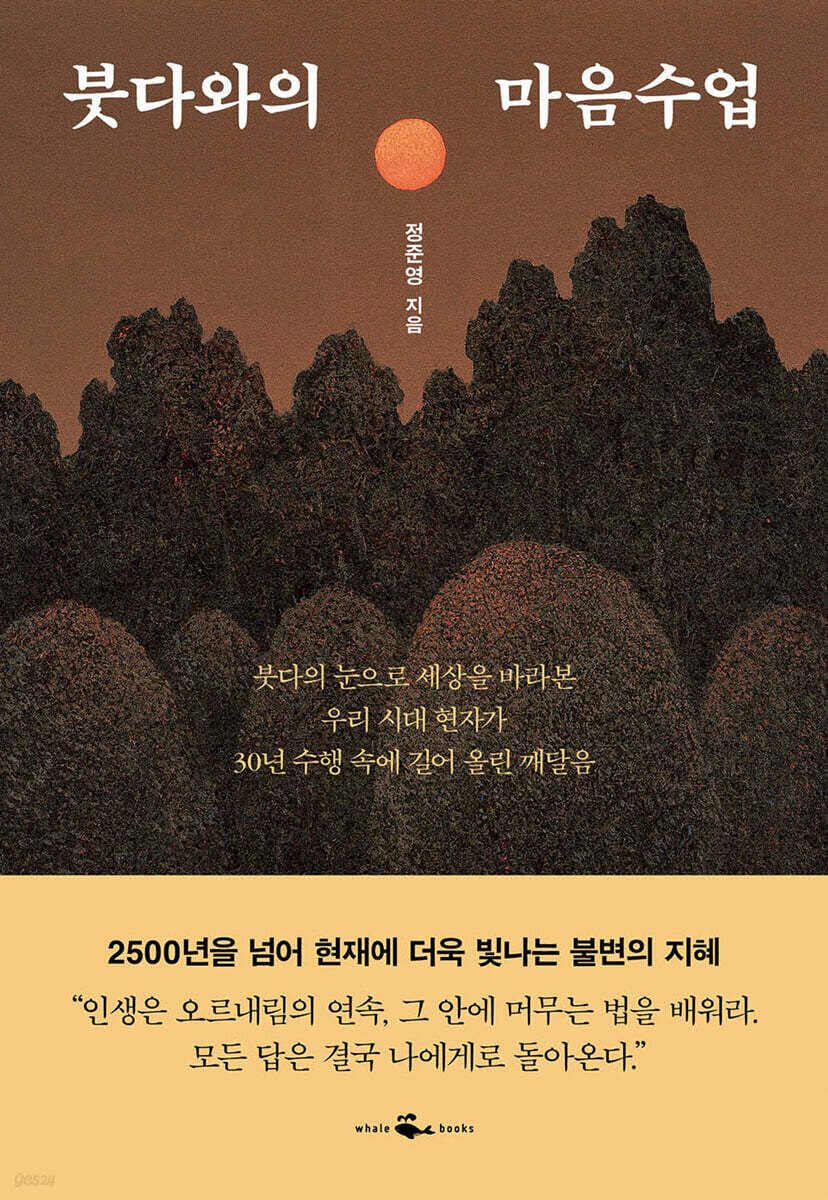
Mindfulness meditation with Buddha
 |
Description
Book Introduction
How to find the center of your life and move into the depth of your being
What the country's top meditation instructor discovered in silence after 30 years of painful practice.
The simplest yet surest path to happiness
“Do not grieve over what has passed, and do not wish for what has not yet come.”
We lose our sense of purpose in life, caught up in the anxieties and worries of our own making.
We live by endless comparison, chasing unfulfilled desires, and relying on momentary satisfaction.
We become obsessed with what we like, angry at what we dislike, and find all of this suffering.
The Buddha says:
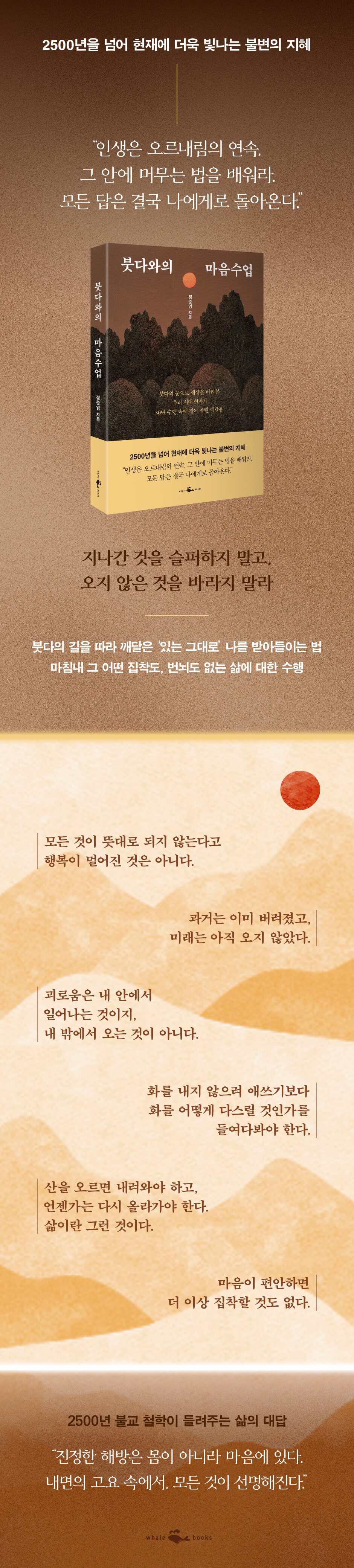
“The past is already gone, and the future has not yet arrived.
“Be aware of me at this very moment.” As the Buddha said 2,500 years ago, only when we become aware of ourselves and regain our mental balance can we attain true liberation.
Author Jeong Jun-yeong, an early Buddhist scholar and Korea's leading meditation instructor, talks about what it means to be free from suffering and obsession and achieve the "ultimate, unconditional happiness."
On the path of 30 years of practice, he realized.
Pure happiness does not lie in having or achieving more.
Only when we face ourselves as we are can we enter a state of peace of mind.
On that path, the author recommends first finding the center of life through the teachings of Buddha and then moving into the depths of existence.
In this fast-paced and endless comparison, we live more and more shallow lives.
Relationships are light, emotions are immediate, and the mind is always empty.
《Mind Lessons with Buddha》 is a book on mind study that teaches us how to regain the 'depth' we have lost in these times.
The author unpacks the Buddha's teachings in everyday language, generously sharing the wisdom of transforming suffering into insight rather than avoiding it.
Peace does not come when pain disappears, but when the mind deepens, peace comes naturally.
When we regulate and center ourselves in a constantly changing world, and when we look at the world from that center with a deepened heart, life becomes solid and pain can be transformed into wisdom.
《Mindfulness with Buddha》 guides us to inner peace in an age where everything is fast and light, a world swirling with anxiety and anger.
A heart that does not waver without having to hold on to something, that is the beginning of a deepening life.
What the country's top meditation instructor discovered in silence after 30 years of painful practice.
The simplest yet surest path to happiness
“Do not grieve over what has passed, and do not wish for what has not yet come.”
We lose our sense of purpose in life, caught up in the anxieties and worries of our own making.
We live by endless comparison, chasing unfulfilled desires, and relying on momentary satisfaction.
We become obsessed with what we like, angry at what we dislike, and find all of this suffering.
The Buddha says:
“The past is already gone, and the future has not yet arrived.
“Be aware of me at this very moment.” As the Buddha said 2,500 years ago, only when we become aware of ourselves and regain our mental balance can we attain true liberation.
Author Jeong Jun-yeong, an early Buddhist scholar and Korea's leading meditation instructor, talks about what it means to be free from suffering and obsession and achieve the "ultimate, unconditional happiness."
On the path of 30 years of practice, he realized.
Pure happiness does not lie in having or achieving more.
Only when we face ourselves as we are can we enter a state of peace of mind.
On that path, the author recommends first finding the center of life through the teachings of Buddha and then moving into the depths of existence.
In this fast-paced and endless comparison, we live more and more shallow lives.
Relationships are light, emotions are immediate, and the mind is always empty.
《Mind Lessons with Buddha》 is a book on mind study that teaches us how to regain the 'depth' we have lost in these times.
The author unpacks the Buddha's teachings in everyday language, generously sharing the wisdom of transforming suffering into insight rather than avoiding it.
Peace does not come when pain disappears, but when the mind deepens, peace comes naturally.
When we regulate and center ourselves in a constantly changing world, and when we look at the world from that center with a deepened heart, life becomes solid and pain can be transformed into wisdom.
《Mindfulness with Buddha》 guides us to inner peace in an age where everything is fast and light, a world swirling with anxiety and anger.
A heart that does not waver without having to hold on to something, that is the beginning of a deepening life.
- You can preview some of the book's contents.
Preview
index
introduction
Introduction to the Three Trainings (Samhak)
Part 1: The Story of Practice
An attitude that knows how to accept everything 'as it is'
Everything depends on me
Wear the Way, not the clothes
There is no wisdom without obstacles.
Is it effort or obsession?
The obsession with disliking
The goal is the same, but the path is different.
Likes and dislikes are not the purpose of practice.
Even if you are lonely, go alone like a rhinoceros horn
The obsession with joy
If you cling to experience, you'll just stop.
Part 2 Three Trainings
Buddha presents the threefold path
First Training: Roots, Relaxation, and Precepts
Reflections on the practice of sharing and the mind that fills
With what kind of heart should we do 'good'?
**** Buddhist karma
Happiness is conditioned by unhappiness
When I love and forgive myself
What is not given, is not taken.
Second Training: Stem, Concentration, and Jeonghak (定學)
Notice the second arrow
How to Face a Fake Tiger
The wisest way to calm your anger
If I hate someone, it's my fault.
**** Buddhist stories about 'hwa'
So that meditation does not become an illusion
Don't stay in faith
How to see elephant footprints
Third Training: Fruit, Observation, and Wisdom
Why should we stay in this moment?
Don't mourn what's gone, don't wish for what hasn't come.
What does it mean to be aware, to 'know clearly'?
Accept things as they are
Everything changes
Things that change are not satisfying
There is nothing that can be called a country
Meditation or practice?
How Buddhism Cares for the Mind
On Early Buddhist Practice
In conclusion
References
Introduction to the Three Trainings (Samhak)
Part 1: The Story of Practice
An attitude that knows how to accept everything 'as it is'
Everything depends on me
Wear the Way, not the clothes
There is no wisdom without obstacles.
Is it effort or obsession?
The obsession with disliking
The goal is the same, but the path is different.
Likes and dislikes are not the purpose of practice.
Even if you are lonely, go alone like a rhinoceros horn
The obsession with joy
If you cling to experience, you'll just stop.
Part 2 Three Trainings
Buddha presents the threefold path
First Training: Roots, Relaxation, and Precepts
Reflections on the practice of sharing and the mind that fills
With what kind of heart should we do 'good'?
**** Buddhist karma
Happiness is conditioned by unhappiness
When I love and forgive myself
What is not given, is not taken.
Second Training: Stem, Concentration, and Jeonghak (定學)
Notice the second arrow
How to Face a Fake Tiger
The wisest way to calm your anger
If I hate someone, it's my fault.
**** Buddhist stories about 'hwa'
So that meditation does not become an illusion
Don't stay in faith
How to see elephant footprints
Third Training: Fruit, Observation, and Wisdom
Why should we stay in this moment?
Don't mourn what's gone, don't wish for what hasn't come.
What does it mean to be aware, to 'know clearly'?
Accept things as they are
Everything changes
Things that change are not satisfying
There is nothing that can be called a country
Meditation or practice?
How Buddhism Cares for the Mind
On Early Buddhist Practice
In conclusion
References
Detailed image
Into the book
This book is a record of my spiritual journey.
It contains stories of his journey to find Arahant, his asceticism and training in Myanmar, and his experiences while traveling to various training centers.
The path of practice is endless, but I want to share my journey with readers through this book.
Perhaps for some, it could be an opportunity to look into their inner selves.
I want to convey that practice is not something far away, but something that is right within us, and that the journey is not something we take alone, but together.
--- From the "Preface"
After briefly greeting the monks and entering the group meditation area, I saw a familiar face.
The practitioner who had practiced with me in Yangon and suddenly disappeared, and who I believed had run away in the middle of the night due to lack of patience, was practicing diligently here.
The conditions here were much worse than Yangon.
That's when I realized.
This means that practice is a path to one goal (nirvana), not a path to one method.
--- From "The goal is the same, but the path is different"
Buddhist practice seeks happiness free from the cycle of deprivation and adaptation.
And in that way, he suggests breaking free from the repetitive cycle of pleasure and pain.
Happiness is conditioned by unhappiness, and unhappiness is conditioned by happiness.
Pleasure is conditioned by pain, and pain is conditioned by pleasure.
They rise and fall like the waves of a wave.
Happiness is called 'sukha' in the ancient Indian language Pali.
--- From "Happiness is conditioned by unhappiness"
It would be unwise to wear wet clothes today after yesterday's rain.
It's said to rain tomorrow, so it would be foolish to carry a heavy umbrella today.
Yet, it seems like we're walking around in wet clothes and carrying heavy umbrellas every day.
The wise way is to stay in the present moment.
The Buddha emphasized staying in the present moment to those who were constantly preoccupied with thoughts of the past and future.
--- From "Why Should I Stay in This Moment?"
Everyone knows that the external environment is changing.
But seeing and knowing the inner changes within oneself as they are, and discovering within it the self that wishes to remain unchanged, is the path from suffering to purity.
Knowing oneself without relying on any external force is the greatness of human beings, and this is the teaching that Buddha wanted to convey to us.
It contains stories of his journey to find Arahant, his asceticism and training in Myanmar, and his experiences while traveling to various training centers.
The path of practice is endless, but I want to share my journey with readers through this book.
Perhaps for some, it could be an opportunity to look into their inner selves.
I want to convey that practice is not something far away, but something that is right within us, and that the journey is not something we take alone, but together.
--- From the "Preface"
After briefly greeting the monks and entering the group meditation area, I saw a familiar face.
The practitioner who had practiced with me in Yangon and suddenly disappeared, and who I believed had run away in the middle of the night due to lack of patience, was practicing diligently here.
The conditions here were much worse than Yangon.
That's when I realized.
This means that practice is a path to one goal (nirvana), not a path to one method.
--- From "The goal is the same, but the path is different"
Buddhist practice seeks happiness free from the cycle of deprivation and adaptation.
And in that way, he suggests breaking free from the repetitive cycle of pleasure and pain.
Happiness is conditioned by unhappiness, and unhappiness is conditioned by happiness.
Pleasure is conditioned by pain, and pain is conditioned by pleasure.
They rise and fall like the waves of a wave.
Happiness is called 'sukha' in the ancient Indian language Pali.
--- From "Happiness is conditioned by unhappiness"
It would be unwise to wear wet clothes today after yesterday's rain.
It's said to rain tomorrow, so it would be foolish to carry a heavy umbrella today.
Yet, it seems like we're walking around in wet clothes and carrying heavy umbrellas every day.
The wise way is to stay in the present moment.
The Buddha emphasized staying in the present moment to those who were constantly preoccupied with thoughts of the past and future.
--- From "Why Should I Stay in This Moment?"
Everyone knows that the external environment is changing.
But seeing and knowing the inner changes within oneself as they are, and discovering within it the self that wishes to remain unchanged, is the path from suffering to purity.
Knowing oneself without relying on any external force is the greatness of human beings, and this is the teaching that Buddha wanted to convey to us.
--- From "Everything Changes"
Publisher's Review
The Answer to Life from 2,500 Years of Buddhist Philosophy
The wisdom to accept myself 'as I am'
“Know yourself without relying on any external force.”
"Mindfulness with the Buddha" opens with the journey of a practitioner who began at a retreat in Myanmar.
Author Jeong Jun-yeong, who was diligently practicing Vipassana, leaves his place of practice and sets out on a journey with one question: “What is enlightenment?”
At the end of his journey to find Arahan, he finally encounters himself, and through that encounter, he realizes the true meaning of practice.
And the words of a teacher whom I respected and always wanted to rely on, “When you climb a mountain, it is not the end; you have to come down and climb again,” became a ‘koan (a deep question or inquiry to which I seek an answer)’ that ran through the author’s life for over 30 years.
This book is divided into two parts.
Part 1 discusses the realizations the author gained through his own practical experience, and Part 2 presents a path to freedom from the suffering of life, focusing on the three trainings (root, stem, and fruit) taught by the Buddha.
The attitude of practice that the author emphasizes is not the will to change oneself by force, but the power to move forward by one's own choice.
The true place of practice is not somewhere else, but right here, right now, in the mind that is awake at every moment.
Only when our obsession and anger subside and a peace that remains unshaken in the midst of change do we truly understand.
Happiness is not something that is far away, but it already exists in your heart right now, just as it is.
The author views practice as a mental act that must be undertaken by everyone who seeks to know themselves in the midst of life.
If you wish to remain in the present moment, neither in the past nor in the future, through practice, this book will illuminate your path like a ray of light.
A mind class that will protect me from the whirlpool of 'anger' and 'anxiety'
When the mind is calm, there is nothing more to cling to or seek.
In Buddhism, it is said that humans live with three poisons.
Greed, anger, and foolishness, or ‘Tam-Jin-Chi’, are seen as the root causes of human suffering.
The author confesses that, although he has been a practitioner for many years and has looked into his mind, the poisons still live and stir within him.
In particular, it is said that 'anger' sometimes becomes motivation, but most of the time it comes back as regret.
That's why we may have to practice constantly.
Not to get better, but to avoid getting worse.
But we live in a poison deeper than anger: anxiety.
The desire to have more and the fear of harm constantly drive us.
However, Buddhism teaches us how to protect ourselves from the vortex of anger and anxiety, saying, “Suffering does not come from outside, but arises within us, and awareness is the first step to not being caught up in that suffering.”
When the mind is calm, there is nothing left to cling to or seek.
"Mindfulness with the Buddha" is a guide to the mind for all of us who are shaken by anger, suffering, desire, and attachment.
The author shares insights gleaned from his practice to help you find peace even in the midst of turbulent emotions.
Through this book, we will examine our own hearts amidst the weight of life and the waves of emotion, and find a more solid and calm peace within them.
The wisdom to accept myself 'as I am'
“Know yourself without relying on any external force.”
"Mindfulness with the Buddha" opens with the journey of a practitioner who began at a retreat in Myanmar.
Author Jeong Jun-yeong, who was diligently practicing Vipassana, leaves his place of practice and sets out on a journey with one question: “What is enlightenment?”
At the end of his journey to find Arahan, he finally encounters himself, and through that encounter, he realizes the true meaning of practice.
And the words of a teacher whom I respected and always wanted to rely on, “When you climb a mountain, it is not the end; you have to come down and climb again,” became a ‘koan (a deep question or inquiry to which I seek an answer)’ that ran through the author’s life for over 30 years.
This book is divided into two parts.
Part 1 discusses the realizations the author gained through his own practical experience, and Part 2 presents a path to freedom from the suffering of life, focusing on the three trainings (root, stem, and fruit) taught by the Buddha.
The attitude of practice that the author emphasizes is not the will to change oneself by force, but the power to move forward by one's own choice.
The true place of practice is not somewhere else, but right here, right now, in the mind that is awake at every moment.
Only when our obsession and anger subside and a peace that remains unshaken in the midst of change do we truly understand.
Happiness is not something that is far away, but it already exists in your heart right now, just as it is.
The author views practice as a mental act that must be undertaken by everyone who seeks to know themselves in the midst of life.
If you wish to remain in the present moment, neither in the past nor in the future, through practice, this book will illuminate your path like a ray of light.
A mind class that will protect me from the whirlpool of 'anger' and 'anxiety'
When the mind is calm, there is nothing more to cling to or seek.
In Buddhism, it is said that humans live with three poisons.
Greed, anger, and foolishness, or ‘Tam-Jin-Chi’, are seen as the root causes of human suffering.
The author confesses that, although he has been a practitioner for many years and has looked into his mind, the poisons still live and stir within him.
In particular, it is said that 'anger' sometimes becomes motivation, but most of the time it comes back as regret.
That's why we may have to practice constantly.
Not to get better, but to avoid getting worse.
But we live in a poison deeper than anger: anxiety.
The desire to have more and the fear of harm constantly drive us.
However, Buddhism teaches us how to protect ourselves from the vortex of anger and anxiety, saying, “Suffering does not come from outside, but arises within us, and awareness is the first step to not being caught up in that suffering.”
When the mind is calm, there is nothing left to cling to or seek.
"Mindfulness with the Buddha" is a guide to the mind for all of us who are shaken by anger, suffering, desire, and attachment.
The author shares insights gleaned from his practice to help you find peace even in the midst of turbulent emotions.
Through this book, we will examine our own hearts amidst the weight of life and the waves of emotion, and find a more solid and calm peace within them.
GOODS SPECIFICS
- Date of issue: November 10, 2025
- Page count, weight, size: 240 pages | 480g | 145*210*18mm
- ISBN13: 9791194627166
- ISBN10: 1194627161
You may also like
카테고리
korean


korean

![GQ KOREA Mark (Monthly): December [2025]](http://librairie.coreenne.fr/cdn/shop/files/8ef265dbbfbf186523ed75ba7319009d.jpg?v=1765340328&width=3840)


