

About Death
 |
Description
Book Introduction
“Mourn deeply, but hope deeply.” The unique hope that Christians enjoy in the face of death It describes how to deal with the death of a loved one and our own death, which we will face one day. In a modern society that somehow denies death, it teaches us to face death with the resources of faith given in the Bible. It is crucial to approach and experience this life's most profound sorrow with grace, patience, and joy. Tim Keller reveals wisdom and compassion as he finds alternatives to despair and negativity in the Bible. This is a powerful book that helps us see and accept the meaning of death through God's perspective on life. In particular, the last part of the book introduces relevant Bible verses for those who are sick, those who are thinking about their own impending death, or those who have experienced the death of a loved one to meditate on every day for a week. It is God, not human thought, who holds onto His promises and helps us to have deep hope. |
- You can preview some of the book's contents.
Preview
index
Preface to the "Tim Keller's Life Basics" series
Foreword by Cathy Keller
1. Am I preparing for my death, which will come someday?
/ Avoidance and denial, modern people's fear of death
2 How to Accept and Cope with the Death of a Loved One
/ Be sufficiently sad, but with deep hope
Holding on to God's Promises 1
Holding on to God's Promises 2
Acknowledgements
main
Recommended books
Foreword by Cathy Keller
1. Am I preparing for my death, which will come someday?
/ Avoidance and denial, modern people's fear of death
2 How to Accept and Cope with the Death of a Loved One
/ Be sufficiently sad, but with deep hope
Holding on to God's Promises 1
Holding on to God's Promises 2
Acknowledgements
main
Recommended books
Detailed image
Into the book
As we get older, my husband and I encounter death more frequently, both in our ministry and in our personal relationships.
Close friends and family members are passing away one by one.
In the past 18 months, we've had three funerals in our family alone, and it's only been in the past three months that I've had conversations with dying friends and relatives about how to face death.
The stories we exchanged during those conversations are contained in this book.
This book is based on a sermon my husband Tim preached at my brother Terry's funeral on January 6, 2018.
My sister's breast cancer had spread to other parts of her body, and after a long illness, she passed away at home on Christmas Day surrounded by her family.
My brother knew that death was imminent, so he used his remaining time to gather all his strength and help us choose hymns to sing at his funeral service and write down prayers.
He especially urged the team to not only celebrate his life at the funeral (of course, Terry was someone we loved and respected immensely), but also to make sure to share the gospel.
“It is strange how people tend to become more thoughtful when faced with death.”
So, my younger brother wanted those who would attend his funeral to prepare for their own death.
--- From the "Foreword by Cathy Keller"
In the past, people saw death up close.
… (omitted)… Today, thanks to medicine and science, many causes of premature death have been solved, and the vast majority of people waste away and die in hospitals and hospice centers, unnoticed by others.
As a result, it became natural for me to not be able to witness even one person's death as an adult.
In Western societies, we have no opportunity to see the dead, except perhaps to briefly glance at the open casket at a funeral.
As Atul Gawande and many others have pointed out, the fact that modern society hides death so much means that, of all cultures, we live in denial of the imminent inevitability of death.
--- pp.16-17
When faced with death, dissatisfaction with one's self becomes much more evident.
We cannot silence our conscience as before.
Hamlet, a character in Shakespeare's play, contemplates suicide but decides not to do so.
It was because of the fear of what lies beyond the grave, that is, the “unexplored land from which no traveler has ever gone and returned.”
Ultimately, we become afraid of judgment, and so we “endure the suffering of this world in silence rather than flee to the unknown world.” The reason is that “conscience makes cowards of us all.”
No matter how hard you try to stop it, guilt is persistent, and it reaches its peak especially in the face of death.
While modern culture offers few solutions to this problem, the Christian faith offers us incredible resources.
--- pp.33-34
All religions talk about death and the afterlife, but most of them insist that we must live a good life to prepare for eternity.
But when death finally comes, we all realize that we are not even close to living our best lives.
I haven't been able to live the way I should have lived.
So it is natural that we are afraid of death and cling to it until the end.
Christianity is different.
Christianity does not leave me to face death alone and hope that my life story will suffice.
In Christianity, there is a champion who conquered death.
He forgives us and covers us with love.
We face death “in Him” (Phil. 3:9) by relying on His perfect history.
To the extent that we believe, know and accept this fact, we are liberated from the power of death.
Therefore, Hamlet's words that death is "an untrodden country, from which no traveler has gone and returned" are wrong.
There is someone who came back from the dead.
As a result of Jesus Christ's destruction of the power of death, "a breach has opened in the cruel wall of the world." If we hold on to this in faith, we need no longer fear the darkness.
--- pp.39-40
For centuries, people have preserved meat by salting it.
If you salt it, the meat won't rot.
Likewise, sadness spoils like meat if it is not seasoned with the salt of hope.
Grief and rage in the face of death are reasonable responses to great evil.
But Christians have hope, and they can 'apply' that hope to their sorrow and anger like salt to meat.
It is not right to suppress sadness or give in to despair.
Suppressing anger or letting it out unconditionally is not good for the soul.
But when sorrow is tempered with hope, wisdom, compassion, humility, and affection sprout.
Grieve deeply, yet harbor deep hope! Do you see why I call this a combination of extremes rather than a moderation? This will give you more strength than mere self-denial, and allow you to mourn more freely than in despair.
--- pp.55-57
George Herbert once said, “Death was once an executioner, but before the gospel he is reduced to a mere gardener.”
Death once had the power to suffocate us, but now all it can do is plant us in God's land and help us blossom into extraordinary beings.
Long ago, the famous Chicago pastor Dwight Moody said this as he was dying:
“If you see Dwight Moody’s obituary in the Chicago papers soon, don’t believe it.
“At that moment, I will be more alive than I am now.”
Be sad, but have hope.
Wake up with peace of mind from negativity and illusion.
Smile in the face of death and sing for joy as you think of what will happen in the future.
If Jesus Christ holds your hand, you too can sing.
--- pp.78-79
If you've experienced the sudden death of someone close to you, don't feel pressured to make major life decisions right away, like where to live or whether to change careers.
Surely now is not a good time to decide such a matter.
If a loved one has been ill for a long time, or has been unconscious or in a coma for a while before passing away, you often begin the process of "letting go" in your mind, preparing for separation even before the deceased leaves.
However, if you are shocked by a sudden death, the feeling of unreality may linger for quite a while.
In other words, everything feels like a dream or a movie and you feel like someone else.
In this state, you just have to live day by day and 'just do what's at hand.'
Make sure you spend neither too much nor too little time with people.
When reality sets in and you can finally let go of the deceased, you can then think about your future in a better light.
Don't rush too much.
Be honest about your thoughts and feelings, whether to yourself, to others, or to God.
Don't think that questioning and venting your frustrations is 'unspiritual.'
Jesus also wept and became angry at the death of his friend Lazarus.
Job also cried out to the Lord.
Job cried out loud to God, and even though there were no immediate results, he continued to pray and meet with Him.
Close friends and family members are passing away one by one.
In the past 18 months, we've had three funerals in our family alone, and it's only been in the past three months that I've had conversations with dying friends and relatives about how to face death.
The stories we exchanged during those conversations are contained in this book.
This book is based on a sermon my husband Tim preached at my brother Terry's funeral on January 6, 2018.
My sister's breast cancer had spread to other parts of her body, and after a long illness, she passed away at home on Christmas Day surrounded by her family.
My brother knew that death was imminent, so he used his remaining time to gather all his strength and help us choose hymns to sing at his funeral service and write down prayers.
He especially urged the team to not only celebrate his life at the funeral (of course, Terry was someone we loved and respected immensely), but also to make sure to share the gospel.
“It is strange how people tend to become more thoughtful when faced with death.”
So, my younger brother wanted those who would attend his funeral to prepare for their own death.
--- From the "Foreword by Cathy Keller"
In the past, people saw death up close.
… (omitted)… Today, thanks to medicine and science, many causes of premature death have been solved, and the vast majority of people waste away and die in hospitals and hospice centers, unnoticed by others.
As a result, it became natural for me to not be able to witness even one person's death as an adult.
In Western societies, we have no opportunity to see the dead, except perhaps to briefly glance at the open casket at a funeral.
As Atul Gawande and many others have pointed out, the fact that modern society hides death so much means that, of all cultures, we live in denial of the imminent inevitability of death.
--- pp.16-17
When faced with death, dissatisfaction with one's self becomes much more evident.
We cannot silence our conscience as before.
Hamlet, a character in Shakespeare's play, contemplates suicide but decides not to do so.
It was because of the fear of what lies beyond the grave, that is, the “unexplored land from which no traveler has ever gone and returned.”
Ultimately, we become afraid of judgment, and so we “endure the suffering of this world in silence rather than flee to the unknown world.” The reason is that “conscience makes cowards of us all.”
No matter how hard you try to stop it, guilt is persistent, and it reaches its peak especially in the face of death.
While modern culture offers few solutions to this problem, the Christian faith offers us incredible resources.
--- pp.33-34
All religions talk about death and the afterlife, but most of them insist that we must live a good life to prepare for eternity.
But when death finally comes, we all realize that we are not even close to living our best lives.
I haven't been able to live the way I should have lived.
So it is natural that we are afraid of death and cling to it until the end.
Christianity is different.
Christianity does not leave me to face death alone and hope that my life story will suffice.
In Christianity, there is a champion who conquered death.
He forgives us and covers us with love.
We face death “in Him” (Phil. 3:9) by relying on His perfect history.
To the extent that we believe, know and accept this fact, we are liberated from the power of death.
Therefore, Hamlet's words that death is "an untrodden country, from which no traveler has gone and returned" are wrong.
There is someone who came back from the dead.
As a result of Jesus Christ's destruction of the power of death, "a breach has opened in the cruel wall of the world." If we hold on to this in faith, we need no longer fear the darkness.
--- pp.39-40
For centuries, people have preserved meat by salting it.
If you salt it, the meat won't rot.
Likewise, sadness spoils like meat if it is not seasoned with the salt of hope.
Grief and rage in the face of death are reasonable responses to great evil.
But Christians have hope, and they can 'apply' that hope to their sorrow and anger like salt to meat.
It is not right to suppress sadness or give in to despair.
Suppressing anger or letting it out unconditionally is not good for the soul.
But when sorrow is tempered with hope, wisdom, compassion, humility, and affection sprout.
Grieve deeply, yet harbor deep hope! Do you see why I call this a combination of extremes rather than a moderation? This will give you more strength than mere self-denial, and allow you to mourn more freely than in despair.
--- pp.55-57
George Herbert once said, “Death was once an executioner, but before the gospel he is reduced to a mere gardener.”
Death once had the power to suffocate us, but now all it can do is plant us in God's land and help us blossom into extraordinary beings.
Long ago, the famous Chicago pastor Dwight Moody said this as he was dying:
“If you see Dwight Moody’s obituary in the Chicago papers soon, don’t believe it.
“At that moment, I will be more alive than I am now.”
Be sad, but have hope.
Wake up with peace of mind from negativity and illusion.
Smile in the face of death and sing for joy as you think of what will happen in the future.
If Jesus Christ holds your hand, you too can sing.
--- pp.78-79
If you've experienced the sudden death of someone close to you, don't feel pressured to make major life decisions right away, like where to live or whether to change careers.
Surely now is not a good time to decide such a matter.
If a loved one has been ill for a long time, or has been unconscious or in a coma for a while before passing away, you often begin the process of "letting go" in your mind, preparing for separation even before the deceased leaves.
However, if you are shocked by a sudden death, the feeling of unreality may linger for quite a while.
In other words, everything feels like a dream or a movie and you feel like someone else.
In this state, you just have to live day by day and 'just do what's at hand.'
Make sure you spend neither too much nor too little time with people.
When reality sets in and you can finally let go of the deceased, you can then think about your future in a better light.
Don't rush too much.
Be honest about your thoughts and feelings, whether to yourself, to others, or to God.
Don't think that questioning and venting your frustrations is 'unspiritual.'
Jesus also wept and became angry at the death of his friend Lazarus.
Job also cried out to the Lord.
Job cried out loud to God, and even though there were no immediate results, he continued to pray and meet with Him.
--- pp.98-99
Publisher's Review
Moments of tectonic shift that shake the axis of life,
Standing before the sovereign of life
Laying the foundation of the mind
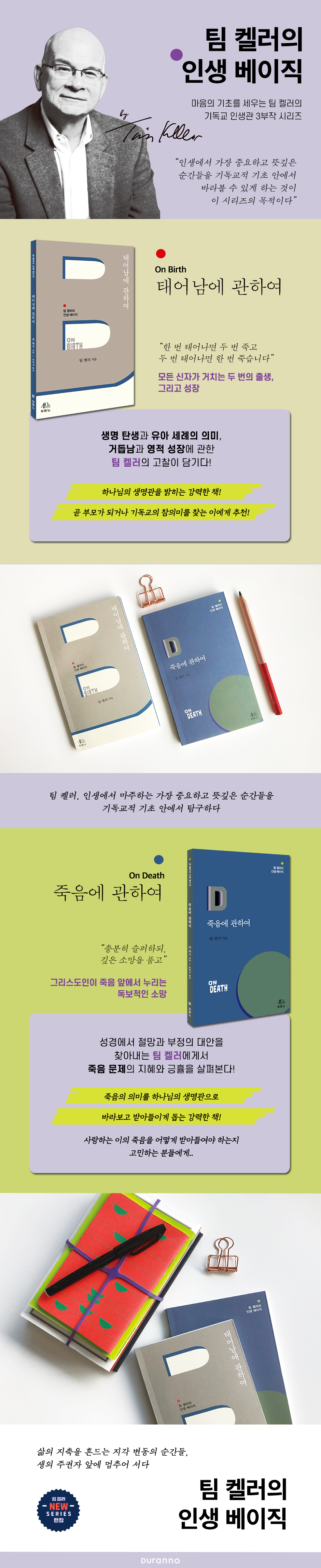
Tim Keller's Christian Life View Trilogy
For many people, the turning point for their faith in Christ comes during a time of profound change: marriage, the birth of a child, or the death of a loved one or their own life.
Tim Keller has observed over his 45 years of ministry that many people, especially during these major life transitions, are open to exploring their relationship with God.
To help those going through a season of significant life change think about what a truly transformed life is, we have created the "Tim Keller's Life Basics" series.
The purpose of this trilogy is to help you view life's most important and meaningful moments from a Christian perspective.
Standing before the sovereign of life
Laying the foundation of the mind
Tim Keller's Christian Life View Trilogy
For many people, the turning point for their faith in Christ comes during a time of profound change: marriage, the birth of a child, or the death of a loved one or their own life.
Tim Keller has observed over his 45 years of ministry that many people, especially during these major life transitions, are open to exploring their relationship with God.
To help those going through a season of significant life change think about what a truly transformed life is, we have created the "Tim Keller's Life Basics" series.
The purpose of this trilogy is to help you view life's most important and meaningful moments from a Christian perspective.
GOODS SPECIFICS
- Date of issue: August 19, 2020
- Page count, weight, size: 119 pages | 120g | 112*180*7mm
- ISBN13: 9788953138247
- ISBN10: 8953138248
You may also like
카테고리
korean


korean

![GQ KOREA Mark (Monthly): December [2025]](http://librairie.coreenne.fr/cdn/shop/files/8ef265dbbfbf186523ed75ba7319009d.jpg?v=1765340328&width=3840)


