

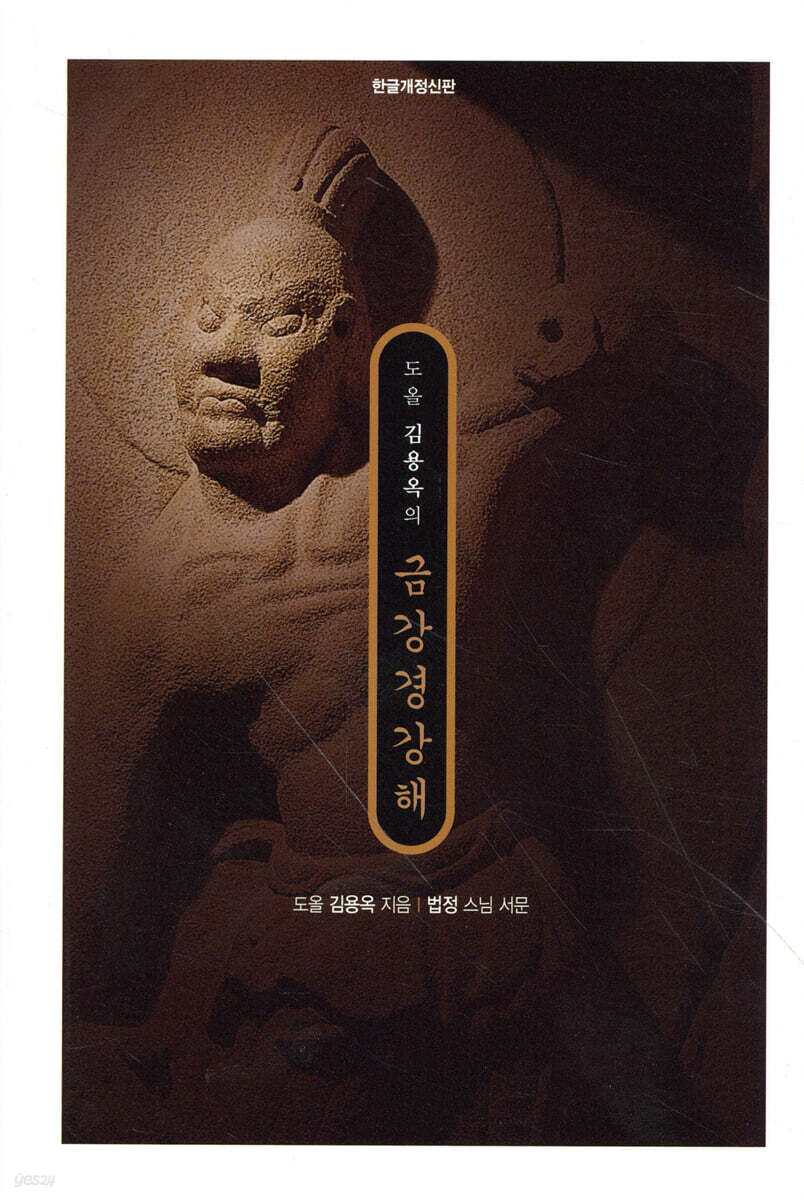
Dool Kim Yong-ok's lecture on the Diamond Sutra
 |
Description
Book Introduction
The best-selling book of 20 years, 『Dool Kim Yong-ok's Commentary on the Diamond Sutra』, has been published in a new version.
The Diamond Sutra, along with the Heart Sutra, is one of the most precious scriptures of Korean Buddhism.
This is the very sutra that the 6th patriarch, Hye-neng, heard when he was a woodcutter and immediately became a monk.
The original 『Daol Kim Yong-ok's Commentary on the Diamond Sutra』, first published in 1999, has been consistently loved by readers, but because it was written in a mixture of Korean and Chinese characters, it was difficult for those unfamiliar with Chinese characters to read.
After 20 years, the author, with the Mahayana spirit of conveying the essence of Buddhism to the general public in an easily accessible manner, undertook a large-scale revision project to completely revise the book into a purely Korean version.
By adding Korean pronunciations to the entire original text of the Diamond Sutra, anyone can read it in Korean while looking at the original Chinese text.
In the author's commentary on the scriptures, vocabulary written solely in Chinese characters was changed to Korean, and Chinese characters were added where necessary.
Additionally, for sentences that were difficult to understand, explanations were supplemented to ensure that the meaning was easily conveyed.
And while preserving the author's sensibility and academic perspective from 20 years ago, he added new feelings and up-to-date information where necessary, giving the entire book a contemporary vitality.
The Diamond Sutra, along with the Heart Sutra, is one of the most precious scriptures of Korean Buddhism.
This is the very sutra that the 6th patriarch, Hye-neng, heard when he was a woodcutter and immediately became a monk.
The original 『Daol Kim Yong-ok's Commentary on the Diamond Sutra』, first published in 1999, has been consistently loved by readers, but because it was written in a mixture of Korean and Chinese characters, it was difficult for those unfamiliar with Chinese characters to read.
After 20 years, the author, with the Mahayana spirit of conveying the essence of Buddhism to the general public in an easily accessible manner, undertook a large-scale revision project to completely revise the book into a purely Korean version.
By adding Korean pronunciations to the entire original text of the Diamond Sutra, anyone can read it in Korean while looking at the original Chinese text.
In the author's commentary on the scriptures, vocabulary written solely in Chinese characters was changed to Korean, and Chinese characters were added where necessary.
Additionally, for sentences that were difficult to understand, explanations were supplemented to ensure that the meaning was easily conveyed.
And while preserving the author's sensibility and academic perspective from 20 years ago, he added new feelings and up-to-date information where necessary, giving the entire book a contemporary vitality.
- You can preview some of the book's contents.
Preview
index
Introduction 9
Introduction 13
About the Diamond Sutra 39
What does "Geumgang" mean? 74
What is "Hinayana" and what is "Mahayana"? 82
Diamond Sutra 101
103. Because of the first minute of the Dharma Assembly
The Second Sage Arose and Asked for the Dharma 148
The Third Part: The Right Purpose of Mahayana 167
Chapter 4: Beautiful Actions Are Non-Attachment 194
See the True Face of the Fifth Truth, Part 203
Chapter 6: True Faith is Rare 218
Chapter 7: Nothing to Gain, Nothing to Say 232
Be reborn by the 8th law 237
Chapter 9: Neither Award is a Prize 245
10th Minute: Adorn the Clean Land 258
The eleventh minute: O blessedness of no burden, how great! 273
Chapter 12: The Right Teachings to Respect 278
Receive it according to the 13th law 283
Leaving the 14th Prize for Eternity 293
Merit of reciting the 15th minute sutra: 313
16th Minute: Always Cleanse Your Dirty Karma 323
The Ultimate Wisdom of the Seventeenth Minute: There Is No Other Way 331
18th Minute: See Everything as One Body 344
Chapter 19: Transform All Dharma Realms 354
Leave the 20th minute, leave the color, leave the prize 356
Chapter 21: There is no one who speaks and no one who is spoken to. 359
There is no way to get the 22nd minute 364
23rd Minute: Do Good with a Pure Heart 366
Chapter 24: Virtue and Wisdom Are Incomparable 368
The 25th minute of teaching has nothing to teach 369
The 26th Dharmakaya has no form 372
27th Minute: There is no break or destruction. 378
Chapter 28: Don't even think about receiving it, and don't be greedy. 382
29th Minute: The Majestic Appearance, Yet Also Serene 385
30 minutes ago, they gathered and dispersed, a sight to behold, 388
31st Minute: Do Not Have Knowledge 399
The 32nd minute, the colorless body has no form 403
Mantra 410
Post-Sutra Commentary 413
Acknowledgments 418
Let us recite the beautiful Korean Diamond Sutra 423
Author's Biography and List of Publications 446
Introduction 13
About the Diamond Sutra 39
What does "Geumgang" mean? 74
What is "Hinayana" and what is "Mahayana"? 82
Diamond Sutra 101
103. Because of the first minute of the Dharma Assembly
The Second Sage Arose and Asked for the Dharma 148
The Third Part: The Right Purpose of Mahayana 167
Chapter 4: Beautiful Actions Are Non-Attachment 194
See the True Face of the Fifth Truth, Part 203
Chapter 6: True Faith is Rare 218
Chapter 7: Nothing to Gain, Nothing to Say 232
Be reborn by the 8th law 237
Chapter 9: Neither Award is a Prize 245
10th Minute: Adorn the Clean Land 258
The eleventh minute: O blessedness of no burden, how great! 273
Chapter 12: The Right Teachings to Respect 278
Receive it according to the 13th law 283
Leaving the 14th Prize for Eternity 293
Merit of reciting the 15th minute sutra: 313
16th Minute: Always Cleanse Your Dirty Karma 323
The Ultimate Wisdom of the Seventeenth Minute: There Is No Other Way 331
18th Minute: See Everything as One Body 344
Chapter 19: Transform All Dharma Realms 354
Leave the 20th minute, leave the color, leave the prize 356
Chapter 21: There is no one who speaks and no one who is spoken to. 359
There is no way to get the 22nd minute 364
23rd Minute: Do Good with a Pure Heart 366
Chapter 24: Virtue and Wisdom Are Incomparable 368
The 25th minute of teaching has nothing to teach 369
The 26th Dharmakaya has no form 372
27th Minute: There is no break or destruction. 378
Chapter 28: Don't even think about receiving it, and don't be greedy. 382
29th Minute: The Majestic Appearance, Yet Also Serene 385
30 minutes ago, they gathered and dispersed, a sight to behold, 388
31st Minute: Do Not Have Knowledge 399
The 32nd minute, the colorless body has no form 403
Mantra 410
Post-Sutra Commentary 413
Acknowledgments 418
Let us recite the beautiful Korean Diamond Sutra 423
Author's Biography and List of Publications 446
Into the book
Buddhism is not atheism.
If we insist on calling Buddhism atheistic, it can only be used in the context of fundamentally saying that God cannot enter the realm of human language, which is existence and non-existence.
… … How can theology be said to be the only path to religion, and how can God be said to be the only subject of religion? --- p.26
I am not preaching the Diamond Sutra to spread Buddhist doctrines to people.
In my opinion, the Diamond Sutra is not a Buddhist scripture.
How can I, who have said that the essence of religion is not found in the sutras, say that the Diamond Sutra is the ultimate truth of Buddhism? The Diamond Sutra does not speak of Buddhism.
It merely expounds a few insights into the ultimate truth that all previous religions, whether Christianity, Buddhism, Islam, Confucianism, or Taoism, had sought.
The Diamond Sutra is not a doctrine.
That's insight! --- p.35
Therefore, this Diamond Sutra is the first movement of Mahayana Buddhism and a great scripture with comprehensive contents that encompasses the final and final possibility.
… … The fact that Seon Buddhism could not help but take the Diamond Sutra as its primary scripture proves that the possibility of Seon was already structurally embedded within the early Buddhist movement, and at the same time, it well represents the historical situation that, despite being anti-Buddhist, Seon Buddhism signifies a return to the early spirit of the Mahayana movement.
--- pp.47~48
In other words, there is no Buddhist scripture with such a broad range of thought as the Diamond Sutra, and for that very reason, it was inevitable that it would be the most memorized, recited, and recited throughout the history of Buddhism in East Asia.
To understand the Diamond Sutra is to understand the alpha and omega of the Mahayana Buddhist spirit.
--- p.48
The Diamond Sutra that I am going to discuss here is, of course, the Diamond Sutra translated by Raja.
But what is important is that there are countless editions of Raja's Diamond Sutra.
However, the most authentic version of Rajip's Diamond Sutra is the Goryeo Tripitaka Koreana edition preserved in the Janggyeonggak of Haeinsa Temple in Korea.
And Japan's 『Daijo Tripitaka Koreana』, which is generally considered the most precise edition of the four seasons, is also based on our 『Goryeo Tripitaka Koreana』.
--- pp.56~57
The common belief that the core of Buddhist doctrine is “cutting off attachment” (滅集) is nothing more than a delusion born from a narrow view.
… … The lightning should not strike the chain of attachment to the objective world surrounding my existence.
That is, the power of the Diamond Wall must soon fall upon my very existence.
--- pp.79~80
When I disappear, the object also disappears, and the chain of obsession loses its place to exist.
It is here that the new standards for understanding Buddhism, the so-called Hinayana and Mahayana, are established.
--- p.81
The term “Mahayana” is, of course, a term that arose from the fact that those who used the term “Mahayana” tried to establish the reason for the existence of Mahayana by creating the term “Hinayana” as a means to justify their “Mahayana”ness.
… … That is, although there is Hinayana in Mahayana, there is no fundamental basis for the distinction between Hinayana and Mahayana in Hinayana.
--- pp.83~84
The ultimate basis for the distinction between Hinayana and Mahayana is the new concept of “Bodhisattva.”
… … It means rejecting any sense of distinction, superiority, or privilege that only I, or a certain group I belong to, can obtain salvation.
This rejection of the sense of superiority and privilege is the beginning of Mahayana.
This Mahayana spirit is the Ilseung spirit and the Bodhisattva spirit.
This Bodhisattva spirit is precisely the thought of Prajna.
And the first clear definition of this Prajna thought is the Diamond Sutra.
--- p.93
The Diamond Sutra is the Mahayana teaching that defines the most primal meaning of “no-self.”
--- pp.93~94
The theory of wisdom and prajna is also denied, and all “enlightenment” is also denied.
Well, then, there would be no such thing as a viciously anti-Buddhist heresy like the Heart Sutra.
Because it completely destroys the basic Buddhist doctrines preached by the Buddha from start to finish.
Is Prajna Buddhism truly Buddhist? Or is it anti-Buddhist? --- p.115
Blessed are the poor in spirit, for theirs is the kingdom of heaven.
I have been memorizing this Sermon on the Mount with great enthusiasm since I was young, but I never understood its meaning.
… …
Being poor in spirit means having no “self” to show off.
… … It is in line with the “nothingness” of the Diamond Sutra and the “emptiness” of the Heart Sutra.
--- p.145~147
For a Bodhisattva, there should never be an entity called “I.”
If there is an ego, then it is not a bodhisattva.
In other words, the rules of becoming a bodhisattva mean practicing non-self.
Without the practice of non-self, the wisdom of Prajna becomes impossible.
(Pages 188-189)
There's nothing like antibiotics to kill bacteria.
However, if you continue to take antibiotics because you like them, it will cause a bigger illness.
The idea of emptiness is the best medicine to cure our chronic disease of believing that existence is the existence of a substance.
However, if you become obsessed with emptiness itself, you will develop a bigger illness.
That is what is called the evil taking emptiness.
--- p.224
The thought of Prajna fundamentally denies the world of our “language.”
But even though it is wrong, we cannot live without the medium of language.
If you look closely at what I am writing now, it is nothing but a mass of contradictions.
Language itself is a mass of paradoxes.
It is a fundamentally ignorant act, like hanging an unnecessary sign that says “No Graffiti” on a clean wall without any graffiti.
However, the Diamond Sutra affirms language as “wonderful and existential.”
If we insist on calling Buddhism atheistic, it can only be used in the context of fundamentally saying that God cannot enter the realm of human language, which is existence and non-existence.
… … How can theology be said to be the only path to religion, and how can God be said to be the only subject of religion? --- p.26
I am not preaching the Diamond Sutra to spread Buddhist doctrines to people.
In my opinion, the Diamond Sutra is not a Buddhist scripture.
How can I, who have said that the essence of religion is not found in the sutras, say that the Diamond Sutra is the ultimate truth of Buddhism? The Diamond Sutra does not speak of Buddhism.
It merely expounds a few insights into the ultimate truth that all previous religions, whether Christianity, Buddhism, Islam, Confucianism, or Taoism, had sought.
The Diamond Sutra is not a doctrine.
That's insight! --- p.35
Therefore, this Diamond Sutra is the first movement of Mahayana Buddhism and a great scripture with comprehensive contents that encompasses the final and final possibility.
… … The fact that Seon Buddhism could not help but take the Diamond Sutra as its primary scripture proves that the possibility of Seon was already structurally embedded within the early Buddhist movement, and at the same time, it well represents the historical situation that, despite being anti-Buddhist, Seon Buddhism signifies a return to the early spirit of the Mahayana movement.
--- pp.47~48
In other words, there is no Buddhist scripture with such a broad range of thought as the Diamond Sutra, and for that very reason, it was inevitable that it would be the most memorized, recited, and recited throughout the history of Buddhism in East Asia.
To understand the Diamond Sutra is to understand the alpha and omega of the Mahayana Buddhist spirit.
--- p.48
The Diamond Sutra that I am going to discuss here is, of course, the Diamond Sutra translated by Raja.
But what is important is that there are countless editions of Raja's Diamond Sutra.
However, the most authentic version of Rajip's Diamond Sutra is the Goryeo Tripitaka Koreana edition preserved in the Janggyeonggak of Haeinsa Temple in Korea.
And Japan's 『Daijo Tripitaka Koreana』, which is generally considered the most precise edition of the four seasons, is also based on our 『Goryeo Tripitaka Koreana』.
--- pp.56~57
The common belief that the core of Buddhist doctrine is “cutting off attachment” (滅集) is nothing more than a delusion born from a narrow view.
… … The lightning should not strike the chain of attachment to the objective world surrounding my existence.
That is, the power of the Diamond Wall must soon fall upon my very existence.
--- pp.79~80
When I disappear, the object also disappears, and the chain of obsession loses its place to exist.
It is here that the new standards for understanding Buddhism, the so-called Hinayana and Mahayana, are established.
--- p.81
The term “Mahayana” is, of course, a term that arose from the fact that those who used the term “Mahayana” tried to establish the reason for the existence of Mahayana by creating the term “Hinayana” as a means to justify their “Mahayana”ness.
… … That is, although there is Hinayana in Mahayana, there is no fundamental basis for the distinction between Hinayana and Mahayana in Hinayana.
--- pp.83~84
The ultimate basis for the distinction between Hinayana and Mahayana is the new concept of “Bodhisattva.”
… … It means rejecting any sense of distinction, superiority, or privilege that only I, or a certain group I belong to, can obtain salvation.
This rejection of the sense of superiority and privilege is the beginning of Mahayana.
This Mahayana spirit is the Ilseung spirit and the Bodhisattva spirit.
This Bodhisattva spirit is precisely the thought of Prajna.
And the first clear definition of this Prajna thought is the Diamond Sutra.
--- p.93
The Diamond Sutra is the Mahayana teaching that defines the most primal meaning of “no-self.”
--- pp.93~94
The theory of wisdom and prajna is also denied, and all “enlightenment” is also denied.
Well, then, there would be no such thing as a viciously anti-Buddhist heresy like the Heart Sutra.
Because it completely destroys the basic Buddhist doctrines preached by the Buddha from start to finish.
Is Prajna Buddhism truly Buddhist? Or is it anti-Buddhist? --- p.115
Blessed are the poor in spirit, for theirs is the kingdom of heaven.
I have been memorizing this Sermon on the Mount with great enthusiasm since I was young, but I never understood its meaning.
… …
Being poor in spirit means having no “self” to show off.
… … It is in line with the “nothingness” of the Diamond Sutra and the “emptiness” of the Heart Sutra.
--- p.145~147
For a Bodhisattva, there should never be an entity called “I.”
If there is an ego, then it is not a bodhisattva.
In other words, the rules of becoming a bodhisattva mean practicing non-self.
Without the practice of non-self, the wisdom of Prajna becomes impossible.
(Pages 188-189)
There's nothing like antibiotics to kill bacteria.
However, if you continue to take antibiotics because you like them, it will cause a bigger illness.
The idea of emptiness is the best medicine to cure our chronic disease of believing that existence is the existence of a substance.
However, if you become obsessed with emptiness itself, you will develop a bigger illness.
That is what is called the evil taking emptiness.
--- p.224
The thought of Prajna fundamentally denies the world of our “language.”
But even though it is wrong, we cannot live without the medium of language.
If you look closely at what I am writing now, it is nothing but a mass of contradictions.
Language itself is a mass of paradoxes.
It is a fundamentally ignorant act, like hanging an unnecessary sign that says “No Graffiti” on a clean wall without any graffiti.
However, the Diamond Sutra affirms language as “wonderful and existential.”
--- p.291
Publisher's Review
The Diamond Sutra is not simply a book that conveys the Buddha's words.
It is simply a universal message that transcends all religions and aims at human enlightenment.
The contents of the Diamond Sutra are finally translated into beautiful Korean through this book.
It will be conveyed to the hearts of our beautiful public.
― Preface by Monk Beopjeong ―
The Diamond Sutra, the scripture of wisdom and the temple of Mahayana Buddhism's Prajna philosophy!
The Diamond Sutra was established in India as part of the Prajna Sutra in the early days of Mahayana Buddhism, and is a scripture that led the Mahayana Buddhist movement that puts bodhisattvas pursuing enlightenment as the main characters.
The entire content teaches the idea of emptiness without even using the term 'emptiness' once.
The early Buddhist doctrinal system, which started from the foundation of the theory of anatta, firmly established the theory of anatta, that the self is merely a temporary combination without substance, but accepted a way of thinking that acknowledged the reality of the objective world and the various elements that recognize that world as dharma.
I do not exist, but the law exists (I am empty, but the law exists).
The Mahayana Buddhist movement, led by the Diamond Sutra, opposes this and pushes the theory of anatta to the end.
There is no me, and there is no law (A-gong-beop-gong-I-empty-Dharma-empty).
It is a denial of the reality of all things that are formed.
That is why we must not be bound by tangible authority, nor by intangible ideas.
It is a terrifying spirit, the pinnacle of human thought.
This is the idea of construction and the idea of Prajna.
Since Kumarajiva first translated and introduced the Diamond Sutra into Chinese, it has been highly regarded as one of the most recited sutras in China, Korea, and Japan. Its content is so pure and profound that it is considered a fundamental sutra by Buddhist sects such as the Samron sect, the Beopsang sect, the Hwaeom sect, and the Cheontae sect, as well as the Seon sect that preaches the Buddha's teachings.
And wise.
The Diamond Sutra dares to think on a higher level than the limitations of language through language.
Dool's beautiful Korean 『Diamond Sutra』!
『Dool Kim Yong-ok's Commentary on the Diamond Sutra』 is a book that easily explains the Diamond Sutra, the holy scripture of Mahayana Buddhism, in beautiful Korean.
In the past, there were many cases where the Korean translation of Buddhist scriptures was difficult to understand just by reading the translated Korean.
This book's translation of the Diamond Sutra revives many forgotten archaic Korean words through the 『Sejo Bon Diamond Sutra Eonhae』, and has been painstakingly translated so that it can be clearly understood even if only the Korean translation is read.
Moreover, a classic cannot be fully understood without at least one of the following three: an accurate edition, detailed annotations, and experiential commentary that touches our hearts.
This book does its best to address all of these.
The edition was the first to use the Goryeo Tripitaka Koreana edition of the Diamond Sutra as its text, and the commentary on the scriptures is a compilation of all the achievements of Buddhist studies accumulated to date.
And in this book, the author connects Buddhism, Christianity, and Taoism through his own life experiences through his commentary on the Diamond Sutra.
The world's best edition of the 『Goryeo Daejangdogam Diamond Sutra』!
The Diamond Sutra, which has traditionally been widely read in East Asia, is based on the Chinese translation by Kumarajiva, and its only authentic version in the world is the Daejangdogam edition of the Goryeo Empire.
However, there was no commentary on the Diamond Sutra using this original text as the text.
Since the early Joseon Dynasty, when Gi Hwa-deuk-tong's 『Diamond Sutra Five Commentaries』 and 『Sejo Eonhae』 were chosen as Ming Dynasty editions with many errors, 『Diamond Sutra』 based on incorrect editions has been circulating in Korea to this day.
This book, 『Diamond Sutra Commentary by Dool Kim Yong-ok』, is the first commentary on the Diamond Sutra based on the text of the Diamond Sutra scriptures of the Kumara-jip translation of the Tripitaka Koreana at Haeinsa Temple.
Only the Haeinsa Temple Tripitaka Koreana edition contains the original copy of the Kumara-jib translation of the Diamond Sutra in its most complete form in the world.
We have been burying the content value of the Tripitaka Koreana, the world's greatest cultural asset.
Readers of this book will be able to rediscover the fierce spirit of our ancestors.
Through the wisdom of the Diamond Sutra, we call for reflection on not only Buddhism but also all religions!
Historically, the beginning of Mahayana Buddhism began with the creation of the Diamond Sutra.
The ideas of Prajna, Emptiness, and Bodhisattva all came from this Diamond Sutra.
In this book, the author urges Korean Buddhism to acquire the wisdom of Prajna and the Bodhisattva spirit, which are the original principles of Mahayana Buddhism, through a thorough awakening to anatta (anatta).
Regarding the evangelistic evils of Korean Christianity, we appeal to restore the fundamental spirit of Jesus and be reborn as Mahayana Christianity.
The Diamond Sutra is said to possess the thoughts and wisdom that can unite all religions.
It is simply a universal message that transcends all religions and aims at human enlightenment.
The contents of the Diamond Sutra are finally translated into beautiful Korean through this book.
It will be conveyed to the hearts of our beautiful public.
― Preface by Monk Beopjeong ―
The Diamond Sutra, the scripture of wisdom and the temple of Mahayana Buddhism's Prajna philosophy!
The Diamond Sutra was established in India as part of the Prajna Sutra in the early days of Mahayana Buddhism, and is a scripture that led the Mahayana Buddhist movement that puts bodhisattvas pursuing enlightenment as the main characters.
The entire content teaches the idea of emptiness without even using the term 'emptiness' once.
The early Buddhist doctrinal system, which started from the foundation of the theory of anatta, firmly established the theory of anatta, that the self is merely a temporary combination without substance, but accepted a way of thinking that acknowledged the reality of the objective world and the various elements that recognize that world as dharma.
I do not exist, but the law exists (I am empty, but the law exists).
The Mahayana Buddhist movement, led by the Diamond Sutra, opposes this and pushes the theory of anatta to the end.
There is no me, and there is no law (A-gong-beop-gong-I-empty-Dharma-empty).
It is a denial of the reality of all things that are formed.
That is why we must not be bound by tangible authority, nor by intangible ideas.
It is a terrifying spirit, the pinnacle of human thought.
This is the idea of construction and the idea of Prajna.
Since Kumarajiva first translated and introduced the Diamond Sutra into Chinese, it has been highly regarded as one of the most recited sutras in China, Korea, and Japan. Its content is so pure and profound that it is considered a fundamental sutra by Buddhist sects such as the Samron sect, the Beopsang sect, the Hwaeom sect, and the Cheontae sect, as well as the Seon sect that preaches the Buddha's teachings.
And wise.
The Diamond Sutra dares to think on a higher level than the limitations of language through language.
Dool's beautiful Korean 『Diamond Sutra』!
『Dool Kim Yong-ok's Commentary on the Diamond Sutra』 is a book that easily explains the Diamond Sutra, the holy scripture of Mahayana Buddhism, in beautiful Korean.
In the past, there were many cases where the Korean translation of Buddhist scriptures was difficult to understand just by reading the translated Korean.
This book's translation of the Diamond Sutra revives many forgotten archaic Korean words through the 『Sejo Bon Diamond Sutra Eonhae』, and has been painstakingly translated so that it can be clearly understood even if only the Korean translation is read.
Moreover, a classic cannot be fully understood without at least one of the following three: an accurate edition, detailed annotations, and experiential commentary that touches our hearts.
This book does its best to address all of these.
The edition was the first to use the Goryeo Tripitaka Koreana edition of the Diamond Sutra as its text, and the commentary on the scriptures is a compilation of all the achievements of Buddhist studies accumulated to date.
And in this book, the author connects Buddhism, Christianity, and Taoism through his own life experiences through his commentary on the Diamond Sutra.
The world's best edition of the 『Goryeo Daejangdogam Diamond Sutra』!
The Diamond Sutra, which has traditionally been widely read in East Asia, is based on the Chinese translation by Kumarajiva, and its only authentic version in the world is the Daejangdogam edition of the Goryeo Empire.
However, there was no commentary on the Diamond Sutra using this original text as the text.
Since the early Joseon Dynasty, when Gi Hwa-deuk-tong's 『Diamond Sutra Five Commentaries』 and 『Sejo Eonhae』 were chosen as Ming Dynasty editions with many errors, 『Diamond Sutra』 based on incorrect editions has been circulating in Korea to this day.
This book, 『Diamond Sutra Commentary by Dool Kim Yong-ok』, is the first commentary on the Diamond Sutra based on the text of the Diamond Sutra scriptures of the Kumara-jip translation of the Tripitaka Koreana at Haeinsa Temple.
Only the Haeinsa Temple Tripitaka Koreana edition contains the original copy of the Kumara-jib translation of the Diamond Sutra in its most complete form in the world.
We have been burying the content value of the Tripitaka Koreana, the world's greatest cultural asset.
Readers of this book will be able to rediscover the fierce spirit of our ancestors.
Through the wisdom of the Diamond Sutra, we call for reflection on not only Buddhism but also all religions!
Historically, the beginning of Mahayana Buddhism began with the creation of the Diamond Sutra.
The ideas of Prajna, Emptiness, and Bodhisattva all came from this Diamond Sutra.
In this book, the author urges Korean Buddhism to acquire the wisdom of Prajna and the Bodhisattva spirit, which are the original principles of Mahayana Buddhism, through a thorough awakening to anatta (anatta).
Regarding the evangelistic evils of Korean Christianity, we appeal to restore the fundamental spirit of Jesus and be reborn as Mahayana Christianity.
The Diamond Sutra is said to possess the thoughts and wisdom that can unite all religions.
GOODS SPECIFICS
- Date of issue: September 5, 2019
- Format: Paperback book binding method guide
- Page count, weight, size: 448 pages | 640g | 152*222*30mm
- ISBN13: 9788982641381
- ISBN10: 8982641386
You may also like
카테고리
korean


korean

![GQ KOREA Mark (Monthly): December [2025]](http://librairie.coreenne.fr/cdn/shop/files/8ef265dbbfbf186523ed75ba7319009d.jpg?v=1765340328&width=3840)


