

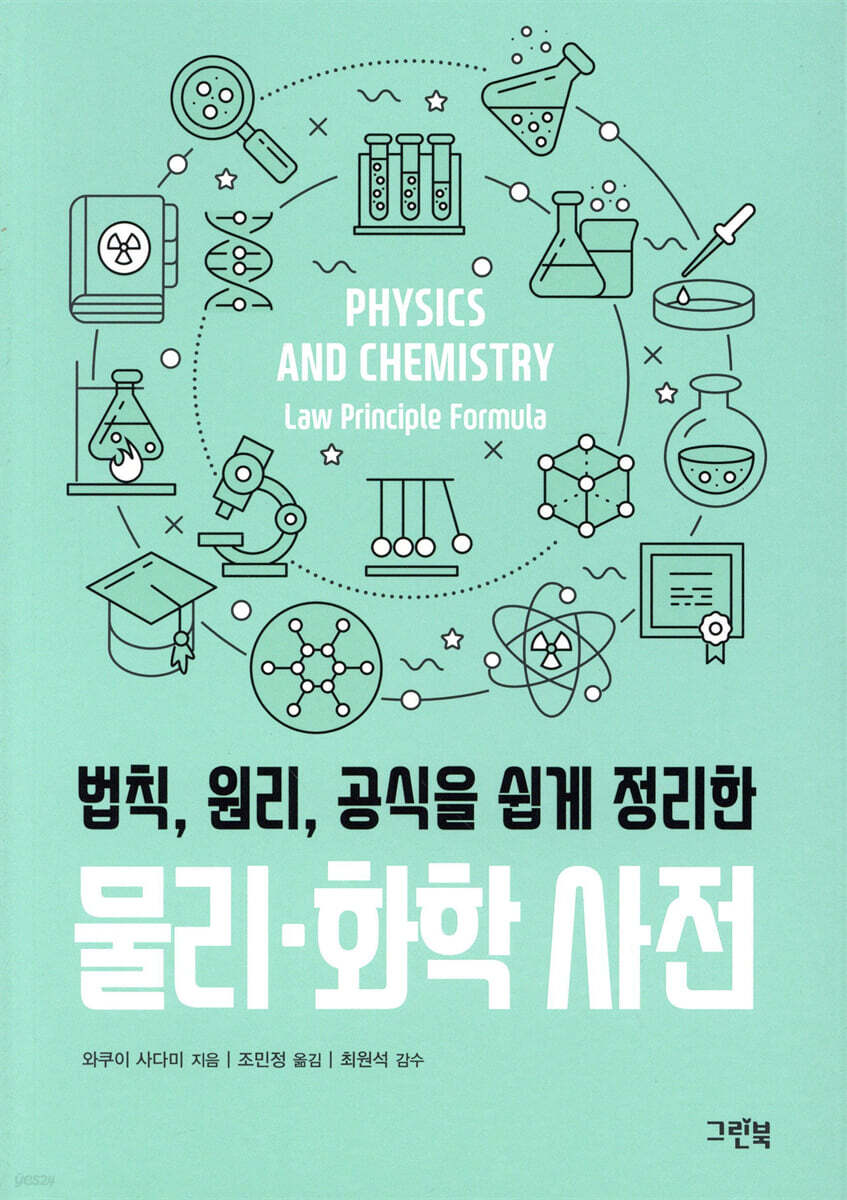
A dictionary of physics and chemistry that easily organizes laws, principles, and formulas.
 |
Description
Book Introduction
《Physics and Chemistry Dictionary: Easily Organized Laws, Principles, and Formulas》 is a dictionary that organizes the laws, principles, and formulas of physics and chemistry learned in high school science classes, starting from the basics.
If you grasp these laws, principles, and formulas that form the basis of modern science, you will be able to organize your knowledge in your head, gain a broader perspective, and understand new knowledge much more easily.
Let's broaden our understanding of the world with 70 items that are fundamental to modern physics and chemistry.
If you grasp these laws, principles, and formulas that form the basis of modern science, you will be able to organize your knowledge in your head, gain a broader perspective, and understand new knowledge much more easily.
Let's broaden our understanding of the world with 70 items that are fundamental to modern physics and chemistry.
- You can preview some of the book's contents.
Preview
index
Preface: The modern age is a time when science is fun! 004
Introduction: Understanding physics and chemistry begins with 'laws, principles, and formulas' 010
Chapter 1: Basic Rules Learned in Elementary and Middle School
01 The Principle of the Lever 016
02 Law of Friction 020
03 Law of Action and Reaction 024
04 Law of Equilibrium of Forces 028
05 The Principle of Pulleys 032
06 Pascal's Principle 036
07 Principle of the Day 040
08 Archimedes' Principle 044
09 Hooke's Law 048
10 Pendulum Law 052
11 Law of Inertia 056
12 Laws of Falling 060
【COLUMN】 Let's Experience Pascal's Principle 064
13 Kepler's Laws 066
Chapter 2 Understanding Physics through the Movement of Objects
14 Law of Universal Gravitation 070
15 Laws of Equilibrium of Forces Acting on Rigid Bodies 074
16 Newton's Second Law of Motion 078
17 Law of Conservation of Momentum 084
18 Law of Conservation of Angular Momentum 088
19 Law of Conservation of Mechanical Energy 092
20 Galileo's Principle of Relativity 096
21 Coriolis Law 100
22 Bernoulli's Theorem 104
23 Doppler Effect 110
24 Wave Superposition Principle 116
25 Huygens' Principle and the Law of Reflection 120
26 Laws of Refraction 124
【COLUMN】 Let's prove the formula for uniformly accelerated motion 130
Chapter 3: Understanding Electricity Reveals the Fundamentals of Technology
27 Coulomb's Law 132
28 Ohm's Law 136
29 Principle of Proximity Action 140
Chapter 30 Superposition Principle 144
31 Gauss's Law 148
32 Ampere's Law 152
33 Faraday's Law of Electromagnetic Induction 156
34 Lenz's Law 160
35 Maxwell's Equations 164
36 Fleming's Law 168
37 Lorentz force 172
38-Line Rule 176
【COLUMN】Learning Electricity and Magnetism with Home Appliances 180
Chapter 4: Laws for Exploring the Appearance of Gases, Liquids, and Solids
39 Law of Conservation of Mass 182
40 The Law of Constant Compositions and the Law of Multiple Proportions 186
41 Avogadro's Law 190
42 Boyle's Law and Charles's Law 194
43 Boyle-Charles Law 198
44 Ideal Gas Equation of State 202
45 Henry's Law 206
46 Van't Hoff's Law of Osmosis 210
47 Laws of Chemical Equilibrium 214
48 Raoult's Law and Boiling Point Elevation 218
49 The First Law of Thermodynamics 222
50 The Second Law of Thermodynamics 226
Chapter 5: Understanding Chemical Reactions Makes Chemistry Better
51 Periodic Elements 232
52 Volta series 236
53 Faraday's Law of Electrolysis 240
54 Hess's Law 244
55 pH Calculation Principle 248
56 Le Chatelier Equilibrium Movement Principle 254
【COLUMN】 Molar concentration 262
Chapter 6 From the Quantum World to Relativity
57 Curie-Weiss law 260
58 Einstein's quantum theory of light 264
59 Superconductivity and BCS Theory 268
60 Schrödinger Equation and Uncertainty Principle 272
61 Pauli Exclusion Principle 276
62 Hunt Rule 280
63 The Law of Constancy of the Speed of Light 284
64 Special Theory of Relativity 288
65 Lorentz Contraction and Time Dilation 292
66 Mass Gain Formula 298
67 Einstein's formula E=mc2 302
68 General Relativity 306
69 Hertzsprung-Russell diagram 310
70 Hubble's Law 314
Search 322
Introduction: Understanding physics and chemistry begins with 'laws, principles, and formulas' 010
Chapter 1: Basic Rules Learned in Elementary and Middle School
01 The Principle of the Lever 016
02 Law of Friction 020
03 Law of Action and Reaction 024
04 Law of Equilibrium of Forces 028
05 The Principle of Pulleys 032
06 Pascal's Principle 036
07 Principle of the Day 040
08 Archimedes' Principle 044
09 Hooke's Law 048
10 Pendulum Law 052
11 Law of Inertia 056
12 Laws of Falling 060
【COLUMN】 Let's Experience Pascal's Principle 064
13 Kepler's Laws 066
Chapter 2 Understanding Physics through the Movement of Objects
14 Law of Universal Gravitation 070
15 Laws of Equilibrium of Forces Acting on Rigid Bodies 074
16 Newton's Second Law of Motion 078
17 Law of Conservation of Momentum 084
18 Law of Conservation of Angular Momentum 088
19 Law of Conservation of Mechanical Energy 092
20 Galileo's Principle of Relativity 096
21 Coriolis Law 100
22 Bernoulli's Theorem 104
23 Doppler Effect 110
24 Wave Superposition Principle 116
25 Huygens' Principle and the Law of Reflection 120
26 Laws of Refraction 124
【COLUMN】 Let's prove the formula for uniformly accelerated motion 130
Chapter 3: Understanding Electricity Reveals the Fundamentals of Technology
27 Coulomb's Law 132
28 Ohm's Law 136
29 Principle of Proximity Action 140
Chapter 30 Superposition Principle 144
31 Gauss's Law 148
32 Ampere's Law 152
33 Faraday's Law of Electromagnetic Induction 156
34 Lenz's Law 160
35 Maxwell's Equations 164
36 Fleming's Law 168
37 Lorentz force 172
38-Line Rule 176
【COLUMN】Learning Electricity and Magnetism with Home Appliances 180
Chapter 4: Laws for Exploring the Appearance of Gases, Liquids, and Solids
39 Law of Conservation of Mass 182
40 The Law of Constant Compositions and the Law of Multiple Proportions 186
41 Avogadro's Law 190
42 Boyle's Law and Charles's Law 194
43 Boyle-Charles Law 198
44 Ideal Gas Equation of State 202
45 Henry's Law 206
46 Van't Hoff's Law of Osmosis 210
47 Laws of Chemical Equilibrium 214
48 Raoult's Law and Boiling Point Elevation 218
49 The First Law of Thermodynamics 222
50 The Second Law of Thermodynamics 226
Chapter 5: Understanding Chemical Reactions Makes Chemistry Better
51 Periodic Elements 232
52 Volta series 236
53 Faraday's Law of Electrolysis 240
54 Hess's Law 244
55 pH Calculation Principle 248
56 Le Chatelier Equilibrium Movement Principle 254
【COLUMN】 Molar concentration 262
Chapter 6 From the Quantum World to Relativity
57 Curie-Weiss law 260
58 Einstein's quantum theory of light 264
59 Superconductivity and BCS Theory 268
60 Schrödinger Equation and Uncertainty Principle 272
61 Pauli Exclusion Principle 276
62 Hunt Rule 280
63 The Law of Constancy of the Speed of Light 284
64 Special Theory of Relativity 288
65 Lorentz Contraction and Time Dilation 292
66 Mass Gain Formula 298
67 Einstein's formula E=mc2 302
68 General Relativity 306
69 Hertzsprung-Russell diagram 310
70 Hubble's Law 314
Search 322
Detailed image

Publisher's Review
You have to know science to know the future.
Modern science and technology are blossoming in various fields based on the basic scientific research that was established in the 19th and 20th centuries.
Robots are dancing and playing the piano, 3D-printing houses and autonomous cars are being produced.
Its achievements are endless to list, and because they are deeply related to our daily lives and economic activities, they are widely covered in the mass media.
In order to live in this era and not be left behind in knowledge and information, it is necessary to have a certain level of scientific knowledge.
Science has become a necessity, not an option.
The ability to read the big picture, based on science, to understand how the things we use are made, how they affect our bodies, and what ripple effects they will have on our society is increasingly needed.
Therefore, the science of the 19th and 20th centuries, which became the foundation of modern science, that is, the science learned in high school, is emphasized.
This book explains the concepts of the foundations of science from the perspective of 'laws, principles, and formulas.'
It is not a superficial explanation of terms, but rather it is explained repeatedly from various aspects.
We also introduced where the laws and principles are used to help you understand them more specifically.
I hope that through this book, you will solidify your fundamental scientific knowledge and keep up with the rapidly advancing science and technology.
Features of this book
A comprehensive overview of high school physics and chemistry concepts in one volume.
Today, understanding the laws, principles, and formulas that are famous in the history of science is very important, regardless of whether you are in the sciences or the humanities.
Even to understand modern science, the outstanding wisdom of science discovered up until the early 20th century is absolutely necessary.
Most of the content that forms the basis for this is what you learn in high school science classes.
This book summarizes the laws, principles, and formulas of physics and chemistry learned in high school science classes and includes examples of how each concept is actually applied.
If you make it a habit to refer to this book like a dictionary whenever you need it, it will become a compass for understanding modern science.
Discovering the laws of science in everyday life
Although it is a dictionary, it is structured to be easy and fun to learn, breaking away from the rigid dictionary format that is commonly thought of.
In particular, it helped us understand how physics and chemistry, which we learn in science class, are applied to our daily lives by explaining them with fun pictures.
From the power that moves scissors, staplers, and bicycles to the principles that drive rockets and yachts, you can easily understand the principles of science by approaching them in a friendly manner using elements that are commonly found around you.
Explore deeper through practical problems and columns.
It is designed to help you understand the concepts more deeply through practical problems of various contents, rather than just explaining the concepts of laws, principles, and formulas.
Additionally, at the end of each unit, interesting topics such as 'Learning about electricity and batteries through home appliances' were selected and organized in column format.
Based on these contents, if you study the basic scientific concepts in this book step by step, from basic to advanced, you will eventually see the principles and structure of modern science and gain the power to foresee the future of science and technology.
Modern science and technology are blossoming in various fields based on the basic scientific research that was established in the 19th and 20th centuries.
Robots are dancing and playing the piano, 3D-printing houses and autonomous cars are being produced.
Its achievements are endless to list, and because they are deeply related to our daily lives and economic activities, they are widely covered in the mass media.
In order to live in this era and not be left behind in knowledge and information, it is necessary to have a certain level of scientific knowledge.
Science has become a necessity, not an option.
The ability to read the big picture, based on science, to understand how the things we use are made, how they affect our bodies, and what ripple effects they will have on our society is increasingly needed.
Therefore, the science of the 19th and 20th centuries, which became the foundation of modern science, that is, the science learned in high school, is emphasized.
This book explains the concepts of the foundations of science from the perspective of 'laws, principles, and formulas.'
It is not a superficial explanation of terms, but rather it is explained repeatedly from various aspects.
We also introduced where the laws and principles are used to help you understand them more specifically.
I hope that through this book, you will solidify your fundamental scientific knowledge and keep up with the rapidly advancing science and technology.
Features of this book
A comprehensive overview of high school physics and chemistry concepts in one volume.
Today, understanding the laws, principles, and formulas that are famous in the history of science is very important, regardless of whether you are in the sciences or the humanities.
Even to understand modern science, the outstanding wisdom of science discovered up until the early 20th century is absolutely necessary.
Most of the content that forms the basis for this is what you learn in high school science classes.
This book summarizes the laws, principles, and formulas of physics and chemistry learned in high school science classes and includes examples of how each concept is actually applied.
If you make it a habit to refer to this book like a dictionary whenever you need it, it will become a compass for understanding modern science.
Discovering the laws of science in everyday life
Although it is a dictionary, it is structured to be easy and fun to learn, breaking away from the rigid dictionary format that is commonly thought of.
In particular, it helped us understand how physics and chemistry, which we learn in science class, are applied to our daily lives by explaining them with fun pictures.
From the power that moves scissors, staplers, and bicycles to the principles that drive rockets and yachts, you can easily understand the principles of science by approaching them in a friendly manner using elements that are commonly found around you.
Explore deeper through practical problems and columns.
It is designed to help you understand the concepts more deeply through practical problems of various contents, rather than just explaining the concepts of laws, principles, and formulas.
Additionally, at the end of each unit, interesting topics such as 'Learning about electricity and batteries through home appliances' were selected and organized in column format.
Based on these contents, if you study the basic scientific concepts in this book step by step, from basic to advanced, you will eventually see the principles and structure of modern science and gain the power to foresee the future of science and technology.
GOODS SPECIFICS
- Date of issue: September 5, 2017
- Page count, weight, size: 336 pages | 545g | 148*210*30mm
- ISBN13: 9788955883398
- ISBN10: 8955883390
You may also like
카테고리
korean


korean

![ELLE 엘르 스페셜 에디션 A형 : 12월 [2025]](http://librairie.coreenne.fr/cdn/shop/files/b8e27a3de6c9538896439686c6b0e8fb.jpg?v=1766436872&width=3840)


