

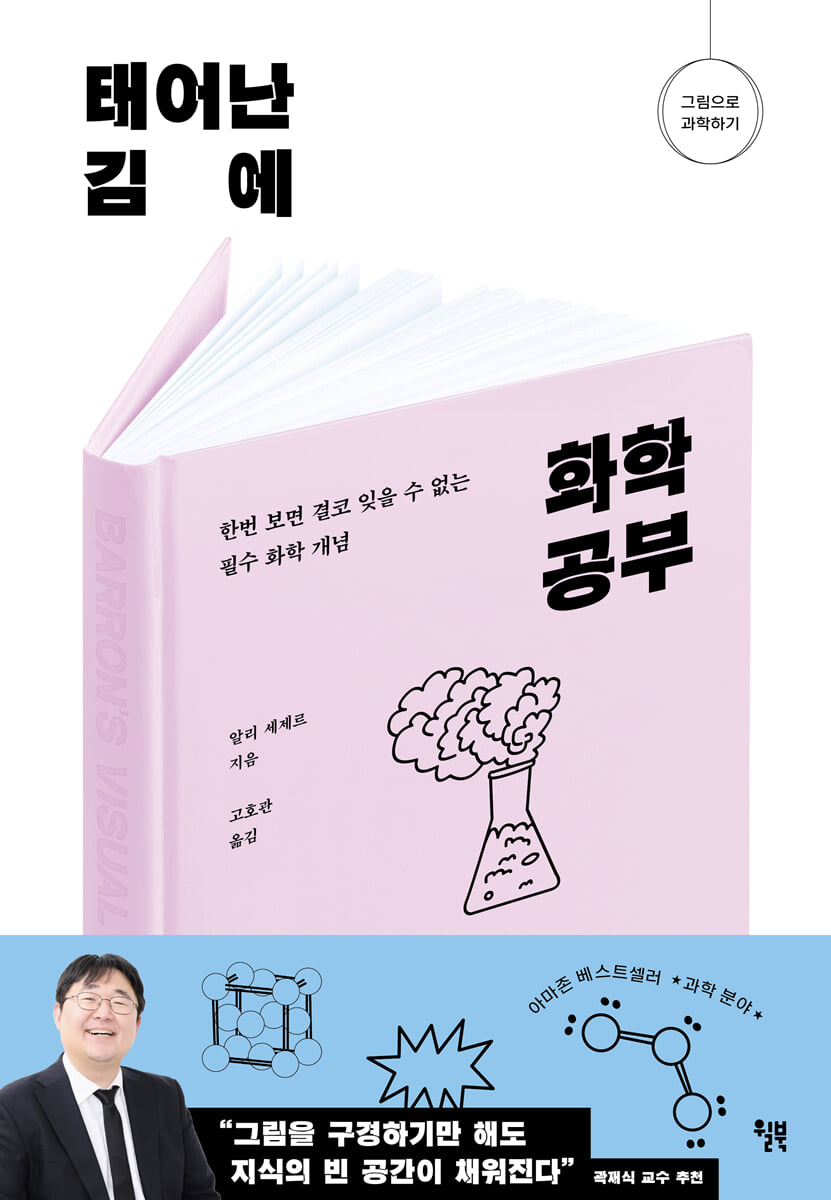
Since I was born, I studied chemistry
 |
Description
Book Introduction
A never-before-seen science book for visual learners
A visual dictionary that provides a simple and clear picture-based overview of scientific concepts.
In this age of technology and science, a basic science series that will take charge of my scientific literacy, "Chemistry"
Professor Kwak Jae-sik recommends, “Just looking at the paintings fills the gaps in your knowledge.”
Science is the basic knowledge of our generation.
Every day, new technologies based on science are introduced, and everyone, knowingly or unknowingly, adapts to these technologies and lives with them.
This is why scientific literacy is more important than ever.
Even the hottest news and emerging investment information are difficult to properly understand without a scientific background.
But science has the impression of being difficult and complicated.
There are many people who try to understand science, but give up because of unfamiliar and difficult terms, concepts, and formulas that are difficult to understand even after reading them.
That's because the way we've approached science so far has been wrong.
It is more effective to study science through pictures than through text.
『Study Chemistry While You're at It』 is the third book in the series 'Science with Pictures', and it uses pictures to teach the basic concepts of the scientific field of chemistry.
It focused on infographics rather than text.
Thousands of characters are compressed into a single picture, and the author, a chemistry professor, has carefully selected and organized essential chemistry concepts, from elements and the periodic table to thermodynamics and electrochemistry.
This book is more user-friendly, informative, and accurate than any other book, so that even adults who want to understand chemistry again, or students who still find chemistry difficult but want to study systematically and major in a related field, can easily study on their own.
Let's travel through the world of chemistry by following the pictures and arrows.
As Professor Kwak Jae-sik said, you will have the 'thrilling experience' of realizing concepts you didn't know exactly what they meant while casually looking at the paintings.
A visual dictionary that provides a simple and clear picture-based overview of scientific concepts.
In this age of technology and science, a basic science series that will take charge of my scientific literacy, "Chemistry"
Professor Kwak Jae-sik recommends, “Just looking at the paintings fills the gaps in your knowledge.”
Science is the basic knowledge of our generation.
Every day, new technologies based on science are introduced, and everyone, knowingly or unknowingly, adapts to these technologies and lives with them.
This is why scientific literacy is more important than ever.
Even the hottest news and emerging investment information are difficult to properly understand without a scientific background.
But science has the impression of being difficult and complicated.
There are many people who try to understand science, but give up because of unfamiliar and difficult terms, concepts, and formulas that are difficult to understand even after reading them.
That's because the way we've approached science so far has been wrong.
It is more effective to study science through pictures than through text.
『Study Chemistry While You're at It』 is the third book in the series 'Science with Pictures', and it uses pictures to teach the basic concepts of the scientific field of chemistry.
It focused on infographics rather than text.
Thousands of characters are compressed into a single picture, and the author, a chemistry professor, has carefully selected and organized essential chemistry concepts, from elements and the periodic table to thermodynamics and electrochemistry.
This book is more user-friendly, informative, and accurate than any other book, so that even adults who want to understand chemistry again, or students who still find chemistry difficult but want to study systematically and major in a related field, can easily study on their own.
Let's travel through the world of chemistry by following the pictures and arrows.
As Professor Kwak Jae-sik said, you will have the 'thrilling experience' of realizing concepts you didn't know exactly what they meant while casually looking at the paintings.
- You can preview some of the book's contents.
Preview
index
introduction
1 Chemistry: The Heart of Science
The fundamental role of chemistry
substance
Classification of substances
Properties and changes of matter
Matter and Energy
Measurement of substances
[Watch Again]
2 atoms
Evolution of the atomic model
Laws of Chemical Bonding
Atomic structure
Mendeleev and the periodic table
Ions and isotopes
Moles and molar mass
[Watch Again]
3 Nuclear Chemistry
nucleus
nuclear conversion
nuclear equation
Half-life and the Use of Radioisotopes
[Watch Again]
4 Electrons in an atom
Electromagnetic radiation: light
Electron arrangement: Bohr model
Electron Arrangement: The Quantum Model
Electronic layout
[Watch Again]
5 Periodic Table of Elements
Quantum numbers and the periodic table
stable electronic configuration
Periodic classification of elements
Periodic trend
Lewis electron dot
[Watch Again]
6 chemical bonds
Types of chemical bonds
Ionic bonds and ionic compounds
Covalent bonds and molecular compounds
metallic bond
Properties of ionic and molecular compounds
[Watch Again]
Structure of the 7 molecules
Lewis dot structure and molecular compounds
VSEPR theory: molecular geometry
Molecular shape and polarity
intermolecular forces
Bonding and crystalline solids
[Watch Again]
8 Chemical Reactions and Stoichiometry
Writing and Balancing Chemical Equations
stoichiometry
Types of chemical reactions
[Watch Again]
9 solution
Type of solution
concentration of the solution
Solution preparation
Solubility
Solubility rules
Totality of solution
[Watch Again]
10 aircraft
Kinetic theory of gases
Gas laws
mixed gas
chemical reaction
[Watch Again]
11 Chemical Equilibrium
dynamic equilibrium
equilibrium constant
Reaction index
Change the equilibrium conditions
Equilibrium calculation
[Watch Again]
12 Acids and Bases
Definition of acids and bases
pH scale
acid-base indicator
Neutralization reaction
buffer solution
[Watch Again]
13 Thermodynamics
Thermodynamics and Enthalpy
Thermodynamics and Entropy
Gibbs free energy and spontaneity
The zeroth and third laws of thermodynamics
equilibrium thermodynamics
[Watch Again]
14 Electrochemistry
The action of electrons
Voltaic cell
Gibbs free energy and electrochemistry
Batteries and fuel cells
electrolytic cell
[Watch Again]
Dictionary of Chemical Terms
1 Chemistry: The Heart of Science
The fundamental role of chemistry
substance
Classification of substances
Properties and changes of matter
Matter and Energy
Measurement of substances
[Watch Again]
2 atoms
Evolution of the atomic model
Laws of Chemical Bonding
Atomic structure
Mendeleev and the periodic table
Ions and isotopes
Moles and molar mass
[Watch Again]
3 Nuclear Chemistry
nucleus
nuclear conversion
nuclear equation
Half-life and the Use of Radioisotopes
[Watch Again]
4 Electrons in an atom
Electromagnetic radiation: light
Electron arrangement: Bohr model
Electron Arrangement: The Quantum Model
Electronic layout
[Watch Again]
5 Periodic Table of Elements
Quantum numbers and the periodic table
stable electronic configuration
Periodic classification of elements
Periodic trend
Lewis electron dot
[Watch Again]
6 chemical bonds
Types of chemical bonds
Ionic bonds and ionic compounds
Covalent bonds and molecular compounds
metallic bond
Properties of ionic and molecular compounds
[Watch Again]
Structure of the 7 molecules
Lewis dot structure and molecular compounds
VSEPR theory: molecular geometry
Molecular shape and polarity
intermolecular forces
Bonding and crystalline solids
[Watch Again]
8 Chemical Reactions and Stoichiometry
Writing and Balancing Chemical Equations
stoichiometry
Types of chemical reactions
[Watch Again]
9 solution
Type of solution
concentration of the solution
Solution preparation
Solubility
Solubility rules
Totality of solution
[Watch Again]
10 aircraft
Kinetic theory of gases
Gas laws
mixed gas
chemical reaction
[Watch Again]
11 Chemical Equilibrium
dynamic equilibrium
equilibrium constant
Reaction index
Change the equilibrium conditions
Equilibrium calculation
[Watch Again]
12 Acids and Bases
Definition of acids and bases
pH scale
acid-base indicator
Neutralization reaction
buffer solution
[Watch Again]
13 Thermodynamics
Thermodynamics and Enthalpy
Thermodynamics and Entropy
Gibbs free energy and spontaneity
The zeroth and third laws of thermodynamics
equilibrium thermodynamics
[Watch Again]
14 Electrochemistry
The action of electrons
Voltaic cell
Gibbs free energy and electrochemistry
Batteries and fuel cells
electrolytic cell
[Watch Again]
Dictionary of Chemical Terms
Detailed image
.jpg)
Into the book
Chemistry is the study of matter.
Matter refers to everything in our universe that has mass and volume.
Chemistry plays a central role in all fields of science.
But you can find it everywhere in everyday life.
Because everything we see is made up of chemicals.
And the things we do on a daily basis involve chemical reactions.
Without chemistry, it would be impossible for us to understand how the physical world works.
Yet we rarely think about the impact chemistry has on our daily lives.
Over the next few pages, we'll explore the history of discoveries and key milestones that have occurred over the centuries, helping to explain the origins of the discipline we call chemistry.
---From the "first sentence"
As a branch of science, chemistry played a central and crucial role in all these discoveries.
Besides this, it contributed to numerous other discoveries.
But without understanding the field of chemistry, it is impossible to appreciate the true value of what scientists have achieved over the past 200 years.
That's why you need this book.
With friendly illustrations and practical explanations, the principles of chemistry will become readily apparent just by reading.
"Study Chemistry While You're at It" explores the world of chemistry, starting from atoms.
In the process, you will understand how chemistry is used in various fields of science and technology and how it has transformed modern society and our lives.
--- p.13
Atoms, which possess all the chemical properties of elements, are the basic units that make up matter.
All matter is made up of the 92 elements we know of.
It's like the letters we use to create words and language.
Therefore, if you want to understand matter and its workings, you must understand atoms and their composition.
Although all atoms share a similar general structure, each element has its own unique atoms and properties because the composition of their elementary subatomic particles is different.
--- p.26
The periodic table is a table that organizes elements based on their atomic number.
We can quickly look up properties of elements in the periodic table, such as mass, number of electrons, electron configuration, and unique chemical properties.
The term 'periodic table' derives its name from the fact that it arranges the elements according to the periodic changes in their chemical properties.
All elements are divided into periods and groups in the periodic table.
And this is closely related to electronic configuration.
Elements with similar chemical properties are arranged in vertical lines.
The arrangement of elements in the periodic table clearly reveals general trends in properties, making it convenient for scientists to predict the chemical properties of all elements.
--- p.62
The first law of thermodynamics is fundamentally related to the law of conservation of energy.
The total amount of energy in the universe is constant, so energy cannot be created or destroyed during physical or chemical changes.
However, it can change shape or move from one place to another.
Matter refers to everything in our universe that has mass and volume.
Chemistry plays a central role in all fields of science.
But you can find it everywhere in everyday life.
Because everything we see is made up of chemicals.
And the things we do on a daily basis involve chemical reactions.
Without chemistry, it would be impossible for us to understand how the physical world works.
Yet we rarely think about the impact chemistry has on our daily lives.
Over the next few pages, we'll explore the history of discoveries and key milestones that have occurred over the centuries, helping to explain the origins of the discipline we call chemistry.
---From the "first sentence"
As a branch of science, chemistry played a central and crucial role in all these discoveries.
Besides this, it contributed to numerous other discoveries.
But without understanding the field of chemistry, it is impossible to appreciate the true value of what scientists have achieved over the past 200 years.
That's why you need this book.
With friendly illustrations and practical explanations, the principles of chemistry will become readily apparent just by reading.
"Study Chemistry While You're at It" explores the world of chemistry, starting from atoms.
In the process, you will understand how chemistry is used in various fields of science and technology and how it has transformed modern society and our lives.
--- p.13
Atoms, which possess all the chemical properties of elements, are the basic units that make up matter.
All matter is made up of the 92 elements we know of.
It's like the letters we use to create words and language.
Therefore, if you want to understand matter and its workings, you must understand atoms and their composition.
Although all atoms share a similar general structure, each element has its own unique atoms and properties because the composition of their elementary subatomic particles is different.
--- p.26
The periodic table is a table that organizes elements based on their atomic number.
We can quickly look up properties of elements in the periodic table, such as mass, number of electrons, electron configuration, and unique chemical properties.
The term 'periodic table' derives its name from the fact that it arranges the elements according to the periodic changes in their chemical properties.
All elements are divided into periods and groups in the periodic table.
And this is closely related to electronic configuration.
Elements with similar chemical properties are arranged in vertical lines.
The arrangement of elements in the periodic table clearly reveals general trends in properties, making it convenient for scientists to predict the chemical properties of all elements.
--- p.62
The first law of thermodynamics is fundamentally related to the law of conservation of energy.
The total amount of energy in the universe is constant, so energy cannot be created or destroyed during physical or chemical changes.
However, it can change shape or move from one place to another.
--- p.161
Publisher's Review
Because the world is full of science,
If we're going to do this, let's become people who know science.
Every day, new technologies based on science are introduced, and everyone, knowingly or unknowingly, adapts to these technologies and lives with them.
This is why scientific literacy is more important than ever.
Even the hottest news and emerging investment information are difficult to properly understand without a scientific background.
Just having a basic scientific knowledge will completely change your perspective on the world.
Knowing science allows you to accurately identify and anticipate what you need in life, reduce unnecessary mistakes, and live more proactively and efficiently.
But haven't you ever tried to study science only to give up because of unfamiliar terminology, concepts, and formulas that were difficult to understand? It's because you've missed out on fundamental concepts, leaving gaps in your knowledge.
Only by having a solid understanding of the fundamental principles of science can you understand and apply new discoveries or new materials introduced in Nature or Science to your own life.
"Study Chemistry While You're at It" contains all the basic information and tools you need to explore the world of chemistry.
All you need is a little curiosity and the thought, “Since I’m born, why not learn about chemistry?”
Because science must be studied through pictures!
Mind maps, flowcharts, and high-quality infographics
A brand new science book for visual learners
Do you ever organize your learning by taking notes or drawing pictures in your head? More than half of the population are visual learners, learning more effectively from visual aids like diagrams, pictures, and videos than from text or audio.
It is said that many people who excel in science and engineering fields are visual learners.
'Science with Pictures' is a series developed by Barron's, a renowned American educational book company, to enable 'visual learners' of all ages to study science on their own.
It features refreshing illustrations and clear explanations from expert professors.
Just by focusing on pictures instead of text, learning efficiency is noticeably improved.
Because dozens of lines of text are compressed into a single image, understanding the concept becomes faster, and because the screen is stored in the mind like taking a screenshot, it is not easily forgotten.
This series is known to be particularly suitable for adults who have trouble concentrating, or for teenagers who have a good understanding but find it difficult to study seriously.
First of all, it contains only the most important scientific information among numerous scientific data, and it is designed to naturally draw attention to the core with refreshing infographics.
The examples are familiar from everyday life, and the explanations are short, friendly, and clear.
『Study Chemistry While You're at It』 is a book about chemistry that explains the principles and changes of substances in the 'Science through Pictures' series.
The author, a professor of chemistry who has taught chemistry, including polymer chemistry, at universities for a long time and has also participated in the development of learning materials, has carefully selected and organized essential chemistry concepts, from elements and the periodic table to thermodynamics and electrochemistry.
From elementary school students to adults,
So that everyone can enjoy science
"Study Chemistry While You're at It" is a book for everyone who loves chemistry and wants to become familiar with it.
Chemistry is explained using simple, intuitive expressions and everyday examples so that anyone can easily understand it, from elementary school students who are just learning about the field of chemistry, middle and high school students who want to study chemistry systematically, students who chose chemistry with the dream of going to a science and engineering university, and even people who did not like chemistry in school but have become interested in it again as adults.
We selected major topics such as atomic and nuclear chemistry, molecular structure, chemical reactions, and thermodynamics, and organized the core concepts for each topic into 1-4 pages.
No matter which page you open, the world of chemistry unfolds in an exciting way.
At the end of each chapter, the content covered in that chapter is summarized in the form of a mind map.
It guides you through the relationship between individual concepts and terms and helps you draw the big picture of 'chemistry'.
At the very end, there is a 'Dictionary of Chemical Terms'.
It's a good book to read from the beginning, but it's also a good book to keep on a corner of your desk and look up related topics when watching science documentaries or YouTube videos, or whenever news about new technologies comes out.
Just looking at the paintings without the burden of studying provides a sense of intellectual stimulation.
Let's travel the world of science through pictures with "Study Chemistry While You're at It."
If we're going to do this, let's become people who know science.
Every day, new technologies based on science are introduced, and everyone, knowingly or unknowingly, adapts to these technologies and lives with them.
This is why scientific literacy is more important than ever.
Even the hottest news and emerging investment information are difficult to properly understand without a scientific background.
Just having a basic scientific knowledge will completely change your perspective on the world.
Knowing science allows you to accurately identify and anticipate what you need in life, reduce unnecessary mistakes, and live more proactively and efficiently.
But haven't you ever tried to study science only to give up because of unfamiliar terminology, concepts, and formulas that were difficult to understand? It's because you've missed out on fundamental concepts, leaving gaps in your knowledge.
Only by having a solid understanding of the fundamental principles of science can you understand and apply new discoveries or new materials introduced in Nature or Science to your own life.
"Study Chemistry While You're at It" contains all the basic information and tools you need to explore the world of chemistry.
All you need is a little curiosity and the thought, “Since I’m born, why not learn about chemistry?”
Because science must be studied through pictures!
Mind maps, flowcharts, and high-quality infographics
A brand new science book for visual learners
Do you ever organize your learning by taking notes or drawing pictures in your head? More than half of the population are visual learners, learning more effectively from visual aids like diagrams, pictures, and videos than from text or audio.
It is said that many people who excel in science and engineering fields are visual learners.
'Science with Pictures' is a series developed by Barron's, a renowned American educational book company, to enable 'visual learners' of all ages to study science on their own.
It features refreshing illustrations and clear explanations from expert professors.
Just by focusing on pictures instead of text, learning efficiency is noticeably improved.
Because dozens of lines of text are compressed into a single image, understanding the concept becomes faster, and because the screen is stored in the mind like taking a screenshot, it is not easily forgotten.
This series is known to be particularly suitable for adults who have trouble concentrating, or for teenagers who have a good understanding but find it difficult to study seriously.
First of all, it contains only the most important scientific information among numerous scientific data, and it is designed to naturally draw attention to the core with refreshing infographics.
The examples are familiar from everyday life, and the explanations are short, friendly, and clear.
『Study Chemistry While You're at It』 is a book about chemistry that explains the principles and changes of substances in the 'Science through Pictures' series.
The author, a professor of chemistry who has taught chemistry, including polymer chemistry, at universities for a long time and has also participated in the development of learning materials, has carefully selected and organized essential chemistry concepts, from elements and the periodic table to thermodynamics and electrochemistry.
From elementary school students to adults,
So that everyone can enjoy science
"Study Chemistry While You're at It" is a book for everyone who loves chemistry and wants to become familiar with it.
Chemistry is explained using simple, intuitive expressions and everyday examples so that anyone can easily understand it, from elementary school students who are just learning about the field of chemistry, middle and high school students who want to study chemistry systematically, students who chose chemistry with the dream of going to a science and engineering university, and even people who did not like chemistry in school but have become interested in it again as adults.
We selected major topics such as atomic and nuclear chemistry, molecular structure, chemical reactions, and thermodynamics, and organized the core concepts for each topic into 1-4 pages.
No matter which page you open, the world of chemistry unfolds in an exciting way.
At the end of each chapter, the content covered in that chapter is summarized in the form of a mind map.
It guides you through the relationship between individual concepts and terms and helps you draw the big picture of 'chemistry'.
At the very end, there is a 'Dictionary of Chemical Terms'.
It's a good book to read from the beginning, but it's also a good book to keep on a corner of your desk and look up related topics when watching science documentaries or YouTube videos, or whenever news about new technologies comes out.
Just looking at the paintings without the burden of studying provides a sense of intellectual stimulation.
Let's travel the world of science through pictures with "Study Chemistry While You're at It."
GOODS SPECIFICS
- Date of issue: June 14, 2024
- Page count, weight, size: 192 pages | 576g | 178*257*15mm
- ISBN13: 9791155817247
- ISBN10: 1155817249
You may also like
카테고리
korean


korean

![GQ KOREA Mark (Monthly): December [2025]](http://librairie.coreenne.fr/cdn/shop/files/8ef265dbbfbf186523ed75ba7319009d.jpg?v=1765340328&width=3840)


